

Abstract
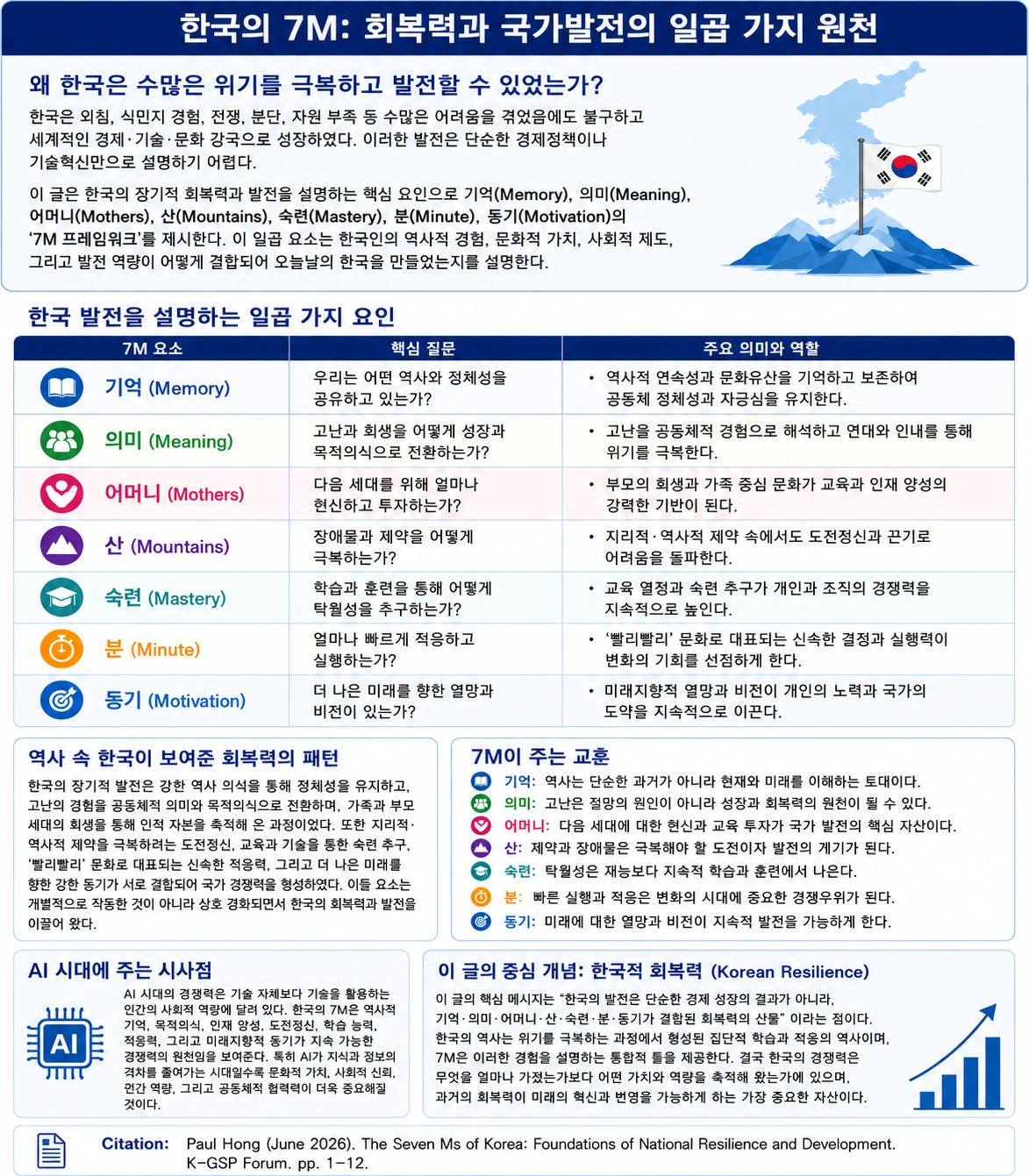
Korea’s remarkable transformation from a historically challenged peninsula to a globally influential nation can be better understood through the framework of the Seven Ms: Memory, Meaning, Mothers, Mountains, Mastery, Minute, and Motivation. Together, these seven dimensions capture the historical continuity, cultural values, social institutions, and adaptive capabilities that have contributed to Korea’s enduring resilience and national development across more than five millennia. Centered on the concept of endurance, The Seven Ms of Korea framework offers a holistic perspective for understanding how Korea has repeatedly overcome adversity, achieved rapid modernization, and positioned itself as a leading economic, technological, and cultural power in the twenty-first century.
Keywords: National Resilience; Korean Civilization; Historical Continuity; Cultural Values; National Development
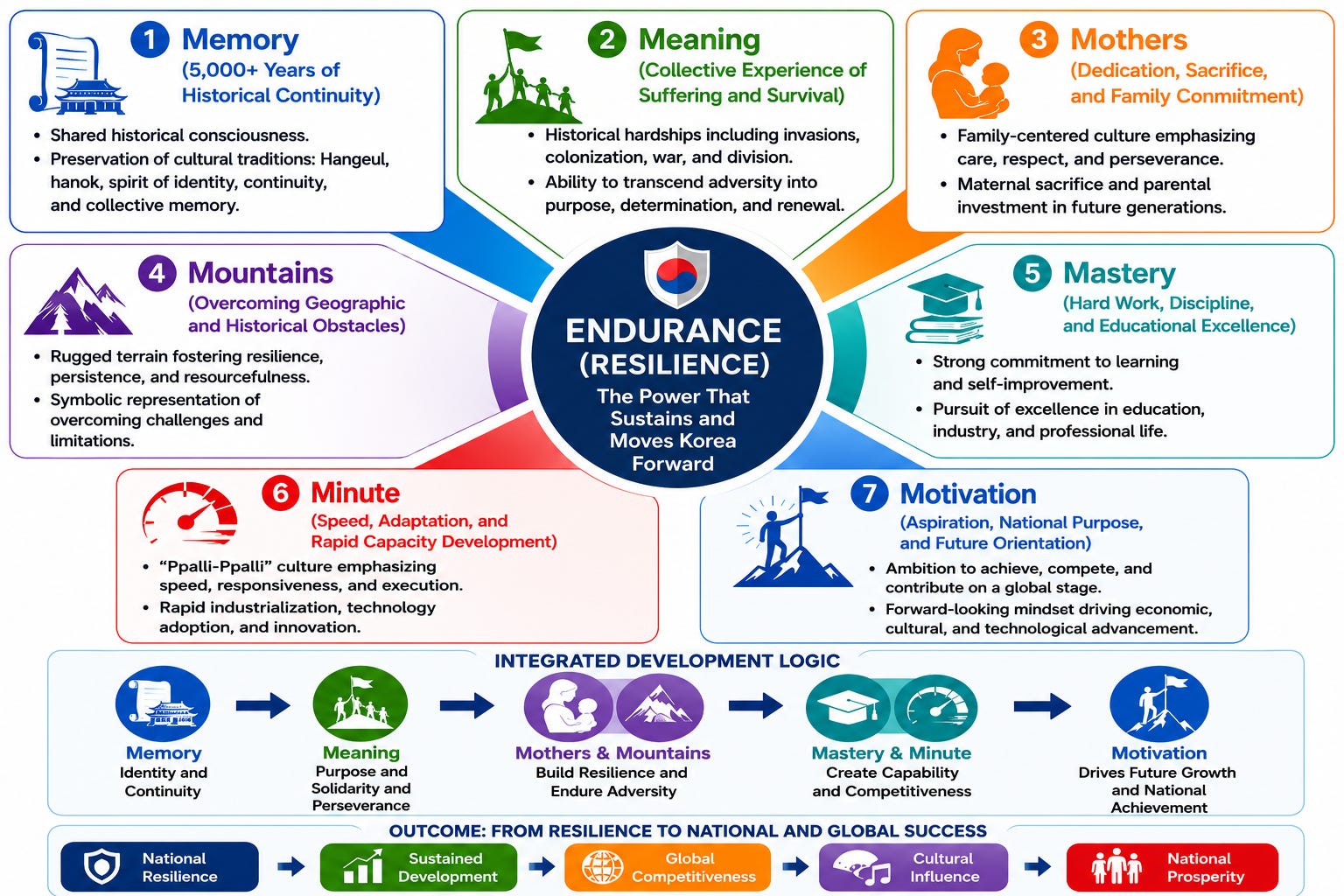
Figure 1. The Seven Ms of Korea Framework: Sources of National Resilience, Development, and Competitiveness
Source: Author-developed conceptual framework. Figure generated using artificial intelligence based on the framework design, content, and specifications developed by Paul C. Hong (2026).
1. Introduction
Defining the character of a nation is both elusive and controversial. Nations are composed of diverse individuals, regions, social classes, and historical experiences, making it impossible to reduce an entire people to a few simple traits (Seth, 2019; Kim, 2012). Moreover, national cultures evolve over time, responding to political, economic, technological, and demographic changes. For these reasons, scholars rightly caution against oversimplified generalizations about national character. Yet despite these limitations, attempts to identify broad cultural patterns remain valuable because they provide a useful starting point for understanding why societies often respond differently to similar challenges and opportunities.
Throughout history, observers have sought to understand the distinctive characteristics of nations and civilizations. Concepts such as the American frontier spirit, British pragmatism, German organization, Japanese discipline, and Chinese civilizational continuity have been used, sometimes imperfectly, to illuminate recurring historical patterns. Scholars have long used broad civilizational frameworks to interpret national development and social behavior (Breen, 1999; Shin, 2006). These frameworks do not explain everything, nor do they apply equally to every individual. Nevertheless, they often serve as helpful interpretive lenses through which larger social, political, and economic phenomena can be examined.
This article proposes the Seven Ms of Korea as one such interpretive framework. Rather than claiming to define all Koreans or fully explain Korea’s remarkable development, the framework seeks to identify seven recurring themes that appear throughout Korean history and culture: Memory, Meaning, Mothers, Mountains, Mastery, Minute, and Motivation. Together, these dimensions offer an accessible way to understand the historical experiences, cultural values, social institutions, and developmental dynamics that have contributed to Korea’s resilience and transformation. Like any conceptual model, the Seven Ms should be viewed not as a definitive description of Korea but as an open door to deeper exploration of the forces that have shaped one of the world’s most remarkable national journeys. While previous studies have examined individual aspects of Korean culture, history, education, and economic development, The Seven Ms of Korea framework integrates these dimensions into a unified model of national resilience and development.
2. Conceptual Foundations of The Seven Ms of Korea Framework
Before examining the seven dimensions individually, it is useful to establish the conceptual foundations that underlie this framework. The following discussion explains why national characteristics, despite their complexity, can serve as meaningful interpretive lenses for understanding historical development and societal outcomes. It also introduces resilience as the central organizing principle connecting the Seven Ms of Korea.
2.1. Why Nations Develop Distinctive Characteristics
Although every society contains diverse individuals and experiences, nations often develop recurring cultural patterns shaped by geography, history, institutions, and collective memory (Deuchler, 1992; Palais, 1996). Over time, these patterns influence how people respond to challenges, organize their communities, educate future generations, and pursue economic and social development. Consequently, scholars frequently employ broad cultural frameworks to understand why nations facing similar circumstances may produce different outcomes.
Korea provides a particularly interesting case. Throughout its long history, the Korean Peninsula has experienced foreign invasions, political upheaval, colonization, national division, war, and rapid modernization (Lee, 1984; Eckert et al., 1990; Seth, 2019). Yet despite these challenges, Korea has demonstrated remarkable resilience and adaptability. The Seven Ms of Korea framework seeks to identify several recurring themes that help explain how the Korean people have repeatedly overcome adversity and transformed challenges into opportunities for national development.
2.2. Endurance as the Central Theme
At the center of The Seven Ms of Korea framework lies the concept of Endurance, or resilience. Resilience refers not merely to surviving hardship but to the capacity to adapt, recover, and emerge stronger from adversity. Korea’s historical experience illustrates this pattern repeatedly, from periods of foreign invasion and occupation to postwar reconstruction and rapid industrialization. The nation’s development cannot be understood solely through economic statistics or political events; it must also be understood through the cultural capacity to persevere under difficult circumstances.
The Seven Ms represent interconnected sources of this resilience. Some reflect historical experiences, others emphasize social institutions, and still others highlight cultural values and developmental practices. Together, they form a mutually reinforcing system that has contributed to Korea’s continuity, adaptability, and achievement across generations. Rather than functioning independently, these factors interact to create a broader culture of endurance and progress.
2.3. The Seven Ms as an Interpretive Framework
The Seven Ms consist of Memory, Meaning, Mothers, Mountains, Mastery, Minute, and Motivation. Memory reflects Korea’s long historical continuity and collective consciousness. Meaning refers to the shared experience of suffering, sacrifice, and survival that has strengthened national identity. Mothers symbolize dedication, family commitment, and investment in future generations, while Mountains represent the challenges and obstacles that Koreans have repeatedly learned to overcome.
The remaining dimensions emphasize development and achievement. Mastery captures the importance of hard work, discipline, and educational excellence. Minute reflects Korea’s culture of speed, adaptation, and rapid catch-up development. The term is used here not in its conventional meaning of a unit of time, but as a metaphor for urgency, responsiveness, and the ability to act quickly and effectively in changing circumstances. Taken together, these seven dimensions offer a practical framework for understanding Korea’s historical resilience, economic transformation, cultural vitality, and growing influence in the contemporary world. The following sections examine each of these dimensions in greater detail and explore how they have contributed to Korea’s national development.
Korea’s greatest strength is not its resources, but its ability to turn adversity into progress.
3. The Seven Ms of Korea: A Framework for Understanding National Resilience
The Seven Ms of Korea framework proposes that Korea’s historical resilience and developmental success can be understood through seven interrelated dimensions: Memory, Meaning, Mothers, Mountains, Mastery, Minute, and Motivation. These dimensions do not represent fixed national traits shared equally by all Koreans; rather, they capture recurring themes that appear throughout Korea’s historical experience, cultural practices, social institutions, and developmental trajectory. Together, they offer a holistic lens through which to interpret Korea’s remarkable capacity for adaptation and achievement.
3.1. Historical and Cultural Foundations
The first four dimensions, Memory, Meaning, Mothers, and Mountains, are rooted primarily in Korea’s historical and cultural experience. Memory reflects the importance of historical continuity and collective identity, while Meaning refers to the shared experience of hardship, sacrifice, and survival that has shaped national consciousness. Mothers symbolize family-centered dedication, intergenerational investment, and personal sacrifice, whereas Mountains represent both the physical environment and the broader challenges that Koreans have repeatedly learned to overcome. Together, these dimensions form the cultural foundations of Korean resilience. Such foundations reflect long-standing Confucian traditions emphasizing family responsibility, education, social harmony, and historical continuity (Deuchler, 1992; Haboush & Deuchler, 1999).
3.2. Developmental and Competitive Foundations
The remaining three dimensions, Mastery, Minute, and Motivation, are more closely associated with Korea’s developmental experience. Mastery reflects the pursuit of excellence through education, discipline, and continuous improvement. Minute captures Korea’s well-known emphasis on speed, responsiveness, and rapid adaptation, often associated with the “ppalli-ppalli” culture. Here, Minute refers not to a sixty-second measure of time but to a broader cultural orientation toward urgency, swift execution, and rapid learning. Motivation refers to aspiration, ambition, and a future-oriented mindset that encourages individuals and organizations to pursue continuous advancement. These dimensions help explain Korea’s rapid economic growth, technological innovation, and global competitiveness.
3.3. Operationalizing The Seven Ms of Korea Framework
To facilitate analysis and discussion, each of the Seven Ms can be associated with a primary definition and representative indicators. Although the framework is primarily conceptual, these dimensions may also serve as a foundation for future empirical research examining cultural resilience, national development, and comparative societal performance.
Table 1 operationalizes The Seven Ms of Korea framework by defining each dimension, Memory, Meaning, Mothers, Mountains, Mastery, Minute, and Motivation, and linking them to representative indicators and real-world examples from Korean history, culture, education, and economic development. Collectively, the table illustrates how these seven interconnected dimensions contribute to Korea’s enduring resilience, rapid modernization, and emergence as a globally competitive and influential nation.
Table 1. Operationalization of The Seven Ms of Korea Framework
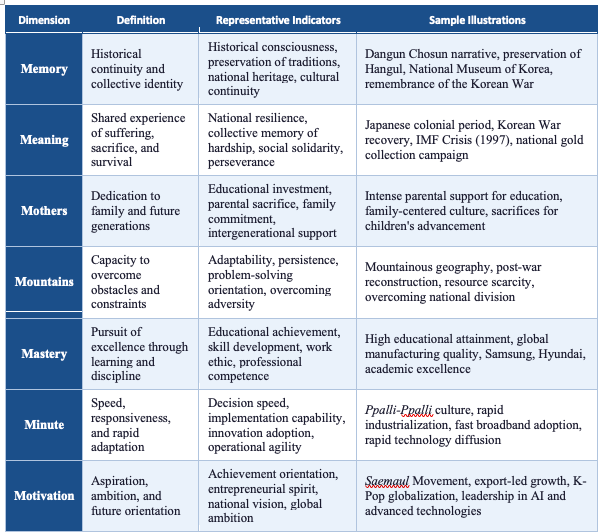
Source: Author’s own.
The interaction of these seven dimensions helps explain Korea’s ability to preserve cultural continuity, overcome adversity, achieve rapid modernization, and sustain global competitiveness. While no single dimension fully explains Korea’s development, their combined influence provides a useful framework for understanding the nation’s historical resilience and continuing transformation.
4. Historical Memory, Collective Meaning, and Family Commitment
The first three dimensions of The Seven Ms of Korea framework, Memory, Meaning, and Mothers, represent the historical and social foundations of Korean resilience. Together, they explain how a strong sense of historical continuity, shared experiences of adversity, and commitment to future generations have contributed to Korea’s capacity to endure and adapt across centuries. These dimensions are deeply embedded in Korean culture and continue to influence national identity, social behavior, and developmental aspirations.
4.1. Memory: Historical Continuity and Collective Identity
Among the world’s nations, Korea possesses one of the longest continuous historical narratives (Nahm, 1983; Lee, 1984; Kim, 2012). From the cultural origins represented by Dangun Chosun to the present day, Koreans have maintained a strong sense of historical continuity despite dynastic transitions, foreign invasions, colonization, national division, and rapid modernization. This historical consciousness has served as an important source of identity and cohesion throughout Korean history.
Memory functions not merely as recollection of the past but as a framework for interpreting the present and envisioning the future. Historical events such as the Imjin War, Japanese colonial rule, the Korean War, and national reconstruction continue to influence Korean perspectives on security, education, development, and national purpose (Eckert et al., 1990; Seth, 2019). The preservation of Hangul, cultural traditions, historical sites, and collective commemorations reflects the enduring importance of memory in Korean society.
4.2. Meaning: Transforming Hardship into Purpose
Korean history has been marked by repeated experiences of adversity, including foreign invasions, political turmoil, colonial occupation, war, poverty, and national division (Eckert et al., 1990; Seth, 2019). Yet these challenges have often contributed to a shared sense of meaning rather than collective despair. The Korean experience demonstrates how suffering can become a source of resilience, determination, and national purpose when interpreted through a broader historical narrative.
Examples of this pattern can be found throughout modern Korean history. The reconstruction that followed the Korean War, the response to the Asian Financial Crisis of 1997, and the nation’s repeated efforts to overcome economic and geopolitical challenges illustrate a capacity to transform hardship into collective action (Amsden, 1989; Tudor, 2012). Rather than defining Korea solely through its struggles, these experiences have strengthened a national belief that obstacles can be overcome through sacrifice, cooperation, and perseverance.
4.3. Mothers: Family Commitment and Intergenerational Investment
The role of family occupies a central place in Korean society, and the concept of Mothers within The Seven Ms of Korea framework symbolizes dedication, sacrifice, and investment in future generations. Throughout modern Korean history, parents, particularly mothers, have played a critical role in supporting education, transmitting cultural values, and encouraging personal achievement (Deuchler, 1992; Sorensen, 1994). Their contributions have often extended beyond immediate family welfare to broader aspirations for social mobility and national advancement.
The emphasis on education provides one of the clearest examples of this commitment (Sorensen, 1994). Generations of Korean parents have devoted extraordinary time, energy, and resources to their children’s development, viewing education as both a personal opportunity and a family responsibility. This intergenerational investment has contributed significantly to the formation of human capital, social mobility, and economic development. In this sense, Mothers represent not only family commitment but also one of the most important social foundations of Korea’s long-term resilience and success.
5. Overcoming Constraints and Pursuing Excellence
While Memory, Meaning, and Mothers provide the historical and social foundations of resilience, the next three dimensions, Mountains, Mastery, and Minute, help explain how Korea translated resilience into national development and global competitiveness. Together, these factors reflect the capacity to overcome constraints, pursue excellence, and adapt rapidly to changing circumstances. They represent not only cultural values but also practical mechanisms through which Korea achieved one of the most remarkable transformations in modern history.
5.1. Mountains: Overcoming Geographic and Historical Constraints
Mountains occupy a special place in Korean geography, culture, and historical imagination. Approximately seventy percent of the Korean Peninsula is mountainous, creating both physical challenges and opportunities throughout Korean history (Kim, 2012; Seth, 2019). Limited arable land, difficult transportation routes, and frequent external threats required communities to develop resilience, adaptability, and self-reliance. Mountains therefore symbolize not only a geographic reality but also a broader cultural disposition toward overcoming obstacles.
Beyond geography, Mountains represent the numerous historical constraints that Korea has faced, including foreign invasions, colonial rule, national division, resource scarcity, and geopolitical uncertainty (Westad, 2021; Eckert et al., 1990). Korea’s ability to transform these disadvantages into sources of determination and innovation reflects one of its most distinctive characteristics. The metaphor of Mountains captures the nation’s repeated efforts to climb difficult paths and reach higher levels of achievement despite significant barriers.
5.2. Mastery: The Pursuit of Excellence Through Learning and Discipline
One of the most visible features of Korean society is its strong commitment to learning, skill development, and continuous improvement. This emphasis has deep historical roots in the educational traditions of the Joseon period and has continued into modern Korea through investments in schooling, professional development, and technological capability (Deuchler, 1992; Palais, 1996). Mastery reflects the belief that excellence is achieved not merely through talent but through discipline, persistence, and lifelong learning.
The impact of this orientation can be observed across multiple domains. Korea’s educational achievements, manufacturing excellence, technological innovation, and global business success are all linked to a culture that values competence and continuous improvement (Amsden, 1989; Sorensen, 1994; Tudor, 2012). From students preparing for university examinations to engineers developing advanced technologies, the pursuit of mastery remains a defining characteristic of Korean development and competitiveness.
5.3. Minute: Speed, Adaptation, and Rapid Development
The Korean expression ppalli-ppalli (빨리빨리, “hurry, hurry”) has become one of the most frequently cited descriptions of modern Korean culture (Tudor, 2012). Although sometimes criticized for creating pressure and impatience, this emphasis on speed has also contributed to Korea’s remarkable capacity for rapid adaptation and execution. Minute represents the ability to respond quickly to changing circumstances, implement decisions efficiently, and accelerate learning and innovation.
This characteristic has been particularly important during periods of national transformation. Korea’s rapid industrialization, adoption of new technologies, expansion of digital infrastructure, and ability to compete in dynamic global markets all reflect a culture that values responsiveness and action (Amsden, 1989; Tudor, 2012). In an increasingly fast-changing world, the capacity to move quickly while maintaining quality has become an important source of competitive advantage. Minute therefore represents not simply speed itself but the ability to combine urgency, adaptability, and execution in pursuit of national progress.
6. Aspiration and Future Orientation
The final dimension of The Seven Ms of Korea framework is Motivation, which connects Korea’s historical experience with its future aspirations. While the previous six dimensions explain how Korea developed resilience, capability, and adaptability, Motivation explains why the nation continues to pursue new goals and opportunities. It reflects a collective desire not merely to survive but to achieve, improve, and contribute on a larger stage. In many respects, Motivation serves as the integrating force that transforms historical experience into future-oriented action.
6.1. Motivation: The Drive to Achieve
Throughout modern Korean history, a strong desire for advancement has been evident at both the individual and national levels. Following liberation, war, and widespread poverty, Korea pursued ambitious goals in economic development, industrialization, education, technology, and global engagement (Amsden, 1989; Breen, 1999). This aspiration was not limited to government policy; it was reflected in the efforts of families, students, entrepreneurs, workers, and communities seeking better opportunities for future generations.
The drive to achieve continues to shape contemporary Korea. The global success of Korean firms, advances in semiconductors, shipbuilding, automobiles, entertainment, and digital technologies, as well as the worldwide influence of K-Culture, reflect a society that consistently seeks higher levels of performance and recognition (Hong et al., 2024; Hong et al., 2026). Motivation therefore represents more than ambition alone; it reflects a collective belief that sustained effort can produce meaningful progress for both individuals and the nation. Korea’s global leadership in semiconductors and advanced manufacturing further illustrates the nation’s motivation to pursue excellence in emerging industries.
6.2. Integrating The Seven Ms of Korea Framework
The Seven Ms are best understood not as independent factors but as mutually reinforcing dimensions of national resilience and development. Memory provides historical identity and continuity, while Meaning transforms hardship into purpose and determination. Mothers contribute intergenerational commitment and human development, and Mountains symbolize the capacity to overcome obstacles and constraints. Together, these dimensions establish the social and cultural foundations upon which development occurs.
Mastery, Minute, and Motivation build upon these foundations by promoting excellence, adaptability, and future orientation. Mastery develops capability, Minute accelerates execution, and Motivation sustains long-term aspirations. The interaction of all seven dimensions helps explain how Korea has preserved its identity while simultaneously adapting to profound political, economic, technological, and social changes. Viewed collectively, the Seven Ms offer a holistic framework for understanding Korea’s historical resilience and contemporary achievements.
6.3. Lessons for Korea in the AI Era
As Korea enters an era shaped by artificial intelligence, demographic change, digital ecosystems, and intensified global competition, the foundations of future competitiveness will extend beyond technological capability alone. Sustainable success will increasingly depend on the ability to integrate innovation with cultural values, institutional trust, human capital development, and ethical leadership. In this context, The Seven Ms of Korea framework remains relevant because it highlights the historical foundations and adaptive capacities that have supported Korea’s resilience, modernization, and global advancement.
The challenge for Korea is not merely to preserve its past but to apply its enduring strengths to emerging realities. Memory provides continuity amid rapid change, Meaning offers purpose during uncertainty, Mothers support human development, Mountains inspire resilience, Mastery promotes lifelong learning, Minute accelerates adaptation, and Motivation sustains national ambition. Although the Seven Ms simplify a complex and diverse society, they offer a useful lens for understanding the recurring historical, cultural, and developmental patterns that have enabled Korea to transform resilience into prosperity and may continue to support its competitiveness in the AI era (Hong & Hyun, 2025; Seth, 2019; Tudor, 2012).
The Korean story is unfinished; its next chapter leads toward reunification and beyond.
7. Conclusion
The Seven Ms of Korea framework offers a holistic perspective for understanding how Korea has sustained resilience and achieved remarkable national development despite numerous historical, geographic, and geopolitical challenges. By integrating Memory, Meaning, Mothers, Mountains, Mastery, Minute, and Motivation, the framework highlights the cultural values, social institutions, and adaptive capabilities that have contributed to Korea’s transformation from a resource-poor nation into a global economic, technological, and cultural leader. Although no single framework can fully capture the complexity of a nation, the Seven Ms provide a useful lens through which to interpret recurring patterns in Korea’s historical experience and contemporary achievements. As Korea enters the AI era and confronts new global uncertainties, the enduring strengths represented by the Seven Ms may continue to serve as valuable foundations for future resilience, innovation, and prosperity.
References
Amsden, A. H. (1989). Asia’s next giant: South Korea and late industrialization. Oxford University Press.
Breen, M. (1999). The Koreans: Who they are, what they want, where their future lies. Thomas Dunne Books.
Deuchler, M. (1992). The Confucian transformation of Korea: A study of society and ideology. Harvard University Asia Center.
Eckert, C. J., Lee, K. B., Lew, Y. I., Robinson, M., & Wagner, E. W. (1990). Korea old and new: A history. Korea Institute, Harvard University.
Haboush, J. K., & Deuchler, M. (Eds.). (1999). Culture and the state in late Chosŏn Korea. Harvard University Asia Center.
Hong, P. C., Park, Y. S., Hwang, D. W., & Sepehr, M. J. (2024). A growth theory perspective on the competitive landscape of shipbuilding: A comparative study of Japan, Korea, and China. Maritime Economics & Logistics, 26(3), 462–489.
Hong, P. C., & Hyun, Y. R. (2025). Impact of diverse orientations in human emergency responses: Illustrations of Korean national experiences in modern history. In Education and Pedagogical Experiences (pp. 277–301). Routledge India.
Hong, P., Hwang, D., Park, Y. S., & Ferreira, C. (2026). Benchmarking national semiconductor strategies: Advancing innovation systems and policy learning for global competitiveness. Benchmarking: An International Journal, 1–27.
Kim, J. (2012). A history of Korea: From “Land of the Morning Calm” to states in conflict. Indiana University Press.
Lee, K. B. (1984). A new history of Korea (E. W. Wagner & E. J. Schultz, Trans.). Harvard University Press.
Nahm, A. C. (1983). A panorama of 5,000 years: Korean history. Hollym International.
Palais, J. B. (1996). Confucian statecraft and Korean institutions: Yu Hyŏngwŏn and the late Chosŏn dynasty. University of Washington Press.
Seth, M. J. (2019). A concise history of Korea: From antiquity to the present (3rd ed.). Rowman & Littlefield.
Shin, G.-W. (2006). Ethnic nationalism in Korea: Genealogy, politics, and legacy. Stanford University Press.
Sorensen, C. W. (1994). Success and education in South Korea. Comparative Education Review, 38(1), 10–35.
Tudor, D. (2012). Korea: The impossible country. Tuttle Publishing.
Westad, O. A. (2021). Empire and righteous nation: 600 years of China–Korea relations. Belknap Press of Harvard University Press.
About the Author

Distinguished Professor, Dr. Paul Hong (Editor in Chief) — University of Toledo
Paul C. Hong is a Distinguished University Professor and affiliated faculty member of the Asian Studies Program at the University of Toledo. His scholarship examines how history, culture, institutions, technology, and leadership shape national resilience, economic transformation, and long-term competitiveness.
His research spans global supply chains, industrial development, innovation, and comparative national systems, with particular focus on Korea, Japan, China, and the United States. Combining academic inquiry with personal engagement in Korean history and society, he explores how historical continuity, collective meaning, family commitment, perseverance, learning, adaptability, and aspiration contribute to Korea’s remarkable development and future competitiveness in the AI era.
Original Article:

Citation: Hong, P. C. (2026, June). The Seven Ms of Korea: Foundations of national resilience and development. K-GSP Forum, pp. 1–12.
© K-Global Scholars and Professionals Forum. All rights reserved. Content published in the K-GSP Forum may not be reproduced, distributed, or transmitted in any form without prior written permission from the K-GSP Forum, except for brief quotations with full attribution.
An e-mail sent as: " I greatly appteciate your sharing this invaluable document with me. Below are my comments on your essay. Mark Yang.
This is a unique and fascinating analysis of the seven factors behind Korea's development, written with remarkable insight into the Korean mindset and culture. As a Korean, I deeply resonate with the author's observation and highly commemd the depth and excellence of the analysis. Mark C. Yang ( Chicago)