
The Three Geniuses of Joseon and the Polymath Network in the Age of AI
Choi Rip’s Language, Han Seok-bong’s Hand, Heo Jun’s Knowledge, and the Future of Networked Genius
Abstract
Generative artificial intelligence is transforming the long-established architecture of human intelligence. Abilities once regarded as the privilege of a small number of gifted individuals—writing, painting, translation, programming, and large-scale information analysis—are increasingly becoming accessible through AI. Yet, as AI democratizes intellectual capability, a more fundamental question emerges: How should human intelligence be defined in the future?
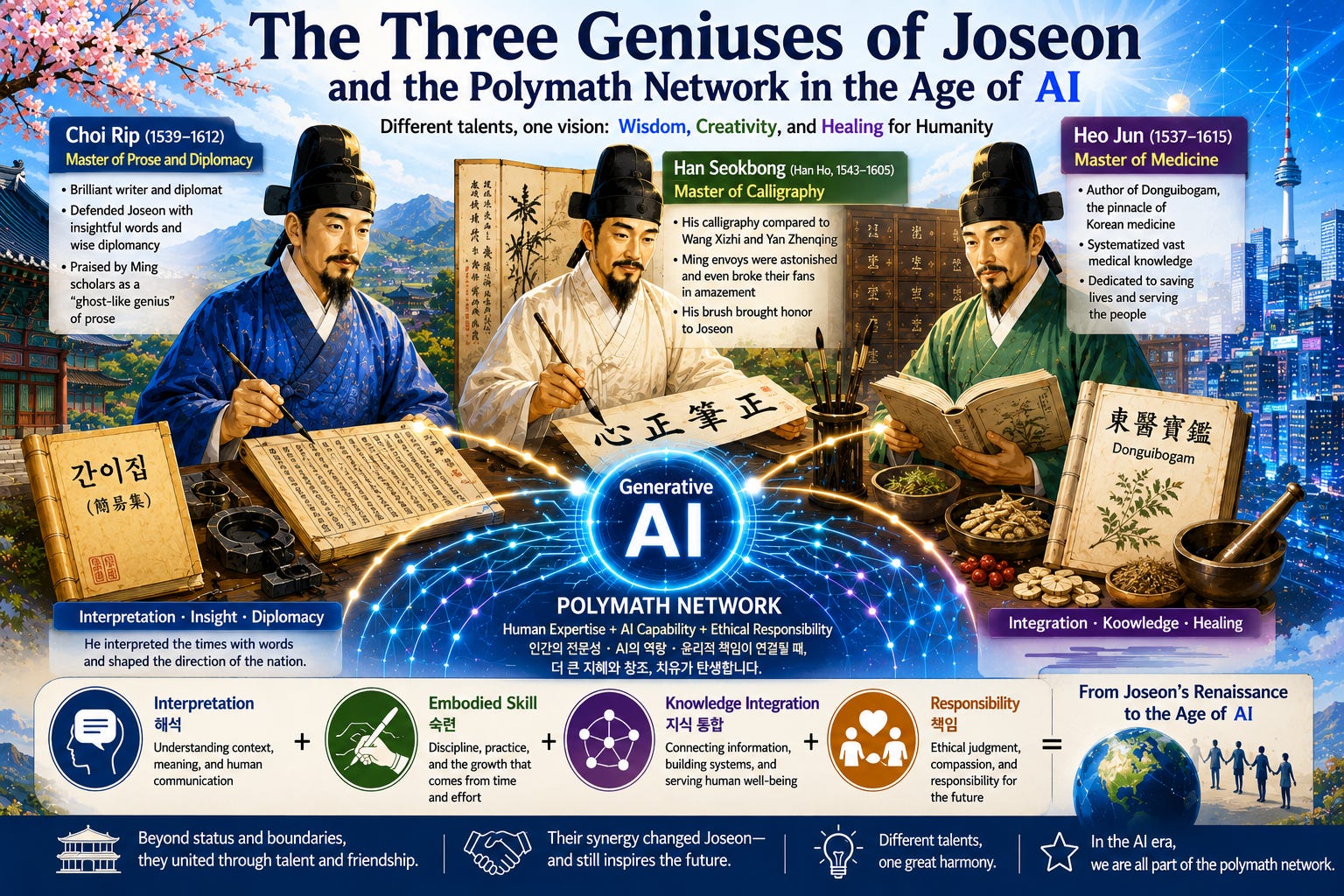
This essay reinterprets the achievements of three distinguished figures of mid-Joseon Korea—writer Choi Rip (崔岦, 1539–1612), calligrapher Han Ho (韓濩, 1543–1605), widely known as Han Seok-bong, and physician Heo Jun (許浚, 1546–1615)—through the contemporary concepts of polymathy and knowledge networks. Historical evidence does not support the claim that all three formed a formally organized collaborative network in the modern sense. The intellectual and artistic relationship between Choi Rip and Han Ho is comparatively well documented, whereas the personal relationship between Heo Jun and the other two should not be exaggerated. Nevertheless, their simultaneous achievements in literature, calligraphy, and medicine reveal an important cultural landscape of late sixteenth- and early seventeenth-century Joseon.
This essay reads Choi Rip as representing interpretive and linguistic judgment, Han Ho as representing embodied skill and disciplined creativity, and Heo Jun as representing knowledge integration and human-centered organization. Building upon these three dimensions, it argues that the polymath of the future will no longer be defined primarily as an individual who knows everything. Instead, the emerging model of polymathy will increasingly take the form of a Polymath Network—a system connecting human expertise, artificial intelligence, diverse disciplinary knowledge, and ethical responsibility.
The central competition of the AI age will therefore not be determined by who possesses the largest quantity of information. It will depend increasingly on who can understand different forms of intelligence most deeply, connect them most creatively, and employ them most responsibly.
Keywords: Choi Rip, Han Ho, Han Seok-bong, Heo Jun, polymath, generative AI, collective intelligence, knowledge networks, human–AI collaboration, creativity
Is the Age of the Rare Genius Coming to an End?
For most of human history, genius was rare. The ability to write eloquently, understand multiple languages, solve complex mathematical problems, or create extraordinary works of art belonged to relatively few individuals. Humanity therefore remembered figures such as Leonardo da Vinci and Isaac Newton, while East Asian intellectual history celebrated polymathic figures such as Jeong Yak-yong. Genius was associated with the scarcity of exceptional human ability.
The rise of generative AI is rapidly disrupting that historical order. Today, individuals can ask AI to summarize thousands of pages without personally reading them, generate computer code without extensive programming experience, create images without mastering traditional artistic techniques, and communicate across languages they have never formally studied. Abilities once associated with years of specialized training are increasingly becoming available on demand.
Recent research suggests that generative AI can expand opportunities for creativity, problem-solving, interdisciplinary learning, and intellectual collaboration in education and research (Ma et al., 2025; Yan & Tang, 2025). At the same time, scholars warn that excessive dependence on AI may externalize essential human cognitive and metacognitive capacities, weakening critical thinking rather than strengthening it (Qian, 2025).
This creates one of the most provocative questions of the AI age:
If AI can write faster, remember more, and connect information more broadly than human beings, what should human beings do?
The answer will not be found in competing with machines in the quantity of information we can memorize. Human intelligence must increasingly move from the accumulation of information toward the interpretation of meaning and the judgment of purpose. In an age when AI can provide capabilities, wisdom about how and why those capabilities should be used becomes more important than capability itself.
At this point, we may unexpectedly return to Joseon Korea more than four centuries ago. Choi Rip, Han Ho, and Heo Jun were not a modern research team. Historical imagination should never replace historical evidence. Yet their nearly simultaneous achievements in different domains provide a remarkable intellectual landscape. One employed language and literary expression to interpret political and diplomatic realities. Another transformed written characters into visual authority and artistic expression. The third organized an immense body of medical knowledge into a systematic framework for human health.
Together—not necessarily as an organized team, but as representative figures of an intellectually dynamic era—they illuminate three dimensions of human capability that the AI age must rediscover.
Choi Rip: Why AI Can Generate Language but Cannot Replace Judgment
Choi Rip was one of the most distinguished writers of mid-Joseon Korea, known not only for literary excellence but also for his contributions to diplomacy and public affairs. He lived during an era in which political conflict, international diplomacy, and cultural identity were deeply intertwined. His writing was therefore more than literary ornament. Language was an instrument for interpreting reality and communicating national intention. The Encyclopedia of Korean Culture recognizes Choi Rip as an important literary figure of his period and highlights the significance of his prose, classical learning, and intellectual contributions to Joseon literature (Academy of Korean Studies, n.d.).
The contemporary significance of Choi Rip begins precisely here. Today, AI can produce dozens of alternative versions of a diplomatic statement within seconds. It can draft speeches, imitate academic styles, summarize political documents, and generate persuasive arguments. Yet the most difficult task is not the production of language itself. It is determining what should be said, under what circumstances, to whom, and with what consequences.
A sentence never exists in isolation. Its meaning depends on context. The same words may produce reconciliation in one situation and conflict in another. Language can be information, but it can also be power, persuasion, diplomacy, and even an instrument of peace or conflict.
For this reason, Choi Rip’s intellectual ability may be understood today as a form of interpretive intelligence. In an age saturated with information, the most valuable person will not necessarily be the one who produces the largest number of sentences. It will be the person who can determine which information matters, interpret its meaning, and transform it into language for which society can responsibly account.
Recent research on AI and education similarly emphasizes that future learning must move beyond memorization toward critical judgment, interdisciplinary problem-solving, human oversight, and the ability to evaluate AI-generated information (Jaldemark et al., 2025; Ma et al., 2025).
AI can generate language. But human beings must decide what ought to be said. AI can generate answers. But human beings must determine which answers can responsibly be accepted.
This is the enduring lesson of Choi Rip’s language.
Han Ho: AI Can Replicate Results, but It Cannot Live Through Human Practice
When we reconsider Han Ho—better known as Han Seok-bong—through the lens of artificial intelligence, we encounter another paradox. Generative AI can increasingly analyze artistic styles and produce images that resemble the visual characteristics of historical masters. In the future, creating an image similar to Han Seok-bong’s calligraphy may become technologically effortless.
But this raises a deeper question. If a machine can reproduce the result, what was the value of decades of human practice? The answer lies in the difference between producing an outcome and becoming a person capable of producing it. AI can generate results. Human beings are transformed through the process.
Han Seok-bong’s brush was not merely an instrument for producing beautiful characters. Repetition trained the hand. Failure trained judgment. Time refined perception. Discipline shaped attention. These capacities accumulated not simply in an artwork but within the human being himself.
This is what may be described as embodied knowledge or embodied skill. The distinction is profoundly important for education in the age of AI. If a student submits an excellent essay generated by AI, has that student truly learned how to write? If AI produces a sophisticated computer program, has the student acquired genuine problem-solving ability?
Recent scholarship on generative AI in education repeatedly identifies this tension. AI can increase efficiency and accessibility, but excessive dependence may weaken critical thinking, metacognitive development, and foundational academic skills if educational systems fail to preserve meaningful human engagement (Qian, 2025). Conversely, human–AI collaboration can enhance learning when AI is integrated with human expertise, feedback, reflection, and iterative revision rather than used merely as a substitute for intellectual effort (Li et al., 2026).
Han Seok-bong’s brush therefore asks the AI age a deceptively simple question: “If you obtained the result, did you truly acquire the ability?”
AI saves time, and this is one of its greatest benefits. Yet not every form of time should be eliminated. Some forms of time are the very processes through which human beings are formed.
The time spent learning to write. The time spent practicing music. The time spent struggling with mathematics. The time spent repeating a brushstroke. These are not merely inefficient paths toward an outcome. They are processes through which human judgment, patience, perception, and identity are created.
Han Seok-bong’s lesson for the AI age is therefore clear:
AI may eventually reproduce the work of the human hand, but it must not replace the time through which human beings develop themselves.
Heo Jun: The More Data We Have, the More We Need the Architecture of Knowledge
If Choi Rip represents interpretation and Han Seok-bong represents embodied skill, Heo Jun invites us to consider another essential capability for the AI age: knowledge integration.
Heo Jun’s monumental medical work, Donguibogam (Principles and Practice of Eastern Medicine), was not simply a collection of medical information. Its significance lay in the systematic organization of accumulated medical knowledge and therapeutic experience into a coherent framework for understanding human health and disease. UNESCO recognized Donguibogam as a significant documentary heritage work and emphasized its importance in the history of medicine, including its attention to preventive health and the accessibility of medical knowledge (UNESCO, 2009).
The modern world faces the opposite problem from Heo Jun’s era. In the past, information was scarce and difficult to collect. Today, information is overwhelming.
Medical records. Genomic data. Clinical studies. Scientific articles. Digital health information.
AI can analyze these materials at extraordinary speed. Yet the accumulation of data does not automatically produce wisdom. The essential question is the relationship among pieces of information. What connects to what? Which information is trustworthy? Which relationships are meaningful? How should knowledge be organized for human benefit?
It would be historically inaccurate to claim that Heo Jun created a modern knowledge graph. Yet from a contemporary perspective, his intellectual achievement may be understood as an early example of a fundamental problem that remains central today: how to organize, classify, connect, and structure knowledge so that human beings can use it meaningfully.
This problem has become even more important in the AI age. Future competitive advantage will not belong simply to those who possess the largest quantities of data. It will increasingly belong to those who understand how knowledge should be structured and connected.
AI can connect information. But human beings must connect purpose. AI can identify patterns of disease. But human beings must preserve the principle that medicine ultimately exists for human dignity and human well-being. Heo Jun’s contemporary legacy may therefore be expressed in one sentence:
Knowledge becomes wisdom only when it is organized for human life.
Not Three Geniuses, but Three Dimensions of Human Intelligence
There is no need to exaggerate Choi Rip, Han Seok-bong, and Heo Jun into a single historical “dream team.” In fact, their modern significance becomes clearer when historical facts are respected.
Their different achievements reveal three dimensions of human intelligence. Choi Rip represents interpretation. Han Seok-bong represents embodied skill. Heo Jun represents integration.
Together, these three concepts provide a concise framework for thinking about human capability in the age of AI: Interpretation → Embodied Skill → Knowledge Integration
Yet one additional dimension is indispensable.
Responsibility.
AI expands human capability. But the greater the capability, the greater the responsibility required to govern it. Human intelligence in the future should therefore not be defined simply by the ability to know more information or solve problems more quickly. A more meaningful formulation would be:
Human Wisdom = Interpretation × Skill × Integration × Responsibility
Knowledge without interpretation loses direction. Knowledge without skill becomes easily externalized. Knowledge without integration becomes fragmented. And intelligence without responsibility becomes dangerous.
From Polymath 1.0 to the Polymath Network
Traditionally, a polymath was an individual who accumulated knowledge across multiple disciplines. Leonardo da Vinci embodied the ability to move among art, science, engineering, and philosophy. We may call this model Polymath 1.0:
Polymath 1.0: Many Fields Inside One Mind
The modern world, however, increasingly challenges this model. The total volume of human knowledge has become too vast for any individual to master comprehensively. AI accelerates this transformation further. Human beings no longer need to memorize everything. What becomes increasingly valuable is the ability to connect different forms of expertise.
This produces Polymath 2.0:
Polymath 2.0: Connecting Knowledge Across Boundaries
The Polymath 2.0 individual is not necessarily an expert in every discipline. Instead, such a person can communicate across disciplinary boundaries. He or she can help an AI researcher understand a physician’s problem, enable engineers and philosophers to discuss the same ethical challenge, and create new questions at the intersection of science, technology, and the humanities.
Research on generative AI suggests that AI may expand opportunities for interdisciplinary collaboration, but it does not automatically create meaningful cooperation. Interdisciplinary learning and collaboration must be deliberately designed, and human expertise remains essential for evaluating and directing AI-generated outputs (Yan & Tang, 2025).
This leads to a third stage: Polymath 3.0: The Polymath Network
The polymath of the future may no longer be a single person. It may be a network. An AI scientist. A physician. A philosopher. A legal scholar. A designer. A policy expert. And AI systems connecting their knowledge.
The purpose is not for AI to replace human beings. The purpose is to enable different forms of human expertise to collaborate more effectively.
Recent research on human–AI collaboration emphasizes that AI becomes most productive when combined with human expertise, feedback, iterative refinement, and professional judgment rather than used as an autonomous replacement for human intelligence (Li et al., 2026).
The future intellectual structure may therefore evolve as follows:
Individual Genius → Connected Expertise → Networked Genius
From individual genius to connected expertise, and ultimately to networked genius.
AI May Create Something More Important Than Superhuman Individuals
Many people believe that AI will turn individuals into intellectual superheroes. In some respects, this is already happening. A single individual equipped with powerful AI tools can accomplish tasks that previously required an entire team.
But AI’s greater potential may not lie in making isolated individuals more powerful. Its deeper potential may lie in reducing the distance between human beings. A physician may use AI to understand the basic language of computer science. An engineer may use AI to explore medical research. A policy specialist may use AI to understand technological systems.
In this sense, AI may become a new kind of translator—not simply translating one human language into another but translating between different domains of expertise.
This transformation has profound implications for universities and research institutions. Future universities should not merely teach students how to use AI tools. Research increasingly suggests that education must develop AI literacy alongside critical thinking, problem-solving, ethical judgment, and interdisciplinary collaboration (Burneo-Arteaga, 2025; Ma et al., 2025).
The most important university of the future will therefore not necessarily be the university that uses AI the most.
It may be the university that enables different forms of intelligence to collaborate most effectively.
The Most Dangerous Future Is Not One in Which AI Becomes Too Intelligent
The most common fear surrounding artificial intelligence is that machines will become more intelligent than human beings.
Yet a more immediate danger may be something else: human beings may stop thinking because machines think for them. AI reads, so humans stop reading. AI writes, so humans stop writing. AI calculates, so humans stop calculating. AI judges, so humans stop accepting responsibility. This may be the more realistic danger.
Recent research on generative AI and education repeatedly identifies this tension. AI can improve efficiency, accessibility, and productivity, but without appropriate educational design it may weaken critical and metacognitive abilities. Conversely, when combined with human expertise, clear goals, feedback, and reflection, AI can become a powerful amplifier of human capability (Li et al., 2026; Qian, 2025).
The central issue of the AI age is therefore not: Human intelligence versus artificial intelligence. The more important formula is:
Human Intelligence + AI Capability + Ethical Responsibility
We need AI’s capabilities. But we also need human judgment. And we need responsibility for the consequences of that judgment.
A New Renaissance Does Not Begin with Technology
A new Renaissance will not begin on the day a more powerful AI model is released. It will not begin with a faster processor. It will not begin with a larger dataset. A new Renaissance will begin when human beings begin asking fundamental questions again.
What is this technology for? Whom does it benefit? Whom might it harm? Does technological possibility automatically mean moral legitimacy?
Choi Rip’s language symbolizes the interpretive capacity required to ask such questions. Han Seok-bong’s brush symbolizes the value of human development through discipline and practice. Heo Jun’s intellectual system symbolizes the principle that knowledge must ultimately be organized for human life.
AI can become a powerful instrument for connecting these human capacities. But it must not become a substitute for them.
The Genius of the Future Will Not Stand Alone
There is no need to transform Choi Rip, Han Seok-bong, and Heo Jun into a fictional historical research team. History requires evidence, and imagination must not replace it.
Yet their achievements, viewed together within the cultural landscape of their time, offer a compelling model for the future.
Choi Rip interpreted a complex world through language. Han Seok-bong transformed discipline and practice into artistic mastery. Heo Jun integrated scattered knowledge into a system designed for human life.
The AI age now requires these same capacities. Deeper interpretation. Stronger human skill. Broader knowledge integration. And, above all, greater responsibility.
We must therefore redefine the polymath. Polymath 1.0 was the person who knew many things. Polymath 2.0 was the person who connected different things. But Polymath 3.0 is a responsible network that connects human beings and AI, specialized expertise and interdisciplinary knowledge, technological capability and ethical purpose.
AI can connect countless pieces of information. But it cannot independently determine what ought to be connected. AI can generate countless answers. But it cannot bear moral responsibility for which answer should be chosen. AI can expand intelligence. But it cannot determine the ultimate purpose of wisdom. That responsibility remains human. Therefore, the most important question of the AI age is no longer: “Who is the smartest?”
The more important question is: “Who can understand different forms of intelligence most deeply, connect them most creatively, and use them most responsibly?”
More than four centuries ago, Choi Rip interpreted the world through language. Han Seok-bong engraved time into the human hand through disciplined practice. Heo Jun organized knowledge for the service of human life.
Our task in the age of AI is to connect these three principles again. To connect language with technology. To connect skill with automation. To connect knowledge with humanity. The genius of the future will not be the individual who knows everything.
It will be the person—and increasingly the network—capable of understanding the expertise of others, harnessing the capabilities of AI, and connecting different forms of intelligence toward a larger human purpose. And perhaps the highest form of genius in the AI age will no longer reside inside a single extraordinary mind. It will emerge from a network in which different human beings and different forms of intelligence are connected creatively—and governed responsibly.
References
Academy of Korean Studies. (n.d.). Choi Rip (崔岦). Encyclopedia of Korean Culture.
Burneo-Arteaga, P. B. (2025). Capability-based training framework for generative AI in higher education. Frontiers in Education, 10. https://doi.org/10.3389/feduc.2025.1594199
Jaldemark, J., Lundin, J., Säljö, R., Edwards, J., Gegenfurtner, A., Holmes, W., Järvelä, S., de Laat, M., Littlejohn, A., Seufert, S., et al. (2025). A multidisciplinary research agenda for artificial intelligence, education, learning, and instruction. Postdigital Science and Education.
Li, T., Krajcik, J. S., & Spiro, R. (2026). The transformative collaboration of human intelligence and artificial intelligence in designing knowledge-in-use science assessment for learning. Journal of Science Education and Technology, 35, 688–714. https://doi.org/10.1007/s10956-025-10275-4
Ma, Y., Su, Y., Li, M., Zhang, Y., Chai, W., Huang, A., & Zhao, X. (2025). Preparing students for an AI-driven world: Generative AI and curriculum reform in higher education. Frontiers of Digital Education, 2(4), Article 30. https://doi.org/10.1007/s44366-025-0067-6
Qian, Y. (2025). Pedagogical applications of generative AI in higher education: A systematic review of the field. TechTrends, 69, 1105–1120. https://doi.org/10.1007/s11528-025-01100-1
UNESCO. (2009). Donguibogam: Principles and practice of Eastern medicine. Memory of the World Register.
Xia, Q., Weng, X., Huang, W., Li, Y. L., Cheng, W. K., & Chiu, T. K. F. (2026). Is generative artificial intelligence (GenAI) a game changer for interdisciplinary collaborative learning in higher education? Education and Information Technologies, 31, 143–166. https://doi.org/10.1007/s10639-025-13812-1
Yan, Z., & Tang, Q. (2025). Integrating AI-generated content tools in higher education: A comparative analysis of interdisciplinary learning outcomes. Scientific Reports, 15, Article 25802. https://doi.org/10.1038/s41598-025-10941-y
조선의 세 천재와 AI 시대의 폴리매스 네트워크
최립의 언어, 한석봉의 손, 허준의 지식, 그리고 연결된 천재성의 미래
초록
생성형 인공지능은 인간의 오랜 지적 질서를 뒤흔들고 있다. 한때 소수의 천재만이 할 수 있다고 여겨졌던 글쓰기, 그림, 번역, 프로그래밍, 정보 분석이 이제 누구나 AI를 통해 접근할 수 있는 능력이 되고 있다. 그러나 AI가 인간의 지적 능력을 민주화할수록 오히려 더 근본적인 질문이 등장한다. 인간의 지능은 앞으로 무엇으로 정의되어야 하는가? 이 글은 조선 중기의 문장가 최립(崔岦, 1539–1612), 서예가 한호(韓濩, 1543–1605), 의학자 허준(許浚, 1546–1615)의 서로 다른 성취를 AI 시대의 폴리매스(polymath: 박학다식한 사람)와 지식 네트워크라는 관점에서 재해석한다. 세 사람이 현대적 의미의 조직된 공동 네트워크를 형성했다는 직접적인 역사적 증거는 제한적이며, 최립과 한호의 교유와 협업은 비교적 확인되지만 허준과 두 사람의 개인적 관계를 과장해서는 안 된다. 그럼에도 세 사람이 거의 같은 시대에 문학·서예·의학이라는 서로 다른 영역에서 최고 수준의 성취를 이루었다는 사실은 중요한 시대적 풍경을 보여준다. 본 글은 최립에게서 해석과 언어적 판단, 한호에게서 체화된 숙련과 창조성, 허준에게서 지식의 통합과 인간 중심성을 읽어낸다. 이를 바탕으로 본 글은 미래의 폴리매스가 모든 것을 아는 개인이 아니라 인간의 전문성, AI의 계산 능력, 서로 다른 학문 영역, 그리고 윤리적 책임을 연결하는 Polymath Network가 될 것이라고 주장한다. AI 시대의 핵심 경쟁은 더 많은 정보를 소유하는 데 있지 않다. 서로 다른 지능을 얼마나 깊이 이해하고, 얼마나 창조적으로 연결하며, 얼마나 책임 있게 사용할 수 있는가에 달려 있다.
주제어: 최립, 한호, 한석봉, 허준, 폴리매스, 생성형 AI, 집단지성, 지식 네트워크, 인간-AI 협업, 창의성
천재가 희귀한 시대는 끝나고 있는가
인류 역사에서 천재는 희귀한 존재였다. 글을 쓰는 능력, 여러 언어를 이해하는 능력, 복잡한 수학적 문제를 해결하는 능력, 아름다운 예술 작품을 만드는 능력은 오랫동안 극소수의 사람들에게 집중되어 있었다. 그래서 우리는 레오나르도 다빈치와 뉴턴을 기억하고, 동아시아에서는 정약용과 같은 다방면의 지식인을 특별한 존재로 기억한다. 그러나 생성형 AI의 등장 이후 이러한 질서가 빠르게 흔들리고 있다. 이제 한 사람은 수천 권의 자료를 직접 읽지 않고도 AI에게 요약을 요청할 수 있고, 프로그래밍을 배우지 않은 사람도 코드를 생성하며, 그림을 그리지 못하는 사람도 이미지를 만들 수 있다. 최근 연구들은 생성형 AI가 교육과 연구에서 창의성, 비판적 사고, 문제 해결, 학제 간 협력의 새로운 가능성을 열고 있음을 보여준다(Qian, 2025; Yan & Tang, 2025). 동시에 이러한 기술에 지나치게 의존할 경우 인간의 핵심적인 인지 능력과 메타인지 능력이 외주화될 위험도 경고한다(Qian, 2025).
바로 이 지점에서 AI 시대의 가장 도발적인 질문이 등장한다. AI가 인간보다 더 빨리 쓰고, 더 많이 기억하며, 더 넓게 연결할 수 있다면 인간은 무엇을 해야 하는가? 이 질문에 대한 답은 인간이 AI보다 더 많은 정보를 기억하려고 경쟁하는 데 있지 않을 것이다. 오히려 인간은 정보의 양에서 경쟁하는 존재에서, 정보의 의미와 방향을 판단하는 존재로 이동해야 한다. AI가 능력을 제공하는 시대에는 능력 자체보다 그 능력을 무엇을 위해 사용할 것인가를 결정하는 지혜가 더 중요해진다.
이러한 질문을 생각할 때 우리는 뜻밖에도 400여 년 전 조선으로 돌아갈 수 있다. 최립과 한호, 그리고 허준은 현대적 의미의 하나의 연구팀은 아니었다. 역사적 사실을 현대의 개념으로 지나치게 포장해서는 안 된다. 그러나 거의 같은 시대에 한 사람은 언어와 문장을 통해 국가와 사회의 현실을 표현했고, 다른 한 사람은 붓을 통해 문자에 예술적 생명과 권위를 부여했으며, 또 다른 한 사람은 방대한 의학 지식을 하나의 체계로 통합했다. 이들의 성취는 AI 시대가 다시 발견해야 할 인간 능력의 세 가지 차원을 보여준다.
최립: AI가 문장을 만들 수 있어도 판단을 대신할 수 없는 이유
최립은 조선 중기를 대표하는 문장가 가운데 한 사람으로 평가되며, 문학뿐 아니라 외교와 행정의 현장에서 뛰어난 문장 능력을 발휘했다. 그는 조선의 정치적 현실과 국제적 관계가 복잡하게 얽힌 시대를 살았으며, 그의 문장은 단순한 문학적 장식이 아니라 국가의 의도와 현실을 표현하는 중요한 지적 도구였다. 한국민족문화대백과사전은 최립을 조선 중기의 대표적 문장가로 평가하며, 그의 문체와 고문론, 그리고 외교적 활동이 당시 문학사에서 중요한 위치를 차지했음을 보여준다(한국학중앙연구원, n.d.).
최립의 현대적 의미는 바로 여기에서 시작된다. 오늘날 AI는 몇 초 만에 수십 가지 문장을 만들어 낼 수 있다. 외교문서의 초안을 작성할 수도 있고, 연설문을 만들 수도 있으며, 학술 논문의 문체를 모방할 수도 있다. 그러나 AI가 가장 어려워하는 것은 문장을 생성하는 일이 아니라 그 문장이 어떤 상황에서 어떤 결과를 만들어 낼 것인가를 책임 있게 판단하는 일이다. 같은 문장도 누구에게, 언제, 어떤 정치적 상황에서 사용되는가에 따라 전혀 다른 결과를 낳는다. 언어는 단순한 정보 전달이 아니라 권력이며, 설득이며, 때로는 평화와 갈등을 결정하는 행위다.
따라서 AI 시대에 최립의 능력은 단순한 글쓰기 능력이 아니라 ‘해석적 지능(interpretive intelligence)’으로 이해할 수 있다. 정보가 넘쳐나는 시대에 필요한 사람은 가장 많은 문장을 생산하는 사람이 아니라, 어떤 정보가 중요한지 판단하고 그것을 사회적으로 책임질 수 있는 언어로 바꾸는 사람이다. 생성형 AI 시대의 교육 역시 이러한 방향으로 이동해야 한다. 최근 AI 교육 연구들이 강조하듯, 미래의 학습은 단순한 정보 암기보다 문제 해결, 비판적 판단, 학제 간 연결, 그리고 인간의 감독과 검증 능력을 강화해야 한다(Ma et al., 2025; Jaldemark et al., 2025).
AI는 문장을 만들 수 있다. 그러나 무엇을 말해야 하는가는 인간이 결정해야 한다. AI는 답을 만들 수 있다. 그러나 어떤 답이 사회적으로 책임질 수 있는가는 인간이 판단해야 한다.
최립의 언어는 바로 이 차이를 상징한다.
한호: 결과를 복제하는 AI와 시간을 살아낸 인간
한호, 곧 한석봉의 서예를 AI 시대에 다시 바라보면 우리는 또 다른 역설을 발견한다. 오늘날 생성형 AI는 특정 화가나 서예가의 양식을 분석하여 놀라울 정도로 유사한 이미지를 만들어 낼 수 있다. 한석봉의 필체와 비슷한 시각적 결과를 생성하는 것은 기술적으로 점점 쉬워질 것이다. 그렇다면 한석봉의 수십 년에 걸친 붓의 훈련은 어떤 의미를 갖는가?
답은 결과와 과정의 차이에 있다. AI는 결과를 생성할 수 있다. 그러나 인간의 훈련 과정을 살아낼 수는 없다.
한석봉의 붓은 단순히 아름다운 문자 모양을 만드는 도구가 아니었다. 반복은 손을 훈련시키고, 실패는 판단을 훈련시키며, 시간은 인간의 감각을 변화시킨다. 이러한 능력은 결과물 속에만 존재하는 것이 아니라 인간의 몸과 기억 속에 축적된다. 이를 현대적으로 표현하면 ‘체화된 지식(embodied knowledge)’ 또는 ‘체화된 숙련(embodied skill)’이라고 할 수 있다.
이것은 AI 시대의 교육에 매우 중요한 질문을 던진다. 학생이 AI를 이용해 훌륭한 에세이를 제출했다면 그는 정말 글쓰기 능력을 습득한 것인가? AI가 복잡한 프로그램을 작성했다면 학생은 정말 문제 해결 능력을 갖게 된 것인가? 최근의 생성형 AI 교육 연구들은 AI가 효율성과 접근성을 높이는 동시에, 지나친 의존이 비판적 사고와 기본적인 학문적 능력을 약화시킬 위험이 있음을 지적한다(Qian, 2025). 인간-AI 협업의 핵심은 인간의 능력을 제거하는 것이 아니라 인간의 전문적 판단을 강화하는 데 있어야 한다(Li et al., 2026).
그래서 한석봉의 붓은 AI 시대에 오히려 더 중요한 철학적 질문을 던진다. “결과를 얻었다고 해서 능력을 얻은 것인가?”
AI는 우리에게 시간을 절약하게 해 준다. 그러나 모든 시간을 절약해야 하는 것은 아니다. 어떤 시간은 인간을 만드는 시간이기 때문이다. 글을 배우는 시간, 악기를 연습하는 시간, 수학 문제를 풀며 실패하는 시간, 붓을 잡고 한 획을 반복하는 시간은 단순히 결과물을 생산하기 위한 비용이 아니다. 그것은 인간의 판단력과 감각을 형성하는 과정이다.
한석봉이 우리에게 남기는 교훈은 단순하다. AI가 인간의 손을 대체할 수 있을지는 몰라도, 인간이 성장하는 시간을 대체해서는 안 된다.
허준: 데이터가 넘칠수록 지식의 구조가 중요해진다
최립이 해석의 중요성을, 한석봉이 숙련의 중요성을 보여준다면 허준은 AI 시대의 또 다른 핵심 능력, 즉 ‘지식 통합(knowledge integration)’의 중요성을 생각하게 한다. 허준이 편찬한 《동의보감》은 단순히 많은 의학 정보를 모은 책이 아니다. 그것은 흩어져 있던 의학적 지식과 치료 경험을 체계적으로 조직하고 인간의 건강과 질병을 이해하기 위한 하나의 거대한 지식 구조로 만든 작업이었다. UNESCO는 《동의보감》을 의학 지식과 치료 기술을 집대성한 중요한 기록유산으로 평가하며, 예방의학과 공공의료라는 관점에서도 중요한 의미를 지닌다고 설명한다(UNESCO, 2009).
오늘날 우리는 허준이 살았던 시대와 정반대의 문제를 안고 있다. 당시에는 정보를 모으는 것이 어려웠지만, 오늘날에는 정보가 너무 많다. 의료 데이터, 유전체 데이터, 임상 기록, 논문, 영상 정보가 폭발적으로 증가하고 있다. AI는 이 데이터를 빠르게 분석하고 패턴을 발견할 수 있다. 그러나 데이터가 많다고 자동으로 지혜가 만들어지는 것은 아니다.
중요한 것은 데이터 사이의 관계다. 무엇이 무엇과 연결되는가? 어떤 정보가 신뢰할 수 있는가?어떤 관계가 인간에게 실제로 도움이 되는가?
허준의 작업을 현대의 Knowledge Graph와 동일시할 수는 없지만, 현대적 관점에서 그의 지식 편찬 작업은 정보를 분류하고 관계를 설정하며 인간이 활용할 수 있는 체계로 만드는 지식 아키텍처의 선구적 사례로 생각할 수 있다. AI 시대의 진정한 경쟁력도 단순한 데이터 보유량이 아니라 데이터를 의미 있는 관계 속에 배치하는 능력에서 나올 가능성이 크다.
AI는 정보를 연결할 수 있다. 그러나 인간은 목적을 연결해야 한다. AI는 질병의 패턴을 발견할 수 있다. 그러나 의료의 궁극적인 목적이 인간의 존엄성과 삶의 질이라는 사실을 지켜야 하는 것은 인간이다. 허준의 현대적 유산은 바로 여기에 있다.
지식은 인간을 위해 조직될 때 비로소 지혜가 된다.
세 천재가 아니라 세 가지 인간 능력
최립과 한석봉과 허준을 하나의 역사적 ‘드림팀’으로 과장할 필요는 없다. 오히려 역사적 사실을 존중할수록 이들의 현대적 의미는 더욱 선명해진다. 세 사람은 각자의 영역에서 서로 다른 방식으로 인간 지능의 중요한 차원을 보여주었다.
최립은 해석을 상징한다. 한석봉은 숙련을 상징한다. 허준은 통합을 상징한다. 이 세 능력은 AI 시대의 인간 교육을 위한 하나의 압축된 모델이 될 수 있다.
Interpretation → Embodied Skill → Knowledge Integration
그러나 AI 시대에는 네 번째 요소가 반드시 필요하다. Responsibility. 책임이다.
AI는 강력한 능력을 제공한다. 그러나 능력이 클수록 책임도 커져야 한다. 따라서 미래의 인간 지능은 단순히 더 많은 정보를 알고 더 빠르게 문제를 해결하는 능력으로 정의될 수 없다.
보다 적절한 공식은 다음과 같다.
Human Wisdom = Interpretation × Skill × Integration × Responsibility
해석이 없는 지식은 방향을 잃는다. 숙련이 없는 지식은 쉽게 외주화된다. 통합이 없는 지식은 파편화된다. 그리고 책임이 없는 지능은 위험해진다.
Polymath 1.0에서 Polymath Network로
전통적인 폴리매스는 여러 분야의 지식을 한 개인 안에 축적한 사람이었다. 레오나르도 다빈치와 같은 인물은 예술과 과학, 공학과 철학의 경계를 넘나들었다. 이를 Polymath 1.0이라고 부를 수 있다.
Polymath 1.0: Many Fields Inside One Mind
그러나 현대 사회에서 이 모델은 점점 어려워지고 있다. 지식의 양이 너무 많기 때문이다. 한 사람이 의학과 AI, 법과 철학, 경제와 사이버보안을 모두 깊이 이해하는 것은 사실상 불가능하다. AI의 등장으로 이러한 변화는 더욱 가속되고 있다. 인간이 모든 것을 기억해야 할 필요는 줄어드는 반면, 서로 다른 전문성을 연결하는 능력은 더 중요해지고 있다. 이것이 Polymath 2.0이다.
Polymath 2.0: Connecting Knowledge Across Boundaries
Polymath 2.0은 모든 분야의 전문가가 아니다. 그러나 서로 다른 분야의 전문가들이 사용하는 언어를 연결할 수 있다. AI 연구자와 의사가 대화하도록 만들고, 기술자와 철학자가 같은 문제를 바라보게 하며, 과학과 인문학의 경계를 넘어 새로운 질문을 제기한다.
최근 연구들은 생성형 AI가 학제 간 협력의 가능성을 확대할 수 있음을 보여주지만, 동시에 AI가 자동적으로 협업과 창의성을 보장하지 않는다는 사실도 보여준다. 학제 간 팀워크 자체가 설계되어야 하며, 인간 전문가의 감독과 전문성이 필수적이다(Xia et al., 2026; Yan & Tang, 2025). 그리고 여기에서 세 번째 단계가 등장한다.
Polymath 3.0: The Polymath Network
미래의 폴리매스는 더 이상 한 사람이 아닐 것이다. 그것은 네트워크다. AI 전문가가 있고, 의사가 있으며, 철학자가 있고, 법학자가 있으며, 디자이너와 정책 전문가가 있다. 그리고 AI가 이들의 정보를 연결한다. 중요한 것은 AI가 인간을 대체하는 것이 아니라, 서로 다른 인간 전문성이 더 효과적으로 협력하도록 돕는 것이다.
최근 인간-AI 협업 연구 역시 AI의 가장 생산적인 역할이 인간 전문성을 제거하는 것이 아니라 전문가의 판단, 피드백, 반복적 수정과 결합될 때 나타난다는 점을 강조한다(Li et al., 2026).따라서 미래의 지적 구조는 다음과 같이 변화할 가능성이 있다.
Individual Genius → Connected Expertise → Networked Genius
개인의 천재성에서, 연결된 전문성으로, 그리고 네트워크화된 천재성으로.
AI는 슈퍼맨보다 더 중요한 것을 만들 수 있다
많은 사람들은 AI가 개인을 슈퍼맨으로 만들어 줄 것이라고 생각한다. 한 사람이 AI를 이용하여 여러 사람의 일을 할 수 있고, 작은 조직이 거대한 기업과 경쟁할 수 있다는 의미에서 이것은 사실이다. 그러나 AI의 더 중요한 잠재력은 인간을 슈퍼맨으로 만드는 데 있지 않을지도 모른다.
AI는 인간들 사이의 거리를 줄일 수 있다. 의사는 AI를 통해 복잡한 컴퓨터 과학의 개념을 이해할 수 있다. 엔지니어는 AI를 통해 의학 연구의 핵심을 파악할 수 있다. 정책 전문가는 AI를 통해 기술적 문제를 이해할 수 있다. AI는 하나의 새로운 종류의 번역자가 될 수 있다. 언어를 번역하는 것을 넘어, 전문 분야와 전문 분야 사이를 번역하는 존재가 될 수 있다.
이러한 변화는 대학과 연구기관의 구조에도 근본적인 질문을 던진다. 미래의 대학은 학생들에게 AI를 어떻게 사용하는지만 가르쳐서는 충분하지 않다. 최근 연구들이 강조하듯 AI 시대의 교육은 AI literacy, 문제 해결, 비판적 사고, 윤리적 판단, 학제 간 협력 능력을 함께 발전시켜야 한다(Ma et al., 2025; Burneo-Arteaga, 2025). 앞으로 가장 중요한 대학은 AI를 가장 많이 사용하는 대학이 아닐 것이다. 서로 다른 지능이 가장 잘 협력하도록 만드는 대학일 것이다.
가장 위험한 미래는 AI가 너무 똑똑해지는 미래가 아니다
AI 시대에 대한 가장 흔한 공포는 기계가 인간보다 똑똑해지는 것이다. 그러나 어쩌면 더 현실적인 위험은 AI가 똑똑해지는 것이 아니라 인간이 생각하기를 포기하는 것일 수 있다. AI가 읽으니 인간은 읽지 않는다. AI가 쓰니 인간은 쓰지 않는다. AI가 계산하니 인간은 계산하지 않는다. AI가 판단하니 인간은 책임지지 않는다. 이것이 진짜 위험이다.
생성형 AI에 관한 최근 교육 연구들이 반복해서 지적하는 핵심적인 긴장도 바로 여기에 있다. AI는 효율성과 접근성을 높이지만, 적절한 교육적 설계 없이 사용될 경우 인간의 비판적·메타인지적 능력을 약화시킬 수 있다(Qian, 2025). 반대로 인간의 전문성, 명확한 목표, 반복적인 피드백과 결합될 경우 AI는 인간의 능력을 증폭시키는 강력한 협력자가 될 수 있다(Li et al., 2026). 따라서 AI 시대의 핵심은 인간 대 AI의 경쟁이 아니다.
핵심은 다음과 같다.
Human Intelligence + AI Capability + Ethical Responsibility
AI의 능력은 필요하다. 그러나 인간의 판단이 필요하다. 그리고 그 판단에 대한 책임이 필요하다.
새로운 르네상스는 기술에서 시작되지 않는다
새로운 르네상스는 더 강력한 AI 모델이 출시되는 날 시작되지 않는다. 더 빠른 컴퓨터가 만들어지는 날 시작되지 않는다. 새로운 르네상스는 인간이 다시 근본적인 질문을 던지기 시작하는 날 시작된다.
이 기술은 무엇을 위해 존재하는가? 누구에게 도움이 되는가? 누구에게 위험할 수 있는가? 기술적으로 가능하다는 것이 윤리적으로 옳다는 뜻인가?
최립의 언어는 이러한 질문에 답하기 위한 해석 능력을 상징한다. 한석봉의 붓은 인간이 시간을 통해 자신을 만들어 가는 숙련의 가치를 상징한다. 허준의 지식체계는 정보가 인간의 삶을 위해 조직되어야 한다는 원칙을 상징한다. 그리고 AI는 이 세 가지 인간 능력을 대체하는 존재가 아니라, 올바르게 설계된다면 그것들을 더 넓게 연결할 수 있는 새로운 도구가 될 수 있다.
미래의 천재는 혼자 있지 않을 것이다
최립, 한석봉, 허준을 하나의 역사적 연구팀으로 만들 필요는 없다. 역사에는 증거가 필요하고, 상상력은 증거를 대신할 수 없다. 그러나 세 사람이 거의 같은 시대에 서로 다른 분야에서 보여준 성취를 함께 바라보는 것은 충분히 의미가 있다.
최립은 복잡한 현실을 언어로 해석했다. 한석봉은 반복과 훈련을 통해 인간의 능력을 예술로 만들었다. 허준은 흩어진 지식을 인간을 위한 체계로 통합했다.
그리고 AI 시대는 이 세 가지 능력을 다시 요구하고 있다. 더 깊은 해석. 더 단단한 숙련. 더 넓은 지식 통합. 그리고 무엇보다 더 큰 책임. 그래서 미래의 폴리매스를 다시 정의해야 한다. Polymath 1.0은 많은 것을 아는 사람이었다. Polymath 2.0은 서로 다른 것을 연결하는 사람이었다. 그러나 Polymath 3.0은 인간과 AI, 전문성과 전문성, 기술과 윤리를 연결하는 책임 있는 지식 네트워크다.
AI는 수많은 것을 연결할 수 있다. 그러나 무엇을 연결해야 하는지는 스스로 결정할 수 없다. AI는 수많은 답을 만들 수 있다. 그러나 어떤 답이 인간에게 좋은지 책임질 수 없다. AI는 지능을 확장할 수 있다. 그러나 지혜의 목적을 정할 수는 없다. 그것은 인간의 몫이다.
그래서 AI 시대의 가장 중요한 질문은 더 이상 이것이 아니다. “누가 가장 똑똑한가?” 더 중요한 질문은 이것이다. “누가 서로 다른 지능을 가장 깊이 이해하고, 가장 창조적으로 연결하며, 가장 책임 있게 사용할 수 있는가?”
400여 년 전 최립은 언어로 세계를 해석했고, 한석봉은 손으로 시간을 새겼으며, 허준은 지식을 인간의 삶을 위해 조직했다. AI 시대의 우리는 이제 그 세 가지를 다시 연결해야 한다.
언어와 기술을 연결하고, 숙련과 자동화를 연결하며, 지식과 인간성을 연결해야 한다. 미래의 천재는 혼자 모든 것을 아는 사람이 아닐 것이다. 그는 다른 사람의 전문성을 이해하고, AI의 능력을 활용하며, 서로 다른 지식을 하나의 더 큰 목적을 위해 연결할 수 있는 사람일 것이다. 그리고 진정한 미래의 천재성은 한 사람의 머릿속이 아니라, 서로 다른 인간과 서로 다른 지능이 책임 있게 연결되는 네트워크 속에서 탄생할 것이다.
참고문헌
Academy of Korean Studies. (n.d.). Choi Rip (崔岦). Encyclopedia of Korean Culture.
Burneo-Arteaga, P. B. (2025). Capability-based training framework for generative AI in higher education. Frontiers in Education, 10. https://doi.org/10.3389/feduc.2025.1594199
Jaldemark, J., Lundin, J., Säljö, R., Edwards, J., Gegenfurtner, A., Holmes, W., Järvelä, S., de Laat, M., Littlejohn, A., Seufert, S., et al. (2025). A multidisciplinary research agenda for artificial intelligence, education, learning, and instruction. Postdigital Science and Education.
Li, T., Krajcik, J. S., & Spiro, R. (2026). The transformative collaboration of human intelligence and artificial intelligence in designing knowledge-in-use science assessment for learning. Journal of Science Education and Technology, 35, 688–714. https://doi.org/10.1007/s10956-025-10275-4
Ma, Y., Su, Y., Li, M., Zhang, Y., Chai, W., Huang, A., & Zhao, X. (2025). Preparing students for an AI-driven world: Generative AI and curriculum reform in higher education. Frontiers of Digital Education, 2(4), Article 30. https://doi.org/10.1007/s44366-025-0067-6
Qian, Y. (2025). Pedagogical applications of generative AI in higher education: A systematic review of the field. TechTrends, 69, 1105–1120. https://doi.org/10.1007/s11528-025-01100-1
UNESCO. (2009). Donguibogam: Principles and practice of Eastern medicine. Memory of the World Register.
Xia, Q., Weng, X., Huang, W., Li, Y. L., Cheng, W. K., & Chiu, T. K. F. (2026). Is generative artificial intelligence (GenAI) a game changer for interdisciplinary collaborative learning in higher education? Education and Information Technologies, 31, 143–166. https://doi.org/10.1007/s10639-025-13812-1
Yan, Z., & Tang, Q. (2025). Integrating AI-generated content tools in higher education: A comparative analysis of interdisciplinary learning outcomes. Scientific Reports, 15, Article 25802. https://doi.org/10.1038/s41598-025-10941-y
2026년 8월 31일
{솔티}

Prof. Dr. Young Choi (Editor in Chief) — Regent University
Young B. Choi is a Professor in the Department of Engineering & Computer Science at Regent University. He published 38 books with ‘Selected Readings in Cybersecurity’ (2018) (over 800 copies archived globally at university/college libraries around the world) and ‘Cybersecurity Applications and Artificial Intelligence’ (2023) available in seven major world languages. He proposed the world’s first global and universal telecommunications “Service Order Handling (SOH)” Model (T-SOH Model) (1995) with Dr. Adrian Tang. With this innovative research work, he received the IEEE NOMS ’96 Best Paper Award and became the first recipient of the Outstanding Contribution Award of the TeleManagement Forum in 1998. His research areas include Natural Language Processing-focused AI, AI-applied cybersecurity, network and telecom service management, and Korean studies on Gani Choi Rip’s Jeonggwan (靜觀: Quiet Contemplation) philosophy and Shilhak ( 實學: Practical Learning).
© K-GSP (K-Global Scholars and Professionals) Forum. All rights reserved. 2026.
Suggested Citation:
Choi, Y. B. (2026, August 31). The Three Geniuses of Joseon and the Polymath Network in the Age of AI: Choi Rip’s Language, Han Seok-bong’s Hand, Heo Jun’s Knowledge, and the Future of Networked Genius. K-GSP.