
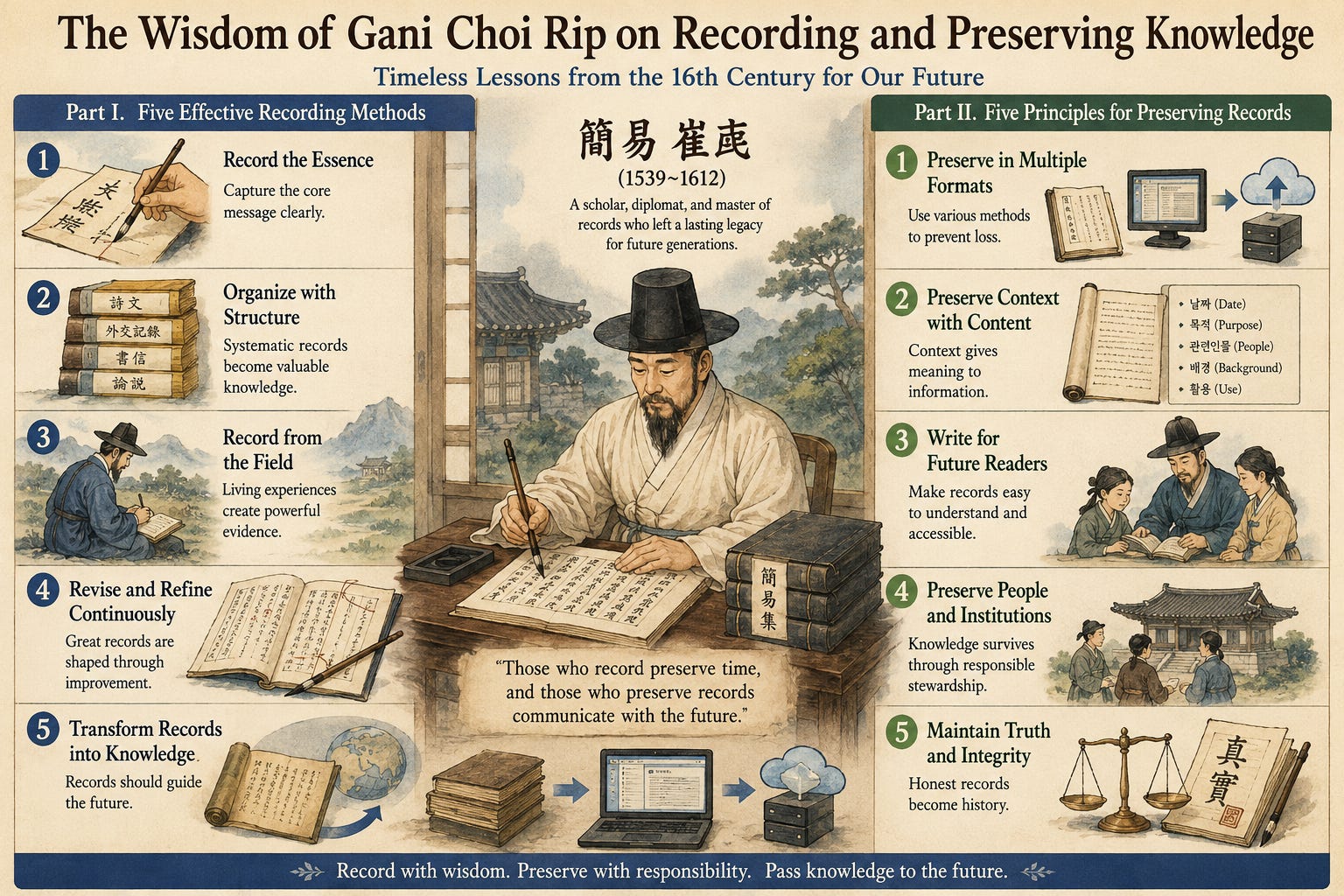
Gani (簡易) Choi Rip (崔岦, 1539–1612), one of the greatest literary figures of the mid-Joseon Dynasty, was not merely an excellent writer. He was a knowledge manager, intellectual architect, and master of historical documentation who carefully organized his thoughts, experiences, diplomatic writings, and scholarly reflections so that they could be transmitted to future generations.
His collected works, 『Gani-jip (簡易集)』, are more than a personal literary collection. They represent a valuable intellectual archive containing the culture, politics, diplomacy, and knowledge system of sixteenth-century Korea.
Although we live in the age of artificial intelligence (AI), cloud computing, and big data, the fundamental question remains unchanged:
“How should we record knowledge effectively, and how can we preserve it faithfully for future generations?”
The life and writings of Choi Rip provide timeless answers. His wisdom can be summarized into five effective recording methods and five principles for preserving records.
Five Effective Recording Methods Learned from Gani Choi Rip
1. Record the Essence ― “The Value of a Record Comes from Clarity, Not Quantity”
One of Choi Rip’s greatest strengths was his ability to capture the essential meaning of complex issues. Rather than simply collecting information, he identified the core message and organized it into a clear logical structure.
When he wrote diplomatic documents and official communications, he did not merely list facts. Instead, he carefully structured arguments based on national interests, historical evidence, and persuasive reasoning.
This principle remains highly relevant today.
In modern organizations, effective reports do not succeed because they contain the most information. They succeed because they clearly communicate:
What happened,
Why it matters,
What decisions should be made,
What actions should follow.
A good record is not simply a storage container for information. It is a vessel that compresses knowledge into wisdom.
“Recording is not the act of preserving everything; it is the art of preserving what truly matters.”
2. Organize Records with Structure and System ― “Unorganized Information Becomes Lost Memory”
Choi Rip understood that knowledge becomes valuable only when it is properly organized.
His 『Gani-jip』 demonstrates systematic classification of various writings, including:
Poetry,
Essays,
Diplomatic documents,
Personal letters,
Scholarly discussions.
He was not only a writer but also a designer of knowledge systems.
His approach can be applied to modern digital knowledge management:
Create clear titles and categories.
Organize documents by themes.
Include dates and background information.
Connect related materials.
These principles are identical to modern database design, digital archives, and AI knowledge management systems.
3. Record Experiences from the Field ― “Living Experiences Become Powerful Historical Evidence”
The importance of Choi Rip’s writings comes from the fact that they were not merely theoretical discussions. They contained his actual experiences as a scholar, government official, and diplomat.
Because he recorded what he personally observed and experienced, his writings became valuable historical evidence of his era.
Modern society requires the same approach.
For example:
Scientists record experimental processes.
Entrepreneurs document customer experiences.
Educators record teaching methods.
Leaders preserve decision-making processes.
Future generations gain deeper wisdom not only from final outcomes but also from understanding how those outcomes were achieved.
4. Revise and Refine Records Continuously ― “Great Records Are Created Through Improvement”
Choi Rip believed that writing was a process of refining thought.
He carefully selected words, corrected expressions, and improved his arguments to communicate ideas accurately.
For him, writing was not merely a method of expression. It was a process of intellectual discipline.
The same principle applies today:
Write an initial draft.
Identify the essential ideas.
Correct errors.
Restructure the content for better understanding.
Even in the AI era, human creativity remains essential through judgment, interpretation, and meaningful editing.
5. Transform Records into Knowledge ― “The Purpose of Recording Is Future Application”
Choi Rip did not write only for himself. He created records that future generations could study and utilize.
His writings later became important sources for understanding:
Joseon intellectual culture,
Diplomatic history,
Literary traditions,
Social values.
A meaningful record does not merely preserve the past. It helps guide the future.
The same principle applies today to:
Corporate innovation reports,
Scientific research papers,
Government policy documents,
Digital knowledge repositories.
“The recorder lives in the present, but the wisdom recorded lives in the future.”
Five Principles for Preserving Records for Future Generations
1. Preserve Records in Multiple Formats ― “A Single Storage Method Creates a Single Point of Failure”
During the Joseon Dynasty, important writings were preserved through multiple handwritten copies and careful management.
Today, preservation requires multiple layers:
Original documents,
Digital copies,
Cloud storage,
Backup systems.
In the digital era, valuable knowledge should never exist in only one location.
AI-based knowledge management also requires multi-layer preservation strategies.
2. Preserve Context Along with Content ― “Without Context, Information Loses Meaning”
The value of Choi Rip’s writings comes not only from the words themselves but also from the historical circumstances surrounding them.
For example, his diplomatic documents reveal not only language but also:
International relationships,
Political strategies,
National priorities.
Modern records should preserve:
Date of creation,
Purpose,
Participants,
Historical background,
Intended use.
Data without context is incomplete knowledge.
3. Write for Future Readers ― “Preservation Exists for Transmission”
Records should not simply be locked away. Their purpose is communication across generations.
The reason 『Gani-jip』 remains valuable today is that later generations could read, interpret, and learn from it.
Therefore, every recorder should consider future readers by providing:
Clear explanations,
Logical organization,
Accessible language,
Necessary background information.
A record becomes truly valuable when it can continue to communicate.
4. Preserve People and Institutions that Manage Knowledge ― “Knowledge Survives Through Human Responsibility”
Choi Rip’s writings survived because later scholars and intellectuals recognized their importance and protected them.
Preservation is not only a technological issue.
It requires people and institutions such as:
Archivists,
Historians,
University libraries,
National archives,
Digital preservation experts.
Technology stores information, but human responsibility preserves meaning.
5. Maintain Truth and Integrity ― “Only Honest Records Become History”
Choi Rip valued truth and responsibility over personal reputation.
Records have great power. However, distorted records can mislead future generations.
Therefore, responsible record keepers must:
Record facts accurately,
Separate personal opinions from evidence,
Preserve sources,
Use responsible language.
Integrity determines the survival and value of records.
“Records Written with a Brush Can Continue Conversations Across Time”
Although Gani Choi Rip lived more than 500 years ago, his philosophy of recording remains remarkably relevant in the AI era.
He teaches us that effective recording requires:
Capturing the essence,
Organizing information systematically,
Preserving real experiences,
Continuously refining knowledge,
Preparing records for future use.
He also teaches that faithful preservation requires:
Multiple storage methods,
Preservation of context,
Consideration for future readers,
Responsible knowledge management,
Commitment to truth.
Today humanity produces billions of digital records every day. Yet not every piece of data becomes history.
A record becomes history only when it contains:
Wisdom,
Structure,
Truth,
Responsibility toward the future.
The legacy of Gani Choi Rip reminds us:
“Those who record preserve time,
and those who preserve records communicate with the future.”
This is the timeless wisdom that a sixteenth-century Korean scholar offers to the twenty-first-century world of artificial intelligence. +++
{Solti}
July 17, 2026
간이(簡易) 최립에게 배우는 지식 기록과 기록 보존의 의 지혜
남기는 기술과 지키는 지혜, 16세기 문인이 오늘의 디지털 시대에 주는 교훈
조선 중기의 문장가 간이(簡易) 최립(崔岦, 1539~1612)은 단순히 글을 잘 쓰는 사람이 아니었다. 그는 자신의 생각과 경험, 국가의 외교 기록, 학문적 성찰을 정교하게 정리하여 후대에 전달한 지식 경영자이자 기록 문화의 장인이었다. 그의 대표 저서인 『간이집(簡易集)』은 한 개인의 문집을 넘어, 한 시대의 지식·문화·정치·외교의 기억을 보존한 거대한 기록 유산이다.
오늘날 우리는 인공지능(AI), 클라우드, 빅데이터 시대에 살고 있지만, 지식이 넘쳐나는 시대일수록 “무엇을 어떻게 기록하고, 어떻게 미래 세대에 남길 것인가”라는 질문은 더욱 중요해지고 있다. 최립의 삶과 글쓰기는 현대인에게 기록의 본질과 보존의 철학을 가르쳐 준다.
그가 보여준 효율적인 기록 방법 다섯 가지와 기록을 후세에 온전하게 보전하는 방법 다섯 가지를 살펴보면 다음과 같다.
간이 최립에게 배우는 효율적인 기록 방법 5가지
1. 핵심을 꿰뚫어 기록하라 ― “많이 쓰는 것보다 정확하게 남기는 지혜”
최립의 글은 화려한 표현보다 핵심 의미를 정확하게 전달하는 힘이 있었다. 그는 외교문서와 공문을 작성할 때 수많은 정보를 단순히 나열하지 않고, 상대방이 이해해야 할 핵심 논리를 찾아 구조화하였다.
예를 들어 중국 사신과 주고받는 외교 문서에서는 감정을 앞세우기보다 국가의 입장, 역사적 근거, 논리적 설득을 중심으로 기록하였다. 이것은 오늘날 기업의 보고서 작성이나 AI 시대의 데이터 관리에도 그대로 적용된다.
좋은 기록은 정보의 양이 아니라 정보의 가치와 명확성으로 평가된다.
오늘날 우리가 배울 교훈은 분명하다.
“기록은 기억의 창고가 아니라 지혜를 압축하는 그릇이다.”
회의록을 작성할 때도 모든 대화를 그대로 저장하는 것보다 결정 사항, 책임자, 미래 행동 방향을 명확히 기록하는 것이 중요하다.
2. 기록에 구조와 체계를 부여하라 ― “정리되지 않은 기록은 사라진 기억이다”
최립은 자신의 글을 주제별·목적별로 분류하고 체계적으로 관리하였다. 『간이집』 역시 시문(詩文), 외교 기록, 서신, 논설 등 다양한 영역으로 구성되어 있어 당시 지식 체계가 어떻게 조직되었는지를 보여준다.
그는 단순한 기록자가 아니라 지식의 설계자였다.
현대적으로 표현하면 다음과 같은 방법이다.
제목과 소제목을 명확히 한다.
주제별 폴더를 만든다.
중요한 기록에는 날짜와 배경을 표시한다.
관련 자료와 연결한다.
이는 오늘날 디지털 시대의 데이터베이스 설계, 문서 관리 시스템, AI 지식 관리와 같은 원리이다.
3. 현장에서 기록하라 ― “생생한 경험이 가장 강력한 역사 자료가 된다”
최립의 기록이 가치 있는 이유는 책상 위의 이론만이 아니라 실제 경험이 담겨 있기 때문이다.
그는 관료 생활, 외교 활동, 학문 교류 과정에서 얻은 경험을 기록으로 남겼다. 현장에서 보고 느낀 것을 기록했기에 그의 문장은 시대의 살아 있는 증언이 되었다.
현대 사회에서도 현장 기록은 중요하다.
예를 들어:
과학자는 실험 과정을 기록한다.
기업가는 고객 경험을 기록한다.
교수는 교육 경험을 기록한다.
지도자는 정책 결정 과정을 기록한다.
미래 세대는 완성된 결과보다 “어떻게 그 결과에 도달했는가”를 통해 더 큰 지혜를 얻는다.
4. 반복해서 다듬어 기록하라 ― “좋은 기록은 수정의 결과이다”
최립은 한 번 쓰고 끝내는 사람이 아니었다. 그는 문장을 고치고 표현을 다듬으며 의미를 정확하게 전달하려 노력했다.
그에게 글쓰기는 단순한 표현 기술이 아니라 사고를 정리하는 과정이었다.
오늘날에도 중요한 기록은 초안을 그대로 보존하지 않는다.
좋은 기록 과정은 다음과 같다.
생각을 자유롭게 적는다.
핵심 내용을 추린다.
오류를 수정한다.
독자가 이해하기 쉽게 재구성한다.
AI 시대에도 인간의 가장 중요한 역할은 바로 이러한 의미 편집과 판단 능력이다.
5. 기록을 지식으로 변화시켜라 ― “기록의 목적은 미래의 활용이다”
최립은 자신의 글을 단순한 개인 일기가 아니라 후대가 활용할 지식으로 남겼다.
그의 기록은 다음 세대 학자들에게 조선 사회와 문화를 이해하는 중요한 자료가 되었다.
훌륭한 기록은 과거를 저장하는 것이 아니라 미래의 행동을 돕는다.
오늘날 기업의 혁신 보고서, 국가 정책 자료, 연구 논문 역시 같은 목적을 가진다.
“기록하는 사람은 현재를 살지만, 기록된 지혜는 미래를 살아간다.”
간이 최립에게 배우는 기록 보존 방법 5가지
1. 기록을 여러 형태로 보존하라 ― “하나의 저장 방식은 하나의 위험이다”
조선 시대에는 종이에 기록했지만, 중요한 문서는 여러 사람이 필사하고 보관하였다.
현대적으로는 다음과 같은 원칙이다.
원본 보존
디지털 복사
클라우드 저장
백업 시스템 구축
오늘날 중요한 데이터는 한 장소에만 저장해서는 안 된다.
AI 시대의 지식 관리에서도 **다중 보존(Multi-layer Preservation)**은 필수이다.
2. 기록의 맥락을 함께 보존하라 ― “내용만 남기면 의미는 사라진다”
최립의 글이 가치 있는 이유는 글 자체뿐 아니라 당시 상황과 목적이 함께 남아 있기 때문이다.
예를 들어 외교문서는 단순한 문장이 아니라 당시 국제 관계와 국가 전략을 보여준다.
현대 기록에서도 다음 정보를 함께 남겨야 한다.
작성 날짜
작성 목적
관련 인물
시대적 배경
활용 방법
데이터만 남기는 것이 아니라 **데이터의 의미(Context)**를 보존해야 한다.
3. 다음 세대가 읽을 수 있도록 기록하라 ― “보존은 전달을 위한 것이다”
기록은 금고 속에 넣어두는 것이 목적이 아니다.
최립의 『간이집』이 오늘날까지 가치 있는 이유는 후대 사람들이 읽고 해석할 수 있었기 때문이다.
따라서 기록자는 미래 독자를 생각해야 한다.
쉬운 표현, 명확한 구조, 설명 자료를 함께 남기는 것이 중요하다.
4. 기록을 관리할 사람을 남겨라 ― “지식은 사람을 통해 이어진다”
최립의 기록이 보존될 수 있었던 이유는 후대 학자와 문인들이 그것을 중요하게 여기고 관리했기 때문이다.
기록 보존은 기술만의 문제가 아니다.
좋은 시스템에는 반드시 사람이 필요하다.
오늘날에도:
기업의 지식 관리자
대학의 기록 보존 기관
국가 기록원
디지털 아카이브 전문가
가 필요한 이유이다.
5. 기록에 윤리와 진실성을 담아라 ― “진실한 기록만이 역사가 된다”
최립의 기록은 개인의 명예보다 사실과 국가적 책임을 중시하였다.
기록은 힘을 가진다. 그러나 왜곡된 기록은 미래 세대를 잘못된 방향으로 이끌 수 있다.
따라서 기록자는 다음을 지켜야 한다.
사실을 정확히 기록한다.
개인적 감정을 구분한다.
근거 자료를 남긴다.
책임 있는 표현을 사용한다.
진실성이 기록의 생명을 결정한다.
“붓으로 남긴 기록은 시간이 지나도 미래와 대화한다”
간이 최립은 16세기의 문인이었지만 그의 기록 철학은 21세기 AI 시대에도 놀라운 의미를 가진다.
그는 우리에게 알려준다.
효율적인 기록이란
핵심을 기록하는 것,
체계적으로 정리하는 것,
현장의 경험을 남기는 것,
끊임없이 다듬는 것,
미래 활용을 생각하는 것이다.
온전한 보존이란
다양한 방식으로 저장하는 것,
맥락을 함께 남기는 것,
미래 독자를 배려하는 것,
관리자를 키우는 것,
진실성을 지키는 것이다.
오늘날 우리는 수십억 개의 디지털 데이터를 생산하지만, 모든 데이터가 역사가 되는 것은 아니다. 역사가 되는 기록은 지혜, 구조, 진실, 그리고 미래를 향한 책임감을 가진 기록이다.
간이 최립이 남긴 붓의 흔적은 우리에게 이렇게 말하는 듯하다.
“기록하는 자는 시간을 붙잡고, 보존하는 자는 미래와 대화한다.”
이것이 바로 500년 전 조선의 지식인이 AI 시대의 우리에게 전하는 기록의 지혜이다. +++
{솔티}
2026년 7월 17일

Prof. Dr. Young Choi (Editor in Chief) — Regent University
Young B. Choi is a Professor in the Department of Engineering & Computer Science at Regent University. He published 38 books with ‘Selected Readings in Cybersecurity’ (2018) (over 800 copies archived globally at university/college libraries around the world) and ‘Cybersecurity Applications and Artificial Intelligence’ (2023) available in seven major world languages. He proposed the world’s first global and universal telecommunications “Service Order Handling (SOH)” Model (T-SOH Model) (1995) with Dr. Adrian Tang. With this innovative research work, he received the IEEE NOMS ’96 Best Paper Award and became the first recipient of the Outstanding Contribution Award of the TeleManagement Forum in 1998. His research areas include Natural Language Processing-focused AI, AI-applied cybersecurity, network and telecom service management, and Korean studies on Gani Choi Rip’s Jeonggwan (靜觀: Quiet Contemplation) philosophy and Shilhak ( 實學: Practical Learning).