

The Precepts for Ordained Buddhist Monks and Nuns: Introduction and Translation
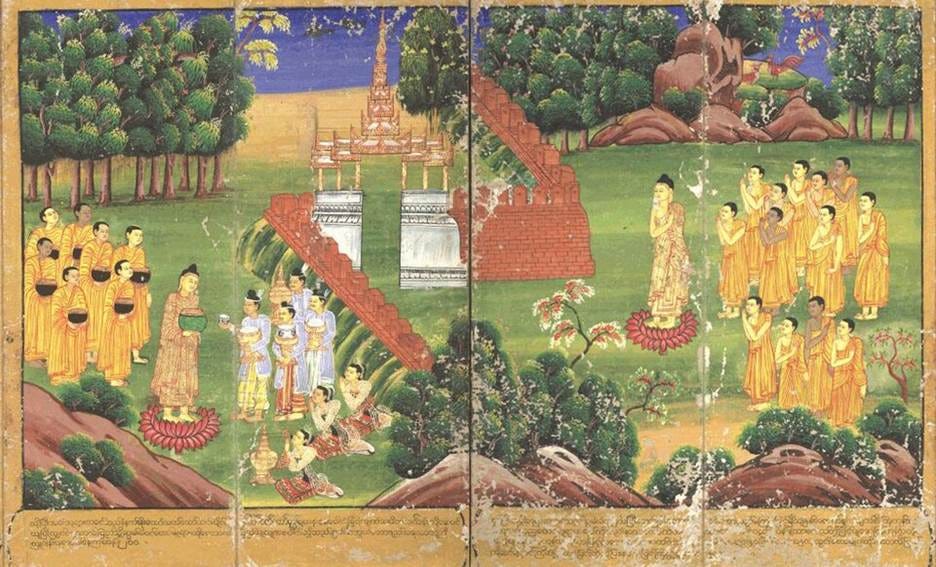
The image depicts the Buddha and his followers receiving offerings, as illustrated in an eighteenth-century Burmese watercolour manuscript.
Image credit: Life of the Buddha, pages 15-18, Burmese watercolour parabeik, 18th century, Bodleian Libraries, University of Oxford, MS. Burm. a. 12. Digital image via Wikimedia Commons, licensed under CC BY 4.0. The image has been cropped and resized for this publication.
INTRODUCTION VIA HAIBUN
Precepts for Buddhist Monks
There are 250 rules for Buddhist monks to follow. The number varies somewhat by region and tradition, but 250 is the standard in the Buddhist tradition followed in China and Korea. Some of these rules are traditionally attributed to the time of the Buddha. When he began his new religious movement, there were no established rules governing the monastic community. However, soon after ordained believers began living together, the need arose to regulate communal life through various rules. Many of the rules are presented as responses to specific incidents that arose in the monastic community. Over time, they were compiled and organized into increasingly elaborate systems governing the lives of ordained monks.
The 250 precepts are organized within the Vinaya, the Buddhist tradition of monastic discipline, into eight categories that cover both serious offenses and the everyday conduct of monastic life. At the most serious end are the four Pārājika (Disqualification) rules. Breaking any of these results in expulsion from the monastic community: sexual intercourse, theft, killing a human being, and falsely claiming a spiritual attainment one has not achieved. These four cardinal rules are followed by rules concerning serious misconduct, rules dealing with uncertain cases, rules involving improper possessions, rules requiring confession and repentance, rules requiring confession in specific circumstances, rules governing proper conduct and daily behavior, and rules for resolving disputes within the monastic community. Taken together, the 250 rules range from grave offenses that can end a monk’s membership in the community to practical guidelines for dealing with possessions, speech, bodily conduct, etiquette, and communal life.
Some of the rules seem anachronistic (“Do not make a fire outdoors”), while others sound frankly amusing (“Do not tickle another person” and “Do not dig into the middle of the rice and eat from there”). Most, however, reflect a deep insight into human psychology. For example, monks are admonished not to sit alone with a woman in a secluded place. Rules like this are designed to protect the integrity of the monastic community and its members. Some rules even sound as though they were taken from a book of Western etiquette: “Do not speak while food is in your mouth” and “Do not slurp your food into your mouth.” All these rules demonstrate a desire to maintain the purity of thought and conduct in everyday life.
250 rules for monks—
we need one about
smartphones
Precepts for Buddhist Nuns
Whereas Buddhist monks are required to follow 250 rules, Buddhist nuns are subject to 348. That is, they have 98 more precepts to follow. It may seem unfair that their monastic life is governed by almost 100 more rules than that of their male counterparts. However, this disparity should be considered in a socio-historical context. In the Buddha’s time, admitting women into a monastic community represented a significant departure from prevailing social conventions. As members of a religious community, they were understood to need protection from society while also safeguarding the community’s integrity and reputation.
In the Four-Part Vinaya tradition followed in Korean Buddhism, the 348 rules are divided into seven categories that cover everything from serious offenses to the details of everyday monastic life. At the most serious end are the eight Pārājika rules, violations of which result in expulsion from the monastic community. These include sexual intercourse, theft, killing a human being, and falsely claiming a spiritual attainment one has not achieved. The seven categories also include rules concerning serious misconduct, rules involving improper possessions, rules requiring confession and repentance, rules requiring confession in specific circumstances, rules governing proper conduct and etiquette, and rules for resolving disputes within the monastic community. Taken together, the 348 rules cover a wide range of behavior, from major offenses to seemingly small matters involving possessions, speech, clothing, bodily conduct, etiquette, and relationships with others.
While the rules for monks emphasize sexual purity, those for their female counterparts are even more stringent. Among the eight cardinal rules for nuns, three (1, 5, and 6) specifically regulate interactions with men: avoid engaging in sexual intercourse; do not caress, with lustful intent, the parts of a lustful man below the armpits or above the knees; and do not meet the gaze of a lustful man, hold his hand or clothing, stand or talk with him in a secluded place, walk together with him, lean against each other, or make an appointment to meet again. There are many more rules concerning personal conduct, including one governing how nuns should clean themselves in the bathroom. The precepts for women offer both a fascinating glimpse into historical concerns about women’s conduct and a reminder of the need to reconsider such rules in a new age.
348 rules for nuns—
protection from the eyes
sunglasses hide
The Buddhist Precepts for the Modern Age
The rules for ordained Buddhist monks and nuns serve as valuable guides for upright and harmonious living, and most of them are reasonable and sound deeply insightful. Still, some of them seem outdated. For example, the rules related to begging for food make sense in the context of early Indian monasticism, but traditional alms-rounds have not generally been the dominant practice in Mahayana Buddhist regions such as China, Korea, and Japan. The rule restricting bathing to no more than once every fifteen days also sounds both anachronistic and unhygienic. Obviously, the rule “Do not keep medicine for more than seven days” reflects a very different medical context from our own. Modern medicines often need to be taken over much longer periods.
remote Korean temple—
monks watch U.S. news
by satellite
TRANSLATION
Note: The Korean text for the 250 precepts for monks can be found at https://whoami555.tistory.com/13742867 (출가 비구 250계 사분율). The Korean text for the 348 precepts for nuns comes from https://cafe.daum.net/mobuddhism/NNzs/608 (비구니 348계율). These texts contain some missing words, vague wording, and even missing rules. When a rule seemed too vague or unclear to translate reliably, I noted this and provided a tentative translation. When a rule was missing, I noted that as well.
The 250 Precepts for Ordained Buddhist Monks
[1] Pārājika (Disqualification): 1-4 (4 rules)
1) Do not engage in sexual intercourse.
2) Do not steal.
3) Do not kill a human being.
4) Do not tell a major lie.
[2] Saṅghādisesa (Serious Misconduct): 5-17 (13 rules)
5) Do not intentionally discharge semen.
6) Do not touch a woman’s body with sexual intent.
7) Do not speak to a woman about sexual matters.
8) Do not praise your own religious practice to a woman to solicit sexual favors.
9) Do not act as a matchmaker.
10) When building a dwelling without a donor, do not exceed the prescribed dimensions without the community’s approval.
11) When building a dwelling with a donor, do not build without the community’s approval.
12) Do not falsely accuse someone, out of personal animosity, of having committed a serious offense.
13) Do not falsely accuse another person of an offense by fabricating details out of personal animosity.
14) Do not reject admonition intended to prevent the disruption of the community’s harmony.
15) Do not resist admonition while supporting a group that seeks to disrupt the harmony of the community.
16) If you are admonished to leave a village because you have defiled a house where you have received alms, do not disparage the admonition; obey it properly.
17) Do not resist admonition while maliciously opposing the community.
[3] Aniyata (Undetermined Cases): 18-19 (2 rules)
18) [The Korean text is unclear.] Do not render a judgment concerning an offense when the person was mentally or physically incapacitated.
19) [The Korean text is unclear.] Do not render a judgment when circumstances prevent the person’s words from being heard or understood.
[4] Nissaggiya Pācittiya (Improper Possessions): 20-49 (30 rules)
20) Do not keep a robe beyond the prescribed period.
21) Do not sleep separated from your three robes.
22) Do not seek a robe after the prescribed robe-making period has passed.
23) Do not accept robes from a nun who is not a relative.
24) Do not have a nun who is not a relative wash your undergarment.
25) Do not ask for a robe from a layperson who is not a relative.
26) Do not accept an excessive number of robes.
27) Do not persuade donors to provide more money to make a finer robe.
28) Do not combine money from two donors to have one fine robe made.
29) Do not demand a robe urgently after the prescribed time has passed.
30) Do not make robes from silk produced by silkworms.
31) Do not make robes from black wool.
32) Do not make robes from white wool.
33) Do not make a new robe before six years have passed.
34) Add pieces of an old robe to a new robe.
35) Do not carry wool yourself for more than three yojanas. [Yojana: a traditional Indian unit of distance, the exact length of which varied by period and tradition.]
36) Do not have a nun who is not a relative wash, dye, or card your wool.
37) Do not accept gold, silver, copper, or other valuables.
38) Do not exchange or trade valuables.
39) Do not sell goods.
40) Do not keep an extra alms bowl beyond the permitted time limit.
41) When your alms bowl is still usable, do not obtain another new one for yourself.
42) Do not obtain thread yourself and have someone who is not a relative weave it for you.
43) Do not ask donors to give excessive thread to the weaver making your robe.
44) Do not reclaim a robe that you have given away.
45) If you keep medicine, do not keep it for more than seven days.
46) Do not obtain or wear a bathing robe before the proper time.
47) Do not accept a robe for the sick before the proper time, nor keep it beyond the permitted period.
48) In a dangerous forest hermitage, do not sleep without your three robes beyond the prescribed period.
49) Do not take goods intended for the community.
[5] Pācittiya (Confession and Repentance): 50-139 (90 rules)
50) Do not tell a minor lie.
51) Do not insult or scold another person.
52) Do not sow discord between people.
53) Do not sleep in the same room as a woman.
54) Do not sleep with a person who has not received full ordination for more than two nights and three days.
55) Do not recite the Dharma together with a person who has not received full ordination.
56) Do not reveal to a person who has not received full ordination that another monk has committed a serious offense.
57) Do not disclose your own spiritual attainments to a person who has not received full ordination.
58) When teaching the Dharma to a woman, do not speak more than five or six sentences unless a wise man is present.
59) Do not dig the ground yourself or have someone else dig it for you. [This precept comes from the Vinaya’s concern about harming living beings in the soil. Digging the ground could injure or kill small creatures—worms, insects, and other organisms believed to inhabit the earth.]
60) Do not cut down an old tree known as a “spirit tree.”
61) Do not cause the community distress through your actions or speech.
62) Do not suspect or reprimand a monk in charge of duties.
63) Do not leave behind a sleeping platform or meditation cushion after using it.
64) Do not leave bedding spread out in a room when you depart.
65) Do not forcibly take a dwelling already occupied by another person.
66) Do not become angry and drive another person out.
67) Do not sit on a couch with missing legs on the second floor.
68) Do not instruct a nun unless she first provides filtered water. [The nun must provide water that has been filtered to remove insects. The underlying concern is the Buddhist prohibition against harming living beings in water.]
69) Do not use more than three layers of thatch when roofing.
70) Do not instruct a nun without the community’s authorization.
71) Do not continue teaching a nun until after sunset.
72) Do not slander a monk who has instructed a nun.
73) Do not give robes to a nun who is not a relative, except in exchange.
74) Do not have a robe made for a non-relative nun.
75) Do not sit together with a nun in a secluded place.
76) Do not arrange to travel together with a nun.
77) [Number 77 is missing from the Korean text.]
78) Do not eat food praised by a nun.
79) Do not arrange to travel together with a woman.
80) Do not sleep a second night in a lodging intended for only one night’s stay unless you are ill.
81) Do not wander from place to place eating meals.
82) Do not gather separately from the community to eat.
83) Do not accept excessive amounts of food meant for a daughter sent to her husband’s home or food from merchants.
84) Do not violate the rules concerning leftover food.
85) Do not cause another person to violate the rules concerning leftover food.
86) Do not eat at an improper time.
87) Do not eat stale food.
88) Do not eat food that has not been properly offered.
89) Do not ask for choice food.
90) Do not personally give food to non-Buddhist ascetics.
91) Do not enter a village without informing another monk.
92) Do not sit shamelessly in a couple’s home when the husband shows signs of displeasure.
93) Do not sit alone with a woman in a secluded place.
94) Do not sit alone with a woman in an open but isolated place.
95) Do not drive away a fellow traveling monk from the village.
96) Do not accept medicine after the prescribed period has passed.
97) Do not mingle with crowds to watch spectacles.
98) If you must stay overnight among a crowd for business, do not stay longer than two nights and three days.
99) Do not watch a battle in progress. [This prohibition concerns watching warfare as a spectacle, rather than simply being present in a military area.]
100) Do not drink alcohol.
101) Do not play in the water.
102) Do not tickle another person.
103) Do not resist admonition.
104) Do not frighten another monk.
105) Do not bathe more than once every fifteen days.
106) Do not make a fire outdoors.
107) Do not take another person’s robes and bowl.
108) Do not take and wear robes left in another’s care without informing the custodian.
109) Dye new robes before wearing them.
110) Do not intentionally kill an animal.
111) Do not drink water containing living beings.
112) Do not cause another monk anxiety.
113) Do not conceal another person’s serious offense.
114) Do not give full ordination to a person who is under twenty years of age.
115) Do not revive a dispute after it has been settled.
116) Do not travel together with smugglers.
117) Do not reject counsel because of your wrong view.
118) Do not shield an offender.
119) Do not shelter a novice who has been expelled.
120) Do not resist an admonition to study the precepts.
121) Do not disparage the precepts.
122) Do not conceal your offense and then confess it merely because you fear someone else will expose it.
123) Do not agree to a resolution and later regret it.
124) Do not leave a meeting without delegating your vote.
125) Do not raise objections after having delegated your vote.
126) Do not eavesdrop on the disputes of other monks.
127) Do not strike anyone out of anger.
128) Do not make a gesture of striking someone out of anger.
129) Do not maliciously accuse another person of a serious offense without evidence.
130) Do not maliciously accuse another person of a serious offense without evidence. [This appears to duplicate no. 129 in the Korean text.]
131) Do not handle gems or jeweled ornaments.
132) Do not go into a village at an improper time.
133) [Number 133 is missing from the Korean text.]
134) Do not stuff a sitting mat with cotton.
135) Do not make a needle case out of bone, teeth, or horn.
136) Make the sitting mat three cheok two ch’i long and two cheok four ch’i wide; if necessary, each dimension may be increased by eight ch’i. [Cheok (尺) and ch’i (寸) are traditional East Asian units of length. One cheok is divided into ten ch’i. Their exact modern equivalent varied by period and region.]
137) Do not make a robe for covering sores larger than six cheok four ch’i long and three cheok two ch’i wide.
138) A bathing garment should be no more than nine cheok six ch’i long and four cheok wide.
139) Do not make a robe the same size as the Buddha’s robe.
[6] Pāṭidesanīya (Confession in Specific Circumstances): 140-143 (4 rules)
140) While staying in a village dwelling, do not accept food from a nun who is not a relative.
141) While staying in a village dwelling, do not accept food obtained through a nun’s improper solicitation of a donor.
142) Do not go to a house where the community has agreed not to receive offerings, and do not accept excessive offerings there unless you are ill.
143) Do not accept a meal while sitting in a monastery located in a dangerous wilderness area unless you are ill.
[7] Sekhiya (Proper Conduct and Etiquette): 144-243 (100 rules)
144) Wear your undergarment properly.
145) Wear your three robes properly.
146) Do not go to a donor’s house with your robes gathered up.
147) Do not sit in a donor’s house with your robes gathered up.
148) Do not enter a donor’s house with your robe wrapped around your neck.
149) Do not sit in a donor’s house with your robe wrapped around your neck.
150) Do not enter a donor’s house with your head covered.
151) Do not sit in a donor’s house with your head covered.
152) Do not enter a donor’s house while running or jumping.
153) Do not run into a donor’s house and sit down.
154) Do not enter a donor’s house while squatting or crouching.
155) Do not enter a donor’s house with your hands clasped behind your back.
156) Do not sit in a donor’s house with your hands clasped behind your back.
157) Do not enter a donor’s house while swaying or moving your body in an undignified manner.
158) Do not sit in a donor’s house while swaying or moving your body in an undignified manner.
159) Do not enter a donor’s house while swinging your arms.
160) Do not sit in a donor’s house while swinging your arms. [The Korean text says “enter” again; the context strongly suggests “sit.”]
161) Enter a donor’s house with your body properly covered.
162) Sit in a donor’s house with your body properly covered.
163) Do not enter a donor’s house while looking restlessly from side to side.
164) Do not sit in a donor’s house while looking restlessly from side to side.
165) Enter a donor’s house quietly.
166) Sit quietly in a donor’s house.
167) Do not enter a donor’s house laughing and joking frivolously.
168) Do not sit in a donor’s house laughing and joking frivolously.
169) Eat your meal with the Five Contemplations.
170) Receive rice neatly into your alms bowl.
171) Receive soup neatly into your alms bowl.
172) Receive rice and soup together.
173) Eat your rice neatly and methodically.
174) Do not dig into the middle of the rice and eat from there.
175) Do not ask for soup and rice merely for your own preference.
176) Do not cover your rice with soup to receive more.
177) Do not look at another person’s alms bowl and express disgust or suspicion.
178) Eat while maintaining mindfulness of the alms bowl.
179) Do not make extra-large lumps of rice when eating.
180) Do not eat with your mouth open.
181) Do not speak while food is in your mouth.
182) Do not throw food into your mouth.
183) Do not mix or knead your food while eating.
184) Do not eat with your cheeks bulging.
185) Chew your food without making noise.
186) Do not slurp your food into your mouth.
187) Do not lick your food with your tongue.
188) Do not shake food from your hands while eating.
189) Do not scatter or push food around with your hands while eating.
190) Do not handle eating utensils with dirty hands.
191) Do not carelessly throw the water used to wash your alms bowl into a donor’s house.
192) Except when ill, do not urinate, defecate, blow your nose, or spit on grass.
193) Except when ill, do not urinate, defecate, blow your nose, or spit into clean water.
194) Except when ill, do not urinate or defecate while standing.
195) Except when the listener is ill, do not teach the Dharma to someone who has gathered up his or her clothing.
196) Except when the listener is ill, do not teach the Dharma to someone who has wrapped clothing around the neck.
197) Except when the listener is ill, do not teach the Dharma to someone whose head is covered.
198) Except when the listener is ill, do not teach the Dharma to someone whose head or neck is wrapped in cloth.
199) Except when the listener is ill, do not teach the Dharma to someone standing with hands clasped behind the back.
200) Except when the listener is ill, do not teach the Dharma to someone wearing leather shoes.
201) Except when the listener is ill, do not teach the Dharma to someone wearing wooden clogs.
202) Except when the listener is ill, do not teach the Dharma to someone who is riding an animal.
203) Except when necessary for protection, do not sleep inside a stupa.
204) Except when necessary for safekeeping, do not store possessions inside a stupa.
205) Do not enter a stupa wearing leather shoes.
206) Do not enter a stupa carrying leather shoes.
207) Do not circumambulate a stupa while wearing leather shoes.
208) Do not enter a stupa wearing short leather shoes.
209) Do not enter a stupa carrying short leather shoes.
210) Do not eat beneath a stupa and leave rice, grass, paper, or other refuse there, making the area dirty.
211) Do not carry a corpse past the base of a stupa.
212) Do not bury a corpse beneath a stupa.
213) Do not cremate a corpse beneath a stupa.
214) Do not cremate a corpse facing a stupa.
215) Do not cremate a corpse in the vicinity of a stupa.
216) Do not carry the possessions of a deceased person past the base of a stupa.
217) Do not urinate or defecate beneath a stupa.
218) Do not urinate or defecate facing a stupa.
219) Do not urinate or defecate around a stupa.
220) Do not urinate or defecate where a Buddha image is enshrined.
221) Do not brush your teeth beneath a stupa.
222) Do not brush your teeth facing a stupa.
223) Do not brush your teeth around a stupa.
224) Do not blow your nose or spit beneath a stupa.
225) Do not blow your nose or spit facing a stupa.
226) Do not blow your nose or spit around a stupa.
227) Do not stretch your legs toward a stupa.
228) Do not place a Buddha image below while you yourself remain in a higher position.
229) Except when the listener is ill, do not teach the Dharma while the person requesting instruction is sitting and you are standing.
230) Except when the listener is ill, do not teach the Dharma while the person requesting instruction is lying down and you are sitting.
231) Except when the listener is ill, do not teach the Dharma when the person requesting instruction is seated properly and you are seated somewhere other than a proper seat.
232) Except when the listener is ill, do not teach the Dharma when the person requesting instruction is seated in a higher place and you are below.
233) Except when the listener is ill, do not teach the Dharma while the person requesting instruction is walking ahead of you and you are following behind.
234) Except when the listener is ill, do not teach the Dharma when the person requesting instruction is on a higher walking path and you are on a lower one.
235) Except when the listener is ill, do not teach the Dharma when the person requesting instruction is on the road and you are off the road.
236) Do not walk down the middle of the road while two people are holding each other’s hands.
237) Except when unavoidable, do not climb a tree higher than one fathom.
238) Do not put your alms bowl in a bag, hang the bag from the end of a staff, and carry it over your shoulder.
239) Except when the person requesting instruction is ill, do not teach the Dharma to someone carrying a staff.
240) Except when the person requesting instruction is ill, do not teach the Dharma to someone carrying a sword.
241) Except when the person requesting instruction is ill, do not teach the Dharma to someone carrying a spear.
242) Except when the person requesting instruction is ill, do not teach the Dharma to someone carrying a knife.
243) Except when the person requesting instruction is ill, do not teach the Dharma to someone holding an umbrella or parasol.
[8] Adhikaraṇasamatha (Dispute Resolution): 244-250 (7 rules)
244) Determine an offense in the presence of the person who committed it.
245) Determine an offense only after the person has acknowledged committing it.
246) Do not reopen an offense committed during a period of mental illness after the person’s condition has been restored.
247) Resolve the matter by having the person make a confession voluntarily.
248) Determine the nature of an offense based on the testimony of multiple witnesses.
249) If the evidence from one person alone is clear and sufficient, the nature of the offense may be determined on that basis.
250) When a dispute has become a prolonged factional conflict and is difficult to resolve, have representatives of both sides come together, put the entire matter aside, and settle it as one would sweep over a muddy place with grass and cover it—thus letting the matter be put to rest.
The 348 Precepts for Ordained Buddhist Nuns
[1] Pārājika (Disqualification): 1-8 (8 rules)
1) Do not engage in sexual intercourse.
2) Do not steal.
3) Do not kill a human being.
4) Do not deceive people by falsely claiming to have attained a spiritual state you have not attained.
5) Do not caress, with lustful intent, a lustful man below the collarbone and above the knees.
6) Do not gaze at a lustful man, hold his hand or clothing, stand or speak with him in a secluded place, walk with him, embrace or lean against him, or make an appointment to meet him again.
7) Do not conceal another nun’s serious offense and wait until after she has disrobed to reveal it.
8) Knowing that a nun has been expelled from the community, do not follow or associate with her.
[2] Saṅghāvaśeṣa (Serious Misconduct): 9-25 (17 rules)
9) Do not act as a matchmaker.
10) Do not falsely accuse someone, out of personal resentment, of committing a serious offense.
11) Do not fabricate or distort facts, out of personal resentment, to accuse someone of committing a serious offense.
12) Do not personally bring a legal case against someone before a ruler or government authority.
13) Knowing that a woman is the wife of a thief, do not ordain her.
14) Knowing that a nun has been expelled from the community, do not follow her.
15) Do not cross a body of water alone, go from one village to another alone, sleep alone, or fall behind your companions and travel alone.
16) If you know that food given by a lustful man is intended to seduce you, do not accept it.
17) Do not encourage another nun to accept food from a lustful man by saying, “What does it matter if you accept it, as long as you keep your mind firm?”
18) Do not defy admonitions intended to prevent the disruption of the harmony of the community.
19) Do not assist wrongdoers in disrupting harmony within the community.
20) Do not cause trouble in a lay household or resist the admonitions of the community.
21) Do not stubbornly resist the admonitions of the community.
22) Do not associate with an evil group in committing wrongdoing, nor conceal their misconduct.
23) If someone living with you does something wrong, do not agree to conceal each other’s misconduct.
24) Do not abandon the Dharma over a trivial matter and say that you will go to followers of other religions to practice religious life.
25) Do not harbor resentment or a desire to quarrel.
[3] Nissargika-Pācittiya (Forfeiture and Confession): 26-55 (30 rules)
26) After the robe season and its special period have ended, do not keep a robe for more than ten days.
27) Except with the permission of the community, do not sleep in a place separate from your five robes (the three main robes plus the under-robe and the bathing cloth).
28) If, because of necessity, you receive cloth outside the proper time but do not have enough, do not keep it for more than one month.
29) Except on special occasions, do not ask a nonrelative for clothing.
30) Even if a donor offers you many robes, do not accept more than you need.
31) If you learn that a donor is having robes made for you, do not go to the donor’s house and ask them to make them better than they have planned.
32) If you hear that two donors are having a robe made for you, do not visit both households and ask them to combine the two gifts into one fine robe.
33) Even if the person making your robe does not deliver it, do not go more than six times to ask for it. Simply notify the donor and give up the matter.
34) Do not accept gold, silver, or other valuables with your own hands or ask for them with your own words.
35) Do not buy or sell various kinds of valuables.
36) Do not engage in the buying and selling of various goods.
37) If your alms bowl can still be repaired with five patches and is not leaking, do not ask for a new one.
38) Do not obtain thread yourself and have a nonrelative weaver make cloth for you.
39) If you hear that a lay donor is having cloth woven for you, do not simply accept what is offered. Do not go to the artisan to ask them to weave it well in exchange for extra payment.
40) Do not give someone a robe and later, out of anger, take it back.
41) Do not keep medicinal supplies for more than seven days.
42) If someone urgently offers you a robe before the robe season, do not accept it during the ten days immediately preceding the robe season.
43) Knowing that an offering is intended for the community, do not take it for yourself.
44) Do not exchange what you originally arranged to purchase for something else after making the arrangement.
45) Do not use money donated for the construction of a meditation hall to make robes and distribute them among yourselves.
46) Do not use money donated for the support of a particular person to make robes and distribute them among yourselves.
47) Do not use money donated specifically for the construction of a dwelling to make robes and distribute them among yourselves.
48) Do not exchange money donated for the construction of a dwelling for robes simply because building a house would involve too much work.
49) Do not keep fine extra robes in storage.
50) Store high-quality vessels (색기, 色器).
51) If you promise to give a sick person’s robe, do not later refuse to give it.
52) Do not turn a robe received outside the proper season into a robe for the proper season.
53) Do not exchange robes with another person and later forcibly take yours back after becoming dissatisfied.
54) Do not obtain a large robe whose value exceeds the price of four pieces of cloth.
55) Do not obtain a small robe whose value exceeds the price of two pieces of cloth.
[4] Pācittiya (Confession): 56-233 (178 rules)
56) Do not knowingly tell a lie.
57) Do not insult or harshly rebuke another person.
58) Do not cause division by telling one person one thing and another person something different.
59) Do not sleep in the same room as a man.
60) Do not sleep in the same room with an unordained woman for more than three nights.
61) Do not recite the Dharma together with a woman who has not received full ordination.
62) Do not disclose another nun’s serious offense to an unordained person, unless the community permits it.
63) Do not mislead unordained people by claiming to possess extraordinary knowledge or spiritual attainments.
64) When teaching a man, do not speak more than five or six sentences unless a knowledgeable woman is present.
65) Do not dig the ground yourself or have someone else dig it for you.
66) Do not cut down an old tree known as a “spirit tree.”
67) Do not trouble the community with contentious or disruptive speech.
68) Do not resent or rebuke those assigned to perform duties for the community.
69) Do not spread a sitting mat outdoors and leave without putting it away.
70) Do not spread a sitting mat indoors and leave without putting it away.
71) Knowing that another nun was staying in a particular place first, do not take a place there to drive her out.
72) Do not angrily drive another nun out of a room.
73) Do not sit on a raised platform or bed with unstable legs while on an upper floor.
74) Do not throw water containing living creatures onto mud or grass.
75) Do not cover a thatched structure with more than three layers of roofing material.
76) If a place is intended for only one night’s stay, do not stay for a second night, except when caring for a sick person.
77) Except on special occasions, do not eat separately from the community.
78) When visiting a lay donor’s house, do not accept more than three bowlfuls of food.
79) Do not eat at an improper time.
80) Do not eat food that has been stored overnight.
81) Do not put food or medicine into your mouth without first receiving it, except water and tooth-cleaning materials.
82) If you have been invited to a meal and go there with another nun, do not leave for another household without informing her.
83) When entering the home of a married couple, do not remain seated after realizing that the husband does not want you there.
84) Do not sit in a secluded place in the home of a married couple.
85) Do not sit together with a man in a secluded place.
86) Do not take another nun to a village by promising that she will receive good food and then abandon her there.
87) When receiving medicinal requisites, do not retain them for more than four months, except for medicines obtained at a patient’s request, through regular or renewed requests, through divided requests, or for lifelong use.
88) Do not go to a military camp to watch unless necessary.
89) If you have business at a military camp, do not stay for more than two nights and three days.
90) If you have business at a military camp, do not watch a battle taking place.
91) Do not drink alcohol.
92) Do not play in water.
93) Do not strike another nun.
94) Do not resist admonition.
95) Do not frighten another nun.
96) Do not bathe more often than once every fifteen days, except when you are ill or on special occasions.
97) Except for the sick or on special occasions, do not light a fire outdoors merely to warm yourself.
98) Do not hide another nun’s sitting mat or needle case.
99) Do not take away the community’s robes without permission.
100) When you receive new clothing, dye it in one of the three permitted dull colors before wearing it.
101) Do not intentionally kill an animal.
102) Do not drink or use water known to contain living creatures.
103) Do not deliberately trouble another nun or cause her even momentary distress.
104) Knowing that another nun has committed a serious offense, do not conceal it.
105) After a dispute has been properly resolved according to the Dharma, do not reopen it.
106) Do not agree to accompany someone to a village when you know that the person is a smuggler.
107) Do not hold wrong views and slander the Dharma.
108) Do not hold wrong views and allow an expelled person to stay with you.
109) Knowing that a novice nun has been expelled, do not arrange lodging for her.
110) Do not resist instruction to study the disciplinary rules.
111) Do not disparage the disciplinary rules.
112) Listen carefully during the fortnightly recitation of the disciplinary rules.
113) Do not make a pact with other nuns and then falsely accuse them of privately giving communal property to a friend.
114) Do not leave a community meeting without being formally excused or delegated.
115) After delegating a matter to someone else, do not later rebuke her for carrying it out.
116) Do not listen in on another nun’s dispute and then report what you heard to the person involved.
117) Do not angrily strike another nun.
118) Do not angrily make a gesture as though you are going to strike another nun.
119) Do not maliciously accuse another nun of a serious offense without evidence.
120) Do not enter the palace grounds early in the morning without prior notice.
121) Except within the monastery grounds and lodging quarters, do not pick up ornaments or other valuable decorations, either yourself or by sending someone else to do so.
122) During the forbidden period, from noon until dawn the following day, do not enter a village unless you have asked another nun to accompany you.
123) Do not make the height of a toilet exceed one cheok and six chon.
124) Do not use soft cotton or similar material as stuffing for a sitting cushion or bedding.
125) Do not eat garlic.
126) Do not shave the hair from the three areas—the two armpits and the pubic area.
127) When cleaning yourself after defecating, do not insert a finger more than one joint into the vagina.
128) Do not make or play with a penis-shaped object made of glue.
129) Do not play by striking each other’s genital areas.
130) When a healthy nun is eating, do not unnecessarily bring her water or fan her.
131) Do not obtain raw grains such as sesame, beans, red beans, or barley.
132) Do not urinate or defecate on living grass.
133) Do not throw excrement or urine outside without first checking whether anyone is there.
134) Do not go to watch or listen to theatrical performances, music, or similar entertainment.
135) After entering a village, do not talk with a man in a secluded place.
136) Do not enter a secluded enclosed place together with a man.
137) Do not send away the companion nun who went with you into the village and whisper privately into a man’s ear in a secluded place.
138) Do not leave a layperson’s house without informing the host.
139) Do not sit on a bed or platform in a layperson’s house without the host’s permission.
140) Do not make your own sleeping place and stay overnight in a layperson’s house without informing the host.
141) Do not enter a dark or enclosed room together with a man.
142) Do not pass on a monk’s message without listening carefully to it.
143) Do not curse someone over a trivial matter or tell that person that he or she will fall into an evil realm.
144) Do not continue to harbor resentment over an old quarrel, striking your chest and grieving over it repeatedly.
145) Except when caring for a sick person, two people should not sleep on the same couch.
146) Except on special occasions, do not sleep under the same blanket.
147) Do not create a disturbance by reciting scriptures, asking questions, teaching, or engaging in similar activities merely to annoy another person.
148) Take good care of a sick nun who lives with you.
149) At the beginning of the rains retreat, if you have permitted another nun to stay with you and share your room, do not later become dissatisfied and drive her out.
150) Do not wander about without restriction during the three seasons of spring, summer, and winter.
151) Do not remain after the rains retreat has ended.
152) Do not wander in dangerous border regions.
153) Do not wander in dangerous areas anywhere in the country.
154) Do not live in close association with laypeople, engage in wrongdoing, and then resist the admonitions of the community.
155) Do not go to the royal palace to admire magnificent buildings, gardens, bathing pools, and similar sights.
156) Do not bathe in ponds, springs, streams, or flowing water.
157) Make a bathing garment no more than nine cheok six ch’i long and four cheok wide.
158) When sewing a robe, except in special circumstances, do not take more than five days.
159) Do not leave an outer robe unattended for more than five days.
160) If a lay donor wishes to offer both food and clothing, do not accept the food while telling the donor not to bother offering the clothing.
161) Do not take another person’s robe without informing its owner.
162) Do not give a monk’s robe to a non-Buddhist or a layperson.
163) When distributing community robes, do not prevent distribution because you fear that your own disciple will not receive one.
164) Do not withhold the special cloth from the community of nuns and give it only later so that you can continue to enjoy the benefits of the five-month period for an extended time.
165) Do not prevent the community of nuns from receiving the special cloth and then, after enjoying the benefits of the five-month period, tell them to give it up.
166) If another nun asks you to settle a dispute, do not deliberately refuse to help settle it.
167) Do not personally give food to laypeople or members of other religious groups.
168) Do not become an attendant or messenger for a layperson.
169) Do not weave cloth with your own hands.
170) When entering a layperson’s house, do not sit or lie down on a large or small couch.
171) When visiting a layperson’s house, do not prepare bedding and sleep there without informing the owner, nor leave in the morning without informing the owner.
172) Do not learn worldly magic or occult practices.
173) Do not teach worldly magic or occult practices to others.
174) Knowing that a woman is pregnant, do not give her full ordination.
175) Knowing that a woman has an infant, do not give her full ordination.
176) Do not give full ordination to a person who is not yet twenty years old.
177) Do not give full ordination to an eighteen-year-old girl unless she has completed two years of training and has reached the age of twenty.
178) Do not give full ordination to an eighteen-year-old girl who, even after completing two years of training, has not been instructed in the six rules; do not ordain her even after she reaches twenty.
179) Even if a ten-year-old girl has completed two years of training and received the six rules and has reached the age of twenty, do not give her full ordination unless the community gives its approval.
180) If a young married woman is accepted for training, she should undergo two years of training after reaching the age of ten and may receive full ordination when she reaches twenty; do not give it to anyone who has not yet reached twenty. [“Young married woman” refers to a woman who was married at an early age, including one whose parents arranged her marriage while she was still a child.]
181) Do not give full ordination to a young married woman merely because she has completed two years of training and reached the age of twelve, without informing the community.
182) Knowing that a woman is a prostitute, do not give her full ordination.
183) Do not accept many trainees without providing them with the required two years of training and instruction in the two rules.
184) A trainee must remain under the guidance and care of her preceptor for two years.
185) Do not give full ordination without the approval of the community.
186) Do not give full ordination to anyone who has not yet reached the age of twelve.
187) Even if a person has reached the age of twenty, do not give her full ordination without the approval of the community.
188) Do not criticize the community for refusing to give someone full ordination.
189) Do not criticize a person because her parents or husband have not given permission.
190) Do not give full ordination to a woman who comes seeking ordination after suffering heartbreak.
191) [No corresponding rule appears in the Korean source.]
192) Do not deceive someone by promising to give her full ordination in exchange for bringing a robe and then refusing to ordain her.
193) Do not accept more than one trainee within a single year.
194) Do not refuse the disciplinary training prescribed for nuns in the assembly of nuns.
195) On a day appointed for instruction, if you are not sick, do not refuse a request for instruction.
196) Do not fail to go to the community of monks every half month to request instruction.
197) At the end of the rains retreat, you must go to the community of monks and make the required confession concerning anything you have seen, heard, or suspected
198) Do not spend the rains retreat in a place where there are no monks.
199) Knowing that a place belongs to the community of monks, do not enter without prior notice.
200) Do not rebuke a monk.
201) Do not repeatedly insult members of the community because you enjoy quarreling.
202) If you develop sores on your body, do not conceal them from the community or expose yourself improperly to men.
203) Do not go from place to place eating meals.
204) Do not become jealous of other nuns at a lay donor’s house.
205) Do not apply perfume to your body.
206) Do not apply sesame or other oil to your body.
207) Do not have another nun massage your body.
208) Do not have a trainee nun (sikkhamānā) massage your body.
209) Do not have a novice nun (sāmaṇerī) massage your body.
210) Do not have laywomen massage your body.
211) Do not wear an overly thick robe to enhance the appearance of the body.
212) Except on special occasions, do not keep cosmetics or other implements for beautifying the body.
213) Except on special occasions, do not wear leather shoes or carry a sunshade.
214) Except when sick or on special occasions, do not ride in a vehicle.
215) Do not enter a village without wearing the outer robe.
216) Except when previously invited, do not visit a layperson’s house in the evening.
217) Do not leave the monastery grounds at dusk without informing someone else, leaving the monastery gate open.
218) Do not leave the monastery grounds after dark without informing someone else, leaving the monastery gate open.
219) If you were unable to participate in the first rains retreat, you must participate in the later rains retreat.
220) Do not allow a woman to receive full ordination if you know that she suffers from a condition that causes continuous discharge of urine and feces, as well as mucus and saliva.
221) Do not allow a person who has both male and female sexual organs to receive full ordination. [“Two forms” refers to a person who has both male and female sexual organs.]
222) Do not allow a woman with a congenital disorder or a serious illness to receive full ordination.
223) Do not allow a woman with a serious physical disorder or illness to receive full ordination.
224) Do not make a living by learning secular trades.
225) Do not teach secular trades to laypeople.
226) Do not refuse to leave after being expelled.
227) If you wish to ask the monks something, inform them beforehand.
228) Do not make noise around others merely to annoy them.
229) Do not build a stupa within the monastery of the monks.
230) Except on special occasions, even when a junior monk has newly received full ordination, you should rise to receive him, pay respects, and honor him.
231) Do not walk while swaying your body to appear attractive.
232) Do not adorn yourself like laywomen by combing your hair, applying perfume, rubbing your body, or engaging in similar forms of beautification.
233) Do not have a woman of another religion apply perfume or rub your body.
[5] Pratideśanīya (Acknowledgment): 234-241 (8 rules)
234) If you are not ill, do not ask for beef.
235) If you are not ill, do not ask for oil.
236) If you are not ill, do not ask for honey.
237) If you are not ill, do not ask for molasses.
238) If you are not ill, do not ask for milk.
239) If you are not ill, do not ask curd. [Here, “curd” means yogurt or curdled milk.]
240) If you are not ill, do not ask for fish.
241) If you are not ill, do not ask for meat.
[6] Śaikṣa-dharma (Rules of Training): 242-341 (100 rules)
242) Wear your undergarment properly.
243) Wear your five-piece robe properly.
244) Do not enter a layperson’s house with your robe hitched up.
245) Do not sit in a layperson’s house with your robe hitched up.
246) Do not enter a layperson’s house with your robe wrapped around your neck.
247) Do not sit in a layperson’s house with your robe wrapped around your neck.
248) Do not enter a layperson’s house with your head covered.
249) Do not sit in a layperson’s house with your head covered.
250) Do not enter a layperson’s house while running or jumping.
251) Do not sit in a layperson’s house while running or jumping.
252) Do not sit crouched in a layperson’s house.
253) Do not enter a layperson’s house with your hands clasped behind your back.
254) Do not sit in a layperson’s house with your hands clasped behind your back.
255) Do not enter a layperson’s house while swaying your body.
256) Do not sit in a layperson’s house while swaying your body.
257) Do not enter a layperson’s house while swinging your arms.
258) Do not sit in a layperson’s house while swinging your arms.
259) Cover your body properly when entering a layperson’s house.
260) Sit properly, with your body properly covered, in a layperson’s house.
261) Do not enter a layperson’s house while looking restlessly from side to side.
262) Do not sit in a layperson’s house while looking restlessly from side to side.
263) Enter a layperson’s house quietly.
264) Sit quietly in a layperson’s house.
265) Do not enter a layperson’s house laughing and joking.
266) Do not sit in a layperson’s house laughing and joking.
267) Eat while reflecting on the Five Reflections.
268) Receive rice neatly into your alms bowl.
269) Receive soup neatly into your alms bowl.
270) Receive soup and rice together.
271) Eat in an orderly manner.
272) Do not dig into the middle of the bowl while eating.
273) Do not ask for soup or rice merely because you want more for yourself.
274) Do not cover the rice with soup to obtain another serving.
275) Do not look suspiciously or resentfully at another person’s alms bowl.
276) Eat while holding the bowl properly.
277) Do not make excessively large balls of rice and put them into your mouth.
278) Do not open your mouth and wait for food to be placed into it.
279) Do not speak with food in your mouth.
280) Do not throw food into your mouth.
281) Do not eat by mixing or mashing the food excessively.
282) Do not eat with your cheeks bulging.
283) Do not chew noisily.
284) Do not eat by making sucking noises.
285) Do not lick your fingers or the food with your tongue.
286) Do not shake food from your hands.
287) Do not scatter or rake through food with your hands.
288) Do not handle eating utensils with dirty hands.
289) Do not carelessly throw the water used to wash your alms bowl into a layperson’s home.
290) Except when sick, do not urinate or defecate, blow your nose, or spit on grass.
291) Except when sick, do not urinate or defecate, blow your nose, or spit into clean water.
292) Except when sick, do not urinate or defecate while standing.
293) Except when sick, do not teach the Dharma to someone whose robe is hitched up.
294) Except when sick, do not teach the Dharma to someone who has wrapped a robe around the neck.
295) Except when sick, do not teach the Dharma to someone whose head is covered.
296) Except when sick, do not teach the Dharma to someone whose head or body is wrapped in cloth.
297) Except when sick, do not teach the Dharma to someone standing with hands clasped behind the back.
298) Except when sick, do not teach the Dharma to someone wearing leather shoes.
299) Except when sick, do not teach the Dharma to someone wearing wooden sandals.
300) Do not teach the Dharma to someone who is riding a horse, except when the person is sick.
301) Except for the purpose of guarding or protecting it, do not sleep inside a stupa.
302) Except for the purpose of safeguarding it, do not store possessions inside a stupa.
303) Do not enter a stupa wearing leather shoes.
304) Do not enter a stupa carrying leather shoes.
305) Do not circumambulate a stupa while wearing leather shoes.
306) Do not enter a shrine wearing short leather shoes.
307) Do not enter a shrine carrying short leather shoes.
308) Do not eat beneath a stupa and leave food, grass, paper, or other refuse there.
309) Do not carry a corpse past a stupa.
310) Do not bury a corpse past a stupa.
311) Do not cremate a corpse a stupa.
312) Do not cremate a corpse facing a stupa.
313) Do not cremate a corpse around a stupa.
314) Do not carry the possessions of a dead person beneath or past a stupa.
315) Do not urinate or defecate beneath a stupa.
316) Do not urinate or defecate facing a stupa.
317) Do not urinate or defecate around a stupa.
318) Do not take an image of the Buddha into a latrine.
319) Do not brush your teeth beneath a stupa.
320) Do not brush your teeth facing a stupa.
321) Do not brush your teeth around a stupa.
322) Do not blow your nose or spit beneath a stupa.
323) Do not blow your nose or spit facing a stupa.
324) Do not blow your nose or spit around a stupa.
325) Do not stretch out your legs toward a stupa.
326) Do not place an image of the Buddha beneath your seat.
327) Except when sick, do not teach the Dharma while the person listening is seated and you are standing.
328) Except when sick, do not teach the Dharma while the person listening is lying down and you are seated.
329) Except when sick, do not teach the Dharma while the person listening is properly seated and you are sitting somewhere other than a proper seat.
330) Except when sick, do not teach the Dharma while the person listening is seated on a high seat and you are seated below.
331) Except when sick, do not teach the Dharma while the person listening is walking ahead of you and you are following behind.
332) Except when sick, do not teach the Dharma while the person listening is walking on a higher walking path and you are walking on a lower one.
333) Except when sick, do not teach the Dharma while the person listening is on the road and you are standing off the road.
334) Do not walk down the middle of the road holding another person’s hand.
335) Except when necessary, do not climb a tree more than ten feet high.
336) Do not carry your alms bowl by placing it in a pouch, hanging it from the end of a staff, and carrying it over your shoulder.
337) Except when sick, do not teach the Dharma to someone carrying a staff.
338) Except when sick, do not teach the Dharma to someone carrying a sword.
339) Except when sick, do not teach the Dharma to someone carrying a spear.
340) Except when sick, do not teach the Dharma to someone carrying a knife.
341) Except when sick, do not teach the Dharma to someone carrying a parasol.
[7] Adhikaraṇa-śamatha (Settlement of Disputes): 342-348 (7 rules)
342) Resolve an offense in the presence of the person who committed it.
343) Resolve an offense after the person has acknowledged the facts.
344) If an offense was committed while a person was mentally ill, do not reopen the matter after the illness has passed.
345) Resolve the matter by having the person confess voluntarily.
346) Determine the facts of an offense based on evidence from several people.
347) When the facts are clear, the testimony of one person is sufficient to determine the matter.
348) When a dispute becomes prolonged and difficult to resolve, have representatives of both sides put all grievances aside and settle the matter.
About the Author

Professor of English and Creative Writing and Associate Dean of the School of Humanities and Theology, Missouri Baptist University
John J. Han, PhD, is the author, editor, co-editor, or translator of 36 books. His forthcoming book, Echoes from the Hills: Critical Essays on Ozarks Literature (co-edited with C. Clark Triplett), will be published by the University of Arkansas Press. He has also published more than 3,000 poems in a wide range of journals and anthologies. In addition to his long tenure at Missouri Baptist University, he has taught at Kansas State University, the University of Nebraska–Lincoln, Nebraska Wesleyan University, and Washington University in St. Louis. He has also served as a visiting scholar at Georgia College & State University and the University of Ljubljana in Slovenia.
© K-Global Scholars and Professionals Forum. All rights reserved. Content published in the K-GSP Forum may not be reproduced, distributed, or transmitted in any form without prior written permission from the K-GSP Forum, except for brief quotations with full attribution.