

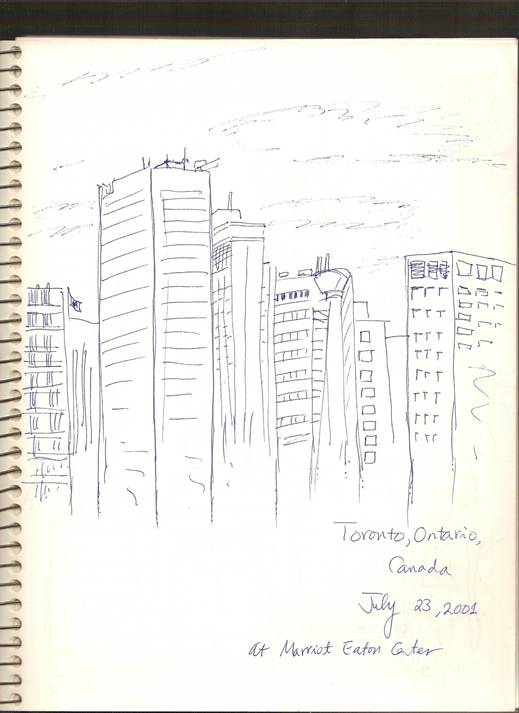
Skyscrapers of Toronto
A sketch of downtown Toronto, Canada, as viewed from the Marriott Eaton Centre, drawn using a rolling-ball pen.
Canada: Three Journeys Through a Land of Natural Beauty and Cultural Diversity
From Toronto’s glittering skyline to Ottawa’s autumn riverside and Vancouver’s Pacific charm
Summary
This essay recounts the author’s three visits to Canada in 1994, 1995, and 2000, reflecting on the country’s natural beauty, cultural diversity, and distinctive urban charm.
The first visit took place in June 1994, when the author, then a doctoral student, traveled to Toronto to present a research paper at IEEE INFOCOM ’94, an international conference on computer communications. He was deeply impressed by the spectacular nighttime views from the CN Tower, the historic campus of the University of Toronto, and the romantic walking and cycling paths along Lake Ontario. He also visited a Korean grocery store and a Korean Catholic church, gaining insights into the diversity of political perspectives and community life within the Korean diaspora.
The second visit occurred in October 1995, when the author attended the DSOM ’95 international conference in Ottawa. He admired the elegance of the historic Château Laurier Hotel and the grandeur of Canada’s Parliament Buildings. One particularly memorable experience was his walk of more than an hour along the river in the chilly autumn weather to visit the Canadian Museum of Civilization, now known as the Canadian Museum of History. The museum’s totem poles and traditional cultural artifacts introduced him to the cultural heritage of Canada’s Indigenous peoples and their ingenuity in adapting to their natural environment.
The third visit took place in Vancouver in 2000. The author was captivated by the city’s beautiful Pacific harbor, the towering trees and totem poles of Stanley Park, and the spectacular scenery where mountains and ocean meet. He also appreciated the city’s distinctive architecture and international atmosphere shaped by Asian immigrant communities. During his stay, he heard about immigration from Hong Kong and other Asian regions, as well as rising property prices. He also hoped to visit nearby Victoria on a future family vacation.
In the final section, the author observes that although Canada possesses abundant natural resources and magnificent landscapes, it also faces practical challenges, including high living costs and housing expenses. A nation’s natural wealth and prosperity, he reflects, do not necessarily guarantee economic security and happiness for all its residents.
Ultimately, this travel essay illustrates how journeys originally undertaken for academic conferences developed into opportunities to discover natural wonders, historical landmarks, Indigenous cultural heritage, and the diversity of immigrant communities. Recalling Toronto’s glittering skyline, Ottawa’s autumn riverside, and Vancouver’s magnificent scenery, the author concludes that Canada is far more than a familiar neighbor of the United States. It is a fascinating country well worth exploring in its own right.
Keywords
Canada travel, Toronto, Ottawa, Vancouver, IEEE international conferences, CN Tower, Château Laurier Hotel, Canadian Museum of History, Indigenous culture, totem poles, Stanley Park, natural environment, multicultural society, immigration and housing costs, academic travel, travel memories
A Neighbor with a Different Character
Canada, the vast country that shares a border with the United States, is often regarded by Americans as a familiar neighbor. Yet familiarity can be deceptive. Although the two countries share many cultural and historical ties, Canada has a distinctive character of its own. I had the good fortune to visit Canada three times, each journey taking me to a different city and revealing another facet of this fascinating country.
Looking back, I realize that my Canadian travels were not simply trips to attend academic conferences. They were also opportunities to discover beautiful landscapes, encounter unfamiliar cultures, and observe the everyday lives of people in a country that seemed both close to home and surprisingly different. Let me revisit those three journeys, drawing on memories that have stayed with me over the years.
Toronto: A Conference, a Tower, and a Lakeside Evening
My first visit to Canada took place from June 12 to 16, 1994, when I traveled to Toronto, Ontario, to present a research paper at IEEE INFOCOM ’94, the IEEE Conference on Computer Communications. At the time, I was a doctoral student, and attending an international conference to present my research was an important part of my academic journey.
Before arriving, I assumed that Canada would feel much like the United States. After all, the two countries share a long border, speak the same language in much of their territory, and maintain close economic and cultural relationships. Yet Toronto soon challenged my assumptions. What impressed me most was the city’s remarkable combination of urban sophistication and natural beauty.
One evening, I visited the famous CN Tower. From its elevated observation area, the city unfolded beneath me in a dazzling panorama. The revolving restaurant and observation facilities offered a memorable perspective on Toronto and Lake Ontario. As darkness descended, the city lights began to sparkle, transforming the skyline into a magnificent spectacle. It was one of those views that makes a traveler pause and simply enjoy the moment.
I also visited the University of Toronto, one of Canada’s oldest and most distinguished universities. Its carefully maintained lawns and historic buildings conveyed a sense of academic tradition and quiet dignity. As a university professor today, I continue to appreciate campuses where natural beauty and intellectual life exist in harmony.
Perhaps my most romantic memory of Toronto, however, is an evening walk along the waterfront. A paved path beside the lake provided space for cyclists, joggers, and pedestrians. As the sun began to set, people moved along the lakeside at an unhurried pace. Some cycled past, others strolled with companions, and still others seemed content simply to breathe the fresh air and admire the view. The scene was peaceful and inviting, a reminder that a great city need not sacrifice its connection to nature.
During my stay, curiosity led me to a Korean grocery store. There, I noticed something unexpected: alongside Korean newspapers were publications associated with pro-North Korean political viewpoints. The shopkeeper explained that Toronto’s Korean community, unlike some Korean American communities I knew in the United States, included people with a variety of political perspectives, and that some customers picked up these publications out of curiosity. The encounter reminded me that immigrant communities are rarely as uniform as outsiders imagine. Even people who share a language and cultural heritage can hold very different political beliefs and personal experiences.
On Sunday, I attended Mass at a Korean Catholic church. The congregation was substantial, and many Korean parishioners had gathered for worship. For a moment, I felt the familiar warmth of community in a foreign city. Traveling abroad can make familiar customs feel especially meaningful. A Korean grocery store, a church service, and a conversation in one’s native language can all become small bridges between home and the wider world.
Toronto had offered me much more than a conference venue. It had introduced me to a cosmopolitan city where academic achievement, natural beauty, and the diversity of immigrant life came together.
Ottawa: An Elegant Hotel and an Autumn Pilgrimage
My second Canadian journey took place from October 16 to 18, 1995. This time, my destination was Ottawa, Canada’s capital, where I presented a paper at the Sixth IFIP/IEEE International Workshop on Distributed Systems: Operations & Management, known as DSOM ’95.
The conference was held at the historic Château Laurier Hotel, an imposing building whose architecture evokes the grandeur of an earlier age. I had heard that members of the British royal family, including Queen Elizabeth II, had stayed there during visits to Canada. Whether or not such stories explained its reputation, the hotel certainly looked worthy of royalty. Its elegant interiors, elaborate decorations, and old-world atmosphere made a strong impression on me.
The accommodation was also memorable for another reason: it was expensive! The pleasure of staying in such a distinguished hotel was accompanied by the sobering realization that historical elegance can come at a considerable price. Academic conferences occasionally provide unexpected lessons in economics as well as technology.
Ottawa itself struck me as a graceful capital, with an atmosphere more relaxed and residential than that of many major metropolitan centers. The Parliament Buildings were among the city’s most impressive landmarks, reflecting Canada’s political institutions and national history.
I arrived in the heart of autumn, when the air was crisp and the trees displayed their seasonal colors. Fellow visitors recommended a walk along the river, and I decided to follow their advice. Dressed warmly against the Canadian chill, I left the hotel alone and set out toward what I remembered as the Canadian Cultural Museum, now known as the Canadian Museum of History, across the river in Gatineau, Quebec.
The walk took well over an hour. I remember the cool wind against my face, the long stretches of riverside scenery, and the invigorating feeling of being outdoors in the Canadian autumn. Although the weather was chilly, I was determined to reach my destination. After exploring the museum, I returned to the hotel late in the day, tired but satisfied.
The museum was one of the most memorable parts of the trip. I had been told that anyone wishing to understand Canada should learn something about the Indigenous peoples who had inhabited the land long before European settlement. The visit helped me appreciate the importance of that advice.
The exhibits presented a rich variety of Indigenous cultural traditions, including distinctive artistic designs, ceremonial objects, and representations of traditional ways of life. Among the most striking displays were the elaborately carved totem poles, decorated with figures of humans and animals. Their vivid colors and intricate forms made them look almost alive, as though the stories and beliefs of earlier generations had been preserved in wood.
I was also fascinated by the displays associated with Arctic Indigenous life, including igloos and traditional wooden boats. These objects revealed the ingenuity required to live in environments where severe weather and limited resources demanded extraordinary practical knowledge.
What impressed me most was the relationship between culture and the natural environment. The objects on display were not merely artistic creations; they also reflected generations of adaptation, observation, craftsmanship, and community knowledge.
On my walk to and from the museum, I repeatedly stopped to admire the river. The deep blue-green water flowed beside steep banks, creating a dramatic contrast with the autumn landscape. I can still picture that beautiful scene.
Looking back, I realize that my walk was more than a sightseeing excursion. It was a small personal pilgrimage toward a better understanding of Canada’s cultural foundations. Sometimes, the most rewarding travel experiences begin with a simple decision to leave the hotel, put on a warm coat, and walk somewhere unfamiliar.
Vancouver: Pacific Splendor and the Charms of Stanley Park
My third visit to Canada came in 2000, when I traveled to Vancouver, British Columbia. Located on Canada’s Pacific coast, Vancouver is widely admired for its spectacular setting between the ocean and the mountains. It is also an important port city, with an international outlook shaped by its connections to Asia and the wider Pacific region.
Of all the sights I encountered there, Stanley Park left perhaps the strongest impression. I explored the park on a sightseeing bus, which offered an easy way to appreciate its expansive grounds. The park’s towering trees, carefully maintained landscapes, and magnificent natural surroundings made it difficult not to be impressed. In several locations, elaborately carved totem poles stood prominently among the greenery, offering reminders of the region’s Indigenous cultural heritage.
The contrast was remarkable: a modern city lay just beyond the park, yet inside it, nature seemed to reclaim the foreground. Trees rose high above the paths, the ocean appeared through openings in the landscape, and the scenery changed as the bus followed the park’s winding roads. It was a place where visitors could appreciate the grandeur of the Pacific Northwest without traveling far from the urban center.
Vancouver also has a distinguished academic institution, the University of British Columbia. Unfortunately, I did not have the opportunity to visit its campus during that trip. It remains one of the places I would have liked to explore more thoroughly.
The city’s waterfront architecture was another attraction. Buildings around the harbor displayed a variety of distinctive designs, giving the area an international and contemporary character. With mountains in the distance and ships moving through the harbor, Vancouver offered a particularly appealing combination of natural scenery and urban development.
Its multicultural population was equally noticeable. In the years following Hong Kong’s return to Chinese sovereignty in 1997, Vancouver became an important destination for Hong Kong immigrants and investors. I heard that the arrival of affluent newcomers had contributed to rising housing prices. Vancouver also attracted people from other Asian countries, including Korea, drawn by its quality of life, natural beauty, and international connections.
Of course, the relationship between immigration, investment, and housing affordability is complex. A city can benefit from international talent and economic activity while simultaneously facing challenges involving housing costs and access to essential services. Vancouver’s experience illustrates how global mobility can reshape a local community in both positive and difficult ways.
I also heard concerns about rising crime in the city. Such impressions are difficult to evaluate without reliable statistics, and a traveler’s observations cannot tell the whole story. Nevertheless, they reminded me that even places blessed with exceptional scenery and prosperity must attend to the practical concerns of everyday life.
Vancouver’s proximity to Seattle also makes it an attractive destination for American visitors. The two cities share important regional and economic connections, yet Vancouver has its own atmosphere. Its relatively mild summer weather, oceanfront scenery, and access to mountains make it especially appealing to travelers seeking a pleasant escape from hotter climates.
One nearby destination remained on my wish list: Victoria, the capital of British Columbia, located on Vancouver Island. I decided to save that excursion for a future family vacation. After all, a good traveler should always leave a few reasons to return.
Canada Today: Between Natural Wealth and Everyday Challenges
Looking back on these three journeys, I am struck by the contrast between Canada’s extraordinary natural resources and the economic challenges that can affect ordinary people. The country possesses vast forests, mineral deposits, energy resources, freshwater reserves, and some of the most beautiful landscapes in the world. Yet natural wealth does not automatically guarantee affordable housing, comfortable living costs, or economic security for every resident.
In recent years, the cost of living and housing affordability have become important concerns in Canada. Some Canadians and immigrants have considered moving elsewhere, including to the United States, in search of employment opportunities or lower living expenses. Such decisions depend on many factors, including profession, family circumstances, immigration status, and regional economic conditions.
The larger lesson is that a country’s appeal cannot be measured by its scenery or natural resources alone. Quality of life also depends on the opportunities people can access, the cost of meeting basic needs, the strength of public institutions, and the ability of communities to adapt to change.
Still, my personal memories of Canada remain overwhelmingly positive. Toronto offered a cosmopolitan atmosphere and a beautiful lakeside setting. Ottawa introduced me to the dignity of a historic capital and the cultural richness of Indigenous traditions. Vancouver revealed the extraordinary beauty of the Pacific coast and the vitality of a multicultural city.
Each visit was relatively brief, and I recognize that three trips cannot provide a complete understanding of such a large and diverse country. Nevertheless, travel does not always need to be comprehensive to be meaningful. Sometimes a single evening by a lake, a long walk through the autumn cold, or an afternoon among towering trees can leave a lasting impression.
A Neighbor Worth Visiting Again
Canada has remained in my memory as a country of spacious landscapes, welcoming cities, and cultural diversity. Its proximity to the United States may make it seem familiar, but my experiences taught me that it deserves to be appreciated on its own terms.
I first visited Canada as a doctoral student presenting a research paper. I returned as an academic attending another international conference, and later explored the Pacific coast of British Columbia. In each case, professional obligations opened the door to experiences that extended well beyond the conference room.
Perhaps that is one of the unexpected gifts of academic travel: a research paper may bring us to a new country, but the places we remember most vividly are often the ones we discover after the presentations have ended.
I still hope to return to Canada, perhaps to explore Victoria with my family, revisit a few favorite places, and discover regions I have never seen. Until then, the memories of Toronto’s illuminated skyline, Ottawa’s blue-green river, and Vancouver’s magnificent Stanley Park remain vivid reminders of a neighbor whose beauty and diversity deserve to be experienced firsthand.
Some journeys end when we return home. Others continue quietly in our memories, inviting us to travel again.
Original travelogue dated September 6, 2010.
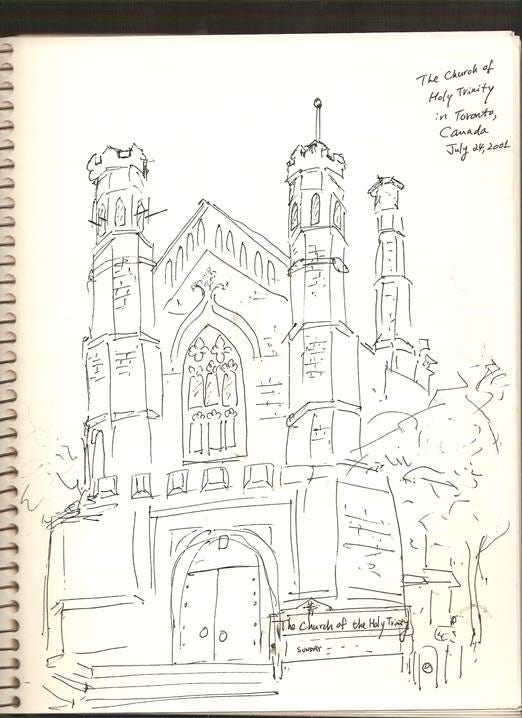
The Church of Holy Trinity in Toronto, Canada
Croquis drawn using a rolling ball pointed pen while pressed for time during a trip to downtown Toronto
캐나다: 자연의 아름다움과 문화적 다양성이 어우러진 땅으로 떠나는 세 가지 여정
토론토의 눈부신 스카이라인부터 오타와의 가을 강변, 그리고 밴쿠버가 지닌 태평양 연안의 매력까지
나는 미국과 이웃한 나라인 캐나다를 3번 가 볼 기회가 있었다. 기억을 더듬어 간단히 나의 여행기를 생각나는 대로 기술해 보기로 한다.
첫번째는, 1994년 6월 12일부터 16일까지 온타리오 주의 토론토에서 열린 IEEE INFOCOM ‘94 - The Conference on Computer Communications에 박사과정 학생으로 논문 발표차 참석하였다. 첫 번째 여행이었는데, 미국과 비슷할 것이란 생각을 하고 방문하였으나 여러모로 다른 바가 있었다. 무엇보다도 캐나다의 수려한 자연환경은 매우 부러웠다. 토론토에서는 유명한 CN Tower의 꼭대기 층에 위치한 회전하는 전망대에서 야경은 매우 아름다웠으며, 유서깊은 토론토대학의 잘 정리된 잔디밭, 그리고 시내에 있는 호반을 따라 만들어진 자전거와 산책객들을 위해 만들어진 도로 를 따라 해질녘에 움직이는 사람들의 모습은 매우 낭만적이었다. 남은 시간을 이용하여 한국식품점에도 가 보았는데 한가지 기억에 남은 것은 한국 신문과 함께 친북계 신문이 가게에 나란히 비치되어 있다는 것이었는데, 주인아주머니 말씀으로는 토론토는 미국과 달리 친북성향의 한국교포들이 꽤 산다는 것이고, 호기심에 사람들이 친북계신문을 가져간다는 것 이었다. 일요일에 들른 한인성당은 제법 규모도 크고 많은 한인 신자들이 미사에 참석하는 것을 보았다.
두번째는 1995년 10월 16일부터 18일까지 오타와 (Ottawa)의 유서깊은 Chateau Laurier Hotel 에서 열린Sixth IFIP/IEEE International Workshop On Distributed Systems: Operations & Management (DSOM ‘95)에 논문 발표차 방문하면서 였다. Chateau Laurier Hotel은 영국여왕이 캐나다 방문시 즐겨 묵는 호텔이라고 그러는데 아주 고풍스럽고 내부장식이 매우 화려한 초고급 호텔임은 분명하였다. 물론 투숙비는 아주 비싼던 것으로 기억된다. 오타와는 캐나다의 수도로서 상 로랭 (Saint Lawrence) 강을 끼고 발달된 아름다운 전원도시의 느낌을 받았다. 캐나다의 국회의사당도 볼만한 것이었으며, 방문한 시기가 가을의 한 가운여서 그런지 상 로랭 강을 따른 도보여행을 주위의 관광객들이 권하였다. 나는 혼자 호텔을 나와 옷을 단단히 차려 입고서 도보여행을 떠났다. 목적지는 캐나다문화박물관 (Canadian Cultural Museum) 이었는데 약 1시간 너머 쌀쌀한 캐나다의 가을바람을 안고서 홀로 걸어가 구경을 하고 저녁 늦게 숙소로 돌아왔던 기억이 난다. 캐나다를 이해할려면 캐나다원주민들의 문화박물관인 거기를 방문해야 한다는 거였다. 박물관은 캐나다원주민 (인디언)들의 생활과 문화를 보여주는 아주 다채롭고 원색적인 (색깔과 문양에 있어) 특징을 보여 주었다. 특히 인상적인 것은 아주 높은 나무를 여러가지 형태의 기괴한 사람과 동물 모양으로 화려하게 조각한 토템 폴 (Totem Pole)과 에스키모들의 주거공간인 이글루 (Igloo) 그리고 그들이 사용하는 통나무를 깍은 나무 배였다. 오가는 길에 보았던 상 로랭 강을 따라 형성된 깊은 벼랑을 따라 흐르던 새파란 강물이 아직도 눈에 선하다.
세번째는 2000년의 밴쿠버 때 방문이다. 밴쿠버는 태평양에 위치한 정말 아름다운 캐나다의 제1 항구 도시이다. 특히 인상에 남는 것은 관광버스로 둘러 본 스탠리 공원 (Stanley Park) 이었다. 광활한 공원 여기저기에 솟아 있는 토템 폴들과 잘 가꾸어진 울창한 수목들로 꾸며진 이 공원은 감탄을 자아 내기에 충분했다. 그리고, 밴쿠버에는 유명한 브리티시컬럼비아대학 (University of British Columbia)가 있는데 직접 방문하지는 못하였다. 벤쿠버 항구 주변의 건축물들은 각기 매우 독특하여 볼만한 구경거리를 선사하고 있었다. 밴쿠버에는 홍콩의 중국 반환이 후 많은 홍콩사람들이 들어와 살고 있어 주택가격을 많이 올려 놓았다 한다. 이 후 한국을 비롯한 아시아 주요 국가의 부자들이 많이 들어와 산다고 들었다. 이 때문인지는 모르지만 최근에는 범죄가 급증하고 있다고 한다. 미국의 시애틀과는 거리가 가까워 미국에서 많은 관광객들이 특히 선선한 여름 날씨 때문에 밴쿠버를 많이 방문한다고 한다. 가까운 관광지인 빅토리아 섬 (Victoria Island)은 나중에 가족여행을 통해 보기로 하고 다음으로 남겨 놓았다.
최근 캐나다의 소식을 들어보면 경제난과 높은 생활비 때문에 많은 캐나다 사람들이나 이민자들이 가까운 미국 이민을 생각하고 있다고 한다. 캐나다에는 무진장한 천연자원이 매장되어 있고, 자연환경도 매우 수려한데 현실 생활은 그렇게 즐겁고 유쾌하지만은 않은 모양이다. 그러나 내 개인적인 경험으로는 그래도 한 번쯤은 관광하고 싶은 많은 매력을 가진 나라가 바로 캐나다가 아닌가 생각한다. +++
2010년 9월 6일
About the Author

Prof. Dr. Young Choi (Editor-in-Chief) — Regent University
Full list of his K-GSP columns:
https://www.k-gsp.org/t/columnist_young_choi
Full list of his Books at Amazon.com
Young B. Choi is a Professor in the Department of Engineering & Computer Science at Regent University. He published 38 books with ‘Selected Readings in Cybersecurity’ (2018) (over 800 copies archived globally at university/college libraries around the world) and ‘Cybersecurity Applications and Artificial Intelligence’ (2023) available in seven major world languages. He proposed the world’s first global and universal telecommunications “Service Order Handling (SOH)” Model (T-SOH Model) (1995) with Dr. Adrian Tang. With this innovative research work, he received the IEEE NOMS ’96 Best Paper Award and became the first recipient of the Outstanding Contribution Award of the TeleManagement Forum in 1998. His research areas include Natural Language Processing-focused AI, AI-applied cybersecurity, network and telecom service management, and Korean studies on Gani Choi Rip’s Jeonggwan (靜觀: Quiet Contemplation) philosophy and Shilhak ( 實學: Practical Learning).
Suggested Citation
Choi, Y. B. (2026). Canada: Three Journeys Through a Land of Natural Beauty and Cultural Diversity - From Toronto’s glittering skyline to Ottawa’s autumn riverside and Vancouver’s Pacific charm. K-GSP Forum.
한글 요약
이 글은 필자가 1994년, 1995년, 2000년에 세 차례 캐나다를 방문하면서 경험한 여행의 추억과 캐나다의 자연환경, 문화적 다양성, 도시의 매력을 회고한 여행기이다.
첫 번째 방문은 1994년 6월, 박사과정 학생으로서 토론토에서 열린 IEEE INFOCOM ’94 국제학술대회에 참석하여 논문을 발표한 때였다. 필자는 CN 타워에서 바라본 아름다운 야경과 토론토대학교의 고풍스러운 캠퍼스, 온타리오호를 따라 이어지는 낭만적인 산책로에 깊은 인상을 받았다. 또한 한국 식료품점과 한인 성당을 방문하면서 해외 한인사회의 다양한 정치적 견해와 공동체 문화를 경험하였다.
두 번째 방문은 1995년 10월, 오타와에서 열린 DSOM ’95 국제학술대회에 참석했을 때였다. 필자는 유서 깊은 샤토 로리에 호텔의 우아한 분위기와 캐나다 국회의사당의 위엄에 감탄하였다. 특히 쌀쌀한 가을바람을 맞으며 강을 따라 한 시간 넘게 걸어 캐나다 문화박물관을 방문한 경험은 잊지 못할 추억으로 남았다. 박물관에서 관람한 원주민들의 토템 폴과 전통 생활용품은 캐나다의 문화적 뿌리와 자연환경에 적응해 온 선주민들의 지혜를 이해하는 계기가 되었다.
세 번째 방문은 2000년 밴쿠버 여행이었다. 필자는 태평양 연안의 아름다운 항구도시 밴쿠버에서 스탠리 공원의 울창한 숲과 토템 폴, 산과 바다가 어우러진 경관을 감상하였다. 또한 도시의 독특한 건축물과 아시아계 이민사회가 형성한 국제적 분위기를 인상 깊게 기억하였다. 홍콩을 비롯한 아시아 지역에서 이주한 사람들과 부동산 가격 상승에 관한 이야기도 접했으며, 인근 빅토리아를 가족과 함께 방문할 계획을 세우기도 하였다.
글의 후반부에서 필자는 캐나다가 풍부한 천연자원과 수려한 자연환경을 지닌 나라임에도 불구하고 높은 생활비와 주거비 등 현실적인 문제를 안고 있음을 지적한다. 국가의 풍요로움이 반드시 모든 국민의 경제적 안정과 행복을 보장하는 것은 아니라는 점도 성찰한다.
결국 이 여행기는 학술대회 참석이라는 전문적인 목적에서 출발했지만, 자연의 아름다움과 역사적 유산, 원주민 문화, 이민사회의 다양성을 발견하는 여정으로 확장되었다. 필자는 토론토의 화려한 야경, 오타와의 가을 강변, 밴쿠버의 웅장한 자연경관을 회상하며 캐나다가 가까운 이웃이라는 친숙함을 넘어 독자적으로 탐험할 가치가 있는 매력적인 나라라고 결론짓는다.
핵심어
캐나다 여행, 토론토, 오타와, 밴쿠버, IEEE 국제학술대회, CN 타워, 샤토 로리에 호텔, 캐나다 문화박물관, 원주민 문화, 토템 폴, 스탠리 공원, 자연환경, 다문화사회, 이민과 주거비, 학술여행, 여행의 추억
© K-Global Scholars and Professionals Forum. All rights reserved. 2026. Content published in the K-GSP Forum may not be reproduced, distributed, or transmitted in any form without prior written permission from the K-GSP Forum, except for brief quotations with full attribution.
Thank you for sharing this vivid account of your Ottawa visit. Your autumn walk across the river brought the scenery to life for me. I was especially touched that your visit took place in 1995—the same year I began living in Ottawa.
Since then, I have enjoyed the beauty of God’s creation here through the changing seasons. The brilliant autumn leaves, flowing river, peaceful forests, and quiet winter landscapes continually give me reasons to thank him. Your description reminds me to pause and appreciate the beauty that can become so familiar in everyday life.
I have also come to treasure Canada’s multiculturalism, especially here in Ottawa, beside Quebec. The meeting of English and French, together with the languages and traditions of neighbours from many backgrounds, has enriched my experience of calling this place home. Your reflections on Indigenous cultures remind me that appreciating Canada also means listening to the peoples whose histories and relationship with this land long precede our arrival.
For me, both the natural beauty and the richness of human life point to God’s wisdom and generosity. Every person bears his image, and every encounter offers an opportunity to show his love. Praise God for this beautiful land and its people. May we honour him by caring for his creation and welcoming our neighbours with gratitude, humility, and kindness.