

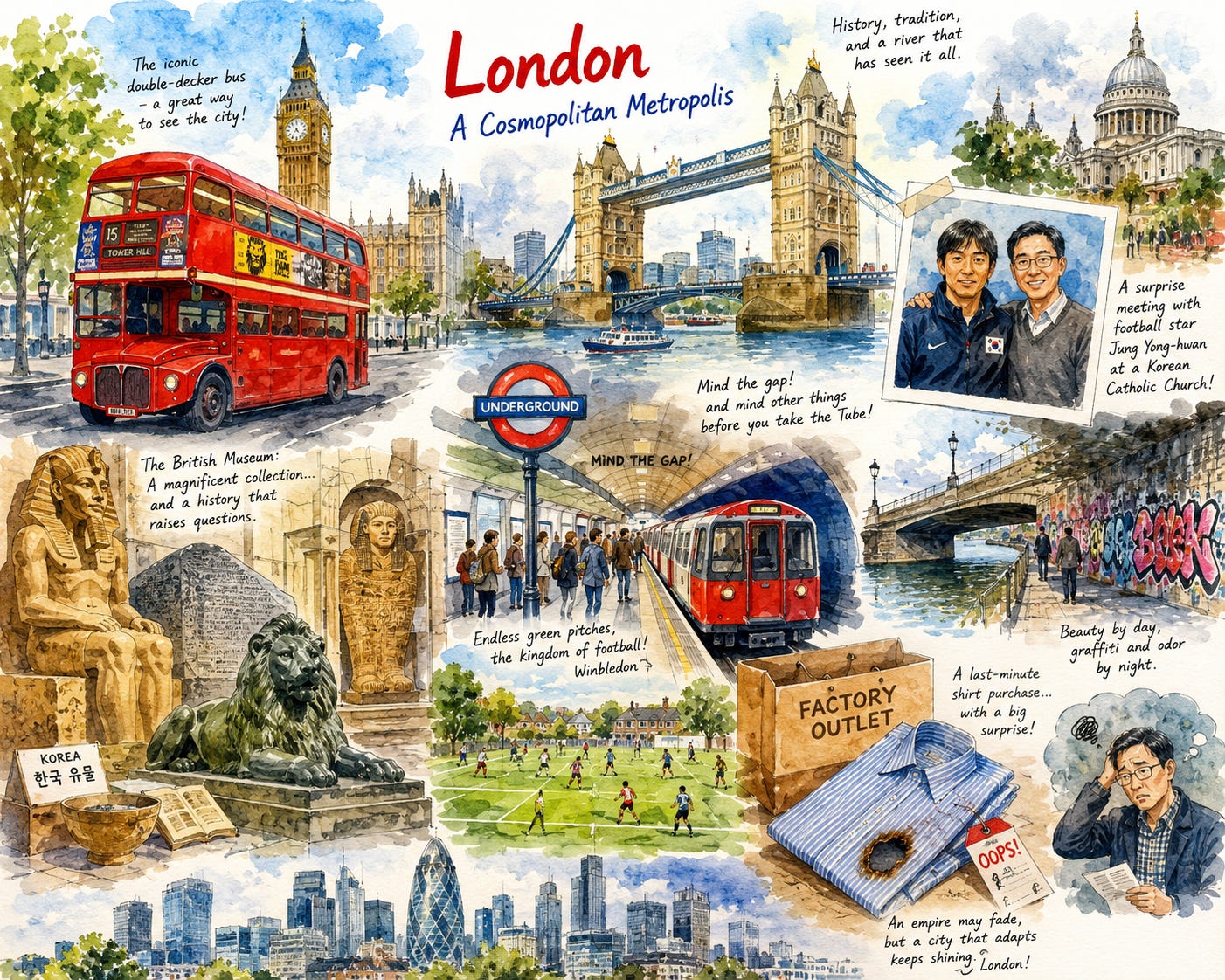
Image credit: Illustration generated with OpenAI’s ChatGPT image-generation tool, 2026.
London: A Cosmopolitan Metropolis
An Academic Pilgrimage, Imperial Treasures, Football Fields, and One Very Expensive Shirt
Abstract
This travelogue recounts the author’s weeklong visit to London in 1995, when he was nearing the completion of his doctoral studies and traveled with his academic adviser to present research related to his dissertation. Blending humor, satire, and personal reflection, the essay explores London’s historical legacy, cultural diversity, and enduring influence as a global metropolis. The author reflects critically on the cultural treasures displayed at the British Museum, questioning the colonial history behind the acquisition of artifacts from around the world and the relatively modest exhibition space devoted to Korean cultural heritage. He also recalls unexpectedly meeting a former member of the Korean national football team at a Korean Catholic church, experiencing disappointing Korean cuisine, and discovering the convenience of London’s iconic double-decker buses and Underground railway. Humorous observations about the famous “Mind the gap!” announcement, an uncomfortable Tube journey, and the abundance of green football pitches near Wimbledon bring everyday London life vividly to the reader. The essay further examines London’s multicultural population, the enduring consequences of British imperialism, the city’s high cost of living, its historical landmarks, and the tradition of maintaining and renovating family homes across generations. A particularly amusing anecdote about a hurried shopping trip to a factory outlet, where a friend unknowingly purchased a shirt with a large cigarette burn shortly before an international flight, illustrates the unpredictable mishaps of travel. While acknowledging London’s historical significance and continuing prominence in international finance, business, and tourism, the author also considers the contradictions associated with its colonial legacy and contemporary urban life. Ultimately, the travelogue suggests that London’s enduring strength lies not merely in its imperial past but in its ability to adapt to changing circumstances, connect diverse cultures, and transform historical experience into contemporary global influence.
Keywords: London, travelogue, global metropolis, British Museum, colonialism, cultural heritage, multiculturalism, London Underground, football culture, international finance
In 1995, as I was approaching the end of my doctoral studies in the United States, I traveled to London with my academic adviser. Our mission was to present research related to my dissertation at an international forum on network management. We planned to spend a week in London, discussing telecommunications research and, if time permitted, discovering what remained of the glory of the British Empire.
We departed Kansas City, connected through Washington, D.C., at Dulles Airport, and eventually landed at Heathrow. From there, we took a train toward London. Looking out the window, I saw numerous old buildings, many of them appearing to have seen better days. They seemed to whisper stories of a once-mighty empire on which, as the famous saying went, the sun never set. Some buildings looked as though they had been standing since the days when the British Empire was busy acquiring the rest of the world. Whether they were proud monuments to history or simply overdue for renovation, I could not say.
My first impression was that London was a city where history had never entirely moved out. It had merely changed its clothes, put on a business suit, and started charging visitors for admission.
The British Museum: A Rather Generous Collection
One of my most memorable visits was to what I would affectionately—and perhaps provocatively—call the British Museum of Borrowed Civilizations.
The museum displayed cultural treasures from all over the world, including objects acquired during wars, colonial expansion, and the long history of imperial collecting. Everything was carefully arranged, beautifully labeled, and presented with the confidence of an institution that had never doubted its right to keep what it possessed. Visitors were invited to admire the treasures, and the museum had become one of London’s major attractions.
I was particularly disappointed by the modest exhibition space devoted to Korean artifacts. Compared with the magnificent displays of some other civilizations, the Korean collection seemed rather neglected. Korea, with its long history and rich cultural heritage, surely deserved more than a corner that appeared to have been assigned after the furniture had been arranged.
What astonished me even more was the display of Egyptian mummies. There were so many of them that I began to wonder whether the museum had acquired an entire ancient Egyptian neighborhood. These people had presumably expected to spend eternity in their own tombs, not to become permanent residents of a London exhibition hall.
Of course, I understood that museums preserve, study, and educate. Yet I could not easily reconcile the educational mission of the institution with the historical circumstances under which many of its treasures had been acquired. The objects were beautifully preserved, but the stories of how they had arrived in London were not always equally comfortable.
I left with mixed feelings. The museum was unquestionably impressive, but it also raised a question that followed me throughout my stay: When does collecting the world’s treasures become collecting the world’s trophies?
The British seemed to have perfected the art of turning imperial history into cultural capital. Even the spoils of empire had found respectable employment.
Korean Food, an Unexpected Football Star, and the Price of Homesickness
During my stay, I made time to visit a Korean Catholic church on the outskirts of London. There, by sheer coincidence, I encountered Jung Yong-hwan, a former member of the Korean national football team. As a football enthusiast, I was delighted to meet him, and we took a commemorative photograph together.
It was a pleasant reminder that travel sometimes rewards us in unexpected ways. One may cross an ocean to attend an academic conference and end up meeting a football star in a church. Research papers are not the only things that can produce memorable results.
Food, however, was another matter.
After several days of unfamiliar meals, I began to long for Korean food. I asked around and eventually found a Korean restaurant called Arirang. The name sounded promising. Arirang is one of Korea’s best-known traditional songs, associated with longing, separation, and the emotional geography of home. Surely a restaurant bearing such a name would understand the homesick Korean scholar.
Unfortunately, the food did not live up to the poetry of the name. It was rather disappointing, and the prices were considerably higher than I had expected. I paid for the meal with the uneasy feeling that I had been charged an additional fee for remembering Korea.
I had often heard that British and German food enjoyed less-than-glowing reputations among European cuisines. Before visiting London, I had regarded such comments as exaggerations by people who preferred their meals seasoned with more than historical tradition. After my experience, I began to understand the joke.
To be fair, one week in a foreign country is hardly enough to judge an entire national cuisine. Nevertheless, during my London visit, I encountered few meals that inspired me to write home about them. If British cuisine was a research subject, my sample size was small, but my preliminary findings were not encouraging.
Riding the Double-Decker: Sightseeing from the Upper Floor
London’s famous red double-decker buses were everywhere, moving tourists and residents through the busy streets with impressive determination. I found the ride comfortable, and the advertisements covering the sides and backs of the buses were attractions in their own right. London appeared to have discovered that if a vehicle was going to travel around the city all day, it might as well carry a few dozen commercial messages with it.
The upper deck was especially enjoyable. From that elevated position, I could see more of the city without having to fight my way through the crowds on the pavement. It was an efficient way to sightsee: one paid the fare, found a seat upstairs, and allowed London to parade past the window.
I also remember noticing a warning inside the bus about a £500 fine for smoking. The amount struck me as astonishingly high. At the time, I could hardly imagine paying such a penalty for lighting a cigarette. In London, apparently, even the simple act of smoking could become a serious financial decision.
The buses offered a wonderful introduction to the city. They were practical, recognizable, and entertaining—a little like London itself, which seemed determined to preserve its traditions while finding new ways to make money from them.
The Tube: Mind the Gap—and Mind Your Own Urgent Needs
London’s Underground railway, affectionately known as the Tube, was another remarkable experience. Its name came from the tube-shaped tunnels through which the trains traveled. The system was among the world’s oldest underground railways and had grown into a vast network connecting much of the metropolitan area.
Despite the complexity of its routes, the trains appeared to operate with admirable punctuality. Stations, connections, and departures were organized with a precision that made navigating the city relatively easy, even for a visitor who was still learning his way around.
One announcement, however, puzzled me for quite some time. Whenever a train stopped, I repeatedly heard the words, “Mind the gap!” At first, the expression sounded slightly mysterious. I understood the individual words, but I did not immediately grasp why the railway staff seemed so concerned about a gap. Was it a philosophical gap? A social gap? Perhaps the British had developed a special sensitivity to gaps after losing so much territory during the decline of their empire.
Eventually, I realized that the announcement was a practical warning about the space between the train and the platform. Passengers needed to watch their step when getting on or off the train. It was a simple instruction, but it revealed something about British communication: a few understated words could convey a serious warning without raising one’s voice.
There was another lesson about the Tube that I learned through personal experience. Before boarding, one should always make sure that any urgent bathroom needs have been taken care of at home or at the hotel. Public toilets were not readily available at the stations I used, and once a passenger entered the system, finding relief could become an adventure of its own. I discovered this unfortunate truth on my return journey from Wimbledon.
The Tube is an excellent transportation system, but it is not designed to accommodate every human emergency. Its trains may be punctual, its routes extensive, and its announcements reassuring, but the human body follows a timetable of its own.
On that particular journey, I learned that there are some problems for which neither a railway map nor an academic degree provides an immediate solution. I shall spare the reader the details. Suffice it to say that I have never again regarded a public transportation timetable as the most important schedule in my life.
Wimbledon and the Green Kingdom of Football
Wimbledon was famous for tennis, and I was pleased to visit the area. Yet what impressed me most on the journey was not the tennis itself but the seemingly endless succession of football pitches visible through the train windows.
There were green fields everywhere. In one neighborhood after another, people were playing football on well-maintained grass pitches, enjoying the game as casually as Americans might enjoy a weekend barbecue.
As a devoted football fan, I found the sight both delightful and slightly painful. In many places, obtaining access to a proper grass football field can be a challenge. In London, it seemed that every community had its own green rectangle waiting for someone to kick a ball across it.
The players did not appear to be preparing for an international tournament. They were simply enjoying the game, exercising, and spending time together. There was something deeply appealing about that ordinary scene.
It also helped explain why football had become such an important part of British life. A sport cannot thrive on national enthusiasm alone. It needs places to play, opportunities to practice, and communities willing to make room for it.
Watching those fields pass by, I felt a little envy. Britain had its ancient universities, its grand museums, its royal ceremonies, and its complicated railway system. It also had an abundance of grass pitches. For a football lover, the last item was reason enough to consider moving there.
A Cosmopolitan City and the Legacy of Empire
One of the most striking features of London was the diversity of its population. Outside the tourist districts, I noticed people of many different ethnic backgrounds going about their daily lives. Residents of African, Caribbean, South Asian, European, and other backgrounds contributed to the city’s visibly cosmopolitan character.
A friend who accompanied me explained that much of this diversity was connected to Britain’s imperial past. During the expansion of the British Empire, people from territories that later became independent countries developed political, economic, and personal connections with Britain. Migration continued after the empire’s decline, and London became home to generations of people whose family histories crossed continents.
His explanation helped me understand what I was seeing. The British Empire had once projected its power outward, establishing networks of trade, administration, and political control across the world. Decades later, people from those former territories were making their way to the former imperial center, bringing their languages, religions, cuisines, customs, and ambitions with them.
History has a curious sense of humor. An empire that once sent administrators to govern distant lands eventually found the descendants of those lands living in its own capital.
London’s cosmopolitan character was not simply a matter of appearance. It reflected the complicated relationships among colonialism, migration, citizenship, opportunity, and identity. The city was both a product of imperial expansion and a place where the consequences of that expansion continued to unfold.
My friend also warned me about pickpockets and street crime, particularly in areas frequented by tourists. Visitors unfamiliar with the city could become easy targets if they were careless with their belongings. I took the advice seriously, although I would not attribute criminal behavior to any particular ethnic or national group. Every large city has its share of opportunists, and tourists everywhere seem to possess a remarkable ability to advertise their vulnerability.
After all, nothing announces “I am unfamiliar with this place and may be carrying cash” quite as effectively as stopping in the middle of a crowded pavement to unfold a map while holding an expensive camera.
London was a meeting place of cultures, but it was also a reminder that cosmopolitanism requires more than people from different backgrounds sharing the same streets. It requires the difficult work of building trust, fairness, and a common civic life.
Expensive London and the Long Shadow of Imperial Glory
London struck me as an expensive city. Based on my experience at the time, everyday costs felt roughly 1.6 times as high as comparable expenses in the United States, although this was only my personal impression rather than a systematic comparison.
The exchange rate between the dollar and the pound made every purchase feel like a small economic calculation. Even an ordinary meal could inspire a moment of hesitation. One began to wonder whether the menu included not only food but also a modest contribution toward maintaining Britain’s historical monuments.
Perhaps the cost of living was simply part of the price of being in London. The city was crowded, space was limited, and its infrastructure carried the burden of centuries of development. Unlike the United States, with its vast territory and abundant natural resources, Britain had to make efficient use of a much smaller land area.
Yet the explanation could not be reduced to geography. London’s economic strength also rested on its concentration of financial institutions, professional services, international businesses, cultural organizations, and tourism. Its role as a global financial center had developed over centuries, supported by commercial networks and expertise that survived the end of formal empire.
The old imperial connections had changed, but many of the skills and institutions developed during that period remained useful. London had learned how to connect distant markets, manage international transactions, and attract people seeking opportunities. A declining empire could therefore leave behind a remarkably successful capital. Its political dominion might disappear, but its financial institutions, commercial traditions, and cultural influence could continue to generate wealth.
Still, I could not help reflecting on the irony. Britain had once ruled territories across the globe, while London had served as the center of an enormous imperial system. By 1995, the empire was history, and its former colonies were increasingly asserting their independence. Yet London remained prosperous, influential, and expensive enough to remind visitors that imperial glory could have a very long economic afterlife. The sun might finally have set on the empire, but it appeared to have left the city with a very substantial bill for dinner.
Westminster, London Bridge, and the Less Photogenic Thames
London’s historical landmarks were impressive. Westminster, associated with Britain’s monarchy, Parliament, and constitutional development, offered a concentrated view of the country’s political history. The familiar image of London Bridge also belonged to the city’s remarkable architectural and cultural landscape.
The city had developed along the River Thames, and its bridges, embankments, and riverside buildings gave London a distinctive character. The river connected different parts of the city while serving as a witness to centuries of commerce, migration, political conflict, and urban change.
During the day, the Thames could look picturesque, especially when viewed against the city’s historic buildings. In the evening, however, some riverside areas presented a less romantic picture. Beneath certain bridges, I encountered graffiti that was difficult to decipher and unpleasant odors that made walking along the river less enjoyable than I had anticipated.
It was a useful reminder that famous cities contain more than the images reproduced on postcards. The same city that offers magnificent architecture and carefully maintained tourist attractions also has neglected spaces, environmental problems, and ordinary urban inconveniences. A city is not a museum exhibit. It is a living place, and living places are rarely tidy from every angle.
I also heard a charming description of British houses. People sometimes referred to their homes as their castles, and traditional houses could remain in the same family for generations. Rather than demolishing an old house and replacing it with a new one, owners might gradually extend, renovate, repair, and modernize it as circumstances allowed. I liked this idea. A house could become a record of family history, with each generation adding something of its own while preserving what earlier generations had built.
From an environmental perspective, maintaining and adapting existing buildings can also conserve materials and reduce waste, although the benefits depend on the condition of the structure and the efficiency of the renovation. In any case, the British tradition of living with old buildings seemed to offer a valuable lesson: progress does not always require starting from scratch. Perhaps that was one of London’s secrets. The city had survived not by erasing its past but by continually finding new uses for it.
The Factory Outlet Expedition: A Shirt, a Deadline, and a Lesson in Planning
Travel has its own small obligations. Whenever I visit another country, I find myself thinking about gifts for family members, friends, and relatives back home. It is not enough to return with photographs and stories. One is also expected to produce tangible evidence of having traveled abroad. This brings me to one of the funniest episodes of my London trip.
A few friends proposed visiting a factory outlet store outside London. One of them was particularly determined to complete what he called his “homework.” By this, he meant purchasing gifts for his wife before returning to Korea.
The fact that our flight was scheduled to depart from Heathrow that evening did not appear to trouble him. He confidently calculated that we had enough time to visit the outlet, shop, return to the airport, and board our flight. His confidence was impressive. His time management was less so.
When we finally arrived at the store, we discovered that it would close in just fifteen minutes. The shopping expedition had become a race against the clock. My friend hurried inside, selected a shirt, paid for it, and emerged with the satisfied expression of a student who has submitted an assignment just before the deadline. He had completed his homework. His wife would have her present. The family obligation had been fulfilled. Or so he thought.
After returning to Korea, he opened the package and discovered that the shirt had a large cigarette burn in it. A cigarette burn! Somewhere between the factory, the outlet store, and the cashier, the shirt had apparently acquired a souvenir of its own. Perhaps it had been damaged during production. Perhaps someone had overlooked the defect. We never learned the explanation.
My friend had rushed across the countryside, risked missing an international flight, and paid for a shirt without properly examining it. His determination to earn a good grade from his wife had produced an unexpected result.
I could imagine the scene at home. He proudly presented his carefully selected gift, anticipating appreciation and perhaps even a few words of admiration for his thoughtfulness. His wife opened the package and found a shirt with a hole large enough to suggest that it had survived a minor industrial accident.
What grade would he receive for that assignment? I was not present when the final evaluation took place, and I was wise enough not to ask. The episode would have been funny enough on its own, but our shopping adventure created another problem: getting back to Heathrow in time for our flight. We returned to the airport with very little time to spare. The journey that had begun as a leisurely shopping excursion had become a practical demonstration of the dangers of poor planning.
I learned two valuable lessons that day. First, never assume that a short shopping trip will remain short simply because the flight is scheduled for later in the evening. Second, never purchase a shirt in a hurry without inspecting it carefully. A third lesson might be even more important: a gift purchased under pressure does not necessarily become a better gift simply because it has been purchased abroad.
Since then, I have tried to avoid such reckless expeditions. If a shop is about to close and an international flight is waiting, the sensible decision is to abandon the shopping and go to the airport. A disappointed family member is generally easier to manage than a missed flight.
As for my friend, I hope he eventually recovered from the incident. Perhaps his wife forgave him. Perhaps the shirt became a household joke. Or perhaps it was quietly retired before anyone could mistake it for a deliberate fashion statement.
London: Still a World City
My week in London passed quickly. There was so much to see and experience that I could not possibly explore everything within such a short visit. The museums, historic buildings, double-decker buses, underground railway, football pitches, restaurants, and busy streets each revealed a different side of the city.
London was not quite the imperial capital that history books had taught me to imagine. Its former empire had largely disappeared, and the world had changed dramatically. Yet the city retained an extraordinary ability to attract visitors, businesses, immigrants, students, scholars, artists, and travelers from every corner of the globe.
Its greatness did not rest solely on royal ceremonies or magnificent buildings. It also came from its capacity to connect cultures, preserve institutions, accommodate change, and transform historical experience into contemporary economic and cultural influence.
Of course, London had its shortcomings. The food I encountered was not particularly memorable, the prices were high, the Tube required advance planning for certain bodily necessities, and a visit to a factory outlet could threaten one’s entire travel schedule. Some of its historical treasures also raised uncomfortable questions about colonialism and cultural ownership.
But perhaps these contradictions were part of what made London interesting. It was a city of extraordinary wealth and ordinary inconvenience, historical grandeur and urban neglect, imperial memories and cosmopolitan realities.
I arrived as a doctoral student hoping to present my research at an international conference. I left with more than academic memories. I had learned a little about Britain’s history, observed the consequences of its imperial past, admired its football culture, and discovered that even a world-famous city could be humbled by an inexpensive shirt with an expensive hole.
London remained one of Europe’s great metropolitan centers and one of the world’s most influential cities. A week was nowhere near enough to understand it completely, but it was enough to appreciate its remarkable character.
If there is one final lesson I carried home, it is this: history may explain why a city becomes great, but it is the city’s ability to adapt that helps it remain great. And if you happen to visit London, enjoy the museums, ride the double-decker, admire the football fields, and listen carefully when the Underground says, “Mind the gap!”
Above all, if you decide to buy a shirt before your flight, take a good look at it first.
After all, even in a cosmopolitan metropolis, the smallest hole can leave the biggest impression.
Original travelogue dated September 16, 2010.
Reference
London. (n.d.). In Wikipedia. http://en.wikipedia.org/wiki/London
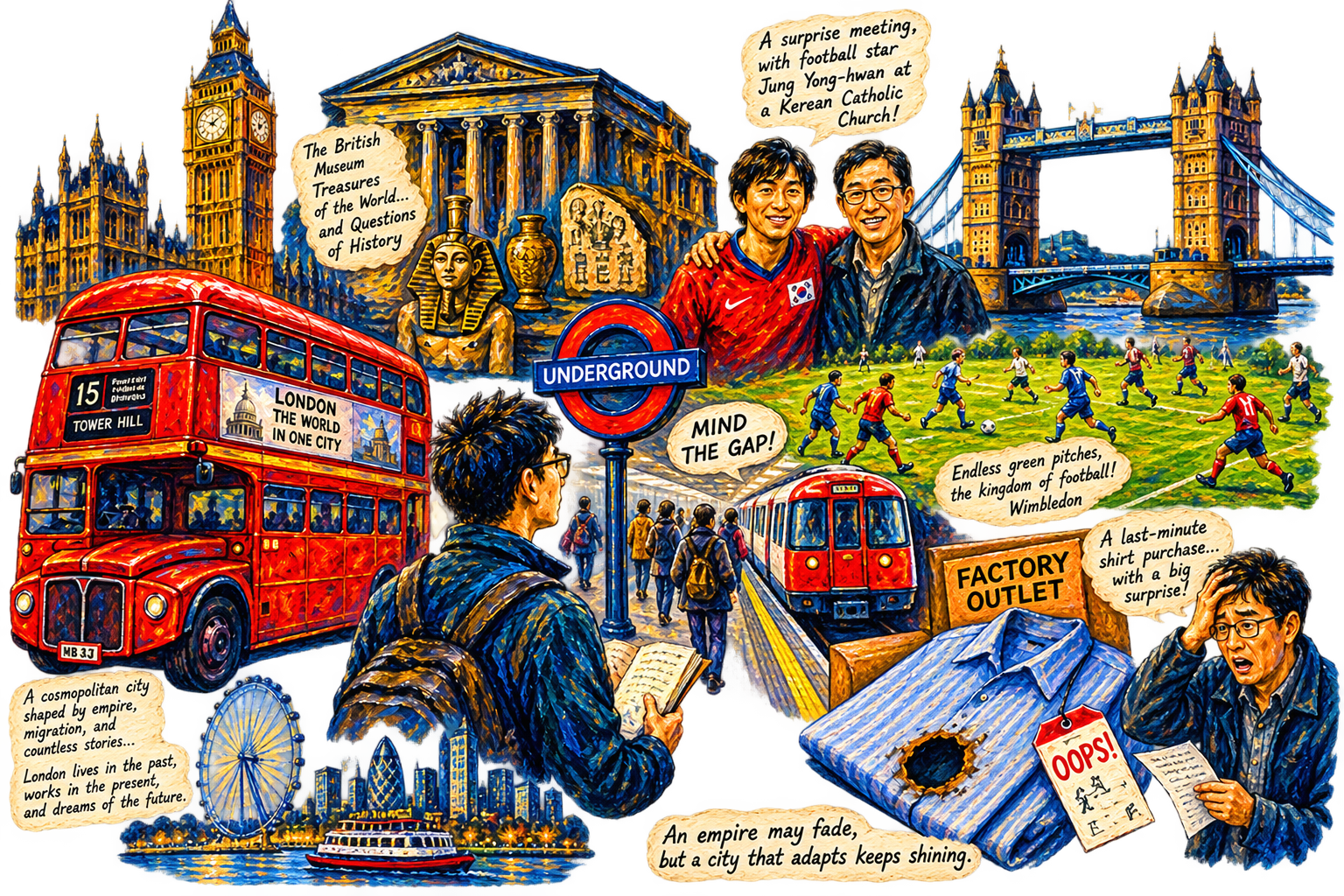
Image credit: Illustration generated with OpenAI’s ChatGPT image-generation tool, 2026.
런던: 세계인이 어우러지는 국제도시
학문을 찾아 떠난 여정, 제국의 보물, 푸른 축구장, 그리고 아주 비싼 셔츠 한 벌
나는 1995년에 미국에서 박사과정을 끝내갈 무렵에 학위논문 주제와 관련된 연구 내용을 국제네트웍관리포럼에서 발표하기 위해 지도교수와 함께 런던을 일주일간 방문하였다.
켄사스시티를 출발하여 워싱턴 디시의 달라스공항을 거쳐 런던의 히드로공항 에서 내려 기차를 타고 런던으로 향하였다. 차창 밖으로 보이는 풍경들은 오래되고 낡은 건물들이 많아서 그런지 과거에 융성했던 나라인 영국의 전통이 느껴졌다.
영국박물관 (나는 이렇게 부르고 싶다.)은 주로 전세계에서 전쟁이나 식민지 경영을 통해 약탈한 문화재들을 잘 정리하고 비싼 입장료를 받고 있었는데, 한국관련 유물의 전시 환경이 너무 초라하였다. 좀 지나치다 싶은 것은 이집트의 미이라를 수십개 뺏어와 상설 전시하고 있는 거였다. 그 외에도 전세계에 퍼져있는 식민지들로부터 약탈한 문화재들을 전시하고 있었는데 나의 상식으로는 쉽게 받아들여지지 않았다.
시간을 내어 런던 외곽에 있는 한인 성당을 방문하였는데, 나는 거기서 한국축구국가대표였던 정용환선수를 우연히 만났고 기념사진도 함께 찍었다. 한국 음식이 그리워 물어물어 한국식당 아리랑에도 가 보았는데, 음식은 별로 맛이 없고 가격은 상당히 비쌌었다. 영국과 독일음식이 특히 유럽에선 맛이 없다고 소문이 나있다는 말은 익히 들어온 터 였지만 정말 일반적으로 영국음식은 한결같이 맛이 없었다.
런던의 명물 2층버스는 부지런히 관광객을 싣고 돌아다니고 있었으며, 시승감은 좋았으며, 버스 옆과 뒤에 부착된 많은광고 포스터도 볼 만하였다. 2층에서는 차창 밖으로 높은 위치에서 구경을 하기 때문에 보다 효율적인 관광을 할 수 있었다. 지금도 기억이 나는데 우연히 차 안에 붙은 차내흡연 벌금 500파운드라는 상당한 벌금 액수였다.
세계에서 가장 오래되고 규모가 큰 지하철인 London Underground는 터널의 모양 때문에 Tube라는 애칭으로 불리는데 그 복잡한 노선에도 불구하고 출발이나 도착 시간이 정확하고 아주 정확하게 운행되고 있었다. 특히, 안전 때문에 지하철 객차가 설 때 마다 “Mind the gap!”하는 안내 방송이 나왔는데, 나는 나중이 그 것이 객차와 플랫폼 사이의 틈에 승하차시 몸이 끼일 수 있기 때문에 조심하라는 “Watch the gap!” 임을 아는 데는 한참의 시간이 걸렸다. Tube를 탈 때 특히 주의해야 할 일은 꼭 볼일를 먼저 집이나 호텔에서 보아야 한다는 것이다. 역에는 화장실이 없기 때문에 급한 김에 Tube를 그냥 타다가는 때로는 아주 곤란해 질 때가 있는데, 나도 런던에서 윔블든을 다녀 오는 길에 한번 경험하였다. 테니스로 유명한 윔블든을 다녀오면서 느낀 것은 차창 밖으로 끊임없이 전개되는 동네 축구장들이었다. 많은 사람들이 정말 축구의 종가 나라 답게 잔디 축구장에서 축구를 한가롭게 즐기고 있었다. 열렬한 축구 팬인 나로서는 정말 끝없는 잔디구장들이 너무 부러웠다.
한가지 놀란것은 거리를 걸어 다니는 사람들 (관광객을 제외한 런던 거주민들인 듯한 사람)의 인종구성이 아주 다양하고 특히 아프리카인들이 많았는데, 런던이 이러한 다양한 인종의 집합소가 된데는 영국이 제국주의를 팽창시키면서 융성하던 시절 영연방 국가로 편입된 식민지들에서 온 사람들이라는 함께 간 친구의 설명에 이해가 갔다. 그런 때문인지 식민지에서 런던에 무작정 살러 온 사람들은 때로는 주류사회에 동화되기 힘들어 범죄를 저지르거나 어수룩한 관광객을 소매치기로 전락하는 경우가 많다고 한다.
런던의 물가는 비싼 편이었으며 체감하기로는 당시 미국 물가의 1.6배 정도로 꼭 달러와 파운드의 교환비율 같았다. 하기야 하루가 다르게 영연방의 국가들은 영국으로부터의 자주권을 주장하고 과거 ‘해가 지지 않는 나라’ 였을 때의 명성은 이제 간데가 없으니 그럴 만도 하였다. 조그만 섬 나라에 인구는 많고 날씨를 비롯한 자연환경이 매우 척박하니 국토면적이 광활하고 물자가 풍족한 미국하고는 비교가 되지 않는 것 같았다. 그러나 부자는 망해도 3대가 간다고 과거의 식민지 경영으로부터 시작한 식민지 무역의 중심지로서의 배운 경험을 바탕으로한 유럽의 국제 금융 및 비지니스와 세계 관광의 중심지로 런던은 그 명맥을 유지하고 있는 것 같았다.
영국 왕정과 시민혁명의 역사가 고스란히 깃든 웨스터민스터와 잘 알려진 런던 브리지는 볼 만하였다. 테임스 강을 끼고 발달된 도시의 경관은 오밀조밀하였는데, 늦은 저녁 강변 주변의 다리 밑은 해독하기 힘든 낙서와 진동하는 악취로 걸어 다니기 힘들어 런던의 또 다른 면을 느끼게 되었다. 영국사람의 집은 城(castle)이라고 하는 데, 들리는 말로는 대를 물려가며 조금씩 증축 또는 개축 또는 유지보수를 통하여 성을 계속 관리한다는 거였다. 자원재활 및 녹색환경 실천을 위해서는 좋은 일이 아닌가 한다.
여행을 하다 보면 나의 경우 항상 가족들이나 친구 친지들의 선물에 신경쓰지 않을 수가 없는데, 여기 한 에피소드를 소개하기로 한다. 나의 친구 몇이서 런던 근교의 factory outlet store를 가자고 제안하였다. 친구 중의 하나는 자신은 꼭 주어진 “숙제”를 해야 한다며 저녁에 런던 히드로공항에서 출발하는 비행기 시간을 감안하더라도 오후시간을 이용하여 그 곳에 충분히다녀 올 수 있다는 거였다. 가게에 도착했더니 폐점까지 15분이 남은 상태였고 내 친구는 급한 김에 셔츠를 샀는데 그냥 돈을 지불하고 나중에 한국에 와서 풀어 보았더니 셔츠에 큰 담배불 구멍이 있더란다. 어떻게 된 영문인지는 모르겠으나 부인에게 숙제 점수를 잘 받으려다가 큰 낭패를 당하고 말았다는 이야기를 듯고서 웃어야 할지… . 이러한 에피소드 때문에 히드로공항으로 돌아와 비행기를 탑승하는 것도 정말로 아슬아슬하였다. 나는 다시는 이런 무모한 행동을 하지 않겠다고 마음 먹었다.
런던이 세계의 중심도시라고는 하지만 적어도 런던은 유럽의 중심도시로서는 손색이 없었다. 짧은 시간에 여러가지를 보고 경험하려 하였으나 쉽지 않았다. 짧은 여행을 통해 느낀 점은 여전히 런던은 세계의 중심도시 중의 하나로서 관광객을 끄는 매력이 있는 도시임에는 틀림이 없다는 점이었다. +++
참고: London
http://en.wikipedia.org/wiki/London
2010년 9월 16일
About the Author

Prof. Dr. Young Choi (Editor-in-Chief) — Regent University
Full list of his K-GSP columns:
https://www.k-gsp.org/t/columnist_young_choi
Full list of his Books at Amazon.com
Young B. Choi is a Professor in the Department of Engineering & Computer Science at Regent University. He published 38 books with ‘Selected Readings in Cybersecurity’ (2018) (over 800 copies archived globally at university/college libraries around the world) and ‘Cybersecurity Applications and Artificial Intelligence’ (2023) available in seven major world languages. He proposed the world’s first global and universal telecommunications “Service Order Handling (SOH)” Model (T-SOH Model) (1995) with Dr. Adrian Tang. With this innovative research work, he received the IEEE NOMS ’96 Best Paper Award and became the first recipient of the Outstanding Contribution Award of the TeleManagement Forum in 1998. His research areas include Natural Language Processing-focused AI, AI-applied cybersecurity, network and telecom service management, and Korean studies on Gani Choi Rip’s Jeonggwan (靜觀: Quiet Contemplation) philosophy and Shilhak ( 實學: Practical Learning).
Suggested Citation
Choi, Y. B. (2026). London: A Cosmopolitan Metropolis - An Academic Pilgrimage, Imperial Treasures, Football Fields, and One Very Expensive Shirt. K-GSP Forum.
한글 초록
이 수필은 필자가 1995년 박사학위 과정을 마무리하던 무렵, 학위논문 관련 연구를 발표하기 위해 지도교수와 함께 일주일간 런던을 방문했던 경험을 유머와 풍자로 풀어낸 여행기이다. 영국박물관에 전시된 세계 각국의 문화유산과 한국 관련 유물의 전시 환경을 비교하며 식민주의와 문화재 소유권의 문제를 성찰하고, 한인 성당에서 우연히 만난 전 국가대표 축구선수와의 추억, 기대에 미치지 못했던 한국 음식, 런던의 명물인 2층 버스와 지하철의 편리함을 생생하게 묘사한다. 특히 ‘Mind the gap!’이라는 안내 방송과 지하철 이용 중 겪은 난처한 경험, 윔블던 주변에 펼쳐진 푸른 축구장에 대한 부러움, 다양한 이민자들이 어우러진 런던의 다문화적 풍경을 통해 도시의 일상과 역사적 배경을 흥미롭게 조명한다. 또한 높은 물가와 제국의 유산, 템스강 주변의 명암, 세대를 거쳐 주택을 보존하고 개조하는 영국의 생활문화 등을 관찰하며 과거의 영광이 현대 런던의 국제 금융·비즈니스 및 관광 경쟁력으로 어떻게 이어지는지 살펴본다. 무엇보다 출국 직전 공장형 아울렛에서 서둘러 구입한 셔츠에 담배불 구멍이 나 있었다는 일화를 통해 여행의 허점과 인간적인 실수를 해학적으로 드러낸다. 이 여행기는 런던의 역사적 위상과 세계도시로서의 매력을 인정하면서도, 식민주의의 유산과 현대 도시생활의 모순을 비판적으로 바라본다. 궁극적으로 런던의 진정한 경쟁력은 과거의 영광 자체가 아니라 역사적 경험을 바탕으로 변화에 적응하고 세계의 다양한 문화를 연결하는 능력에 있음을 강조한다.
핵심어: 런던, 여행기, 세계도시, 영국박물관, 식민주의, 문화유산, 다문화주의, 런던 지하철, 축구 문화, 국제 금융
© K-Global Scholars and Professionals Forum. All rights reserved. 2026. Content published in the K-GSP Forum may not be reproduced, distributed, or transmitted in any form without prior written permission from the K-GSP Forum, except for brief quotations with full attribution.