

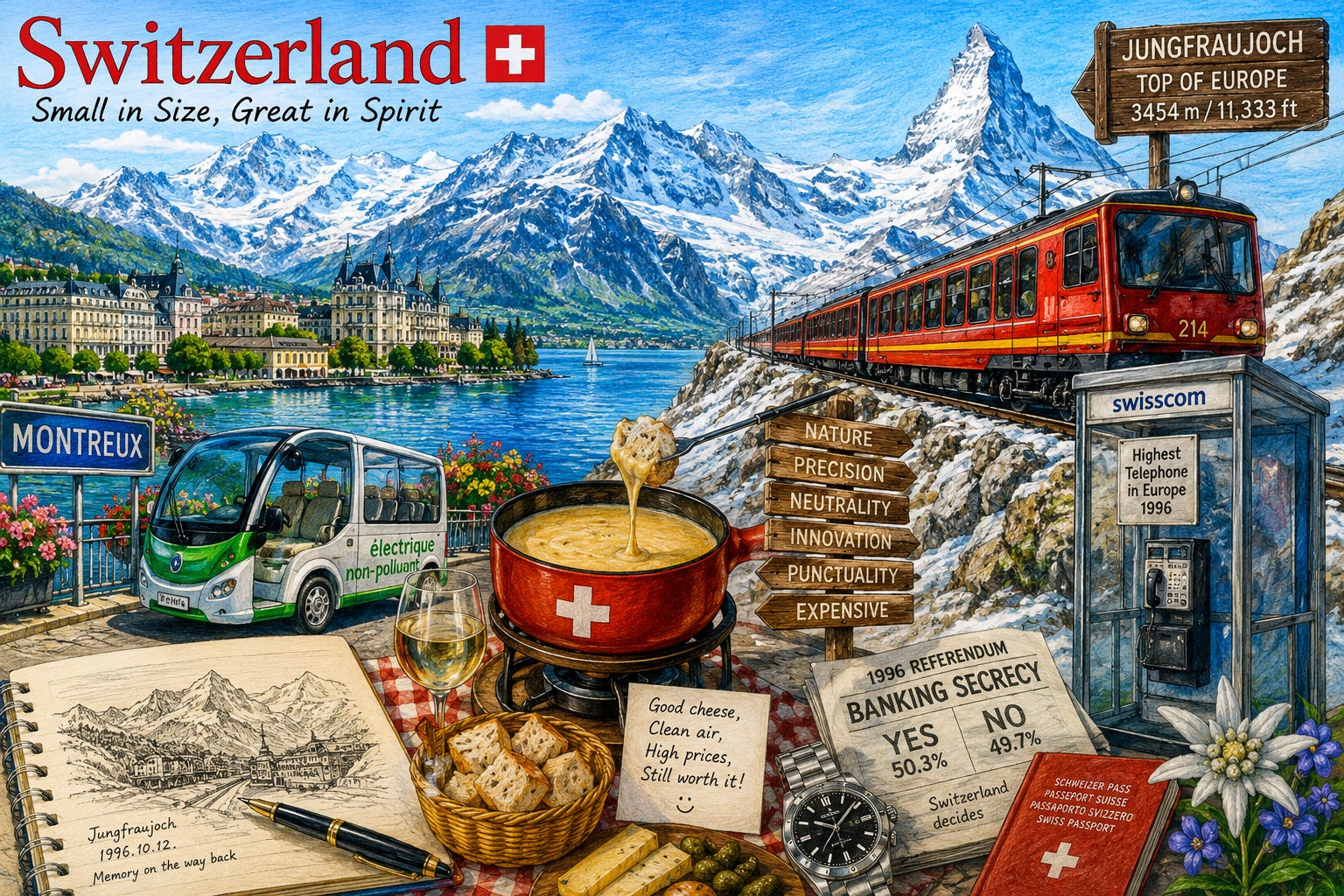
Image credit: Illustration generated with OpenAI’s ChatGPT image-generation tool, 2026.
Switzerland: A Small Country with a Remarkably Large Reputation
Alpine Grandeur, Precision Engineering, Expensive Fondue, and the Art of Staying Neutral
Abstract
Switzerland is a small European nation with an extraordinarily large international reputation. Famous for its magnificent mountains, precision watches, financial institutions, political neutrality, and efficient transportation, it demonstrates that national influence does not necessarily depend on geographical size. During a visit to Montreux in October 1996, I encountered a country of extraordinary natural beauty, impressive engineering, and prices capable of making an ordinary tourist reconsider his financial philosophy. A journey to Jungfraujoch, the celebrated high-altitude destination in the Swiss Alps, left me with unforgettable memories of snow-covered peaks, glaciers, mountain railways, multilingual announcements, and a telephone booth perched remarkably high above sea level. Switzerland also prompted reflections on financial secrecy, immigration, national defense, and the sometimes uncomfortable relationship between economic necessity and social acceptance. Combining personal recollections with humor and social satire, this essay explores how a small nation surrounded by larger powers became a symbol of both practical ingenuity and national self-confidence.
Keywords: Switzerland, Montreux, Jungfraujoch, Swiss Alps, precision engineering, political neutrality, banking secrecy, immigration, social satire, travel writing2026.
A Small Country That Refuses to Think Small
Switzerland is a beautiful country. Much of its territory is mountainous, its towns seem to have been arranged by someone with an unusually refined sense of aesthetics, and its lakes reflect the surrounding scenery so perfectly that one occasionally suspects nature has been practicing for a postcard competition.
Geographically, Switzerland is a relatively small European nation. Yet its international reputation is considerably larger than its territory might suggest. It is known for precision watches, excellent engineering, financial institutions, political neutrality, efficient public transportation, and mountains that seem determined to touch the sky.
I had an opportunity to visit Montreux in October 1996, when I attended an academic conference. The experience introduced me to a country that seemed to have perfected the art of making a small geographical space perform a remarkable number of impressive functions.
Switzerland had mountains for scenery, lakes for reflection, railways for transportation, watches for measuring time, and banks for keeping track of money. It also had a reputation for neutrality, which seemed particularly useful in a continent where neighboring countries had occasionally demonstrated an enthusiasm for disagreeing with one another.
A Swiss watch might lose only a few seconds in a year, while European political arrangements could change considerably faster. The Swiss, however, appeared to prefer precision in their machinery and caution in their national affairs.
I came away with the impression that Switzerland had discovered an important principle: a country does not have to be large to be influential. It merely needs to identify what it does well, do it consistently, and persuade the rest of the world that the result is worth paying for.
As I would soon discover, the last part of that principle was particularly well developed.
Environmental Consciousness Before It Became Fashionable
One of my early impressions was Switzerland’s concern for environmental preservation. For a country whose tourism industry depends heavily on mountains, lakes, forests, and clean air, protecting the natural environment is not simply an act of generosity. It is also sound economic judgment.
A beautiful landscape attracts visitors. A damaged landscape attracts complaints.
Even in 1996, I saw electric vehicles operating in tourist areas. They moved quietly and comfortably, without the familiar noise and exhaust associated with conventional automobiles. Their speed was not particularly impressive, but speed did not seem to be the principal objective.
In fact, I began to wonder whether the vehicles were intentionally moving slowly so that passengers would have sufficient time to appreciate the scenery. Perhaps the Swiss had concluded that a tourist who travels too quickly through a beautiful place is merely paying for the privilege of missing it.
There was something refreshing about this approach. Modern societies often measure progress by the speed at which people can move, the number of devices they can purchase, and the quantity of noise they can produce. Switzerland seemed willing to consider another possibility: progress might also mean reaching one’s destination without disturbing everyone along the way.
Environmental protection is not an exclusively Swiss virtue, and the country has its own environmental challenges. Nevertheless, what impressed me was the visible effort to reconcile tourism with the preservation of the scenery that makes tourism possible.
Switzerland was also widely recognized for precision manufacturing, especially watchmaking. Yet its economic strength extended well beyond watches. Its industries, transportation systems, and technical capabilities reflected a broader culture of engineering competence.
I could not help wondering whether a nation that had learned to manufacture remarkably accurate watches had also learned to organize its daily affairs with similar care. The answer, as I would discover, depended partly on whether one was examining a railway timetable or a restaurant bill.
Fondue: A National Treasure That Failed to Conquer My Taste Buds
No visit to Switzerland would seem complete without sampling fondue, one of the country’s best-known culinary traditions. People told me that I simply had to try it. Their enthusiasm was so persistent that I began to suspect eating fondue was not merely a dining recommendation but a matter of national duty.
Fondue is traditionally prepared by melting cheese, often with wine and seasonings, in a communal pot. Diners dip pieces of bread into the warm mixture, enjoying a meal that encourages conversation and shared participation.
The arrangement is appealing. Instead of everyone concentrating on a separate plate, people gather around one pot. It is an excellent demonstration of cooperation, provided everyone agrees about what tastes good.
Unfortunately, my own taste buds declined to participate in the national consensus. I tried fondue, but it did not become one of my favorite dishes. The Swiss might have perfected watches, railway engineering, and financial administration, but they had not yet persuaded my palate to recognize melted cheese as a culinary revelation. I admired the tradition even though I was not converted by the meal.
Perhaps this is one of the pleasures of international travel. We learn that other people can be intelligent, sophisticated, and entirely reasonable while enjoying food that we ourselves would not voluntarily order a second time. I would not presume to judge Switzerland by my personal response to fondue. That would be like judging American civilization by its fast food or evaluating an entire nation by the quality of its airport coffee.
Still, if fondue is a national treasure, I must confess that I returned home without requesting a second helping. My gratitude to Switzerland was sincere. My appetite, however, remained diplomatically neutral.
Montreux: Where the Lake Meets the Mountains
Montreux was one of the most memorable parts of my visit. Situated beside Lake Geneva, known in French as Lac Léman, the town enjoys a magnificent setting of blue water, surrounding mountains, and historic buildings.
The scenery seemed almost too carefully composed. The lake provided the foreground, the mountains supplied the background, and the buildings connected the two with an elegance that would have impressed a professional landscape painter. One could easily understand why visitors were attracted to the region. Montreux offered the rare combination of natural beauty and an atmosphere suitable for leisurely exploration.
I found myself wishing that I had brought a sketchbook and more time. Photographs can preserve a view, but drawing requires a person to study it. A pencil forces the eye to notice the shape of a mountain, the line of a roof, the angle of a shoreline, and the relationship between light and shadow. A camera can take a picture before its owner has properly looked at the subject. A sketchbook is less forgiving. It requires the traveler to remain present long enough to discover what he is looking at.
Unfortunately, academic conferences operate according to a different philosophy. Their schedules are usually designed to ensure that participants spend a considerable amount of time indoors discussing subjects that may have been inspired by the outside world. I had come to Switzerland for an academic meeting, not a painting holiday. Nevertheless, Montreux left me with the feeling that the conference organizers had selected a place capable of competing successfully with their own program.
The lake, the mountains, and the historic surroundings offered a reminder that knowledge does not always arrive in the form of a presentation. Sometimes it comes quietly, through the experience of standing beside a beautiful lake and realizing that one’s next appointment can wait for a few more minutes.
Jungfraujoch: Engineering Takes a Train to the Roof of Europe
My most unforgettable excursion was the journey to Jungfraujoch, the celebrated high-altitude destination in the Swiss Alps often promoted as the “Top of Europe.” Jungfraujoch is a high mountain saddle between the Jungfrau and Mönch, where the railway station reaches an elevation of approximately 3,454 meters, or 11,332 feet. It is recognized as Europe’s highest railway station (Jungfrau Railways, n.d.-a; High Altitude Research Stations Jungfraujoch and Gornergrat, n.d.).
Getting there was an engineering experience as much as a sightseeing adventure.
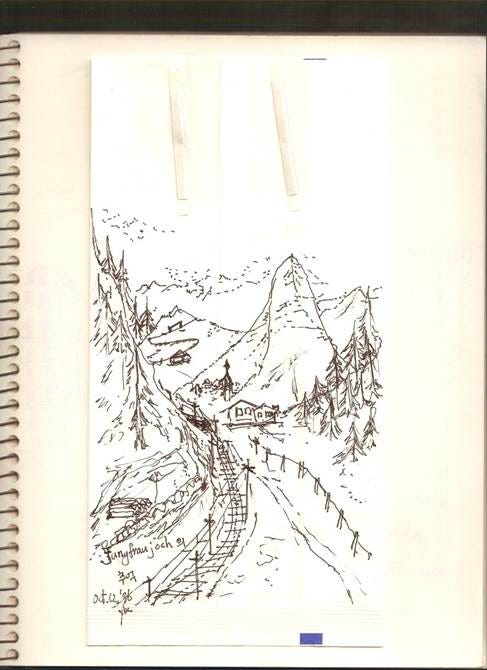
Jungfraujoch Revisited
A personal sketch drawn in fountain pen on an airline airsickness bag during the return flight, October 12, 1996.
The Jungfrau Railway opened in 1912 after an extraordinary construction project involving tunnels through the Eiger and Mönch mountains. Its route includes approximately seven kilometers of tunnel, allowing passengers to reach a destination that would otherwise be difficult to access (Jungfrau Railways, n.d.-b).
The mountain railway climbed through increasingly dramatic terrain, carrying passengers toward a world of steep slopes, towering peaks, and magnificent Alpine scenery. On the rack railway sections, a special toothed rail system helped the train negotiate steep gradients that would be difficult for an ordinary railway to manage. Watching the small train advance into the mountains, I found myself admiring the determination of the engineers who had designed such a system.
Mountains generally do not welcome transportation projects. They are solid, steep, and indifferent to the convenience of tourists. Yet engineers had devised a way to bring people into this formidable environment without requiring everyone to become a mountaineer. The train seemed to demonstrate a practical truth about engineering: when nature presents a difficult problem, one can either complain about the problem or design a machine capable of dealing with it.
The views along the route were spectacular. Mountains rose sharply on either side, and the scenery changed as the railway climbed higher. Words alone cannot adequately convey the scale of the landscape. The mountains appeared both magnificent and slightly unreasonable, as though they had been built by a geological contractor who had never heard of moderation.
As the train approached its destination, I became increasingly aware that this was not an ordinary railway journey. It was a carefully constructed passage into an environment where altitude, ice, rock, and weather imposed conditions that no amount of human enthusiasm could simply ignore. The engineering achievement was impressive precisely because the natural obstacles were so formidable.
I was also delighted by the multilingual announcements aboard the train. Information was provided in several languages, including English, German, Italian, French, Japanese, and Korean. Hearing Korean in the middle of the Alps was especially welcome. For a moment, the mountains seemed less distant from home. Tourism, I realized, had developed its own form of international diplomacy. A country might have disagreements with other governments, but a tourist railway could still find it commercially sensible to tell visitors from many nations where they were going.
The Swiss had understood that international hospitality required more than beautiful scenery. Visitors also needed to know when to get off the train, where to go next, and how not to become accidentally stranded on a mountain. That was diplomacy in practical form.
A Telephone Booth at an Extraordinary Elevation
At Jungfraujoch, I encountered several remarkable sights. Snow and glaciers surrounded the high mountain landscape, and the facilities included an artificial ice tunnel or ice palace carved into the frozen environment. Modern visitor facilities continue to offer access to the Alpine scenery and the surrounding glacier landscape (Jungfrau Railways, n.d.-a).
The railway station itself was astonishing. It seemed almost unbelievable that a passenger train could reach such an elevation and deliver ordinary visitors into a world of ice and rock.
Yet one small object attracted my attention in a particularly memorable way: a telephone booth. There it stood, high in the mountains, apparently ready to help someone communicate with the outside world. I remember being told that the installation was among the highest-altitude locations for a conventional wired telephone service at the time. I have not been able to verify that it held a world record, so I preserve this detail as a recollection rather than a confirmed historical fact.
Imagine climbing to an elevation of more than 3,400 meters, looking out over snow-covered peaks and glaciers, and deciding that the next important thing to do is make a telephone call. Perhaps someone needed to tell a family member that the train had arrived. Perhaps a businessperson needed to discuss a meeting. Perhaps a traveler simply wanted to say, “I am standing on top of the world, and the weather is cold.” The mountains had taken millions of years to form, but a telephone call could be completed in minutes. The telephone booth was a charming symbol of modern civilization. It suggested that human beings could climb almost anywhere, provided someone remembered to install the necessary infrastructure.
I later preserved my memory of Jungfraujoch in a small drawing made with a fountain pen on an airline airsickness bag during my return flight. Dated October 12, 1996, the sketch was an improvised souvenir of the journey. The choice of drawing surface was hardly elegant, but inspiration does not always wait for a proper sheet of paper. A landscape can remain in the mind long after the tourist has left it, and sometimes the nearest available object becomes an artist’s notebook.
I still find something amusing about the contrast. I had visited one of Europe’s most spectacular mountain destinations, yet the lasting record of my experience was drawn on an object designed for passengers who were having a rather different sort of travel experience. Art, like engineering, often succeeds by making the best of available resources.
Switzerland’s Other Mountain: The Cost of Being a Tourist
If Jungfraujoch demonstrated what engineering could accomplish, the cost of getting there demonstrated what a successful tourist economy could charge. Switzerland was expensive. Hotel rooms, food, and transportation all placed considerable pressure on a visitor’s budget. Transportation costs were particularly memorable.
The country had developed an impressive railway network that could carry passengers into mountain regions that would otherwise be difficult to reach. Such infrastructure required considerable investment, maintenance, and technical expertise. I understood that providing these services was not inexpensive.
Understanding a price, however, does not necessarily make paying it more pleasant. A tourist may admire an engineering achievement and still experience a small financial crisis when purchasing the ticket required to enjoy it. The Swiss railway system seemed to have mastered two different forms of elevation. The train raised passengers toward the mountain peaks, while the fares raised their awareness of the limits of their bank accounts.
I occasionally wondered whether the cost of transportation was calculated according to distance, altitude, engineering complexity, or the number of breathtaking views available along the route. Perhaps the formula included all four. The higher one traveled, the more impressive the scenery became. Unfortunately, the bill could also become increasingly impressive. There is a certain logic to this arrangement. A country with extraordinary scenery and excellent transportation infrastructure can attract large numbers of visitors. Demand helps sustain the system, while the costs of maintaining it must be covered somehow.
Still, the experience gave me a useful lesson in tourism economics. Natural beauty may be free in principle, but reaching the best places to appreciate it can be surprisingly expensive. Switzerland had found a way to turn geography into an economic asset without pretending that the mountains were easy to manage.
For the budget-conscious traveler, the result was a memorable combination of wonder and arithmetic. I left Switzerland with admiration for its engineering and a renewed appreciation for the financial advantages of walking—at least on level ground.
The Swiss Reputation for Secrecy
Switzerland’s international reputation extends well beyond mountains, watches, and railways. Its financial institutions, particularly the tradition of banking secrecy, have long occupied a prominent place in the public imagination.
The subject has an uncomfortable side. Swiss banking secrecy historically attracted clients who valued confidentiality, but secrecy could also be used to conceal questionable wealth and financial misconduct. The relationship between privacy and accountability has therefore been an important issue in international financial policy.
In popular discussions, Switzerland sometimes appears as a place where powerful people can store their money safely while the rest of the world attempts to discover where it came from.
One could almost imagine a fictional conversation between a wealthy dictator and his banker.
“Can you keep my money confidential?” the dictator might ask.
“Certainly,” the banker might reply. “We are famous for discretion.”
“And can you explain where it came from?”
“Sir, that is a different department.”
This imaginary exchange is satire, not a quotation or a description of any particular bank. Its point is that confidentiality, although legitimate in many circumstances, can become morally questionable when it shields wealth obtained through corruption, repression, or other abuses. A financial institution cannot be judged solely by the precision of its accounting. The origin and consequences of the money also matter.
A historical example illustrates how seriously Switzerland has debated the issue. On May 20, 1984, Swiss voters rejected a popular initiative titled Against the Abuse of Bank Secrecy and the Power of Banks. Approximately 73.04% voted against the proposal, while 26.96% supported it (Swissvotes, n.d.). The result was not a narrow victory for reform or a close decision to preserve secrecy. It was a decisive rejection of the proposed changes.
I recall hearing accounts of a later public debate over whether Switzerland should continue practices associated with controversial foreign wealth. However, I have not been able to verify a specific referendum matching that recollection in 1996, nor the reported narrow result. It would therefore be misleading to present that story as an established event.
Switzerland’s financial policies subsequently faced increasing international pressure. In March 2009, the Swiss Federal Council announced its intention to adopt the OECD standard for administrative assistance in tax matters, permitting information exchange in individual cases involving specific and justified requests. The government emphasized at the time that this did not mean banking secrecy had simply disappeared (Swiss Federal Council, 2009).
Switzerland’s financial history illustrates a broader dilemma faced by successful societies. A policy may be economically advantageous while creating moral complications that cannot be resolved simply by calculating its profitability. Precision is an admirable quality in banking. Ethical judgment, however, requires more than accurate arithmetic.
The Welcome Mat and the Locked Door
Another aspect of Switzerland that interested me was its approach to immigration and permanent residence. I had heard that naturalization could involve demanding procedures and substantial participation by local communities. Switzerland has indeed historically included municipal and cantonal dimensions in its citizenship system, although the requirements have changed over time and vary according to the applicable law.
According to the Swiss State Secretariat for Migration, ordinary naturalization generally requires ten years of residence and a permanent residence permit, together with successful integration and familiarity with Swiss life. Cantons and communes have responsibilities in the naturalization process and may impose additional requirements within the legal framework (State Secretariat for Migration, n.d.).
The underlying idea is understandable. Switzerland is a small country with distinct linguistic, cultural, and regional traditions. Its political system places considerable importance on local communities, and citizenship involves more than a simple administrative transaction.
Yet the arrangement raises an interesting question when considered alongside the country’s labor needs. Switzerland’s prosperous economy has long attracted workers from neighboring European countries, including Italy, France, and other parts of Europe. Cross-border commuting has become an important feature of life in some Swiss regions. Workers can live in one country and travel to another to earn their living. This creates an arrangement that is economically practical but socially complicated.
A worker may be welcome to arrive early in the morning, perform valuable work throughout the day, contribute to the economy, and return home in the evening. Whether that worker can eventually become a permanent member of the political community is a separate question.
One can imagine Switzerland addressing an imaginary foreign worker in the following manner: “We are delighted that you have come to help build our prosperity. Your skills are excellent, your work is valuable, and your contribution is appreciated. Please report for duty at eight o’clock. As for becoming one of us, we shall need to discuss the matter with the appropriate community.” The joke exaggerates the distinction between economic participation and political belonging, but the distinction itself deserves attention.
Countries have legitimate reasons to regulate immigration and establish citizenship requirements. Language, civic knowledge, legal status, and integration can all be relevant. The difficulty arises when a society needs people’s labor but treats their long-term membership as a separate matter that may remain difficult to obtain.
Switzerland’s approach should not be reduced to a caricature of hostility toward foreigners. Its immigration system has evolved, and its international agreements, labor markets, and citizenship laws are more complex than a tourist’s brief observations can capture.
Still, the contrast between welcoming workers and carefully controlling citizenship offers a useful lesson. Economic interdependence can develop faster than social acceptance. A country may depend on people whom it has not yet decided to regard as permanent members of its community. This is not uniquely Swiss. Many prosperous societies face the same tension, including the United States.
Perhaps the real question is not whether a nation should have borders. Every functioning political community must define some form of membership. The more difficult question is how fairly it treats those who contribute to its prosperity while standing outside the boundaries of full citizenship.
Neutrality Is Not the Same as Being Unprepared
Switzerland’s position as a small, traditionally neutral country surrounded by larger European powers presents another fascinating challenge: national defense. Neutrality may reduce the likelihood of becoming directly involved in certain international conflicts, but it does not eliminate the need to prepare for danger.
Switzerland has a long tradition of armed neutrality and a citizen-based military system. Its militia principle remains an important part of its defense arrangements. According to the Swiss Armed Forces, compulsory military service applies to male Swiss citizens, while women may serve voluntarily. Military personnel participate in regular training, reflecting the country’s longstanding emphasis on preparedness (Swiss Armed Forces, 2022).
I had heard stories suggesting that Swiss households were equipped for emergencies with food, medical supplies, and, in some cases, firearms. I did not personally inspect Swiss homes, so I cannot confirm the particular household arrangements described to me. Emergency preparedness and military service should also not be confused with a universal requirement for every household to keep weapons. Nevertheless, the broader national philosophy impressed me.
Switzerland appeared to have understood that neutrality was not a substitute for responsibility. A country could avoid unnecessary confrontation while still maintaining the capacity to protect itself.
In this respect, Swiss neutrality resembled a sensible form of personal independence. A person who wishes to live peacefully should not necessarily spend every day looking for a fight, but neither should that person assume that good intentions will solve every practical problem. The Swiss approach suggests that peace requires institutions, preparation, and public commitment, not merely the hope that other countries will behave well.
There is a quiet irony here. Switzerland’s international image often emphasizes tranquility: orderly towns, beautiful lakes, punctual trains, and people tending flowers beside their windows. Behind that peaceful appearance lies a serious historical concern with national survival. A small country can be peaceful without being careless. Indeed, its ability to remain peaceful may depend partly on its willingness to take the possibility of danger seriously.
The Chalet: A Small House with a Large Sense of Peace
Among the most charming features of Switzerland are its traditional chalets. These houses, often associated with Alpine architecture, are recognizable by their sloping roofs, wooden construction, balconies, and decorative details. Their appearance varies by region, and modern examples may differ considerably from older rural buildings.
What particularly attracted me was the custom of decorating homes with flowers. A chalet with colorful blossoms arranged along its windows or balcony seems to express a quiet affection for everyday life. The flowers do not need to be spectacular. Their beauty comes from the care devoted to them and from the way they complement the surrounding landscape.
After seeing the imposing mountains, the elaborate railway infrastructure, and the country’s formidable international reputation, I found something especially appealing about these modest domestic details. A mountain may inspire awe, but a flowerpot suggests that someone has taken time to care for a small corner of the world.
Perhaps this is one reason Switzerland remains so attractive to visitors. Its appeal does not depend exclusively on grand scenery. It also comes from the relationship between the landscape and ordinary human activity. The flowers beside a chalet window are a small reminder that civilization is built not only through industrial achievement, financial institutions, and national defense, but also through the everyday habits that make a place pleasant to inhabit.
Of course, even flower arranging may require some discipline. One imagines that the Swiss would prefer the flowers to be healthy, the balcony orderly, and the watering schedule observed with reasonable punctuality. I have no evidence that Swiss flowers grow according to railway timetables. Yet after my visit, I would not have been entirely surprised to discover that they were expected to do so.
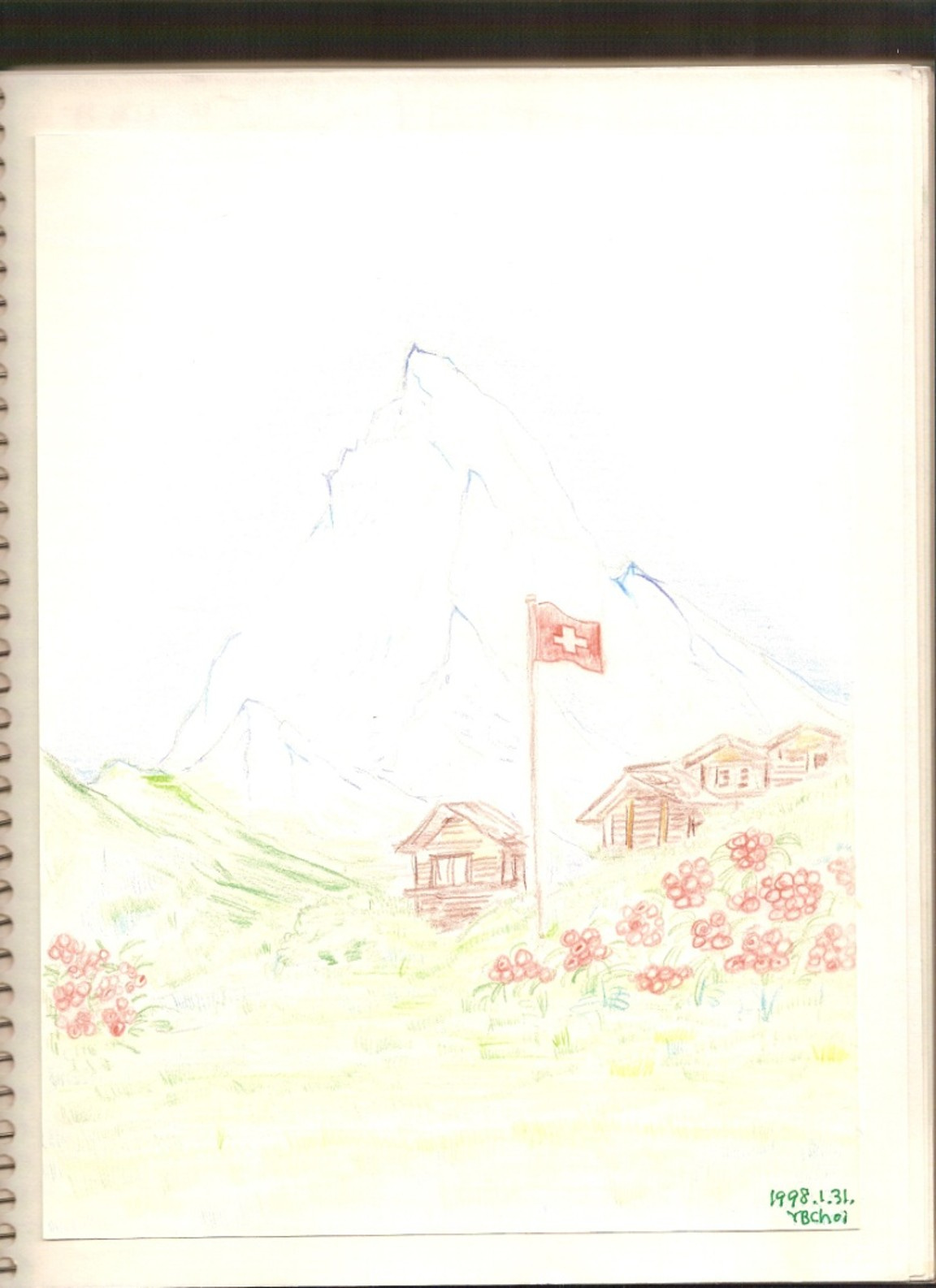
Swiss Mountains
A colored-pencil drawing recalling Jungfraujoch, featuring a traditional Swiss chalet, the Swiss flag, and Alpine wildflowers, January 31, 1998.
A Small Nation, a Large Lesson
My visit to Switzerland in October 1996 left me with lasting memories of Montreux, Lake Geneva, the magnificent Alpine scenery, and the remarkable railway journey to Jungfraujoch. I remember the multilingual announcements, the ice formations, the extraordinary elevation of the railway station, and the telephone booth that seemed to connect the high mountains with the ordinary concerns of everyday life.
I also remember the fondue that failed to win my heart, the transportation expenses that challenged my budget, and the questions raised by the country’s reputation for financial secrecy, its approach to citizenship, and its commitment to national defense. These memories have remained meaningful because Switzerland was more than a beautiful destination. It was a study in contrasts.
A small country could possess considerable international influence. A society committed to peace could prepare seriously for conflict. An economy dependent on international labor could maintain demanding rules for citizenship. A nation celebrated for precision could still face difficult ethical questions that no watchmaker’s tools could solve. The lesson is not that Switzerland has discovered a perfect formula for national success. No country has. Rather, Switzerland demonstrates that geographical size is only one measure of a nation’s capacity. Institutions, technical competence, public responsibility, cultural continuity, and the ability to adapt can matter just as much. A country does not need a vast territory to develop a distinctive identity or to make a significant contribution to the world.
There is also a lesson in the limits of efficiency. A precisely engineered railway can carry passengers toward a magnificent destination, but it cannot guarantee that every passenger will enjoy the food, approve of the ticket price, or agree with the country’s policies. Technology can solve many practical problems. Human judgment remains necessary for the rest.
And so I would like to return to Switzerland someday, this time with a sketchbook, a box of colored pencils, and enough time to travel without constantly consulting the clock. I would like to sit beside Lake Geneva, observe the chalets, study the mountain flowers, and sketch the Alpine scenery at my own pace. I might even give fondue another chance, although I would not want the Swiss government to interpret that decision as a binding declaration of cultural allegiance. Above all, I would like to experience the country without hurrying from one appointment to another.
For a nation famous for accurate watches, Switzerland has taught me an unexpectedly valuable lesson: measuring time precisely is not the same as using it wisely. Perhaps the true luxury is not reaching the highest railway station, staying in the most expensive hotel, or possessing the most accurate watch. It is having enough time to appreciate where one is, what one sees, and what one has learned.
Switzerland may be small on the map, but it occupies a substantial place in the imagination. Its mountains reach toward the sky, its railways demonstrate the power of engineering, and its institutions reveal both the achievements and the contradictions of modern society.
And if the Swiss ever decide to establish a national museum dedicated to the economics of expensive tourism, I suspect they will have no difficulty finding an appropriate location.
They can build it on a mountain.
The admission fee will be extra.
References
High Altitude Research Stations Jungfraujoch and Gornergrat. (n.d.). Overview: Research station Jungfraujoch, Switzerland. https://www.hfsjg.ch/en/jungfraujoch/overview/
Jungfrau Railways. (n.d.-a). Jungfraujoch railway station. https://www.jungfrau.ch/en-gb/arrival-at-station-car-parks/jungfraujoch-railway-station/
Jungfrau Railways. (n.d.-b). Jungfrau Railway: Rocky road to the project of the century. https://www.jungfrau.ch/en-gb/jungfraujoch-top-of-europe/construction-of-the-jungfrau-railway/
State Secretariat for Migration. (n.d.). Ordinary naturalisation. Swiss Confederation. https://www.sem.admin.ch/sem/en/home/integration-einbuergerung/schweizer-werden/ordentlich.html
Swiss Federal Council. (2009, March 13). Switzerland to adopt OECD standard on administrative assistance in fiscal matters. The Swiss Confederation. https://www.admin.ch/en/nsb?id=25863
Swiss Armed Forces. (2022, June 15). Soldiers are a part of everyday life in Switzerland. The Swiss Confederation. https://www.vtg.admin.ch/en/soldiers-are-a-part-of-everyday-life-in-switzerland
Swissvotes. (n.d.). Initiative “gegen den Missbrauch des Bankgeheimnisses und der Bankenmacht” (Bankeninitiative) [Initiative against the abuse of bank secrecy and the power of banks]. https://swissvotes.ch/vote/319.00
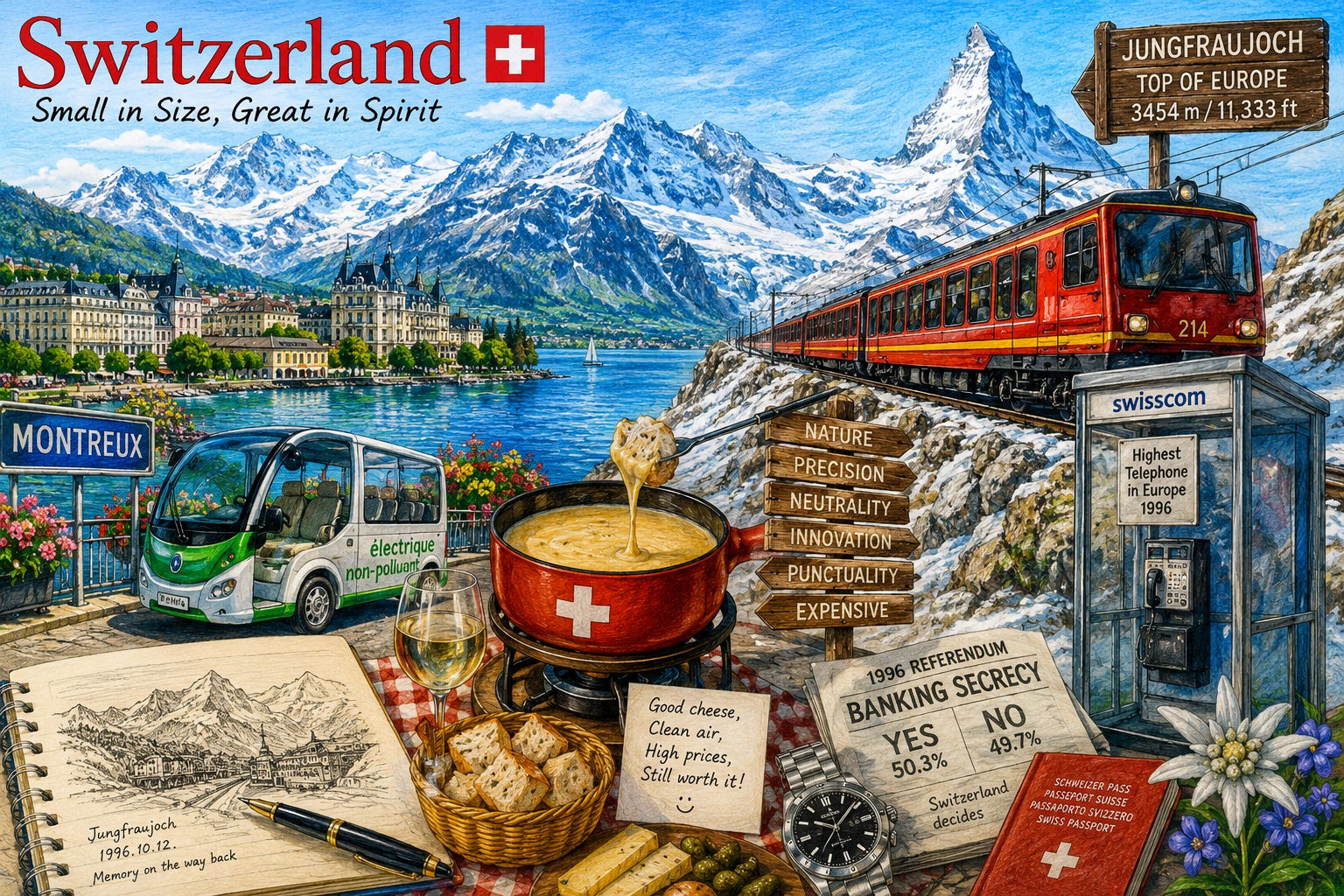
Image credit: Illustration generated with OpenAI’s ChatGPT image-generation tool,
스위스: 작은 나라, 그러나 놀라울 만큼 큰 명성
알프스의 장엄함, 정밀 공학, 비싼 퐁뒤, 그리고 중립을 지키는 기술
스위스는 참 아름다운 나라이다. 국토의 많은 부분이 산으로 구성되어 있는 유럽의 소국이지만 세계적인 지명도에서는 결코 다른 나라보다도 뒤지지 않는 힘을 가지고 있다. 나는 1996년 10월에 스위스의 몽트뢰를 방문할 기회를 가졌는데 몇 가지 인상적인 일들을 여기 소개하기로 한다.
스위스는 환경보존에 많은 신경을 쓰고 있는데, 이는 관광을 주산업으로 하는 나라로서는 당연한 선택이 아닌가 한다. 하나의 예로 그들은 전기자동차를 벌써 그 당시에 관광지에서 운행하고 있었다. 속도는 빠르지 않았지만 소음도 적고 쾌적하게 달리는 것이 인상적이엇다. 시계제작과 같은 정밀공업이 발달되어 있다는 사실은 누구나가 다 알고있지만 전반적으로 모든 산업이 고루 잘 발달되어 있다.
스위스의 대표적인 음식으로는 퐁뒤를 들 수 있는데, 이는 치즈로 만든 수프와 같이 생각할 수 있겠다. 스위스를 방문하면 꼭 퐁뒤를 먹어봐야 한다고 많은 사람이 이야기하지만 나는 입맛에 잘 맞지 않았다. 학회가 열린 몽뜨뢰는 레만 호수를 바라보며 형성된 아름다운 성들과 주변의 수려한 산들과 잘 어우러져 많은 관광객을 끌어들이고 있었다.
시간을 내어 산간기차를 타고 세계적인 관광지이며 유럽의 지붕이라고 알려진 융프라우요흐로 올라갔는데, 깍아지른 듯한 산을 조그만 기차가 체인과 같은 톱니바퀴 모양의 바퀴를 철로의 가운데에서 맞물려 돌아가면서 등산하듯 산을 올라 갔는데, 좌우로 펼쳐지는 장관은 말로 표현하기 힘들정도로 아름다웠다.
기차 내의 관광 안내방송은 영어, 독일어, 이탈리아어, 프랑스어, 일본어를 비롯하여 한국어까지 자세히 나와서 너무나 반가웠다. 정상에서는 만년설로 뒤덥힌 산과 빙하로 둘러 쌓인 주변의 산들을 볼 수 있었으며, 중간에 인위적으로 만든 얼음 동굴과 가장 높은 산 꼭대기에 위치한 기차역, 그리고 그 곳에 관광객들을 위해 설치된 깜직한 공중전화기가 인상적이었다. 당시에는 세계에서 몇 안되는 고산지대에 설치된 유선전화라고 하였다.
다음의 그림은 내가 스케치한 융프라우요흐의 모습이다.
Jungfraujoch의 추억
여행을 마치고 돌아오는 비행기 안에서 만년필로 기내에서 그린 그림
스위스는 물가가 아주 비싸기로 유명한데, 호텔 숙박비는 물론 식품이나 교통비에 이르기 까지 모든게 주머니 사정이 빠듯한 관광객의 입장으로는 너무 비쌌다. 특히, 교통비는 아주 비쌌다.
스위스에는 몇 가지의 비밀이랄까, 세계 사람들이 공공연하게 알고있는 흥미로운 사실 들이 있다고 한다. 그 중 하나는 세계적인 독재자들의 금고나 비밀 자금 은행구좌 관리 업무이다. 최근 스위스 국민들의 의견을 물어 이러한 일을 윤리적인 기준에 비추어 스위스가 계속해야 할 것인가를 표결했는데, 근소한 차로 계속 해야 한다는 측의 의견이 우세했다고 한다. 다른 하나는 외국인의 영주권 취득 과정으로 그 과정이 극히 까다롭고, 마을 사람들이 그 외국인을 받아들인다는 공감대가 형성되어야 한다고 들었다. 좁은 국토를 가진 작은 나라이기 때문에 그러한 요구사항이 조금은 이해되었다. 노동인력이 아주 부족하여 근처의 이탈리아나 프랑스, 스페인 등의 인근 유럽 국가들에 사람들이 스위스로 많은 일하러 온다고 한다. 심지어 어떤 사람들은 국경을 넘어 출근하기도 한단다. 그러더라도, 외국인의 영주권 취득은 극히 제한되어 있다고 들었다. 인력이 부족한 것을 외국인 노동자의 노동력으로 많이 해결하고 있었지만 외국인을 스위스 시민으로 받아들이는데는 매우 제한적인 정책을 실행하고 있다.
스위스의 또다른 고민은 조그만 영세중립국으로서의 국가방위의 문제인데, 모든 국민이 군사훈련을 규칙적으로 받고 있고 유사시 전쟁에 대비하여 각 가정에 비상 식량, 의약품, 그리고 무기까지 소유하고 있다고 들었는데 직접 확인하지는 못하였다.
스위스 사람들은 전통가옥인 샬레의 창가에 여러가지 아름다운 꽃들로 집을 장식하기로 좋아하는 평화를 사랑하며 강대국들로 둘러 쌓여 있는 작지만 강한 나라 스위스를 나는 언젠가 다시금 느긋한 마음으로 화첩을 가지고 스케치해 나가면서 돌아보고 관광하고 싶다.
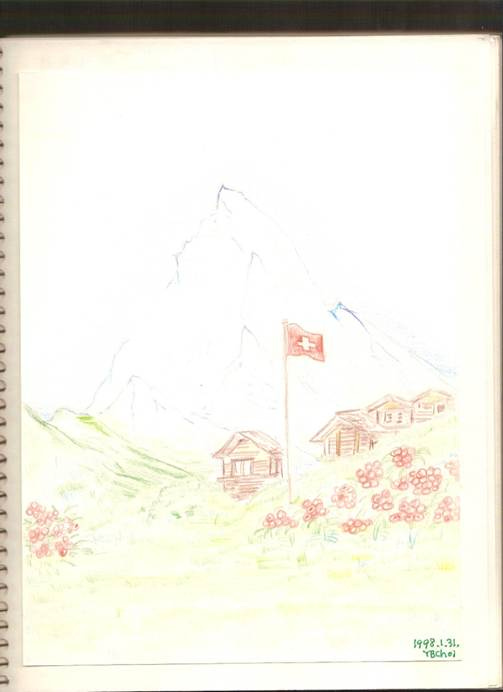
Swiss Mountains
Jungfraujoch를 회상하며 스위스의 전통가옥인 샬레 (chalet), 국기, 그리고 야생화들을 color pencil 로 그린 그림
참고
chalet (스위스의 전통가옥 샬레)
http://en.wikipedia.org/wiki/Chalet
About the Author

Prof. Dr. Young Choi (Editor-in-Chief) — Regent University
Full list of his K-GSP columns
Full list of his Books at Amazon.com
Young B. Choi is a Professor in the Department of Engineering & Computer Science at Regent University. He published 38 books with ‘Selected Readings in Cybersecurity’ (2018) (about 800 copies archived globally at university/college libraries around the world) and ‘Cybersecurity Applications and Artificial Intelligence’ (2023) available in seven major world languages. He proposed the world’s first global and universal telecommunications “Service Order Handling (SOH)” Model (T-SOH Model) (1995) with Dr. Adrian Tang. With this innovative research work, he received the IEEE NOMS ’96 Best Paper Award and became the first recipient of the Outstanding Contribution Award of the TeleManagement Forum in 1998. His research areas include Natural Language Processing-focused AI, AI-applied cybersecurity, network and telecom service management, and Korean studies on Gani Choi Rip’s Jeonggwan (靜觀: Quiet Contemplation) philosophy and Shilhak ( 實學: Practical Learning).
Suggested Citation
Choi, Y. B. (2026). Switzerland: A Small Country with a Remarkably Large Reputation - Alpine Grandeur, Precision Engineering, Expensive Fondue, and the Art of Staying Neutral. K-GSP Forum.
한글 요약
스위스는 국제사회에서 대단히 높은 명성을 누리는 작은 유럽 국가이다. 웅장한 산악 지형, 정밀 시계, 금융기관, 정치적 중립성, 효율적인 교통체계로 유명한 스위스는 국가의 영향력이 반드시 영토의 크기에 비례하는 것은 아니라는 사실을 보여 준다. 1996년 10월 몽트뢰를 방문했을 때, 나는 비범한 자연의 아름다움과 인상적인 공학 기술, 그리고 평범한 여행객으로 하여금 자신의 재정 철학을 다시 생각하게 만드는 물가를 경험했다. 스위스 알프스의 유명한 고산 관광지인 융프라우요흐로 향하는 여정은 눈 덮인 봉우리와 빙하, 산악 철도, 여러 언어로 안내하는 방송, 그리고 해발고도상 놀라울 만큼 높은 곳에 자리 잡은 전화 부스에 대한 잊지 못할 추억을 남겼다. 스위스는 또한 금융 비밀주의, 이민, 국가 방위, 그리고 경제적 필요와 사회적 수용 사이의 때로는 불편한 관계에 대해서도 생각하게 했다. 이 글은 개인적인 여행의 기억에 유머와 사회적 풍자를 결합하여, 더 큰 강대국들에 둘러싸인 작은 나라가 어떻게 실용적인 창의성과 국가적 자신감의 상징으로 자리 잡았는지를 살펴본다.
핵심어: 스위스, 몽트뢰, 융프라우요흐, 스위스 알프스, 정밀 공학, 정치적 중립성, 은행 비밀주의, 이민, 사회적 풍자, 여행 수필
© K-Global Scholars and Professionals Forum. All rights reserved. 2026. Content published in the K-GSP Forum may not be reproduced, distributed, or transmitted in any form without prior written permission from the K-GSP Forum, except for brief quotations with full attribution.