

EXECUTIVE SUMMARY
The Beatles and BTS stand as the two defining poles of global popular music, separated by six decades, two languages, and a technological revolution. This article examines their shared architecture of influence alongside their fundamental contrasts, arguing that both reveal a common logic of enduring relevance — disciplined identity, purposeful innovation, and deep audience engagement — while differing profoundly in how that relevance was produced, sustained, and globalized. The Beatles conquered the world through broadcast media in an analogue age, whereas BTS has done so through digital ecosystems and participatory fandom, a distinction brought into sharp focus as the ARIRANG World Tour fills U.S. stadiums in 2026.
Keywords: Beatles, BTS, Global Influence, Analogue vs. Digital Era, ARMY, Fandom Studies, Cultural Power, Enduring Relevance
1. INTRODUCTION
In February 1964, four young men from Liverpool stepped off a plane at John F. Kennedy Airport and changed American culture overnight. The Beatles’ arrival — greeted by thousands of screaming fans and broadcast live on The Ed Sullivan Show to 73 million viewers — was not simply a musical event, but a seismic rupture in the cultural order. It marked the moment when popular music emerged as a force capable of transcending national boundaries while combining artistic ambition with mass global influence.
Sixty years later, a different kind of arrival is reshaping that same cultural landscape. In April 2026, BTS launched the North American leg of their ARIRANG World Tour at Raymond James Stadium in Tampa, Florida, initiating an 85-show, 34-city, 23-country global run that sold out within hours. Their return from mandatory South Korean military service has amplified rather than diminished their momentum, transforming U.S. stadiums into the new global stage — no longer defined by passive broadcast audiences, but by millions of actively engaged, digitally coordinated fans known as ARMY. The comparison is not merely symbolic: The Beatles and BTS represent two defining poles of global popular music, whose trajectories reveal the structural conditions under which cultural influence is produced, sustained, and transformed across fundamentally different technological eras.
The Beatles showed the world that music could cross borders. BTS showed the world that borders themselves were the wrong frame.
2. CONVERGENT GENIUS: WHAT THEY SHARE
Despite their separation across time and technology, both groups are underpinned by a common structural logic of breakthrough that merits closer examination.
2.1. The Architecture and Evolution of Breakthrough
Both The Beatles and BTS achieved something that defies statistical probability: they did not merely succeed in their home markets and expand outward, but reached a level of global cultural saturation in which their music, image, and meaning resonated across radically different languages, cultures, and social contexts. This kind of breakthrough is not a product of luck or novelty alone, but of a specific architecture — authentic identity, creative distinctiveness, disciplined craft, and the ability to translate particular cultural expressions into universal human experiences. The Beatles spoke to teenage longing and rebellion in a postwar world hungry for joy, while BTS speaks to self-acceptance and collective empowerment in a digitally saturated world searching for meaning, demonstrating that enduring cultural relevance follows a discernible logic rather than chance.
Crucially, this breakthrough was not static but sustained through continuous creative evolution, as neither group remained bound to the formula that produced initial success. The Beatles moved from the polished pop of Please Please Me (1963) to the experimental ambition of Sgt. Pepper’s Lonely Hearts Club Band (1967) and the reflective minimalism of Let It Be (1970), while BTS evolved from early hip-hop foundations to the thematic depth of the Love Yourself series and the maturity of ARIRANG (2026). In both cases, evolution did not signal a departure from identity but a deepening of it, enabling each group to sustain global attention and transform breakthrough moments into enduring cultural institutions.
2.2. System Dynamics and the Global Stage
Both acts derived structural resilience from their group configuration, functioning not simply as collections of individuals but as integrated creative systems. The Beatles’ internal dynamic — driven by the creative tension between John Lennon and Paul McCartney and complemented by George Harrison and Ringo Starr — generated output greater than any individual could achieve, while BTS extends this model through a structured system of distributed excellence in which each member contributes a distinct role. This architecture sustains innovation, reduces dependence on any single figure, and reflects broader cultural conditions shaped by British and Korean soft power, which enabled each group’s global diffusion (Philo, 2015; Lie, 2015).
If the group represents the internal system, the United States has historically functioned as the external stage where global legitimacy is conferred. For The Beatles, this stage operated through analogue gatekeepers such as The Ed Sullivan Show, while for BTS it functions as a networked ecosystem activated through streaming platforms, social media, and coordinated fan engagement. Although the mechanisms have shifted from institutional validation to digital mobilization, the symbolic centrality of the U.S. remains unchanged, continuing to serve as the pivotal arena where global cultural influence is confirmed and amplified.
3. ANALOGUE WORLD VS. DIGITAL WORLD
This divergence becomes most visible at the level of infrastructure, where the mechanisms of fame differ fundamentally across the two eras.
3.1. The Infrastructure of Fame
The most fundamental difference between The Beatles and BTS is not musical, geographical, or even cultural — it is infrastructural. The Beatles operated within an analogue media ecosystem in which radio broadcasters, television networks, record labels, and music press served as the gatekeepers of global attention. Fame required the approval and amplification of institutional intermediaries. When The Beatles arrived in America, it was because Ed Sullivan and Capitol Records had decided to make it happen. The audience was a mass — undifferentiated, passive, receiving. BTS’s evolution reflects a structured entrepreneurial transformation process rather than organic growth alone (Hong et al., 2024).
BTS operates in a digital ecosystem in which platforms, algorithms, and networked fans have displaced institutional gatekeepers. Their global reach does not depend on a single broadcaster’s decision or a major label’s promotional budget. It is generated through a tightly integrated system of social media presence, streaming platform optimization, direct fan communication through Weverse, and real-time data analytics that allow HYBE to understand and respond to global audience behavior with unprecedented precision. This is not merely a technological upgrade — it is a structural transformation in how cultural power is produced and sustained.
3.2. Fandom: Spectators vs. Co-Creators
Beatlemania was one of the most intense fan phenomena in cultural history. Yet for all its ferocity, it remained essentially one-directional. Fans screamed, purchased, and consumed — but they did not participate in the production or amplification of The Beatles’ cultural output in any meaningful structural sense. The relationship was asymmetrical: artists produced, fans received. The infrastructure of analogue media made anything else impossible. Letters to fan clubs, local listening parties, and occasional concert attendance were the outer limits of fan engagement.
ARMY is a categorically different phenomenon. Fans are not passive consumers but active participants in amplifying and co-creating value within the ecosystem. This transformation reflects a broader shift toward participatory culture, where audiences actively shape the circulation and meaning of media content (Jenkins et al., 2013). ARMY members produce fan translations of content into dozens of languages, coordinate global streaming campaigns to maximize chart performance, organize fundraising initiatives aligned with BTS’s social messaging, and engage in sophisticated activism on issues from anti-racism to mental health awareness. The ARIRANG World Tour’s presale was structured around ARMY Membership numbers, recognizing that fan community participation is not ancillary to BTS’s success — it is architecturally embedded in it.
This platform-driven model reflects broader structural changes in the global music industry, where streaming has reshaped production, distribution, and consumption patterns (Hesmondhalgh, 2022; IFPI, 2023). This distinction reflects a fundamental shift in the sociology of fandom. The Beatles’ fans were, in the language of media theory, an audience. BTS’s fans are a community — a globally distributed, organizationally sophisticated, purposefully engaged collective that functions as both a consumer base and a co-producer of cultural value.
Beatlemania was a wave. ARMY is an ocean — and it moves with intention.
4. THE COMPARISON AND CONTRAST IN FULL
To move from conceptual discussion to structured analysis, the comparison between The Beatles and BTS can be distilled into a set of core dimensions that capture both their shared logic of enduring relevance and the fundamentally different conditions under which that relevance was produced, a perspective that aligns with broader analyses of K-pop as a hybrid cultural and economic system integrating production efficiency, global strategy, and cultural adaptation (Lie, 2015).
4.1. A Structured Framework of Comparison
Beneath the surface of their success lies a shared structural blueprint that can be distilled into a small number of defining dimensions, including the amplifying role of national cultural influence, or soft power. The Beatles emerged at the height of British soft power in the 1960s, when the “British Invasion” extended the United Kingdom’s global reach, while BTS operates within the rise of Korean soft power, where cultural industries and digital platforms project Korean culture worldwide. In both cases, the relationship is reciprocal rather than dependent, as each group not only benefited from but also actively transformed soft power into a globally recognized cultural force.
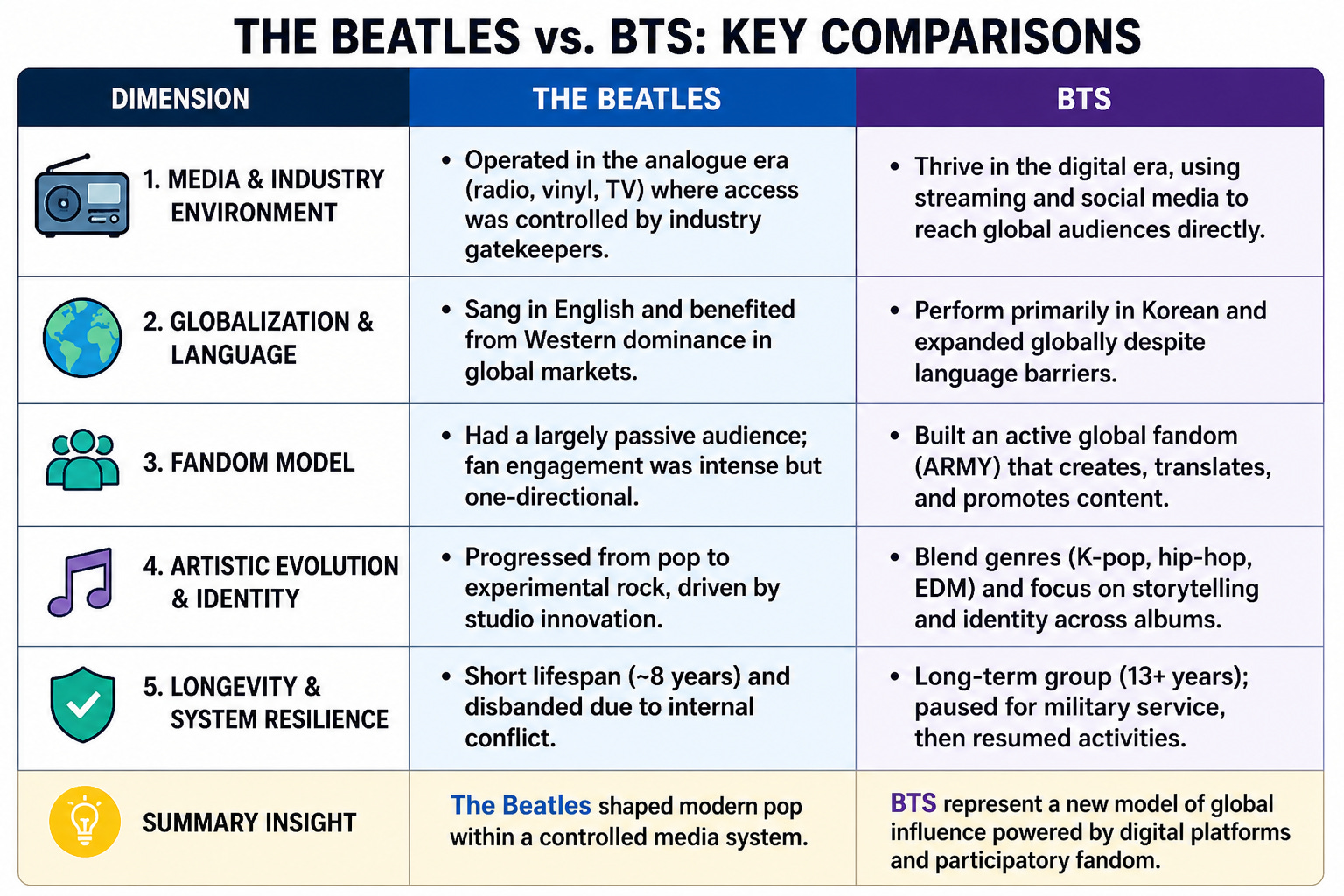
Table 1 synthesizes five key dimensions — media environment, globalization, fandom, artistic identity, and system resilience — providing a concise framework for understanding how two groups from different eras achieved comparable global impact through distinct structural pathways.
Table 1. The Beatles and BTS: A Comparative Framework of Global Influence
4.2. Interpreting the Comparison
The framework reveals that the similarities between The Beatles and BTS lie not in surface features, but in a deeper architecture of cultural breakthrough. Both groups achieved global saturation by aligning authentic identity with continuous creative evolution and by responding precisely to the emotional needs of their historical moment. In this sense, their success is not accidental or purely market-driven — it reflects a disciplined capacity to translate particular cultural expressions into universal resonance. What appears as two distinct phenomena across time is, at its core, a shared logic of enduring relevance.
Yet the differences between them are fundamentally structural, shaped by the transformation of the media environment across six decades. The Beatles’ rise was enabled by a centralized, gatekeeper-driven system that amplified influence through broadcast scale but limited audience participation and long-term adaptability. BTS, by contrast, operates within a decentralized, digitally networked ecosystem in which fans function as active co-creators of value and meaning. This shift from audience to community, from distribution to interaction, and from momentary saturation to sustained engagement explains not only how BTS extends the model pioneered by The Beatles, but also how the very nature of global cultural power has been redefined.
5. THE ARIRANG MOMENT: BTS IN REAL TIME
The contrast between eras becomes most visible not in abstraction, but in practice — on the global stage where scale, technology, and audience converge in real time. BTS’s position as a global cultural force reflects not only musical success but a broader transformation in how influence is constructed and sustained in the digital age (Hiatt, 2021).
5.1. Infrastructure at Scale
The ARIRANG World Tour, currently sweeping through U.S. stadiums as this article goes to press, offers a live demonstration of the structural differences outlined above. Where The Beatles ceased touring in 1966 — constrained by technological limitations and the inability to perform meaningfully in environments overwhelmed by audience noise — BTS has inaugurated what is being described as the largest K-pop stadium tour in history. Featuring a 360-degree “in-the-round” stage design, the production eliminates traditional boundaries between performer and audience, transforming the stadium into an immersive performance space.
The tour’s scale — 85 dates across 34 cities in 23 countries, extending through 2027 — would have been logistically inconceivable in the analogue era. Its execution depends on a fully integrated digital infrastructure: a global content supply chain, sophisticated fan engagement platforms, and real-time data analytics that enable precise coordination across continents. What was once limited by physical distribution and broadcast scheduling is now orchestrated through continuous, data-driven connectivity.
5.2. The Relational Core of Global Impact
Yet the significance of the ARIRANG tour is not exhausted by its scale or technological sophistication. Its true power lies in the nature of the relationship it embodies. The reason tens of thousands fill stadiums and tickets sell out within hours is not simply access — it is identification. ARMY members do not attend as passive consumers of entertainment; they participate as contributors to a shared cultural system they have helped to build, amplify, and sustain.
This distinction marks the deepest divergence from The Beatles’ era. In a one-directional media environment, even the intensity of Beatlemania could not translate into structural participation. BTS, by contrast, has systematically cultivated a model in which fandom operates as a distributed network of co-creation and meaning-making. The result is not merely larger audiences, but more deeply embedded ones — transforming live performance from a spectacle to be witnessed into a collective experience to be enacted.
6. WHAT THE COMPARISON TEACHES US
These contrasts ultimately point to a deeper set of principles that explain not just their success, but the conditions under which global cultural relevance is sustained. The shift from analogue to digital cultural systems reflects a broader transformation in how media industries operate and sustain relevance over time (Hesmondhalgh, 2022).
6.1. The Enduring Logic of Authentic Identity
Both The Beatles and BTS demonstrate that enduring global relevance is grounded not in novelty or spectacle but in authentic identity, with each group sustaining a coherent sense of self under intense external pressure across very different eras. In both cases, identity functions not as a brand attribute but as a structural anchor that stabilizes the system and enables continuity amid cultural and technological turbulence.
6.2. The Transformation of Audience Relationships
The shift from The Beatles’ audience to BTS’s ARMY is not simply a story of technological change — it is a story of a fundamental transformation in the nature of cultural participation. Organizations and leaders seeking to build enduring influence in the digital age cannot afford to treat their audiences as passive recipients of value. They must invest in the infrastructure of community — the platforms, norms, and shared purposes that transform consumers into co-creators and amplifiers of cultural meaning.
6.3. Interruption as Strategy
Both groups faced significant interruptions to their momentum. For The Beatles, internal tensions and the impossibility of sustaining creative collaboration ultimately proved fatal. For BTS, mandatory military service — which many predicted would trigger irreversible decline — has instead functioned as a strategic compression of visibility that intensified long-term attention and returned the group to the global stage with amplified symbolic weight. The difference is structural: BTS had built a system robust enough to withstand interruption, while The Beatles’ system was too dependent on continuous interpersonal chemistry to survive it.
The Beatles proved music could conquer the world. BTS proved the world could help music conquer itself.
7. CONCLUSION
The Beatles and BTS are not rivals across time — they are complementary chapters in the same unfolding story of how popular culture achieves enduring global influence. The Beatles proved that music could transcend language, geography, and culture to become a shared human experience, while BTS has shown that such transcendence can be systematically engineered, digitally amplified, and sustained through global community. As the ARIRANG tour fills stadiums across the United States in 2026 with fans who helped build the phenomenon they celebrate, the comparison becomes not nostalgic but instructive: both made the world feel unified in a single cultural moment, but where The Beatles sparked it once in an analogue age, BTS sustains it continuously in a digital one — turning fleeting impact into enduring presence.
REFERENCES
Hesmondhalgh, D. (2022). Streaming’s effects on music culture: Old anxieties and new simplifications. Cultural Sociology, 16(1), 3–24. https://doi.org/10.1177/17499755211019974
Hiatt, B. (2021, May 18). The triumph of BTS. Rolling Stone. https://www.rollingstone.com/music/music-features/new-bts-song-2021-worlds-biggest-band-1166441/
Hong, P. C. (2026). Beyond success: BTS and the discipline of enduring relevance. K-Global Scholars and Professionals Forum, May 2026.
Hong, P., Kim, S. C., Lee, A., & Kang, H. (2024). The entrepreneurial transformation process of BTS: initiation, development, growth and expansion. Journal of Enterprising Communities: People and Places in the Global Economy, 18(5), 1078–1097.
International Federation of the Phonographic Industry. (2023). Global music report 2023: State of the industry.https://www.ifpi.org/wp-content/uploads/2020/03/Global_Music_Report_2023_State_of_the_Industry.pdf
Jenkins, H., Ford, S., & Green, J. (2013). Spreadable media: Creating value and meaning in a networked culture. New York University Press.
Lie, J. (2015). K-pop: Popular music, cultural amnesia, and economic innovation in South Korea. University of California Press. https://doi.org/10.1525/9780520958944
Philo, S. (2015). The British Invasion: The crosscurrents of musical influence. Rowman & Littlefield.
ABOUT THE AUTHOR

Paul C. Hong DISTINGUISHED UNIVERSITY PROFESSOR · UNIVERSITY OF TOLEDO
Paul C. Hong is a Distinguished University Professor and Chair of Information Systems and Supply Chain Management at the University of Toledo. His work focuses on leadership, governance, and decision-making in the AI era, integrating strategy, technology, and institutional trust. He has published extensively in leading academic journals and writes on how individuals and organizations navigate complexity, disruption, and global transformation.
K-GSP Forum · May 2026 · All Rights Reserved
© K-Global Scholars and Professionals Forum. All rights reserved. Content published in the K-GSP Forum may not be reproduced, distributed, or transmitted in any form without prior written permission from the K-GSP Forum, except for brief quotations with full attribution.
I really enjoyed reading this article. Rather than simply comparing The Beatles and BTS, it offered a thoughtful perspective on how cultural influence has evolved across different eras. I especially appreciated the insight that lasting impact comes not only from talent, but also from authenticity, continuous growth, and meaningful relationships with people. It was an engaging and thought-provoking article that gave me a deeper appreciation of both groups and the changing nature of global influence.