
Executive Summary
This article explores the enduring significance of two major figures in modern Korean literature—Yi Kwang-su and Park Kyong-ni—and examines how their lives and representative works illuminate contrasting paths of modernization, moral responsibility, resilience, and hope. Writing within different but interconnected periods of Korea’s modern history, they responded to colonial rule, cultural disruption, national division, war, and social transformation through the novel and historical epic. By integrating their life profiles, major works, historical contexts, and lasting legacies, this article shows how modern Korean literature preserves the experiences of earlier generations while offering timeless guidance for readers facing rapid technological change, social uncertainty, and ethical challenges in the twenty-first century.
Keywords: Korean modern literature; Yi Kwang-su; Park Kyong-ni; modernization; resilience
1. Introduction
My interest in modern Korean literature began during my middle school years at Seoul Middle School (서울중학교), when I started reading Yi Kwang-su’s Mujeong (무정, The Heartless) and Yujeong (유정, Affection) for no particular academic reason. I was fascinated by his descriptive ability, especially his portrayal of characters, relationships, social customs, and everyday life under Japanese colonial rule. His novels allowed me to enter a historical world that I had not personally experienced and helped me understand how individuals struggled with education, love, social expectations, modernization, and national uncertainty during a period of profound transition.
My appreciation of Park Kyong-ni developed gradually over the years, particularly through television dramatizations of her monumental novel Toji (토지, The Land). Through its extensive cast of characters and multigenerational historical setting, Toji presented Korean life not as a simple national narrative but as a complex human journey shaped by family, land, displacement, suffering, dignity, and survival. Together with Yi Kwang-su’s writings on education, modernization, social reform, and individual choice, Park’s work offers a contrasting literary path through Korea’s modern transformation. These two writers therefore provide a useful framework for examining how Korean literature responded differently to historical disruption, moral complexity, social change, and the continuing search for renewal.
I approach Yi Kwang-su and Park Kyong-ni as a Korean American global supply chain scholar and lifelong reader whose professional work has focused on resilience, adaptation, leadership, and human responses to disruption. From this interdisciplinary perspective, I seek to understand how their lives and writings illuminate enduring questions of identity, moral responsibility, resilience, national history, and hope. Although they wrote in different periods and carried very different personal and literary legacies, both confronted the human consequences of colonialism, modernization, social transformation, and historical disruption. This article examines how their personal experiences and major works continue to offer meaningful lessons for contemporary readers living amid artificial intelligence, rapid technological change, social polarization, and global uncertainty. Technologies may transform how people live and work, but literature continues to help us understand why we live, what we should value, and how we may respond to suffering and change with integrity, wisdom, and hope.
2. Contexts of Korean Modern Literature
Korean modern literature emerged from profound historical upheaval,
engaged central cultural and societal tensions,
and developed as a moral and imaginative response to national transformation.
2.1 Historical and Social Background
Korean modern literature developed within a century marked by extraordinary disruption and transition. Japanese colonial rule, national liberation, ideological division, the Korean War, displacement, poverty, and later industrialization and democratization created a historical environment in which literature could not remain detached from collective experience. Writers confronted a society repeatedly broken and reconfigured by external domination, internal conflict, and rapid social change. As a result, Korean modern literature became closely tied to questions of survival, memory, identity, and the meaning of human dignity under pressure.
This historical background helps explain why Korean modern literature often carries unusual emotional depth and moral seriousness. Literary works did not merely describe changing events; they interpreted the human consequences of colonial oppression, war, migration, family separation, urbanization, and economic hardship. Through fiction, poetry, and essays, writers preserved experiences that official histories alone could not fully express. In this sense, the historical context of Korean modern literature is not just a backdrop, but the very ground from which its themes, forms, and ethical concerns emerged.
2.2 Cultural and Societal Issues
Within these turbulent historical settings, Korean modern literature engaged a wide range of cultural and societal issues. Questions of national identity, collective memory, suffering, resilience, family disruption, social inequality, gender roles, class tensions, and the conflict between tradition and modernity became central concerns. Writers explored how ordinary people experienced large structural changes, including the erosion of established values, the pressures of modernization, the persistence of poverty, and the search for moral direction in times of compromise and uncertainty. Literature thus became a space in which Korean society examined not only what had happened, but what kind of people it was becoming.
These issues were not treated abstractly. Korean modern writers often grounded them in concrete human relationships, domestic struggles, village life, urban hardship, and the inner conflicts of individuals facing historical pressure. Through this approach, literature made visible the emotional and ethical dimensions of national transformation. It showed how public events entered private lives and how social change shaped love, loss, ambition, loyalty, faith, and conscience. By giving narrative form to these tensions, Korean modern literature illuminated the lived realities of modern Korean society more deeply than political or economic analysis alone could do.
2.3 The Role of Literature
The role of literature in modern Korea has therefore been far more significant than simple artistic expression. Literature has served as a witness to history, a preserver of memory, a critic of injustice, and a voice of conscience. It has enabled writers to interpret suffering, affirm human dignity, expose moral failure, and connect personal life with broader national experience. In times of colonial rule, war, authoritarianism, and rapid modernization, literature provided a medium through which deeply felt truths could be expressed, contested, and remembered.
At the same time, literature has also played a renewing role by helping later generations understand the past and reimagine the future. It has preserved cultural memory across generations while also encouraging reflection on responsibility, resilience, and ethical choice. Through this dual function of remembrance and renewal, Korean modern literature has contributed not only to national cultural identity but also to broader human understanding. Its enduring value lies in its ability to transform historical upheaval into moral insight and artistic form, making literature an essential part of Korea’s modern intellectual and cultural life.
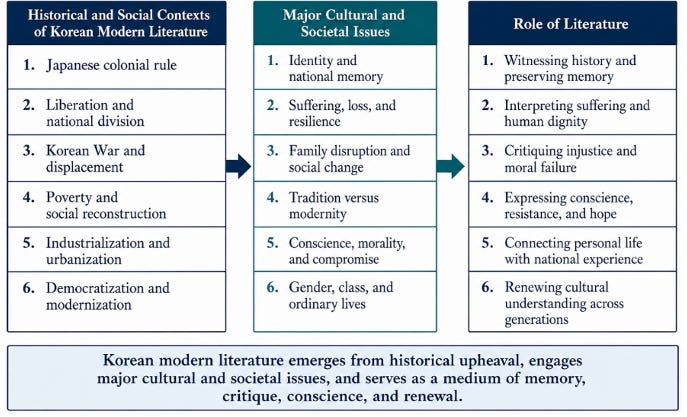
Figure 1 presents Korean modern literature as emerging from the interaction of historical disruption, major cultural and societal concerns, and literature’s continuing interpretive role. The historical context includes Japanese colonial rule, liberation and national division, the Korean War and displacement, poverty and social reconstruction, industrialization and urbanization, and democratization and modernization, all of which reshaped Korean society and individual lives. These conditions generated recurring issues of identity and national memory, suffering and resilience, family disruption, tension between tradition and modernity, conscience and moral compromise, and the experiences of women, social classes, and ordinary people. Literature responded by preserving historical memory, interpreting suffering and human dignity, critiquing injustice and moral failure, expressing conscience and hope, connecting personal experience with national history, and renewing cultural understanding across generations.
Figure 1
Contexts of Korean Modern Literature
Note. Source: Author’s own compilation.
3. Yi Kwang-su: Modernization, Contradiction, and Literary Influence
Yi Kwang-su’s life, writings, and divided legacy reveal both the aspirations of early Korean modernization and the moral complexity of intellectual life under colonial rule.
3.1 Life and Historical Context
Yi Kwang-su, also known by his pen name Chunwon, was born in 1892 in Jeongju, North Pyongan Province. He lost both parents during childhood and grew up amid poverty, social instability, and the decline of the Joseon order. He later studied in Japan, where he encountered modern education, nationalism, social reform ideas, and Western literary traditions. These experiences shaped his belief that education, individual development, and cultural modernization were essential to Korea’s national renewal.
Yi initially participated in the Korean independence movement, contributed to the February 8 Declaration of Independence in 1919, and worked with the Korean Provisional Government in Shanghai. During the later years of Japanese colonial rule, however, his position changed dramatically, and he became a prominent supporter of imperial assimilation and wartime mobilization, encouraging Koreans to cooperate with Japan’s war effort and creating a lasting moral controversy surrounding his legacy. After liberation, he was arrested and investigated for pro-Japanese collaboration, but the proceedings remained unresolved when the Korean War began in 1950. Already seriously ill, Yi was unable to flee Seoul and was taken north by North Korean forces with other prominent intellectuals; later accounts indicate that his health deteriorated during captivity and that he died from tuberculosis and severe lung disease in Manpo on October 25, 1950. Because his disappearance left his family and the public without reliable information for decades, the details of his final days remained uncertain until reports about his death and burial emerged much later.
3.2 Major Works
Yi’s most influential novel, Mujeong (무정, The Heartless), was serialized in 1917 and is often regarded as a foundational work of the modern Korean novel. It portrays young Koreans caught between traditional customs and new ideas about education, romantic love, personal choice, and national development. Through its characters, the novel reflects the uncertainty of a society confronting colonial domination and rapid cultural change.
His other works include Yujeong (유정, Affection), Heuk (흙, The Soil), and numerous essays, biographies, and historical novels. These writings frequently explore education, rural reconstruction, personal discipline, emotional conflict, national identity, and social reform. Yi helped introduce new narrative methods and psychological characterization into Korean fiction, making individual emotions and choices central to the literary representation of modern life.
3.3 Themes and Legacy
Yi’s central themes include modernization, education, enlightenment, individual freedom, romantic love, rural reform, and national regeneration. His characters often struggle between inherited social obligations and emerging modern values. His fiction therefore provides valuable insight into how Koreans understood social change, colonial pressure, and the uncertain promises of modernity during the early twentieth century.
His legacy remains deeply divided. Yi was an innovative writer who played a major role in the development of modern Korean prose, yet his later support for Japanese imperial assimilation and wartime mobilization remains central to assessments of his life and legacy. Scholars have interpreted this collaboration from different perspectives, including colonial pressure, nationalism, modernity, political aspiration, and individual moral agency, cautioning against both simple condemnation and explanations that remove personal responsibility (Kwak, 2008; Treat, 2012). His life therefore presents a difficult question about how literary achievement should be evaluated when intellectual influence becomes entangled with political accommodation and compromised judgment under colonial rule. Reading Yi critically requires acknowledging both his contribution to Korean modern literature and the moral seriousness of his collaboration without allowing either dimension to erase the other.
Yi Kwang-su— Interpretive Summary
Cultivate knowledge and influence but never separate achievement from conscience and moral responsibility.
3.4 An East Asian Comparative Horizon: Natsume Sōseki and Lu Xun
Yi Kwang-su may also be situated within a broader East Asian literary context alongside Japan’s Natsume Sōseki (1867–1916) and China’s Lu Xun (1881–1936), who likewise confronted the tensions between inherited traditions and rapidly changing modern societies. While Yi emphasized education and national regeneration, Sōseki explored the psychological costs of modernization and Lu Xun employed sharper cultural criticism to challenge social convention and intellectual complacency (Biddle, 1973; Chou, 2002). Yi’s later collaboration with Japanese imperial rule adds a distinctive moral dimension, reminding readers that modernization involved not only institutional and cultural change but also difficult questions of conscience, responsibility, and intellectual judgment.
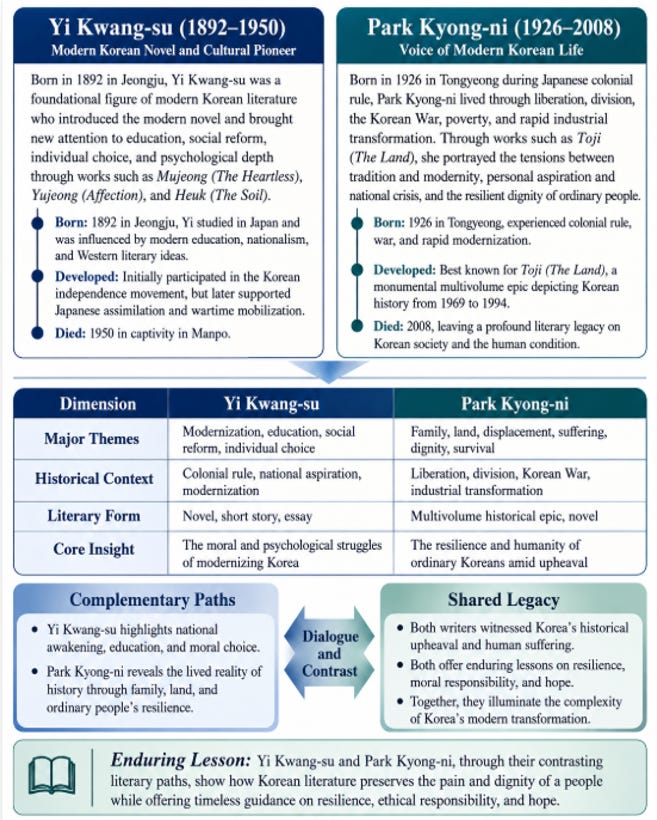
It also develops this comparison more systematically. A central table contrasts the two writers across major themes, historical context, literary form, and core insight, showing Yi’s focus on modernization and moral struggle and Park’s emphasis on family, land, suffering, dignity, and resilience. Beneath the table, the “Complementary Paths,” “Dialogue and Contrast,” and “Shared Legacy” sections draw the two writers into a broader interpretive relationship, suggesting that Yi illuminates the ethical and psychological tensions of Korea’s modernization while Park reveals the endurance and humanity of ordinary people amid upheaval. The concluding “Enduring Lesson” section unifies the figure by arguing that, despite their differences, both writers preserve the pain and dignity of Korean experience and continue to offer guidance on resilience, moral responsibility, and hope.
Figure 2 presents a comparative overview of Yi Kwang-su and Park Kyong-ni as two major figures in modern Korean literature. The upper section introduces each writer in parallel panels. Yi Kwang-su is presented as a modern Korean novelist and cultural pioneer whose work emphasized education, modernization, social reform, and individual choice, while also acknowledging the moral controversy surrounding his later collaboration with Japanese imperial rule. Park Kyong-ni is presented as a voice of modern Korean life whose writing, especially Toji (The Land), portrays the experiences of colonialism, liberation, division, war, poverty, and industrial transformation through the lives of ordinary people. By placing their profiles side by side, the figure highlights both their distinct historical locations and their differing literary emphases.
Figure 2
Contrasting Paths in Modern Korean Literature
Note. Source: Author’s own synthesis.
4. Park Kyong-ni: History, the Land, and Human Resilience
Park Kyong-ni transformed personal hardship and Korea’s turbulent modern history into a broad literary vision of family, land, resilience, and human renewal.
4.1 Life and Historical Context
Park Kyong-ni was born in 1926 in Tongyeong during the Japanese colonial period. She lived through liberation, national division, the Korean War, poverty, and rapid industrial transformation. Her personal life was also marked by hardship, including family instability, the loss of her husband during the turmoil surrounding the Korean War, and the responsibility of raising her daughter under difficult circumstances.
Park began her literary career during the 1950s and gradually became one of Korea’s most respected novelists. Her experiences of loss and displacement contributed to her deep understanding of widows, children, impoverished families, marginalized people, and women who struggled to preserve dignity under harsh social conditions. Although her fiction was informed by personal suffering, it grew into a broad examination of Korean history and the endurance of ordinary people.
4.2 Major Works
Park’s greatest literary achievement is Toji (토지, The Land), an epic multivolume novel written from 1969 to 1994. Beginning in the late nineteenth century and concluding with Korea’s liberation in 1945, the novel follows the Choi family and hundreds of related characters across Korea, Manchuria, Japan, and Russia. It portrays the collapse of the traditional social order, colonial expansion, migration, resistance, family conflict, class inequality, and the continuing struggle for survival.
Her other works include The Daughters of Pharmacist Kim, The Marketplace and the Battlefield, and numerous novels and short stories centered on war, widowhood, poverty, family disruption, and women’s lives. Park’s narratives combine historical breadth with close attention to individual emotions and relationships. She shows how large political events enter homes, divide families, reshape communities, and alter the destinies of people who rarely control the historical forces surrounding them.
4.3 Themes and Legacy
Park’s major themes include attachment to the land, family continuity, displacement, women’s resilience, historical suffering, moral complexity, and the regenerative power of life. In Toji, land represents far more than property. It signifies memory, identity, livelihood, ancestry, belonging, and the continuing relationship between human beings and the natural world. Her characters suffer under colonialism, war, greed, social hierarchy, and personal betrayal, yet many continue to protect life, family, and community. Park’s legacy lies in her ability to transform Korean history into an expansive human narrative. She avoided reducing history to a simple conflict between heroes and villains and instead portrayed people as morally complex individuals shaped by both personal choices and historical circumstances. Her work gives dignity to ordinary lives and demonstrates that national history is ultimately experienced through families, relationships, losses, migrations, and acts of endurance. She remains a timeless literary teacher because her novels show that survival is not passive; it requires memory, responsibility, adaptability, and the continuing will to rebuild life after devastation.
Park Kyong-ni’s Toji— Interpretive Summary
Persevere through adversity, preserve enduring relationships, and rebuild life with resilience and hope.
5. Conclusion
Yi Kwang-su and Park Kyong-ni transformed Korea’s turbulent modern history into literature of enduring human significance. Through modernization, moral responsibility, historical memory, and resilience, their works reveal how individuals and communities respond to oppression, disruption, and change. Their lives were shaped by particular historical circumstances, but the questions they raised concerning integrity, responsibility, memory, and hope extend far beyond their own times. Reading them today helps preserve historical understanding while offering practical wisdom for living responsibly in a rapidly changing world.
References
Biddle, W. W. (1973). The authenticity of Natsume Sōseki. Monumenta Nipponica, 28(4), 391–426.
Chou, E. S. (2002). Learning to read Lu Xun, 1918–1923: The emergence of a readership. The China Quarterly, 172,1042–1064.
Kim, H. (2018). Modern Korean literature: An anthology. Columbia University Press.
Kwak, J.-H. (2008). Domination through subordination: Yi Kwangsu’s collaboration in colonial Korea. Korea Observer, 39(3), 427–452.
Lee, P. H. (Ed.). (1997). Sources of Korean tradition: From the sixteenth to the twentieth centuries (Vol. 2). Columbia University Press.
Park, K.-N. (2007). Land (Toji). Hyundai Munhak. (Original work published 1969–1994)
Ryu, J. (2019). Korean literature in the global era: History, translation, and reception. Korean Studies, 43(1), 1–23.
Shin, K.-Y., & Hwang, K. (2018). Korean society: Civil society, democracy and the state. Routledge.
Suh, J. J. (2007). Korean studies handbook. University of Hawai’i Press.
Treat, J. W. (2012). Choosing to collaborate: Yi Kwang-su and the moral subject in colonial Korea. The Journal of Asian Studies, 71(1), 81–102.
Yi, K.-S. (1917/2005). Mujeong (The Heartless). Minumsa.
Yoon, S. (2015). Modern Korean literature and national identity. Journal of Korean Studies, 20(2), 245–269.
Young, C. (Ed.). (2006). The Cambridge history of Korean literature. Cambridge University Press.
Original Article:

About the Author

Distinguished Professor, Dr. Paul Hong (Editor in Chief) — University of Toledo
Paul C. Hong is Distinguished University Professor at the University of Toledo. Drawing on more than four decades of leadership and missional service and three decades of scholarship in leadership and supply chain management, his research examines how individuals, organizations, and societies develop the capabilities necessary for resilience, adaptation, and long-term impact. His recent work integrates history, management, philosophy, and faith-based narratives to explore leadership formation through the development of identity and purpose, interests and priorities, insight and perspective, integrity and principles, and influence through stewardship—qualities that remain essential in the age of artificial intelligence.
© K-Global Scholars and Professionals Forum. August 2026. All rights reserved.
Suggested Citation: Paul C. Hong (2026, August 25). Two Paths in Korean Modern Literature: Yi Kwang-su and Park Kyong-ni. K-GSP Forum, pp. 1–11.
한국 근대문학의 두 길: 이광수와 박경리
폴 C. 홍(Paul C. Hong)은 미국 톨레도대학교 석좌교수로서 글로벌 공급망관리, 리더십, 회복탄력성, 거버넌스를 연구하며, 서울중학교 시절 이광수의 『무정』과 『유정』을 통해 근대 한국인의 교육, 사랑, 사회적 기대와 국가적 불안을 처음 접하고, 이후 박경리의 『토지』를 통해 한국 역사가 가족, 땅, 이주, 고통과 생존의 이야기로 이루어져 있음을 깨닫게 되었다. 한국계 미국인 공급망 학자이자 평생 독자의 시각에서 두 작가의 삶과 작품이 현대인에게 주는 교훈을 탐색한다. 이광수는 1892년 평안북도 정주에서 태어나 어린 시절 부모를 잃고 가난과 사회적 혼란 속에서 성장했다. 일본 유학을 통해 근대교육, 민족주의, 사회개혁과 서구문학을 접한 그는 교육과 계몽, 개인의 발전이 한국의 재생에 필요하다고 믿었다. 『무정』, 『유정』, 『흙』 등은 전통과 근대, 개인의 선택과 사회적 의무, 사랑과 국가 발전 사이에서 갈등하는 인물들을 묘사하며 한국 근대소설의 형성에 큰 영향을 주었다. 그러나 독립운동에 참여했던 초기와 달리 일제 말기에는 황민화와 전쟁 동원을 지지함으로써 깊은 도덕적 논란을 남겼다. 이광수의 삶은 지식, 재능과 문학적 업적이 반드시 도덕적 용기를 보장하지 않으며, 정치적 압력과 생존의 욕망 속에서 지식인이 얼마나 쉽게 판단을 타협할 수 있는지를 보여주는 경고가 된다.
박경리는 1926년 통영에서 태어나 식민지 시대와 해방, 분단, 한국전쟁, 가난과 급격한 산업화를 모두 경험했다. 가족의 불안정, 남편의 죽음, 경제적 곤란과 홀로 딸을 양육해야 했던 현실은 그의 작품에 깊은 흔적을 남겼지만, 그는 자신의 고통을 개인적 비극에 머물게 하지 않고 여성, 과부, 농민, 아이, 가난한 가족과 주변부 사람들의 삶을 이해하는 문학적 자원으로 변화시켰다. 1969년부터 1994년까지 집필한 대하소설 『토지』는 최씨 집안과 수백 명의 인물을 통해 조선 말기부터 1945년 해방까지의 식민지 지배, 이주, 저항, 계급 갈등, 가족 해체와 생존을 거대한 역사적 서사로 그려낸다. 그에게 땅은 단순한 재산이 아니라 기억, 정체성, 생계, 조상, 소속과 자연과의 연속성을 의미하며, 그의 문학은 생존이 수동적인 버팀이 아니라 기억을 보존하고 관계를 지키며 책임과 적응력을 통해 삶을 다시 세우는 창조적 행위임을 보여준다.
이광수와 박경리는 한국 근대사의 서로 다른 압력을 경험했으며, 각자의 삶과 작품을 통해 근대화와 도덕적 책임, 역사적 고통과 기억, 인간의 회복력이라는 공통된 문제에 서로 다른 두 가지 길로 응답했다. 이광수는 재능과 영향력이 윤리적 판단과 분리될 때의 위험을 보여주며, 박경리는 상처와 상실을 역사적 기억과 인간적 연대로 변화시키는 창조적 인내를 상징한다. 오늘날에도 지식에는 윤리적 방향이 필요하고, 양심에는 용기가 필요하며, 회복력은 기억과 관계, 책임 위에서 형성된다. 두 작가의 대조적인 길을 함께 읽을 때, 한국 근대문학은 과거의 유산을 넘어 급변하는 시대 속에서 어떻게 책임 있게 살고 인간의 존엄과 희망을 지킬 것인가를 묻는 지속적인 도덕적 대화가 된다.
From Joan Park <joanpark@xxxx>. 글 잘읽었습니다. 두 작가의 삶과 작품을 대조하여 살펴보니 한국현대문학를 새롭게 이해하게됩니다. 특히 이 광수의 삶을 통해 지식과 재능만으로는 충분하지 않으며 도덕적 용기가 필요하다는 점을, 그리고 박 경리 작가가 개인의 고통과 상실을 역사에 대한 기억과 인간에 대한 연대로 승화시켰다는 점을 깊이 느끼게 되었습니다. 급변하는 시대를 살아가는 우리에게 지식에는 용기가 그리고 회복력에는 기억과 관계가 필요하다는 귀한 교훈을 주는 뜻깊은 글이었습니다. 좋은 글을 공유해 주셔서 감사합니다.
Thank you, Professor Hong — as always, your writing gives me much to reflect on. The two paths through Yi Kwang-su and Park Kyong-ni stay with me, especially Park's vision of the strength to rise again: that survival is not passive endurance, but a creative perseverance built on memory, relationships, and responsibility. That truth speaks deeply to me as I keep getting back up, one step at a time. Grateful, as always, for your mentorship. Andrew Park, LA