

EXECUTIVE SUMMARY
This article examines the recent escalation of U.S.–Canada trade tensions, tariffs, and political disagreements as part of a broader shift from highly trusted economic integration toward a more contested form of interdependence. It analyzes the short-term consequences for trade, investment, supply chains, and bilateral negotiations while exploring the longer-term implications for Canadian diversification, U.S. economic influence, and the future of USMCA-based North American integration. The article argues that a constructive path forward requires both countries to move beyond retaliatory measures and develop a more resilient partnership based on strategic reciprocity, diversified supply chains, economic security, and renewed institutional trust.
Keywords: U.S.–Canada Relations; Trade Tensions; Tariffs; Economic Interdependence; North American Integration
1. Introduction
Why has the United States, which shares one of the world’s longest peaceful borders and one of its deepest economic relationships with Canada, become increasingly confrontational toward its northern neighbor? For decades, the U.S.–Canada relationship was commonly viewed as a model of stable economic integration built on geographic proximity, extensive cross-border trade, shared security interests, institutional cooperation, and closely connected supply chains. Yet recent disputes over tariffs, industrial policy, automobiles, steel, aluminum, dairy, energy, and market access suggest that even highly institutionalized partnerships can become vulnerable when domestic political priorities, economic nationalism, and strategic competition begin to outweigh assumptions of mutual trust.
The recent tensions are especially striking because the two economies remain deeply interdependent. Canada depends heavily on access to the U.S. market, while the United States relies on Canadian energy, critical minerals, intermediate goods, agricultural products, and integrated manufacturing networks. In sectors such as automobiles, aerospace, energy, and advanced manufacturing, production frequently crosses the border multiple times before reaching final consumers. This makes confrontation costly for both sides and raises an important question: why would two countries with such strong economic complementarities repeatedly resort to tariffs, retaliatory measures, and political pressure?
One explanation is that the broader philosophy governing North American trade is changing. Earlier phases of integration emphasized efficiency, comparative advantage, predictable rules, and the expansion of cross-border commerce. The emerging environment places greater weight on economic security, domestic production, strategic industries, supply-chain resilience, national content requirements, and political control over critical economic assets. From the U.S. perspective, tariffs can therefore serve not only as trade remedies but also as instruments for reshoring production and extracting concessions (Baldwin, 1985); from the Canadian perspective, repeated exposure to U.S. economic pressure strengthens arguments for diversification and greater strategic autonomy.
This article is intended to provide a general understanding of these developments from a global supply chain and economic interdependence perspective, rather than to offer specialized legal, diplomatic, or trade-policy prescriptions (Keohane & Nye, 2012; Farrell & Newman, 2019). Its purpose is to help readers interpret the broader strategic implications of changing U.S.–Canada relations while recognizing that detailed policy guidance requires expertise beyond the scope of this article (Baldwin, 1985; Organisation for Economic Co-operation and Development, 2025).
2. Contextual Overview
To understand the current confrontation, it is important to trace how decades of deep economic integration have gradually encountered stronger pressures from tariffs, national industrial priorities, and competing expectations about North American cooperation.
2.1. From Deep Integration to Growing Trade Friction
For much of the postwar era, the United States and Canada built one of the world’s most integrated bilateral economic relationships through geographic proximity, cross-border investment, and successive trade agreements including CUSFTA, NAFTA, and USMCA/CUSMA. Their economies became deeply interconnected across automobiles, energy, agriculture, metals, aerospace, and manufacturing, with many firms operating within a shared North American production system. More recently, however, the United States has placed greater emphasis on reciprocity, reshoring, economic security, and strategic industries, while Canada has increasingly stressed the protection of domestic workers, industries, and national economic interests. As a result, the relationship is shifting from relatively predictable rules-based integration toward a more contested form of interdependence in which tariffs, market access, and industrial policy are increasingly used as instruments of negotiation (Office of the United States Trade Representative, 2025; Government of Canada, 2026).
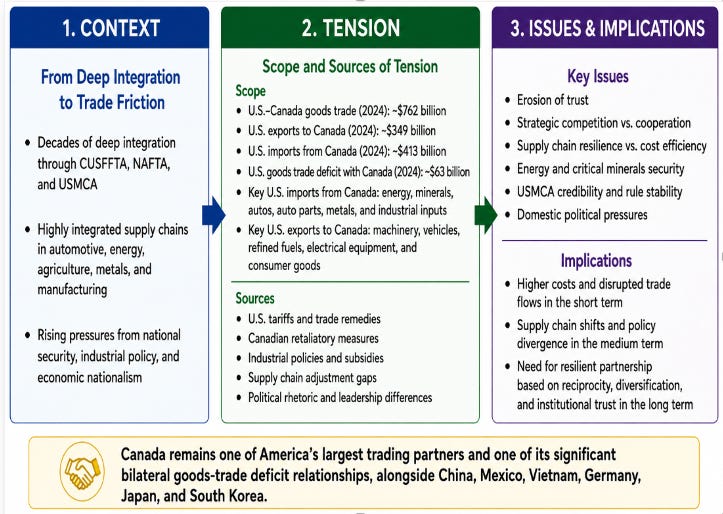
Figure 1 presents a simplified three-stage overview of U.S.–Canada trade relations. The first panel, Context, highlights the long period of deep bilateral integration shaped by CUSFTA, NAFTA, and USMCA, as well as highly interconnected supply chains in sectors such as automotive, energy, agriculture, metals, and manufacturing, while also noting rising pressures from national security concerns, industrial policy, and economic nationalism. The second panel, Tension, summarizes the scope and sources of current friction by showing the large volume of bilateral goods trade, major U.S. exports to and imports from Canada, the U.S. goods trade deficit with Canada, and the main drivers of tension, including tariffs, retaliatory measures, industrial policies, supply chain adjustment gaps, and political rhetoric. The third panel, Issues & Implications, identifies the main concerns arising from these tensions, such as erosion of trust, strategic competition, supply chain resilience, energy and critical minerals security, and USMCA credibility, and concludes with the short-, medium-, and long-term implications for trade flows, policy divergence, and the need for a more resilient North American partnership based on reciprocity, diversification, and institutional trust.
Figure 1
U.S.–Canada Trade Relations: Contexts, Issues and Implications
Source: Author’s own synthesis based on U.S. Census Bureau (2025); Office of the United States Trade Representative (2025, 2026); Global Affairs Canada (2026a, 2026b); Government of Canada (2026); International Monetary Fund (2026); Organisation for Economic Co-operation and Development (2025); Statistics Canada (2025); and United States, Mexico, & Canada (2020).
2.2. Escalating Tariffs, Retaliation, and Political Discord
The conflict intensified during 2026 as tariff negotiations became linked to broader questions of fairness, sovereignty, national production, and the future structure of North American trade. In July 2026, the United States announced additional Section 338 tariffs of up to 50 percent on selected Canadian goods, with the measures taking effect in August. Canada subsequently announced that it would match the new U.S. tariffs dollar for dollar and rate for rate, with counter-tariffs scheduled to take effect on September 8, 2026 (Office of the United States Trade Representative, 2026; Government of Canada, 2026).
2.3. USMCA, Economic Interdependence, and the Emerging Strategic Dilemma
Despite growing political discord, economic separation between the United States and Canada remains difficult because deeply integrated supply chains connect automobiles, energy, critical minerals, agriculture, and intermediate goods, while Canada continues to depend heavily on the U.S. export market. This creates a central paradox: political confrontation is increasing even as economic interdependence remains exceptionally deep, meaning that protectionist measures can impose costs on producers and consumers in both countries. USMCA remains at the center of this dilemma, as uncertainty surrounding its 2026 review gives the United States leverage to pursue stronger domestic-content and reshoring provisions while encouraging Canada to diversify exports, strengthen domestic capabilities, and deepen ties with Europe and Asia (United States, Mexico, & Canada, 2020; Global Affairs Canada, 2026a). The long-term challenge is therefore not whether the two countries can reduce interdependence, but whether they can redesign it so that greater national resilience strengthens rather than weakens North American competitiveness.
Interdependence creates prosperity—but when trust weakens,
dependence can become vulnerability.
3. Scope, Scale, and Sources of U.S.–Canada Tensions
The significance of the current tensions can be understood by examining how widely they extend across economic sectors, how deeply they affect integrated production networks, and what underlying forces continue to drive them.
3.1. Scope of Tensions: From Trade Disputes to Strategic Friction
The current U.S.–Canada tensions extend beyond tariffs to automobiles, steel and aluminum, softwood lumber, dairy, energy, critical minerals, procurement, industrial subsidies, digital trade, and rules governing domestic and North American content. What distinguishes the present period is that these commercial disputes are increasingly intertwined with broader concerns about economic security, sovereignty, strategic industries, border management, and political trust. This wider scope makes compromise more difficult because concessions in one sector can become linked to demands in another, while domestic political pressures raise the cost of accommodation for both governments. The relationship is therefore shifting from relatively contained trade disputes toward broader strategic economic bargaining, with Canada emphasizing economic autonomy and the United States using tariffs and market-access pressure to strengthen domestic production and address perceived imbalances.
3.2. Scale of Tensions: Deep Interdependence Raises the Stakes
The scale of U.S.–Canada tensions is magnified by the extraordinary depth of bilateral economic integration, with large flows of goods, services, energy, capital, and intermediate inputs supporting cross-border production networks in automobiles, aerospace, agriculture, energy, chemicals, and advanced manufacturing (Global Affairs Canada, 2026b). As a result, tariffs can raise input costs, disrupt production, weaken investment certainty, and affect workers and consumers on both sides of the border. Although Canada is more dependent on the U.S. market, giving Washington greater short-term bargaining leverage, many U.S. industries also depend heavily on Canadian energy, minerals, components, and markets (Statistics Canada, 2025; International Monetary Fund, 2026). The relationship therefore combines asymmetric leverage with mutual vulnerability, making coercion more powerful but prolonged separation more costly for both countries.
3.3. Sources of Tensions: Economic Nationalism, Strategic Autonomy, and Eroding Trust
Three underlying forces help explain the intensification of U.S.–Canada tensions. First, rising economic nationalism in the United States has increased emphasis on domestic manufacturing, reshoring, national-content requirements, and protection of strategic industries, with tariffs increasingly used to influence investment and supply-chain decisions rather than simply resolve narrow trade disputes. Second, Canada is pursuing greater strategic autonomy and diversification by reducing excessive dependence on the U.S. market, expanding ties with Europe and Asia, strengthening infrastructure, and supporting nationally important industries. Third, recurring tariffs, retaliation, and uncertainty are eroding institutional and political trust, leading firms and governments to hedge against future political risk and raising a deeper question about whether economic interdependence remains a source of mutual security or is becoming a source of vulnerability (Farrell & Newman, 2019).
4. 2×2 Scenarios for the Future of U.S.–Canada Relations
Looking beyond immediate disputes, the interaction between political tension and economic integration provides a useful framework for considering alternative short- and long-term trajectories of the U.S.–Canada relationship. A useful way to examine the future of U.S.–Canada relations is to consider two critical dimensions: the level of political tension and the degree of economic integration. Political tension may range from low, characterized by negotiated compromise and institutional cooperation, to high, characterized by tariffs, retaliation, and recurring political disputes. Economic integration may remain high because of geography, trade, investment, energy, and deeply connected supply chains, or decline as firms and governments deliberately diversify away from bilateral dependence. Combining these dimensions produces four plausible scenarios.
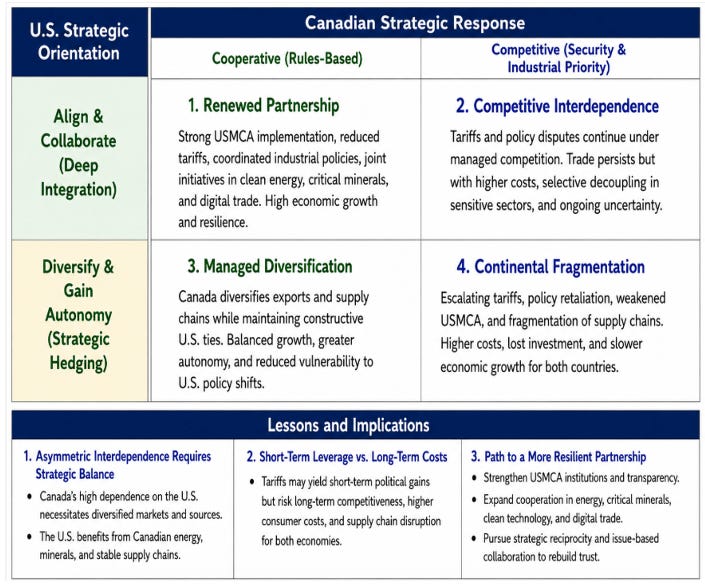
Table 1
Scenario Framework and Lessons for U.S.–Canada Trade Relations
Source: Author’s synthesis based on U.S. Census Bureau (2025); USTR (2025, 2026); Global Affairs Canada (2026a, 2026b); IMF (2026); OECD (2025); and Statistics Canada (2025).
Note: Scenario outcomes are conditional and subject to changes in policies, negotiations, and global economic developments.
4.1. Scenario Framework: Four Possible Futures
The interaction between political tension and economic integration produces four distinct pathways for the future of U.S.–Canada relations, ranging from renewed cooperation to deeper continental fragmentation. Scenario I: Renewed Partnership represents the most constructive outcome, with the United States and Canada resolving major tariff disputes, strengthening USMCA institutions, and coordinating more closely in automobiles, energy, critical minerals, infrastructure, and strategic manufacturing while preserving deep integration through greater reciprocity and resilience. Scenario II: Competitive Interdependence combines continued political tension with sustained economic integration, as tariffs, domestic-content rules, and sectoral disputes persist but firms remain dependent on cross-border supply chains because separation is too costly; this is the most plausible near-term scenario. Scenario III: Managed Diversification emerges if political relations improve while Canada continues reducing excessive dependence on the U.S. market by expanding ties with Europe and Asia, strengthening domestic capabilities, and developing alternative transportation and energy corridors as a form of strategic risk management. Scenario IV: Continental Fragmentation is the most disruptive outcome, in which persistent tariffs, political hostility, investment restrictions, and retaliation push both countries toward more nationally concentrated production systems, weakening North American competitiveness relative to Europe and Asia (Global Affairs Canada, 2026a, 2026b; Government of Canada, 2026; Office of the United States Trade Representative, 2025, 2026).
4.2. Short-Term Outlook: Competitive Interdependence as the Dominant Scenario
In the short term, Competitive Interdependence appears to be the most likely trajectory, as political tensions remain elevated while deeply embedded supply chains, transportation systems, energy networks, and business relationships make large-scale economic separation costly (Global Affairs Canada, 2026b; International Monetary Fund, 2026; Statistics Canada, 2025). The United States is likely to continue pressing Canada on U.S. content, market access, and investment commitments, while Canada responds through selective retaliation, negotiation, and diversification (Government of Canada, 2026; Office of the United States Trade Representative, 2026). At the same time, firms, workers, provinces and states, and consumers on both sides will pressure governments to limit sustained economic damage. The likely near-term pattern is therefore neither full reconciliation nor decoupling, but repeated cycles of pressure, negotiation, partial settlement, and renewed disagreement.
4.3. Long-Term Transition: From Competitive Interdependence toward Managed Resilience
Over the longer term, the key question is whether Competitive Interdependence becomes permanent or evolves toward a more stable relationship characterized by Managed Diversification and renewed cooperation. Continued uncertainty may encourage Canada to diversify markets and strengthen domestic capabilities, while the United States pursues greater domestic production but continues relying on Canada for energy, critical minerals, and selected industrial inputs (Global Affairs Canada, 2026a; International Monetary Fund, 2026; Statistics Canada, 2025). The most sustainable pathway would combine elements of Renewed Partnership and Managed Diversification, allowing Canada to reduce excessive dependence without abandoning close U.S. ties and enabling the United States to strengthen domestic resilience without weakening continental cooperation. In this model, U.S.–Canada relations would move from maximum integration toward strategically balanced integration, based on the principle that resilient partners can create a stronger North American system than dependent partners (Keohane & Nye, 2012; Organisation for Economic Co-operation and Development, 2025).
The Future is not less U.S.–Canada integration, but more resilient integration built on reciprocity, diversification, and trust.
5. Lessons and Implications
The evolving U.S.–Canada relationship offers broader lessons about the opportunities and vulnerabilities of economic interdependence, the limits of tariff-based leverage, and the importance of building a more resilient partnership.
5.1. Interdependence Creates Strength, but Also Vulnerability
The first lesson is that deep economic integration can generate substantial efficiency, investment, and productivity benefits while also creating strategic vulnerability (Keohane & Nye, 2012; Organisation for Economic Co-operation and Development, 2025). Canada’s greater dependence on the U.S. market gives Washington stronger short-term bargaining leverage, yet U.S. firms also rely heavily on Canadian energy, minerals, intermediate goods, and integrated manufacturing networks, making the relationship a form of asymmetric interdependence rather than simple mutual dependence (Farrell & Newman, 2019; International Monetary Fund, 2026; Statistics Canada, 2025). For Canada, the strategic response is not separation from the United States but greater diversification, infrastructure development, and domestic capability building. For the United States, repeated use of interdependence as leverage may encourage partners to reduce their exposure, suggesting that a resilient bilateral relationship requires a better balance between national flexibility, mutual dependence, and long-term trust.
5.2. Tariffs Can Produce Short-Term Leverage but Long-Term Strategic Costs
The second lesson is that tariffs can provide short-term negotiating leverage but become increasingly costly when used repeatedly against a deeply integrated ally (Baldwin, 1985). They may encourage production shifts and signal political resolve, yet they can also raise costs, discourage investment, provoke retaliation, and weaken confidence in established trade arrangements (Office of the United States Trade Representative, 2026). If Canada comes to view access to the U.S. market as less predictable, governments and firms will have stronger incentives to diversify markets, reconfigure supply chains, and deepen economic ties with Europe and Asia, potentially reducing U.S. influence over time (Farrell & Newman, 2019; Government of Canada, 2026). Tariffs are therefore most effective when they support clearly defined negotiating objectives and durable institutional settlements, rather than becoming a permanent substitute for economic diplomacy.
5.3. The Future Requires Resilient Partnership Rather Than Maximum Integration
The third lesson is that the future of U.S.–Canada relations should not be framed as a choice between complete integration and economic separation, but as the pursuit of a resilient partnership that preserves the benefits of continental integration while strengthening both countries’ capacity to absorb geopolitical shocks, supply disruptions, and political change (Keohane & Nye, 2012; Organisation for Economic Co-operation and Development, 2025). Such a partnership would emphasize trusted supply chains, reciprocal market access, strategic coordination in energy and critical minerals, clearer rules for industrial subsidies and domestic content, and more predictable dispute-resolution mechanisms consistent with the institutional logic of USMCA (United States, Mexico, & Canada, 2020). More broadly, sustainable economic alliances in an era of geopolitical rivalry and politicized trade will depend not only on efficiency but also on trust, reciprocity, resilience, and strategic flexibility (Farrell & Newman, 2019). The most durable path forward is therefore neither unconditional dependence nor defensive fragmentation, but a rebalanced relationship in which national resilience and continental competitiveness reinforce one another.
6. Conclusion
The recent U.S.–Canada trade tensions demonstrate that even one of the world’s most deeply integrated bilateral relationships can become vulnerable when economic nationalism, tariff leverage, domestic industrial priorities, and concerns over sovereignty begin to challenge established expectations of rules-based cooperation. In the short term, competitive interdependence is likely to characterize the relationship, as tariffs and political disagreements coexist with extensive cross-border flows of automobiles, energy, critical minerals, investment, agricultural products, and intermediate goods that make large-scale economic separation costly for both countries. Over the longer term, persistent uncertainty may encourage Canada to diversify its markets and strengthen domestic capabilities while prompting the United States to emphasize reshoring and economic security, but excessive use of economic leverage could gradually weaken the trust and influence upon which successful interdependence ultimately depends (Baldwin, 1985; Keohane & Nye, 2012). The more constructive path is therefore neither a return to unquestioned dependence nor continental fragmentation, but a resilient North American partnership in which strategic autonomy, reciprocity, predictable institutions, and mutually beneficial integration enable the United States and Canada to transform present tensions into an opportunity for renewed cooperation and stronger long-term competitiveness.
References
Baldwin, D. A. (1985). Economic statecraft. Princeton University Press.
Farrell, H., & Newman, A. L. (2019). Weaponized interdependence: How global economic networks shape state coercion. International Security, 44(1), 42–79. https://doi.org/10.1162/isec_a_00351
Global Affairs Canada. (2026a). Joint review of the Canada–United States–Mexico Agreement (CUSMA). Government of Canada.
Global Affairs Canada. (2026b). Monthly trade report: May 2026. Government of Canada.
Government of Canada. (2026). What we heard: 2025 public consultations on the CUSMA review. Global Affairs Canada.
International Monetary Fund. (2026). Canada: 2025 Article IV consultation—Press release; and staff report (IMF Country Report No. 26/012). International Monetary Fund.
Keohane, R. O., & Nye, J. S., Jr. (2012). Power and interdependence (4th ed.). Longman.
Office of the United States Trade Representative. (2025). 2025 national trade estimate report on foreign trade barriers. Executive Office of the President.
Office of the United States Trade Representative. (2026). Ambassador Greer issues statement on President Trump imposing Section 338 tariffs on Canada. Executive Office of the President.
Organisation for Economic Co-operation and Development. (2025). OECD economic surveys: Canada 2025. OECD Publishing. https://doi.org/10.1787/28f9e02c-en
Statistics Canada. (2025). Canadian international merchandise trade and Canada–United States economic linkages. Government of Canada.
U.S. Census Bureau. (2025). Trade in goods with Canada. U.S. Department of Commerce.
United States, Mexico, & Canada. (2020). Agreement between the United States of America, the United Mexican States, and Canada. Office of the United States Trade Representative.
ABOUT THE AUTHOR

Paul C. Hong
Distinguished University Professor, University of Toledo
Paul C. Hong is a Distinguished University Professor at the University of Toledo whose academic background integrates economics, manufacturing management, engineering, and global supply chain strategy. He earned a B.A. in Economics from Yonsei University, an M.A. in Economics from Bowling Green State University, and a Ph.D. in Manufacturing Management and Engineering from the University of Toledo. His research focuses on global supply chain management, strategic benchmarking, manufacturing competitiveness, resilience, industrial policy, and geo-economics, with particular interest in how trade policy, technological change, economic security, and geopolitical competition reshape international production networks and national competitiveness. His current work increasingly examines the intersection of global supply chains, strategic industries, AI-enabled transformation, and geo-economic relations among major economies, emphasizing how firms and nations can balance efficiency, resilience, strategic autonomy, and international cooperation in an increasingly complex global environment.
Original Article

Suggested Citation
Hong, P. C. (2026, September 1). U.S.–Canada trade relations: Navigating tensions, rebalancing interdependence, and building a more resilient North American partnership. K-GSP Forum, pp. 1–11.
한글요약
미국–캐나다 무역관계: 긴장을 넘어 상호의존을 재조정하고 더욱 회복력 있는 북미 파트너십을 구축하다
이 글은 최근 미국과 캐나다 사이에서 심화되고 있는 무역갈등, 관세분쟁, 정치적 불협화음을 단순한 양국 간 마찰이 아니라 북미 경제통합의 성격이 변화하는 과정으로 해석한다. 오랫동안 미국과 캐나다는 세계에서 가장 안정적이고 긴밀한 경제 파트너십을 유지해 왔지만, 최근에는 철강·알루미늄·자동차·목재·농산물·에너지·핵심광물 등을 둘러싼 갈등이 확대되고 있다. 미국은 자국 제조업 강화, 리쇼어링, 미국산 부품 사용 확대, 무역조건 개선을 강조하는 반면, 캐나다는 경제주권과 예측 가능한 무역질서, 북미 전체의 공급망 통합을 중시하고 있다. 따라서 현재의 갈등은 특정 품목의 관세문제를 넘어 경제적 상호의존을 어떻게 관리할 것인가라는 전략적 문제로 발전하고 있다.
이 글은 양국 갈등의 범위(scope), 규모(scale), 원천(sources)을 중심으로 현재 상황을 분석한다. 갈등의 범위는 전통적인 무역분쟁을 넘어 산업정책, 공급망 안보, 국내생산, 에너지, 핵심광물, 경제주권으로 확대되고 있으며, 갈등의 규모 또한 막대한 양국 간 교역과 투자가 얽혀 있다는 점에서 매우 크다. 특히 캐나다는 미국시장에 대한 의존도가 높기 때문에 단기적으로 미국이 더 큰 협상력을 갖지만, 미국 역시 캐나다의 에너지, 광물, 중간재, 자동차 부품 등에 크게 의존하기 때문에 장기적인 갈등은 미국경제에도 상당한 비용을 초래할 수 있다. 이러한 현상은 양국 관계가 단순한 상호의존을 넘어 비대칭적 상호의존(asymmetric interdependence)의 특성을 가지고 있음을 보여준다.
향후 전망을 위해 이 글은 정치적 긴장 수준과 경제통합 수준을 기준으로 네 가지 2×2 시나리오를 제시한다. 첫째는 정치적 갈등이 완화되고 경제통합이 유지되는 ‘Renewed Partnership’, 둘째는 정치적 갈등이 지속되지만 깊은 경제통합도 계속되는 ‘Competitive Interdependence’, 셋째는 정치관계는 안정되면서 캐나다가 시장과 공급망을 점진적으로 다변화하는 ‘Managed Diversification’, 넷째는 높은 정치갈등과 경제적 분리가 동시에 진행되는 ‘Continental Fragmentation’이다. 단기적으로는 Competitive Interdependence가 가장 현실적인 가능성으로 보이지만, 장기적으로는 캐나다가 미국 의존도를 낮추고 유럽·아시아와의 경제관계를 확대하면서 Managed Diversification으로 이동할 가능성도 있다. 따라서 양국의 미래는 최대한의 경제통합 자체가 아니라 전략적 자율성과 협력을 동시에 확보하는 회복력 있는 북미 파트너십을 구축할 수 있는가에 달려 있다.
이 연구가 제시하는 가장 중요한 교훈은 관세가 단기적으로는 효과적인 협상수단이 될 수 있지만 반복적으로 사용될 경우 장기적으로는 신뢰를 약화시키고 상대국의 시장 다변화를 촉진하여 오히려 미국의 경제적 영향력을 감소시킬 수 있다는 점이다. 캐나다에게 필요한 것은 미국과의 관계를 단절하는 것이 아니라 과도한 의존을 줄이고 국내 산업역량과 글로벌 네트워크를 확대하는 것이며, 미국에게 필요한 것은 자국의 경제안보와 제조업 경쟁력을 강화하면서도 가장 가까운 동맹국과의 제도적 신뢰를 유지하는 것이다. 양국 관계의 지속가능한 미래는 의존과 단절 사이의 선택이 아니라, 상호주의·예측가능성·공급망 회복력·전략적 유연성을 결합한 새로운 형태의 경제협력에 있다.
Paul C. Hong은 University of Toledo의 Distinguished University Professor로서 글로벌 공급망, 전략적 벤치마킹, 리더십, 거버넌스와 AI 시대의 의사결정을 연구하고 있다. 그는 국제 공급망과 국가 경쟁력 문제를 경제적 효율성뿐 아니라 역사적·전략적·인문학적 관점에서 통합적으로 해석하는 데 관심을 두고 있다.
© K-Global Scholars and Professionals Forum. September 2026. All rights reserved. Content published in the K-GSP Forum may not be reproduced, distributed, or transmitted in any form without prior written permission from the K-GSP Forum, except for brief quotations with full attribution.