

Walking Meditation
The long and endless suffering of life is likened to the sea, and thus life is called a “sea of suffering.” People suffer from various problems every day. Inevitable sufferings, such as aging, falling ill, or facing death, also follow. However, not many people live with the proper awareness that pain or difficulty is an integral part of life. Overlooking the fact that this is a situation everyone faces, one that must be met with composure and preparation, people tend simply to dislike it.
Religions have long taught us how to examine the sufferings within body and mind, grasp their true nature, and find release from them. In the medical field, researchers have sought ways to maintain both physical and mental health: vitality, thinking, memory, concentration, and creativity. Considering these teachings alongside the results of research, one realizes that mindset matters more than anything else.
Farsighted leaders have advised that one must keep the mind at ease to escape suffering. Pascal said that all human misfortunes stem from not knowing how to sit quietly in a room and rest. Sometimes you should stop what you are doing and sit quietly to reflect on yourself. To overcome difficult circumstances and live comfortably, it is good to set aside even a few minutes each day for your mind. When you let go of excessive desire or attachment and follow the natural flow, you can attain true peace and freedom.
The whole world is becoming increasingly noisy these days, leaving people uneasy and anxious. In times like these, we need to be wise. It is not desirable to narrow one’s perspective by focusing only on oneself and believing that one alone is suffering. One good way to enjoy peace is simply to accept what happens without being troubled by it.
Just as one might sit by a stream and watch fish playing in the water without missing a beat, observing all that arises in the body and mind is beneficial in many ways. All manner of trouble is created in the heart, and the core philosophy of Buddhism holds that everything in the world depends on one’s mindset. If you master your mind and overcome hardship, you can become happy.
In the traditions of Buddhism, Hinduism, and Christianity, countless books and courses teach ways to help discipline the mind. Mental discipline can be one method of maintaining physical health. While the rules and procedures of training matter, one’s mindset appears to have a greater impact than technique alone in achieving rewarding results.
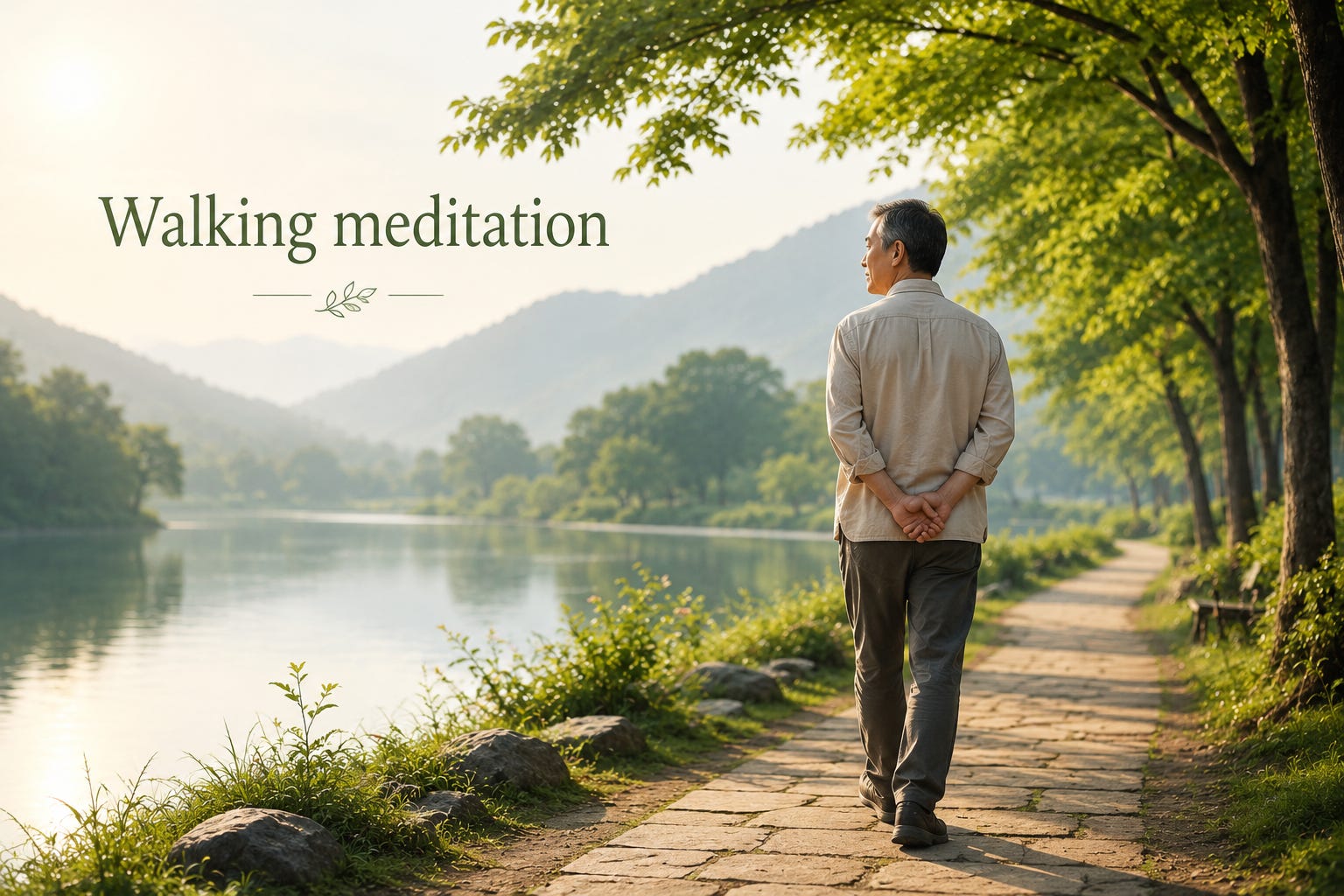
Stand upright and keep your gaze three to four meters ahead of your toes. Since lowering your head makes you tired more easily, keep your chin up straight. Walk slowly, holding your hands together in front or behind so they do not shake. With every step, feel the moment your feet touch the ground. If you attend to your breathing at the same time, you can sense how many steps you walk comfortably during a single inhale or exhale. While inhaling, say “It comes in,” and while exhaling, “It’s going out.”
This is walking mindfulness meditation. Its quintessence lies in conscious breathing and walking. One should be aware of the surroundings and physical sensations while walking. Recommended by Thich Nhat Hanh (1926–2022), the Vietnamese Buddhist monk, it is known to be especially effective for cooling anger (Anger: Wisdom for Cooling the Flames, Riverhead Books, 2001). He was regarded as the “father of mindfulness” and was a major influence on Western practices of Buddhism.
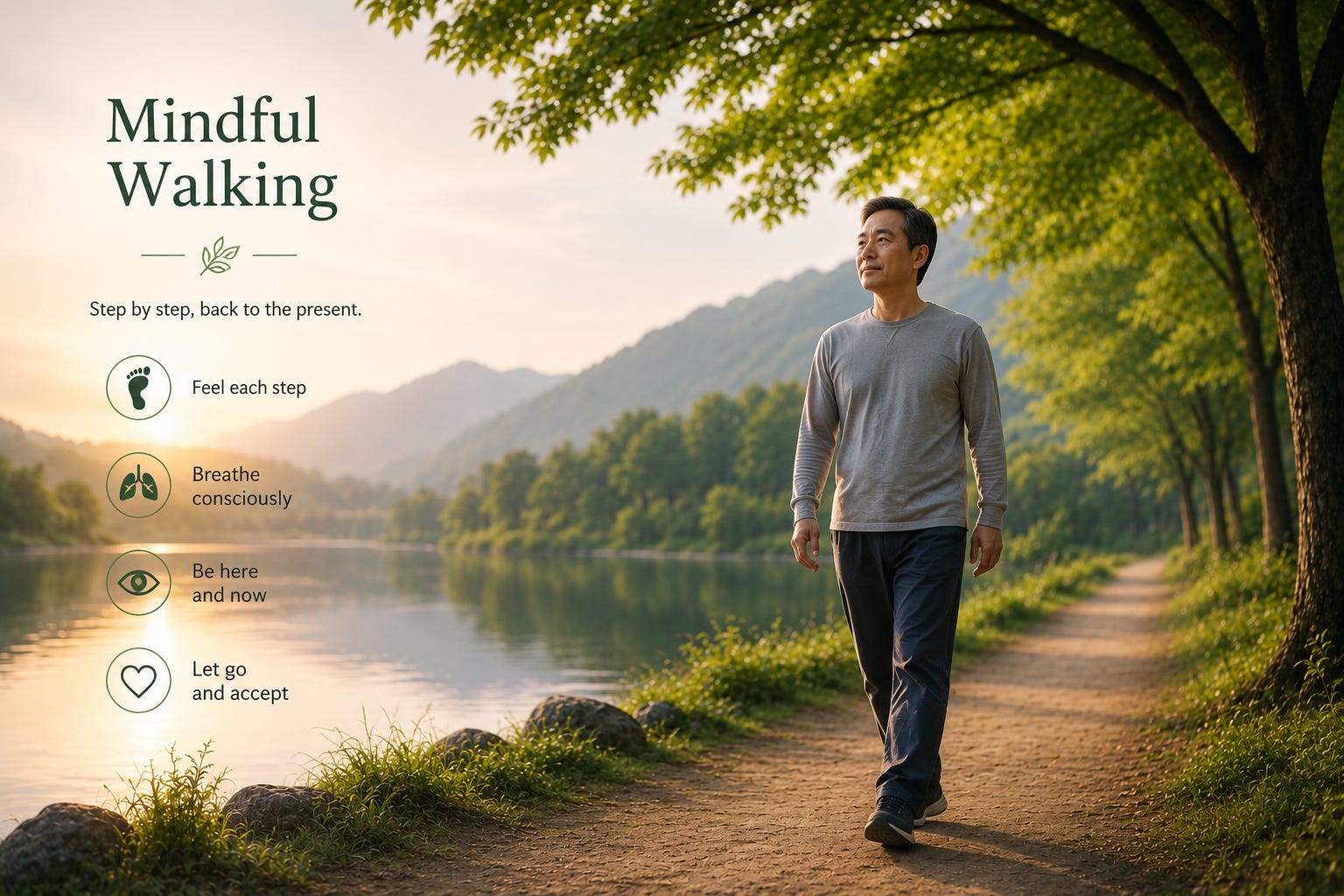
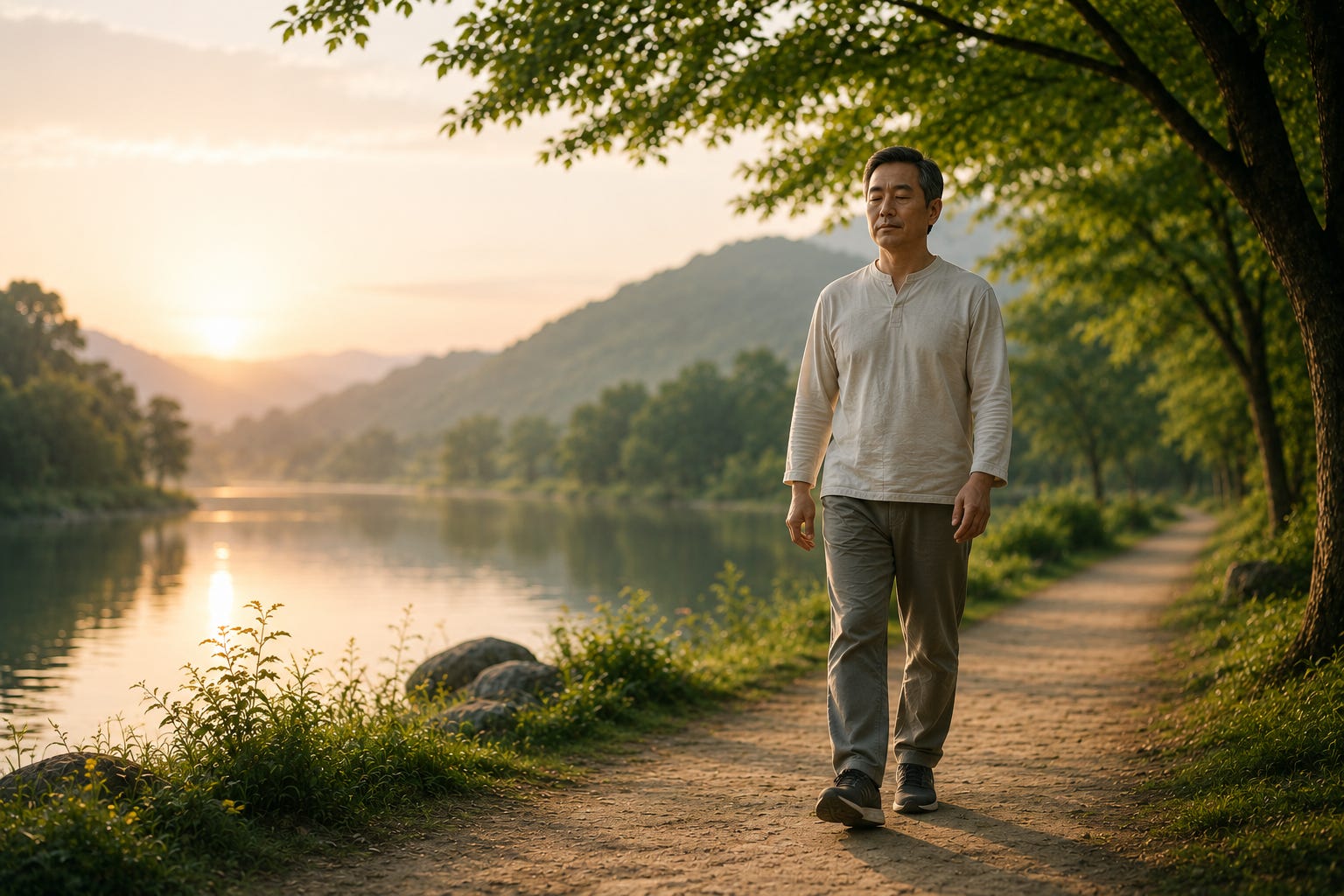
It is important not to miss a single sensation in the feet as the center of gravity shifts. Walk naturally while aligning your mind with the movements and sensations of your feet. Do not move like a machine; try to feel, in detail, each moment your feet touch the floor.
If you align your mind with the movements and sensations of your feet while simultaneously feeling your breath, your mind, restless like a grasshopper, butterfly, or monkey, will come to dwell in the “here and now.” In a gait where observation coincides with phenomenon, only intention and action remain, and the self that led to it disappears spontaneously.
While focusing your mind throughout this process, your mind may wander; this is an illusion. Do not let delusions hinder practice; treat them as simply another object to be observed. Notice the state of mind at that moment, and rather than wishing for the absence of delusion, simply recognize that you are deluding. There is no room for delusion to seep into proper walking meditation.
It is advisable to make this a habit of daily life. It suits those who spend a great deal of time sitting. Many people read various books on spiritual traditions and perform rituals, but few put those teachings into practice faithfully. Practicing only while sitting or only while walking leaves mind and body prone to stagnation or restlessness, making concentration difficult. Efficiency increases when the two are practiced in harmony. One must adopt the attitude that good results come from ceaseless, faithful practice, dedicating the whole heart to the present moment.
보행 명상
현세의 괴로움이 길고 끝없음을 바다에 비유하여 고해라고 한다. 수많은 사람들이 삶에서 고통을 겪고, 여러 가지 문제들에 날마다 시달린다. 나이를 먹거나, 병에 걸리거나, 죽음을 맞이하는 것과 같은 필연적 고통도 뒤따른다. 그런데 고통이나 문제가 삶의 일부이어서 겪을 수밖에 없다는 사실을 제대로 인식하고 사는 사람은 많지 않다. 누구나 처하는 상황이기 때문에 의연히 이겨 내고, 그에 대해 준비할 필요가 있다는 사실은 외면한 채 그저 싫어하는 성향을 띤다.
종교계에서는 오래전부터 몸과 마음 안에서 일어나는 현상을 적극적인 방법으로 살펴보고 그 실상을 파악하여 고통으로부터 벗어나라고 가르쳤다. 의료계에서는 신체의 상태를 건강하게 유지시켜 활력을 되찾고, 사고 능력을 비롯하여 기억력, 집중력, 창의력 등을 향상시키는 방법을 밝히려고 노력했다. 가르침이나 연구 결과를 보면 무엇보다 마음가짐이 중요하다는 것을 깨닫게 된다.
선각자들도 고통에서 벗어나려면 마음을 편하게 가져야한다고 일렀다. 파스칼은 인간의 모든 불행은 단 한 가지, 조용한 방에 들어앉아 휴식할 줄 모른다는 데서 비롯된다는 말을 남겼다. 때때로 휴식을 취하면서 생각하는 시간을 가지라는 말이다. 어려운 환경을 이겨 내고 편안하게 살려면 하루에 단 몇 분이라도 마음을 위해 쓸 시간을 따로 떼어놓는 것이 좋다. 하던 일을 멈추고 조용히 앉아 자신을 돌아보아 차분하고 편안해질 수 있어야 한다. 진정한 평화나 자유는 과욕이나 집착을 버릴 때 얻을 수 있다.
요즈음 온 지구촌이 부쩍 시끄러워 사람을 편안하지 않고 조마조마하게 만든다. 이런 때일수록 우리는 지혜로워져야 할 필요가 있다. 오로지 자신에게만 초점을 맞추어 나만 고통을 받는다고 생각하거나 자신에게 미치는 영향에만 신경을 곤두세우고 모든 일을 이해하거나 오해함으로써 심리적으로 시각을 좁히는 경향 등은 바람직하지 않다. 세상에서 일어나는 일을 상관하지 않고 그냥 받아들이는 것은 평화를 누리는 좋은 방법 중의 하나다.
시냇가에 앉아 물 속에서 노는 물고기를 놓치지 않고 들여다보듯이 몸과 마음에서 일어나는 모든 현상을 주시하면 여러 가지로 이롭다. 세상만사가 마음먹기에 달렸다는 말은 불교의 핵심 사상으로, 온갖 현상을 마음이 만들어 내기 때문에 마음가짐에 따라 세상이 달라 보인다는 의미이다. 현상 그 자체보다 그것을 대하는 마음의 자세가 중요하다는 뜻이며, 마음을 다스려 고난을 극복하면 행복해질 수 있다는 조언을 담고 있다.
불교, 힌두교, 기독교의 전통에는 마음을 다스리는 데에 도움이 되는 방법을 가르치는 책과 강좌가 셀 수 없이 많다. 정신의 수련은 건강을 위한 양생법의 하나이기도 하다. 수련의 기법을 충실히 따르면서 평소의 마음가짐이 좋아야 보람이 있는 결과가 나타난다.
반듯하게 서서 시선을 발끝에서 3~4 미터 앞에 둔다. 고개를 숙이면 쉽게 피곤해지기 때문에 턱을 바르게 세우고, 흔들리지 않게 손을 앞이나 뒤로 모아 잡고 걷는다. 발을 디딜 때마다 바닥에 닿는 순간과 호흡을 느끼면 한 번의 들숨 또는 날숨 동안에 몇 걸음을 편안하게 걸을 수 있는지 짐작이 간다. 발이 바닥에 닿거나 숨이 들고나는 것을 낱낱이 느끼면서, 들이쉴 때 ‘들어온다’ 하고, 내쉴 때 ‘나간다’ 하고 말하라.
천천히 걸으면서 발바닥의 감각, 몸의 움직임, 호흡 등의 신체 감각과 주변 환경을 알아차리는 마음 챙김 명상이다. 틱낫한(1926~2022) 스님이 스트레스 해소, 집중력 향상, 불안 감소에 효과적이라고 권하면서, 화를 삭이는 데에 특효를 나타낸다고 했다. 수련의 핵심은 의식적인 호흡과 보행이며, 평소에 걷는 것보다 천천히 걸어야 동작에서 오는 갖가지 느낌을 놓치지 않고 주시할 수 있다.
체중의 중심이 옮겨질 때 발의 상태 등은 물론 움직임에서 오는 모든 느낌을 하나도 놓치지 않는 것이 중요하다. 인간적인 감정이나 자주성 또는 창의성 없이 기계처럼 해서는 안된다. 자연스럽게 걸으면서 발의 동작과 감각에 마음을 일치시키고 동시에 호흡도 느끼면 메뚜기, 나비, 원숭이처럼 한시도 가만히 있지 못하는 마음이 ‘지금 여기에’ 머무르게 된다. 주시와 현상이 일치하는 걸음걸이 안에는 의도와 행위만 있을 뿐 그것을 주도하는 나는 자연스럽게 사라져버린다.
정신을 모아 살피는 중에 마음이 대상을 떠나 방황하는 수도 있는데 그것은 망상이다. 망상이 수행에 지장을 준다고 여기지 말고 주시해야 하는 또 다른 대상으로 보아야 한다. 그때의 마음 상태를 알아차리고, 망상이 없기를 바랄 것이 아니라 망상하고 있음을 깨닫는 것이 중요하다. 제대로 된 걷기 명상에는 망상이 스며들 틈이 없다.
마음만 먹으면 언제 어디서든지 수련할 수 있기 때문에 생활의 습관이 되는 것이 좋다. 앉아있는 시간이 많은 이들이 수행하기에 알맞다. 여러 가지 정신적 전통에 관한 다양한 책을 읽고 의식을 치르지만 막상 그 가르침들을 충실히 실천하는 사람은 많지 않다. 수행을 그저 앉아서 하거나 걸으면서 하면 심신이 침체되기 쉽거나 정신이 들떠 집중하기가 어렵다. 두 가지를 조화롭게 수련하면 효율이 높아진다. 지금 이 순간 온 마음을 다 바쳐 부단하고 충실하게 수련할 때에 좋은 효과를 거둔다는 사실을 깊이 새기는 자세라야 한다.
Original Article:

About the Author:

Dr. Chung Gil Lee is Professor Emeritus of Veterinary Medicine at Chonnam National University, where he served on the faculty until 2007. He holds an M.Sc. and Ph.D. from James Cook University, Australia, and began his career as an Interpreter Officer in the Korean Army. A graduate of Chonnam National University (1963), he is currently a member of the Korean Literature Society of America.
© K-Global Schoalrs and Professionals Forum. All rights reserved. Content published in the K-GSP Forum may not be reproduced, distributed, or transmitted in any form without prior written permission from the K-GSP Forum, except for brief quotations with full attribution.
좋은 정보를 담은 글 감사드립니다.