

EXECUTIVE SUMMARY
Water is foundational infrastructure that sustains human survival, enables energy systems, and supports modern economic activity. As population growth, industrial production, and AI-driven digital infrastructure increase demand, water is emerging as a critical constraint across interconnected systems. This article argues that long-term resilience depends not simply on water availability, but on the governance capability and institutional coordination needed to manage water effectively.
Key Words: Water Infrastructure, Resource Governance, Water–Energy Nexus, Economic Resilience, System Capability
1. Introduction
In recent years, advanced economies have faced growing disruptions not from technological failure, but from water constraints. Drought conditions have threatened semiconductor production in parts of Asia, while the rapid expansion of AI-driven data centers has intensified pressure on already stressed cooling and energy systems. These developments reveal a critical reality: even the most advanced industries remain dependent on water as a finite and unevenly distributed resource. Behind digital infrastructure, industrial production, and global supply chains lies a foundational system increasingly under strain.
Water is therefore emerging not simply as an environmental issue, but as strategic infrastructure that sustains human survival, energy systems, and economic resilience (IEA, 2022). Population growth, climate variability, and rising industrial demand are placing unprecedented pressure on water systems worldwide, even in regions historically considered secure (UNESCO, 2024). In this context, the defining challenge is no longer only resource availability, but governance capability, the ability of institutions to manage, coordinate, and sustain water flows across interconnected ecosystems, energy networks, and supply chains.
2. Water as Foundational Infrastructure
Water must be understood not merely as a natural resource, but as foundational infrastructure, a dynamic, governed flow that sustains survival, enables energy systems, and underpins modern economic activity across supply chains, ecosystems, and industrial networks. From agriculture and manufacturing to data centers and energy generation, water functions as an essential input whose reliability determines system performance and resilience. This perspective shifts attention from resource availability alone to the capacity to manage, allocate, and sustain water flows across interconnected systems. Countries facing similar levels of water stress often experience sharply different outcomes depending on governance capability, infrastructure quality, and policy coordination, demonstrating that water security is shaped not only by physical scarcity but also by institutional effectiveness. Water, therefore, is not simply an environmental concern. It is strategic infrastructure that determines long-term economic resilience and stability.
2.1. Sustaining Survival: Stability Through System Capability
Countries with low water stress and strong governance operate under favorable conditions that allow them to sustain human survival while optimizing water use across sectors. Abundant or reliable water supply, when combined with effective infrastructure, regulatory coordination, and long-term planning, enables consistent access to safe drinking water, sanitation, and food production. These systems integrate water seamlessly into economic activity, ensuring stable flows for agriculture, industry, and urban life without significant disruption.
What distinguishes these countries is not simply resource abundance, but system capability, the ability to manage water as part of an interconnected supply network. Even when variability occurs, strong institutions ensure that water is monitored, allocated, and reused efficiently. This coordination supports both public health and economic productivity, transforming water from a basic necessity into a stable platform for development. As a result, these systems serve as benchmarks, demonstrating how governance and integration, not just natural endowment, sustain survival and long-term resilience.
2.2. Water–Energy Systems Under Constraint: From Risk to Resilience
In contrast, countries facing high water stress operate under structural constraints, particularly in energy systems that depend heavily on water for cooling, hydropower, and fuel processing. However, outcomes vary significantly depending on governance capability. Where coordination is strong, constraints are actively managed through infrastructure investment, technological innovation, and integrated planning, allowing water-dependent energy systems to function with relative stability despite limited resources.
Where governance is weak, the same level of stress leads to misalignment between supply and demand, creating inefficiencies and systemic vulnerabilities. Disruptions in water availability can cascade into energy shortages, industrial slowdowns, and broader economic instability. This contrast underscores a critical insight: constraint alone does not determine outcomes. Capability does. Effective coordination transforms water stress into managed resilience, while weak systems amplify it into risk. Understanding this interaction provides a practical framework for identifying where intervention is needed and how nations can transition toward more stable, sustainable water–energy systems.
2.3. Toward the AI-Enabled Economy
As economies transition toward AI-driven systems, water is becoming an increasingly critical constraint embedded within digital infrastructure. Data centers, semiconductor manufacturing, and advanced computing systems require substantial volumes of water for cooling, processing, and maintaining operational stability. What appears to be a virtual, data-driven economy is in fact deeply dependent on physical resource flows, with water emerging as a limiting factor in the expansion of AI capabilities. This creates a new dimension of infrastructure risk, where the growth of digital intelligence is directly tied to the sustainability of water systems.
In this context, the challenge extends beyond efficiency to intelligent coordination. AI itself can play a role in optimizing water use, through predictive analytics, real-time monitoring, and adaptive system management, but only within the boundaries set by governance and infrastructure capacity. Countries that align technological advancement with strong water governance will be better positioned to sustain both digital growth and resource resilience. Ultimately, the AI-enabled economy will not be defined solely by computational power, but by the ability to integrate and sustain the physical systems, especially water, that make such power possible.
Water is no longer just a resource. It is the invisible infrastructure that determines which supply chains survive and which fail.
3. Rethinking Water: A Global Supply Chain Perspective
Water should be understood not as a static natural resource, but as a critical flow within global supply chains, moving across sourcing, production, processing, consumption, and reuse. From agriculture and manufacturing to energy and digital infrastructure, water is embedded at every stage of value creation. This perspective reframes water management as a cross-border coordination challenge, where disruptions in one region can propagate through interconnected supply networks, affecting production, trade, and economic stability worldwide. As with other supply chain inputs, reliability, timing, quality, and governance of water flows are as important as physical availability.
From a global supply chain perspective, outcomes are shaped by the interaction between water stress (constraint) and governance capability (coordination and control). A simple 2×2 framework, contrasting high vs. low stress with strong vs. weak capability, provides a practical lens for comparing national systems and their roles within global networks. Countries with similar levels of water scarcity often produce very different supply chain outcomes depending on how effectively they manage allocation, infrastructure, and cross-sector integration. This explains why some regions remain reliable nodes in global production, while others become sources of disruption and risk.
3.1. Water Supply as a Strategic Input in Global Value Chains
Water is a foundational input across global supply chains because it underpins essential systems of life, production, and technological advancement. At the most basic level, reliable water access sustains human health, sanitation, and workforce stability, conditions necessary for any productive economy. In agriculture, which dominates global water use, water availability directly affects crop yields, food supply chains, and international trade flows. In manufacturing, industries such as semiconductors, chemicals, steel, and pharmaceuticals depend on consistent water inputs for processing, cooling, and cleaning. As a result, water disruptions are not localized events. They cascade across upstream and downstream supply chain partners, affecting output, pricing, and delivery reliability.
In the AI-driven global economy, water’s role becomes even more strategic through its connection to energy and digital infrastructure. Data centers, cloud platforms, and AI training systems require large-scale energy inputs, much of which depends on water-intensive cooling and power generation. This creates a tightly coupled water–energy–digital nexus, where water availability directly influences technological capacity and competitiveness. Countries that can reliably manage water flows are better positioned to anchor high-value segments of global supply chains, including advanced manufacturing and AI infrastructure. In this context, water is no longer a background input. It is a strategic enabler of global economic positioning.
3.2. From Efficiency to Vulnerability: Capability as the Supply Chain Differentiator
In global supply chains, countries with low water stress and strong governance capability function as stable and efficient nodes, enabling predictable production and reliable delivery across sectors. These systems combine resource availability with robust infrastructure, regulatory alignment, and long-term planning, allowing water to flow seamlessly through agricultural, industrial, and urban systems. Their strength lies not only in abundance, but in the ability to integrate water into complex supply chain operations, ensuring continuity and resilience even under variable conditions.
However, as water stress increases, differences in governance capability become more pronounced and consequential. Under high stress, countries with strong coordination can adapt through technological innovation, infrastructure investment, and integrated resource management, maintaining their role in global supply chains despite constraints (World Bank, 2023). In contrast, countries with weaker governance face misalignment between supply and demand, leading to inefficiencies, production disruptions, and systemic risk. These vulnerabilities can ripple across global networks, affecting industries far beyond national borders. Thus, in the global supply chain context, capability, not just resource endowment, determines whether water becomes a source of competitive advantage or systemic disruption.
4. Benchmarking Water in Global Supply Chains: Capability Under Constraint
Building on the supply chain perspective in Section 3, national water systems can be understood as nodes within global production and distribution networks, where performance depends on the ability to manage constraint. Countries facing high water stress operate under structural limitations, but their outcomes diverge significantly based on governance capability. In high-capability systems, stress is actively managed through infrastructure investment, technological innovation, and coordinated policy frameworks, enabling stable and reliable water flows that sustain participation in global supply chains.
In contrast, countries with weaker governance capacity struggle to manage these constraints effectively, with fragmented institutions and poor coordination creating inefficiencies that ripple across agriculture, industry, and trade. Benchmarking national systems through this lens reveals where resilience is built and where vulnerabilities persist.
4.1. Global Patterns Across Nations: Divergence Under Similar Constraints
Comparative evidence from global water governance and hydrological risk assessments reveals recurring patterns in how national systems respond to water stress under differing levels of institutional capability (OECD, 2021; UNESCO, 2024; WRI, 2023). While countries differ significantly in geography, political systems, and development trajectories, broad comparative tendencies emerge from the interaction between structural water constraints and governance effectiveness.
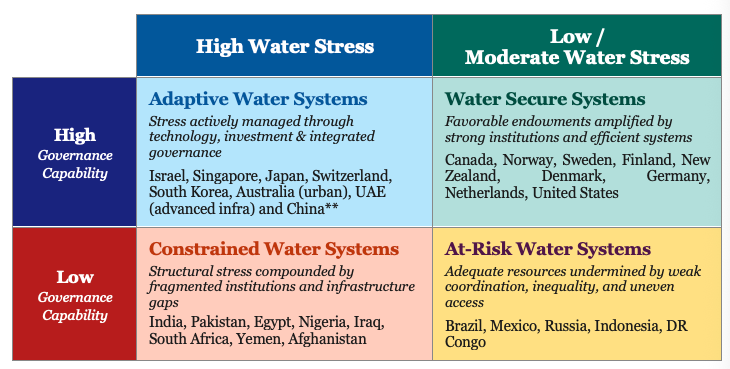
Figure 1. Four-quadrant typology of national water systems by stress exposure and governance performance.
Figure 1 presents a heuristic comparative framework derived from the interaction between structural water stress and governance capability, informed primarily by the WRI Aqueduct Water Risk Atlas and related hydrological assessments, as well as OECD water governance principles, World Bank governance indicators, and UNESCO water resilience assessments (OECD, 2021; UNESCO, 2024; WRI, 2023). The framework is intended as a strategic comparative typology rather than a quantitative ranking system, and country examples represent dominant national tendencies rather than uniform conditions across all regions within each state.
4.2. Strategic Imperative: Water as a Determinant of Global Competitiveness
Water is rapidly emerging as a defining constraint in an era of climate volatility and supply chain fragility. Changing precipitation patterns, prolonged droughts, and extreme weather events are increasing uncertainty in water availability, directly affecting agricultural output, industrial production, and trade reliability. As global supply chains become more interconnected and sensitive to disruption, water-related risks are no longer localized. They propagate across borders, influencing pricing, availability, and economic stability at a global scale.
This challenge is intensified by the growing dependence of advanced industries on stable water systems. Semiconductor manufacturing, energy production, and AI-driven data centers all require significant and reliable water inputs, linking water governance directly to technological leadership and economic security. Countries that effectively manage and integrate water into their supply chain strategies will strengthen their position in critical industries, while those that do not risk disruption and strategic vulnerability. In this context, water governance is no longer a peripheral environmental issue. It is a central pillar of global competitiveness and long-term economic resilience.
Adaptive Water Systems operate under severe structural water stress yet maintain relatively stable and reliable outcomes through strong governance capability, technological investment, and long-term infrastructure planning. Countries such as Japan, Singapore, Israel, South Korea, and the UAE demonstrate that strong governance, desalination, recycling, storage, and integrated infrastructure planning can sustain industrial and urban resilience even under severe hydrological stress (UNESCO, 2024). These systems show that high water stress does not necessarily produce instability when governance capability, technological adaptation, and long-term investment remain strong.
Water Secure Systems combine relatively favorable hydrological conditions with advanced infrastructure, effective regulation, and strong institutional coordination. Countries including Canada, Norway, Sweden, Finland, New Zealand, Germany, the Netherlands, and the United States maintain highly reliable water systems supported by long-term investment and regulatory effectiveness (OECD, 2021; World Bank, 2023). Although localized droughts and regional disparities exist, these systems generally sustain stable conditions for agriculture, manufacturing, energy production, and urban development, while emphasizing sustainability and climate adaptation (UNESCO, 2024).
In contrast, At-Risk Water Systems possess substantial freshwater resources but lack the institutional coordination and infrastructure quality needed to translate resource abundance into reliable water security. Countries such as Brazil, Mexico, Indonesia, Russia, and the Democratic Republic of Congo illustrate how uneven infrastructure, weak regulation, and governance limitations can generate instability despite relatively favorable resource endowments (FAO, 2022; UNESCO, 2024). In these systems, climate variability, rapid urbanization, and rising industrial demand can amplify supply chain risks and reduce the reliability of water access (World Bank, 2023).
Constrained Water Systems experience both severe water stress and weak governance capacity, creating recurring disruptions across agriculture, industry, and public services. Countries such as Pakistan, Egypt, Iraq, Yemen, Afghanistan, Nigeria, and parts of South Africa and India face overlapping pressures from population growth, fragmented institutions, inadequate infrastructure, and limited investment in water management (WRI, 2023; UNESCO, 2024). These vulnerabilities frequently propagate through regional and global supply chains, particularly in food, textiles, minerals, and energy production, leaving such systems highly exposed to climate variability and future demand growth (World Bank, 2023).
In the AI era, the true power of nations lies not in data or energy alone, but in how wisely they govern water.
5. Conclusion
The experiences of South Korea, Israel, and Singapore demonstrate that effective water governance can transform structural constraint into strategic advantage through integrated river management, desalination, recycling, digital monitoring, and long-term infrastructure investment. These cases show that resilience depends less on natural abundance than on institutional capability, technological integration, and system coordination, positioning countries such as South Korea to emerge as global leaders in water governance for high-density, industrialized economies facing rising climate and supply chain pressures. More broadly, the findings highlight the growing need for international coordination in water governance, including cooperation in data sharing, technology transfer, and resilience strategies across interconnected supply chains. As climate volatility and AI-driven industrial demand intensify, water is becoming a defining infrastructure constraint linking survival, energy systems, digital economies, and global competitiveness. The future resilience of global supply chains will depend not simply on resource availability, but on the ability of nations to govern critical water flows with foresight and coordination. Countries that treat water as strategic infrastructure, alongside energy, logistics, and digital networks, will be better positioned to sustain economic stability, industrial competitiveness, and long-term prosperity in the AI era.
About the Author

Distinguished Professor, Dr. Paul Hong — University of Toledo
Paul C. Hong is a Distinguished University Professor and Chair of Information Systems and Supply Chain Management at the University of Toledo. His work focuses on leadership, governance, and decision-making in the AI era, integrating strategy, technology, and institutional trust. He has published extensively in leading academic journals and writes on how individuals and organizations navigate complexity, disruption, and global transformation.

Dr. Mingu Kim is a senior research scientist at Lambton College, Canada, specializing in sustainable and energy-efficient solid waste and wastewater treatment, greenhouse gas emission control, sewer corrosion mitigation, and microplastic pollution management. He has published in a variety of engineering and scientific journals, disseminating next-generation technologies for wastewater pollution control and management.
Original Article:

References
Food and Agriculture Organization of the United Nations (FAO). (2022). The state of the world’s land and water resources for food and agriculture: Systems at breaking point. FAO.
International Energy Agency (IEA). (2022). Water-energy nexus: Challenges and opportunities. IEA.
OECD. (2021). OECD principles on water governance. Organisation for Economic Co-operation and Development.
Sela, L., Sowby, R. B., Salomons, E., & Housh, M. (2025). Making waves: The potential of generative AI in water utility operations. Water Research, 272, 122935.
United Nations. (2023). Governing AI for humanity: Interim report. United Nations.
United Nations. (2024). Governing AI for humanity: Final report. United Nations.
United Nations World Water Assessment Programme (UNESCO). (2024). The United Nations world water development report 2024: Water for prosperity and peace. UNESCO.
World Bank. (2023). Water in circular economy and resilience (WICER): The case for action. World Bank Group.
World Resources Institute. (2023). Aqueduct water risk atlas.
© K-Global Scholars and Professionals Forum. All rights reserved. Content published in the K-GSP Forum may not be reproduced, distributed, or transmitted in any form without prior written permission from the K-GSP Forum, except for brief quotations with full attribution.