

EXECUTIVE SUMMARY
McKinsey’s Center for CEO Excellence interviewed 30 leading owner-CEOs across Asia and found that founder-led companies accounted for nearly half the value created among the region’s top-decile firms over two decades, outperforming every other ownership category. The traits binding these founders proved remarkably consistent despite enormous regional diversity: relentless curiosity and continuous learning, exceptional relationship-building, energy drawn from genuine joy in the work, and the capacity to hold long-horizon vision and daily operational detail simultaneously. This summary presents those findings and considers, tentatively, what they might illuminate about Korean founder-led enterprise, where the chaebol model complicates any straightforward application.
Introduction
Founder-led companies dominate value creation in Asia, yet the reasons remain poorly understood. McKinsey’s Center for CEO Excellence set out to answer this by interviewing thirty of the region’s leading owner-CEOs. What emerged was not a strategy playbook but a pattern of character: five traits that recurred across markets, generations, and industries with unexpected consistency.
The Findings
Cheryl Lim, a McKinsey partner in Kuala Lumpur and coauthor of the forthcoming book Shapers and Founders, identified several traits that recurred across founders of widely differing backgrounds, ages, and ethnicities.
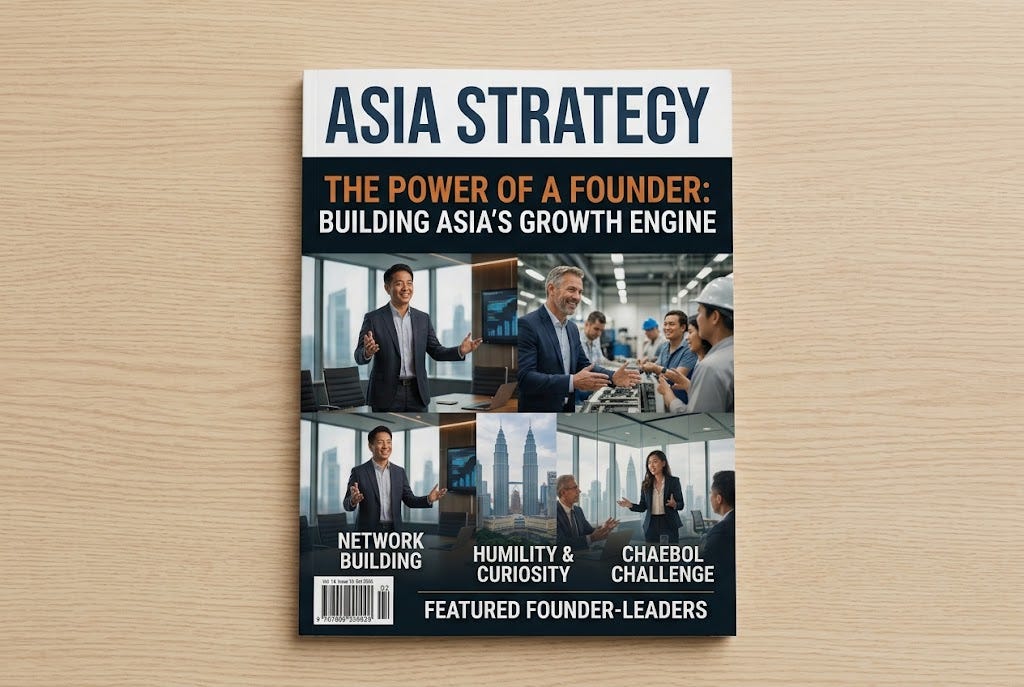
Curiosity as organizational practice. These founders believe they can learn from anyone, and they work to embed that belief in their organizations rather than holding it privately. Lim reads this as humility: recognition that they are not always the smartest person in the room.
Relationship-building as method. The founders understand that success comes through networks, immediate teams, stakeholders, and partnerships, not individual brilliance.
Energy over time management. Nearly all interviewees described no separation between work and life. Joy in the work itself functions as their source of renewal.
Holding contradictions. They combine long-horizon strategic vision with granular attention to daily operations, and their capacity for large bets rests on disciplined stress-testing that renders apparently reckless moves manageable.
Humility about legacy. One founder, asked how he wished to be remembered, said he would want an epitaph reading that he built a company where people became the best they could be.
What This Might Mean for Korean Founders
The parallels invite reflection, though I want to mark clearly where evidence ends and speculation begins.
The traits Lim describes map recognizably onto the founding generation of Korean industry. The energy-over-time pattern and the collapsed boundary between work and life are familiar features of Korean founder narratives, as is the humble-origins arc that Jennifer Chiang found most memorable in the interviews. The emphasis on relationship networks rather than individual heroics also resonates with the relational orientation embedded in Korean business practice.
But Korea complicates the picture in a way worth naming. The dominant Korean model is not founder-led in the ongoing sense the study examines; it is founder-established and then family-succeeded. The question of whether inherited leadership sustains founder traits, or whether those traits are precisely what does not transfer across generations, is not one this research answers. Korean readers may find the more useful question is not what the founders shared, but what their successors retained.
A second complication concerns joy. Lim frames the absence of work-life separation as a source of renewal. In the Korean context, that same absence has a considerably darker history, one measured in overwork and its costs. Whether the difference lies in the founder’s ownership stake, in autonomy, or simply in survivorship bias among those interviewed, the study does not say.
On the Gender Question
Only three of the thirty interviewees were women. Lim notes this roughly tracks global norms and reflects structural barriers around funding, entrepreneurial access, societal expectation, and disproportionate caregiving burden. Her advice to aspiring women leaders is not to work harder or sacrifice more, but to be intentional about where time and energy are invested and how support systems are built.
For Korean and diasporic readers, this may land with particular weight. Korea’s gender gap in senior corporate leadership remains among the widest in the OECD, and the caregiving asymmetry Lim describes is, if anything, more pronounced.
Reference
Lim, C., & Chiang, J. (2026, September 3). Shapers and founders: The traits behind outsized value creation in Asia [Podcast]. McKinsey & Company. https://www.mckinsey.com/featured-insights/future-of-asia

Prof. Dr. Jeonghwan (Jerry) Choi (Managing Editor), University of Maine at Presque Isle
Jeonghwan (Jerry) Choi, PhD is an Associate Professor of Business at the University of Maine at Presque Isle and Editor-in-Coordination of K-GSP Forum (contact: jeonghwan.choi at gmail.com). With over 25 years of industry and consulting experience, he specializes in leadership development, human resource management, organizational behavior, and social entrepreneurship. His research focuses on workforce resilience, organizational health, and self-directed leadership — bridging rigorous scholarship with practical insight to cultivate leaders who create meaningful, sustainable, and humane organizations.
한글요약
아시아 창업자들의 공통점, 그리고 한국 기업가에게 던지는 질문
맥킨지 CEO 엑설런스 센터가 아시아의 대표적인 오너 CEO 30명을 인터뷰했다. 지난 20여 년간 아시아 상위 10퍼센트 기업이 만들어낸 가치의 절반 가까이가 창업자가 이끄는 회사에서 나왔고, 이는 다른 어떤 소유 형태보다 높은 성과다.
배경도 나이도 출신도 제각각인데 이들에게서 비슷한 특징이 반복해서 나타났다.
첫째는 호기심이다. 누구에게서든 배울 수 있다고 믿고, 그 태도를 자기 조직에도 심으려 한다. 회의실에서 자기가 가장 똑똑한 사람은 아니라는 걸 인정한다는 뜻이다.
둘째는 관계를 만드는 힘이다. 혼자 성공하는 게 아니라 곁에 쌓아온 사람들과 함께 간다는 걸 안다.
셋째는 에너지다. 이들은 시간을 관리하는 대신 에너지를 관리한다. 일에서 기쁨을 얻기 때문에 일이 곧 회복의 원천이 된다. 인생은 하나뿐이라며 일과 삶을 나누지 않는다.
넷째는 모순을 함께 품는 능력이다. 멀리 보는 눈과 오늘의 세부를 챙기는 눈을 동시에 갖고, 무모해 보이는 승부수도 꼼꼼한 검증을 거쳐 감당 가능한 것으로 만든다. 한 창업자는 어떻게 기억되고 싶냐는 질문에 “사람들이 자기 최고의 모습이 될 수 있는 회사를 만든 사람”이라는 답을 남겼다.
다섯째는 겸손이다. 업계의 거인이라 불리는 사람들인데도 놀랄 만큼 자신을 낮췄다.
한국 기업가에게 이 이야기는 익숙하면서도 어긋난다. 창업 1세대의 모습과는 상당히 겹친다. 하지만 한국의 지배적 모델은 창업자가 계속 이끄는 형태가 아니라 창업 이후 가족이 승계하는 형태다. 창업자의 특성이 다음 세대로 넘어가는지, 아니면 바로 그 부분이 넘어가지 않는지는 이 연구가 답하지 않는다. 한국 독자에게는 창업자들이 무엇을 공유했는가보다, 그 후계자들이 무엇을 물려받았는가가 더 중요한 질문일 수 있다.
일과 삶의 경계가 없다는 대목도 그렇다. 맥킨지는 이를 회복의 원천으로 해석하지만, 한국에서 같은 현상은 훨씬 어두운 역사를 갖고 있다. 그 차이가 주인이라는 위치에서 오는지, 자율성에서 오는지, 아니면 살아남은 사람만 인터뷰한 결과인지는 알 수 없다.
30명 중 여성은 셋뿐이었다. 자금 접근과 돌봄 부담 같은 구조적 장벽 때문이다. 맥킨지의 조언은 더 열심히 일하라는 것이 아니라, 시간과 에너지를 어디에 쓸지 의도적으로 정하라는 것이었다.
© K-Global Scholars and Professionals Forum. All rights reserved. Content published in the K-GSP Forum may not be reproduced, distributed, or transmitted in any form without prior written permission from the K-GSP Forum, except for brief quotations with full attribution.