

Executive Summary
A technical error placed another student’s paper in a working adult student’s submission. The problem could have ended in suspicion and procedure. Instead, quick, transparent, and warm communication turned it into a human conversation, and an unexpected question about pool turned that conversation into informal learning about humility and leadership. Drawing on research on informal learning and critical incidents, this column argues that the human touch is not a soft extra in teaching. It is how problems become learning.
Keywords: human touch in teaching, informal learning, critical incident learning, developmental mentorship, leader humility, working adult students, Korean diaspora educators
Hashtags: #KGSPForum #Teaching #InformalLearning #CriticalIncident #LeaderHumility
1. Introduction: A Problem in the Inbox
Late in a busy grading week, I opened the second assignment of a working adult student in my online leadership course and found a paper written by someone else. He was an active-duty U.S. Army officer, the kind of learner who fits graduate study around duty, family, and responsibilities most classmates never see. I added a short note to my next feedback asking him why another student’s paper was in his submission.
His reply came the next morning, calm and respectful. He had reviewed his work, it did not match what I described, and he had no connection to the other student. Could there be a mix-up, since their names sat next to each other on the course list? He was right. The error was in the system.
Moments like this usually end one of two ways. They harden into procedure, with forms, reports, and a lingering chill between teacher and student. Or they open into something better. This column is about how the second path happened, and what it taught both of us. Figure 1 summarizes the exchange.
Figure 1
A File Mix-Up, a Pool Table, and a Lesson in Humility
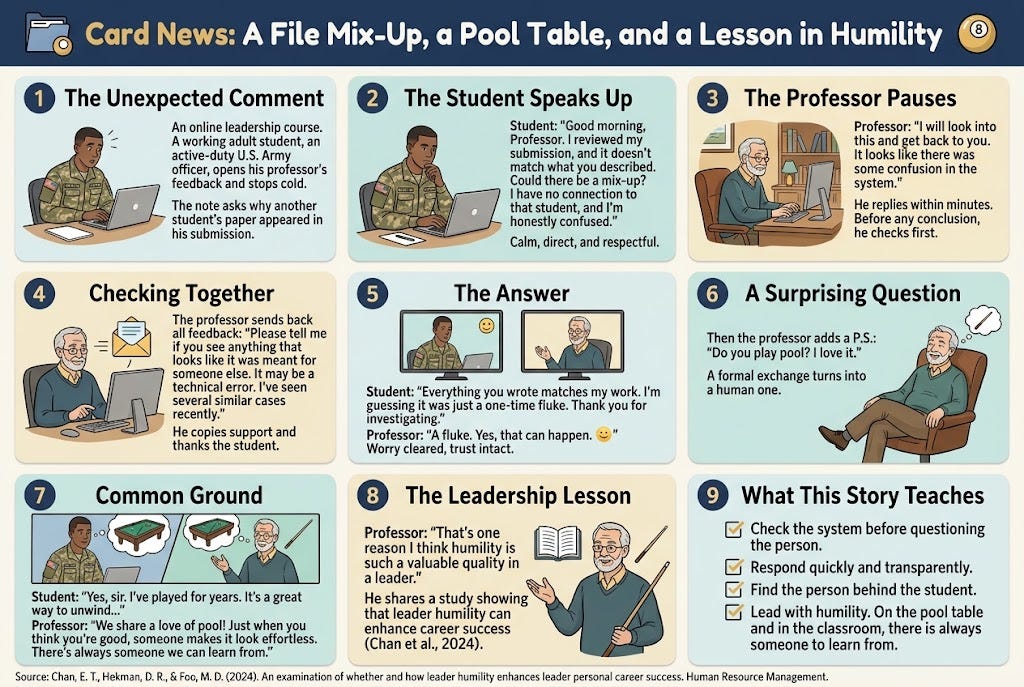
Note. Names and identifying details have been removed. Illustrations are symbolic and do not depict actual persons. Figure created by the author.
2. Turning a Problem Into a Conversation
The first opinion I want to offer is that the tone of the first reply decides what a problem will become. Within minutes of his email, I wrote back that I would look into it and that there seemed to be some confusion in the system. That afternoon, I sent him all of my feedback on both assignments and asked him to tell me exactly what he saw, in case comments meant for someone else had slipped in. I copied his student success coach, explained that I had seen several similar cases recently, and thanked him for his patience.
None of this was elaborate. What mattered was that it was fast, open, and personal. I did not hide behind the system or ask him to prove his innocence. I showed my own work and invited him to check it with me. When he answered that everything matched and it was probably a one-time fluke, I replied in kind: “A fluke. Yes, that can happen,” with a smile at the end.
This is what I mean by the human touch. It is not decoration added after the real work of grading. It is the act of treating a student as a partner in solving a problem rather than as a suspect in it. Once that happens, a problem stops being a threat to the relationship and becomes a shared task inside it.
3. When Conversation Opens Informal Learning
The exchange could have ended with the fluke. Instead, I added one more line: “Do you play pool? I love it.”
He wrote back that he had played for years to relieve stress, and that just when he thought he was pretty good, he would meet players on a whole different level. I knew exactly what he meant. I told him that this is one reason I see humility as such a valuable quality in a leader: there is always someone we can learn from. I sent him a recent study finding that leader humility can enhance a leader’s own career success (Chan et al., 2024).
Nothing in the syllabus called for this conversation, yet it may be the part of the course he remembers longest. Marsick and Watkins (2001) describe informal learning as learning that happens outside formal structures, often triggered by an unexpected event and driven by the learner’s own reflection. Incidental learning, in their account, is a byproduct of other activity, such as a task, a mistake, or a conversation. Our exchange began as a technical problem and became, through a few human sentences, a lesson about humility that neither of us had planned.
This is also where my teaching philosophy becomes concrete. One of its commitments is informal learning through developmental mentorship: supportive feedback, meaningful connection, and respect for students’ lives beyond the classroom (Choi, 2026). A shared hobby is not a distraction from that work. It is the doorway to it.
4. Reading the Episode as a Critical Incident
My third opinion is that ordinary moments become learning only when we stop and interpret them. Tripp (1993) argued that critical incidents in teaching are not dramatic by nature. They are everyday events that become critical because someone reflects on them and asks what they reveal about practice and values. The method has older roots in Flanagan’s (1954) critical incident technique, which studies specific behaviors in specific situations to understand what makes action effective.
Read this way, the episode taught each of us something different (Table 1). For the student, it was practice in raising a concern upward, calmly and respectfully, to someone with authority over his grade. That is a skill an officer uses every day. For me, it was a reminder that my first reaction had been to ask the person before checking the process, and that humility applies to teachers as much as to the leaders we teach.
Table 1
The File Mix-Up as a Critical Incident
StageWhat happenedHuman touchWhat was learnedProblemAnother student’s paper appeared in a submissionQuestion raised, not a verdictSystems can produce misleading evidenceResponseFast reply; all feedback shared; support coach copiedTransparency and thanksOpenness protects trust under unequal powerResolutionStudent confirms a one-time flukeWarm, light replyProblems can strengthen relationshipsConnection“Do you play pool?”Interest in the personCommon ground opens informal learningReflectionHumility in pool and leadershipShared study and insightBoth teacher and student keep learning
Source: Author’s analysis, informed by Tripp (1993) and Marsick and Watkins (2001).
5. Conclusion: The Lesson Ran Both Ways
I began by asking a student to explain himself. I ended by learning from him. A file error became a conversation, the conversation became a connection, and the connection became a lesson in humility for both of us. None of this happened because of better technology. It happened because each of us chose to respond to a problem as a person.
As AI and automated systems take on more of education, technical problems will multiply. Each one is a fork in the road. It can harden into procedure and distance, or it can become a moment of human communication from which real learning grows. Korean diaspora scholars and professionals often teach and work across cultures, where misunderstandings are common and connection is hard-won, so the human touch may be one of the most valuable skills we bring. There is always someone to learn from, sometimes the very person we first asked to explain.
References
Chan, E. T., Hekman, D. R., & Foo, M. D. (2024). An examination of whether and how leader humility enhances leader personal career success. Human Resource Management, 63(3), 427–442. https://doi.org/10.1002/hrm.22208
Choi, J. (2026, October). In the age of AI, teachers need to see their students’ faces again. K-GSP Forum. [URL]
Flanagan, J. C. (1954). The critical incident technique. Psychological Bulletin, 51(4), 327–358. https://doi.org/10.1037/h0061470
Marsick, V. J., & Watkins, K. E. (2001). Informal and incidental learning. New Directions for Adult and Continuing Education, 2001(89), 25–34. https://doi.org/10.1002/ace.5
Tripp, D. (1993). Critical incidents in teaching: Developing professional judgement. Routledge.
About the Author

Prof. Dr. Jeonghwan (Jerry) Choi (Managing Editor)
Full list of his K-GSP columns:
Jeonghwan (Jerry) Choi, PhD is Editor-in-Coordination of K-GSP Forum (contact: jeonghwan.choi at gmail.com). With over 25 years of industry and consulting experience, he specializes in leadership development, human resource management, organizational behavior, and social entrepreneurship. His research focuses on workforce resilience, organizational health, and self-directed leadership — bridging rigorous scholarship with practical insight to cultivate leaders who create meaningful, sustainable, and humane organizations.
Suggested Citation
Choi, J. (2026, October 16). When a problem becomes a conversation: Human touch, informal learning, and a critical incident in an online classroom. K-GSP Forum.
Original Article:

한글요약
문제가 대화가 될 때: 사람의 온기, 비공식 학습, 그리고 온라인 수업의 결정적 사건
바쁜 채점 주간, 필자는 온라인 리더십 수업을 듣는 직장인 학생, 현역 미 육군 장교의 과제에서 다른 학생의 글을 발견하고 그 이유를 묻는 메모를 남겼습니다. 학생은 차분하고 정중하게 자기와 무관한 혼선일 수 있다고 답했고, 실제로 문제는 시스템에 있었습니다. 이런 일은 보통 서류와 절차, 서먹한 거리로 끝나기 쉽지만, 이번에는 달랐습니다. 필자는 몇 분 안에 답장하고 모든 피드백을 공유하며 함께 확인해 달라고 부탁했고, 학생이 단순한 오류였다고 답하자 웃음으로 받았습니다. 학생을 의심의 대상이 아니라 문제를 함께 푸는 동반자로 대한 것, 이것이 사람의 온기입니다. 이어 “당구 치세요?”라는 질문 하나가 대화를 따뜻한 관계로 바꾸었고, 아무리 잘해도 늘 더 뛰어난 사람이 있다는 당구의 깨달음은 리더의 겸손이라는 교훈으로 이어졌습니다. 이는 계획에 없던 상황 속에서 일어나는 비공식·우연적 학습이며, 평범한 사건도 성찰을 거치면 ‘결정적 사건’이 되어 배움을 남깁니다. 학생은 권한을 가진 사람에게 정중하게 문제를 제기하는 법을, 필자는 사람보다 과정을 먼저 확인해야 한다는 겸손을 배웠습니다. 여러 문화 사이에서 가르치고 일하는 재외 한인 학자와 전문가들에게, 문제를 사람 사이의 대화로 바꾸는 온기는 무엇보다 소중한 역량이 될 수 있습니다.
주제어: 사람의 온기, 비공식 학습, 결정적 사건 학습, 성장 멘토링, 리더의 겸손
© K-Global Scholars and Professionals Forum. All rights reserved. Content published in the K-GSP Forum may not be reproduced, distributed, or transmitted in any form without prior written permission from the K-GSP Forum, except for brief quotations with full attribution.