

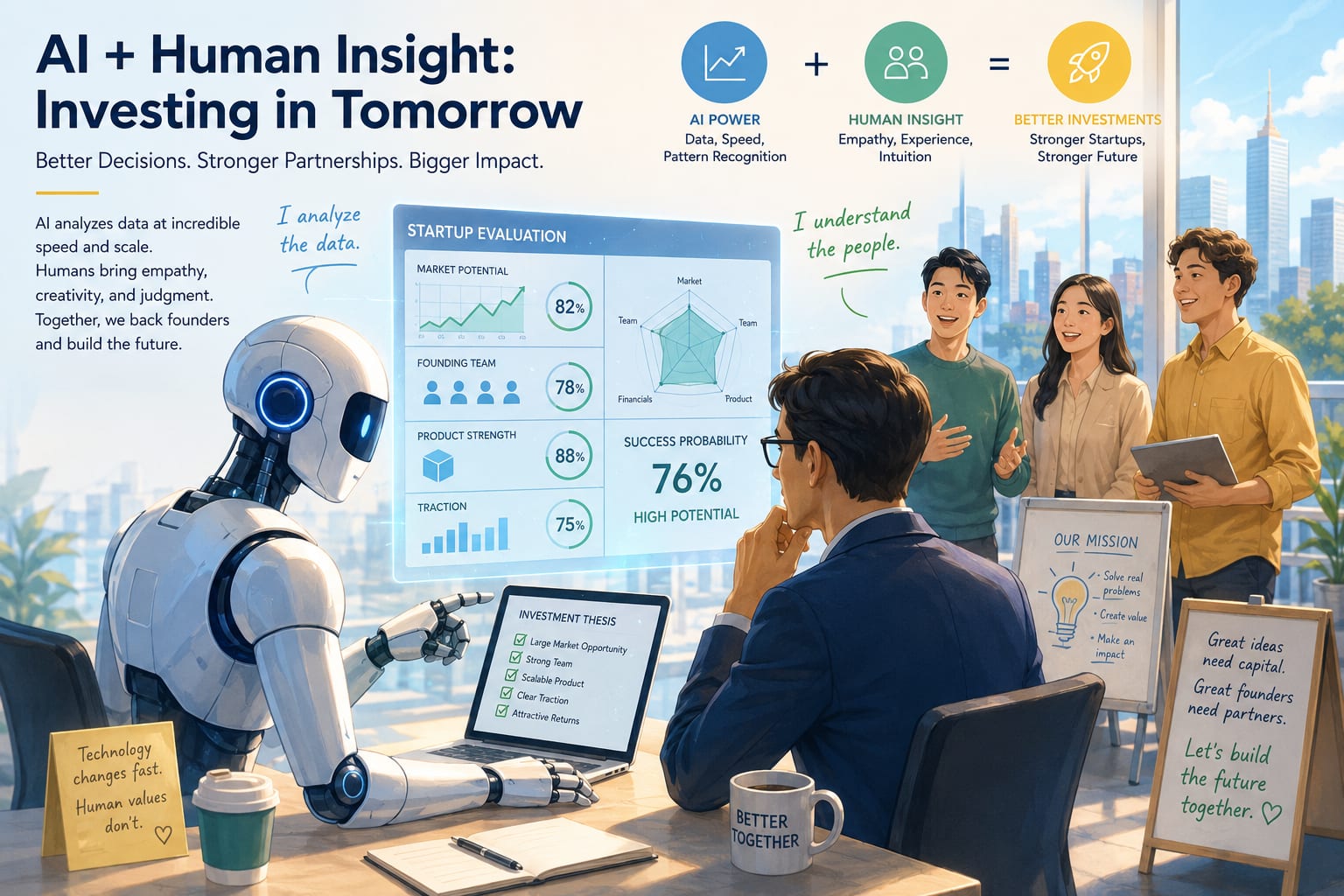
For decades, the venture capital (VC) industry was governed by what many called the “human touch.” Successful investors were admired for their intuition—the ability to discover promising startups, read the character of founders, and sense future market trends before others could see them. Today, however, artificial intelligence (AI) is rapidly entering that territory. AI systems are no longer just assisting with data analysis; they are beginning to identify startups, evaluate business models, and even predict investment potential. Recent reports suggest that AI agents are already performing a significant portion of the work traditionally assigned to junior investment analysts.
This transformation is far more than a technological upgrade. It symbolizes a profound shift in which AI is penetrating one of the last domains thought to belong uniquely to human judgment. Just as machines once automated physical labor in factories, AI is now beginning to automate intellectual and analytical labor performed by highly educated professionals.
First, AI can already search for startups far faster than humans. Traditionally, venture capitalists relied on networks, conferences, referrals, and personal connections to discover new companies. AI, however, can simultaneously analyze global company databases, patents, social media trends, developer activities, hiring patterns, and investment flows. Tasks that once required weeks of human research can now be completed in minutes. In terms of information processing speed, humans are increasingly unable to compete.
Second, AI is not easily influenced by emotions or social bias. Human investors may unconsciously be affected by educational background, regional ties, personal preferences, hype, or fear of missing out. AI systems, by contrast, focus primarily on data patterns and measurable indicators. This could potentially reduce irrational decision-making in the investment world and accelerate the shift from instinct-driven investing to evidence-based investing.
Third, AI is attempting to forecast failure as well as success. By analyzing a founder’s background, market growth rates, competitive dynamics, consumer reactions, technological trends, and financial indicators, AI models attempt to calculate the probability of a company’s success. In some ways, this resembles weather forecasting for businesses. While no system can perfectly predict the future, AI has the advantage of evaluating far more variables simultaneously than any individual human can manage.
Fourth, this development could significantly impact young professionals entering the finance industry. Traditionally, junior analysts gained experience by conducting market research, reviewing company documents, and supporting senior investors. If AI increasingly performs these entry-level tasks, the “learning ladder” through which young professionals develop expertise may begin to disappear. This is not merely a labor issue; it is also an educational and institutional challenge.
Fifth, despite these advances, human investors are unlikely to disappear entirely. Investment is ultimately built on trust between people. Entrepreneurs do not simply seek capital; they seek mentors, advisors, and partners who can guide them during difficult moments. AI may provide data-driven recommendations, but genuine empathy, relationship-building, and emotional understanding remain deeply human qualities that are difficult to replicate.
Sixth, true innovation often emerges from areas where historical data is limited or misleading. Many groundbreaking companies initially appeared unrealistic or irrational. Smartphones, electric vehicles, and online streaming platforms were once dismissed by numerous experts. Because AI systems rely heavily on past data and observable patterns, they may struggle to recognize revolutionary ideas that do not fit existing models. Human imagination and intuition therefore continue to play an essential role.
Seventh, AI-driven investment systems may reshape the startup ecosystem itself. Entrepreneurs may begin tailoring business plans not only for human investors but also for algorithmic evaluation systems. In other words, startups may optimize themselves for AI scoring models in much the same way students prepare for standardized tests. This could create a new form of competition centered around data optimization rather than originality alone.
Eighth, serious ethical concerns also emerge. AI decision-making processes are often opaque. If an AI system highly recommends a company, but cannot clearly explain its reasoning, questions of accountability inevitably arise. If investors suffer major financial losses after following AI-generated recommendations, who should bear responsibility—the developers, the venture capital firm, or the final decision-maker? The ethical and legal frameworks governing AI-driven finance are still far from fully established.
Ninth, this transformation carries major implications for national competitiveness. Venture capital firms that effectively leverage AI may identify promising companies more quickly and efficiently than their rivals. This could directly influence the speed of innovation within entire economies. In places like Silicon Valley, some investment firms are already aggressively adopting AI-based analytical systems, intensifying global competition for technological leadership.
Tenth, the future will likely not be defined by “AI versus humans,” but rather by humans who know how to work effectively with AI. When calculators were invented, mathematicians did not disappear. Instead, their roles evolved. Similarly, AI may transform the venture capital industry, but it will likely elevate the importance of creativity, ethical reasoning, strategic insight, and human communication rather than eliminate human participation altogether.
Humanity now stands at a critical turning point where AI is evolving from a tool into a decision-maker. Yet history repeatedly shows that technological revolutions rarely eliminate human roles entirely; instead, they redefine them. In an age when machines increasingly analyze numbers and patterns, humans must focus even more deeply on understanding people, society, ethics, and meaning. That may ultimately become the most valuable human skill in the age of artificial intelligence. +++
{Solti}
May 12, 2026

Young Choi, PhD is a Professor at Regent University bringing a rare combination of technical expertise and creative spirit to everything he does. A scholar in AI, cybersecurity, and network & telecommunications service management, he has published 38 books including AI and cybersecurity area books, over 200 refereed articles, and over 20 book chapters. Beyond the academy, Dr. Choi is a passionate poet, essayist, and wooden block laser engraving artist whose reflective writing invites readers to rediscover life’s beauty in quiet contemplation(靜觀). He lives under the motto: “Study hard and give generously without holding back! (열심히 공부해서 아낌없이 남주자 !)”
Published books: https://www.amazon.com/stores/Young-Choi/author/B0DMZ5S6R7?ref=ap_rdr&shoppingPortalEnabled=true