

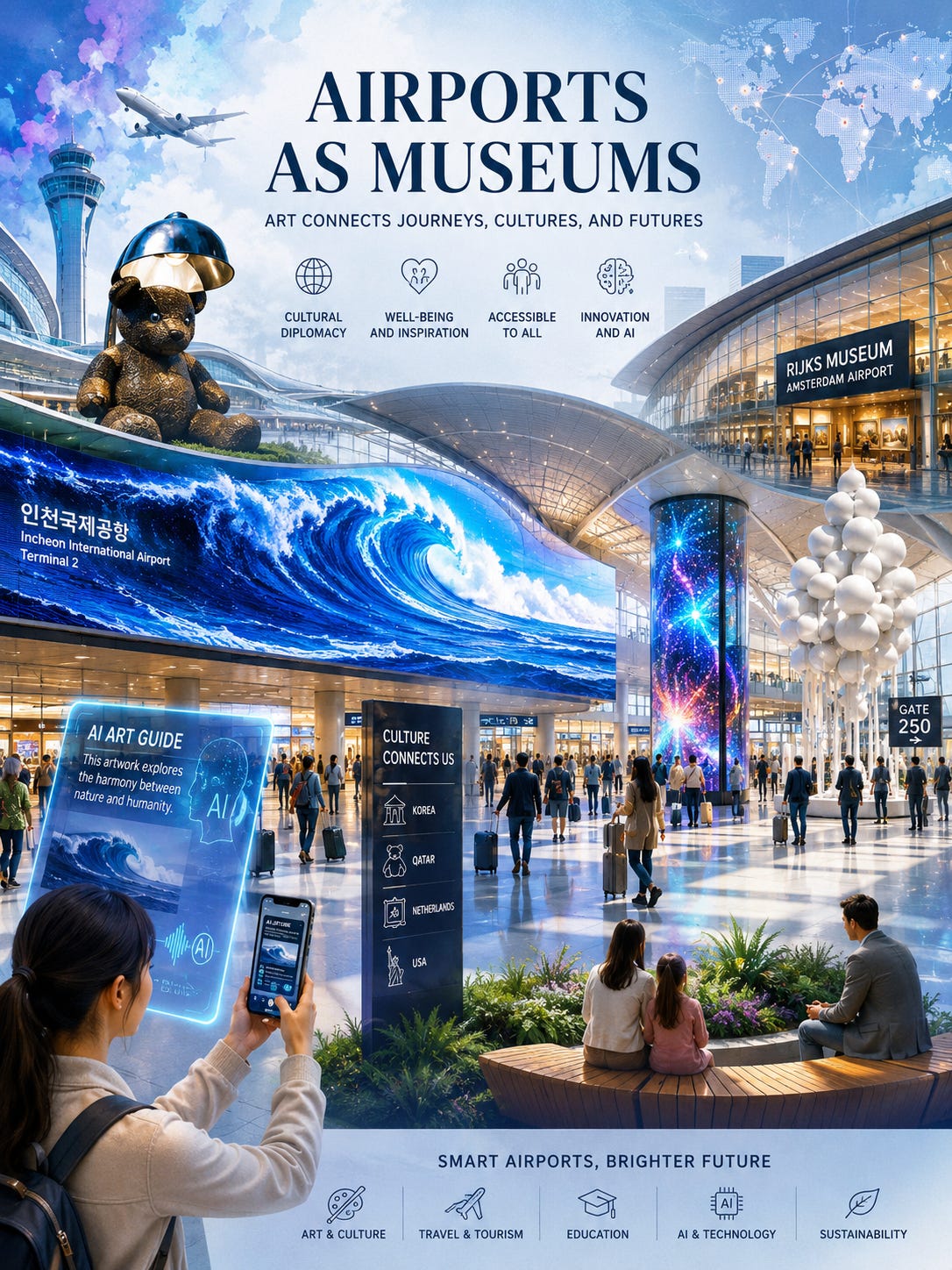
Abstract
For much of aviation history, airports were designed primarily for efficiency—places where people arrived, departed, and connected. Today, however, many of the world’s leading international airports are undergoing a remarkable transformation. They are becoming public museums where millions of travelers encounter art unexpectedly. From immersive digital installations at Korea’s Incheon International Airport to monumental sculptures at Qatar’s Hamad International Airport and museum partnerships at Amsterdam Schiphol Airport, airports are evolving into cultural ambassadors that communicate national identity, creativity, and innovation. This essay explores five major values of airport art, five emerging challenges, and future directions for developing airports into intelligent cultural ecosystems in the age of artificial intelligence (AI).
When the Journey Begins Before the Flight
A traveler usually expects to encounter great works of art after arriving at renowned museums in Paris, Florence, or New York. Increasingly, however, the artistic journey begins much earlier—inside the airport.
Modern international airports welcome hundreds of thousands of passengers every day. Regardless of nationality, language, or purpose of travel, every passenger shares one common experience: waiting. Rather than allowing these moments to become empty intervals, visionary airports are transforming waiting into opportunities for cultural discovery.
Airports are no longer merely transportation hubs; they are becoming humanity’s largest free museums.
A striking example can be found at Incheon International Airport Terminal 2, where visitors are greeted by ‘WAVE,’ an immersive digital artwork created by d’strict. Displayed on a massive 78-meter-wide curved LED screen, the realistic ocean waves appear to surge out of the terminal itself, captivating travelers from the moment they enter the building. The installation demonstrates that public art can inspire millions of people who never intended to visit an art museum.
Five Remarkable Contributions of Airport Art
1. Airports Become Cultural Ambassadors
For international visitors, the airport often provides the very first impression of a country.
Rather than introducing themselves solely through immigration checkpoints and duty-free stores, nations increasingly showcase their artistic identity through public art. Korea presents contemporary media art, traditional crafts, large-scale installations, and elements of K-Culture, allowing travelers to experience Korean creativity before they even leave the terminal.
Airport art has therefore become a powerful instrument of cultural diplomacy.
2. Art Reduces Travel Stress
Air travel frequently involves stress arising from security screening, flight delays, long layovers, jet lag, and unfamiliar environments.
Numerous studies have shown that exposure to visual art can reduce anxiety, lower stress levels, and improve emotional well-being. Immersive works such as WAVE transform waiting time into moments of relaxation and reflection, reminding travelers that technology and beauty can coexist harmoniously.
3. Airports Democratize Art
Traditional museums require deliberate visits, admission fees, and dedicated time.
Airport museums require none of these.
Millions of travelers who might never intentionally visit an art museum encounter sculptures, paintings, installations, and digital media naturally while walking toward their departure gates.
Art becomes an everyday human experience rather than an exclusive cultural activity.
This democratization represents one of the greatest achievements of public art in the twenty-first century.
4. Art Communicates National Identity Without Words
Great public art transcends language.
The iconic seven-meter-tall bronze sculpture Untitled (Lamp/Bear) at Hamad International Airport in Doha has become an internationally recognized symbol of Qatar. Likewise, Korean installations exploring themes such as future space migration, traditional aesthetics, and digital imagination communicate Korea’s creativity without requiring verbal explanation.
Art serves as a silent yet persuasive cultural ambassador.
5. Airports Become Laboratories of Innovation
Contemporary airport art increasingly integrates cutting-edge technologies, including:
Artificial Intelligence (AI)
Interactive digital media
Projection mapping
Immersive LED environments
Digital twins
Real-time data visualization
As a result, airports are evolving beyond museums into experimental spaces where technology, creativity, and public engagement intersect.
Five Challenges Facing Airport Art
1. Balancing Commerce and Culture
Commercial activities remain central to airport operations. Duty-free shopping, restaurants, and retail spaces often dominate terminal design.
Airport art should complement commercial success rather than become secondary to it, requiring thoughtful cultural planning and long-term vision.
2. Ensuring Accessibility
Airport visitors represent every age group, nationality, educational background, and cultural tradition.
Public artworks should be intellectually meaningful while remaining universally understandable and emotionally engaging.
3. Maintaining Large-Scale Installations
Digital artworks require continuous maintenance, including software updates, cybersecurity protection, LED replacement, and energy management.
Without sustained investment, even spectacular installations risk becoming obsolete.
4. Supporting Artistic Diversity
Airport collections should reflect diverse artistic voices rather than relying exclusively on internationally famous artists.
Providing exhibition opportunities for emerging artists allows airports to represent contemporary society more authentically while encouraging cultural innovation.
5. Promoting Sustainability
Large digital displays consume considerable amounts of electricity.
Future airport art should embrace renewable energy, environmentally responsible materials, and sustainable exhibition practices that align with global environmental goals.
The AI Era: Intelligent Airports as Living Museums
Artificial intelligence introduces extraordinary possibilities for the future of airport art.
Imagine entering an airport where AI recognizes your preferred language and offers personalized artistic experiences.
An AI-powered guide could explain the symbolism of a sculpture through augmented reality. Machine learning systems could adjust digital artworks according to weather conditions, passenger traffic, cultural festivals, seasons, or even the time of day.
Instead of static exhibitions, airport museums could become living cultural ecosystems that evolve continuously with their audiences.
AI could also assist curators in selecting artworks, optimizing visitor engagement, preserving digital cultural heritage, and creating personalized cultural experiences for travelers from around the world.
Korea’s Opportunity
South Korea possesses exceptional strengths that position it to become a global leader in airport culture.
These strengths include:
World-class digital infrastructure
Internationally acclaimed media artists
The global popularity of K-Pop and K-Drama
Rich traditional cultural heritage
Advanced AI technologies
Few countries combine technological excellence with artistic creativity as naturally as Korea.
By strategically integrating these assets, Korean airports can become global models of Smart Cultural Airports, where transportation, tourism, education, entertainment, and digital innovation converge seamlessly.
Recommendations
To maximize the cultural value of airport art, several strategies deserve consideration.
First, every major international airport should develop a long-term cultural master plan alongside its transportation strategy.
Second, AI-powered multilingual interpretation systems should make artworks accessible to visitors from every linguistic background.
Third, stronger partnerships among airports, museums, universities, and technology companies should encourage continuous artistic innovation.
Fourth, airports should provide exhibition opportunities for emerging local artists alongside internationally recognized masters.
Finally, sustainability should become a core principle guiding future airport art initiatives.
Airports once symbolized movement.
Today, they increasingly symbolize cultural encounter.
Every sculpture, media installation, and public artwork reminds travelers that crossing borders is not merely a geographical experience—it is also a cultural one.
As artificial intelligence reshapes global mobility, airports have the opportunity to become humanity’s most accessible museums—places where technology serves beauty, where waiting becomes learning, and where every journey begins with inspiration rather than impatience.
The future of aviation is not simply faster transportation.
It is a richer human experience.
In that future, airports will do more than connect cities.
They will connect civilizations. +++
{Solti}
July 20, 2026
공항이 미술관이 될 때: 공항 예술이 여행자를 사로잡는 이유
인공지능 시대, 이동의 공간에서 문화의 관문으로
초록
오랫동안 공항은 사람들을 신속하고 효율적으로 이동시키기 위한 공간으로 설계되어 왔다. 그러나 오늘날 세계 주요 국제공항들은 놀라운 변화를 맞이하고 있다. 공항은 이제 수백만 명의 여행객이 예상치 못한 순간 예술을 만나는 거대한 공공미술관으로 진화하고 있다. 대한민국 인천국제공항의 몰입형 미디어아트에서부터 카타르 하마드 국제공항의 대형 조각 작품, 네덜란드 암스테르담 스히폴공항의 미술관 협업에 이르기까지 공항은 국가의 문화적 정체성과 창의성, 혁신을 세계에 알리는 문화 외교의 무대로 자리 잡고 있다. 본 수필은 공항 예술이 지닌 다섯 가지 가치와 앞으로 해결해야 할 다섯 가지 과제를 살펴보고, 인공지능(AI) 시대의 공항이 지향해야 할 새로운 문화생태계의 방향을 제안한다.
여행은 비행기가 아니라 예술에서 시작된다
대부분의 사람들은 파리나 피렌체, 뉴욕에 도착한 뒤 유명한 미술관에서 예술을 만날 것이라 기대한다. 그러나 오늘날 그 예술적 경험은 비행기에 오르기 전, 공항에서 이미 시작된다.
현대의 국제공항은 하루에도 수십만 명의 여행객이 오가는 세계 최대의 공공공간이다. 국적과 언어, 여행 목적은 모두 다르지만 모든 사람에게 공통적으로 주어지는 시간이 있다. 바로 ‘기다림’이다.
선진 공항들은 이 기다림을 단순한 공백이 아니라 문화적 경험으로 바꾸고 있다.
공항은 더 이상 단순한 교통시설이 아니다. 이제는 인류가 가장 쉽게 접근할 수 있는 거대한 무료 미술관으로 변화하고 있다.
대표적인 사례가 인천국제공항 제2여객터미널에 설치된 디스트릭트(d’strict)의 미디어아트 ‘WAVE’이다. 폭 78m의 초대형 곡면 LED 스크린 위에서 거대한 파도가 실제로 공항 안으로 밀려오는 듯한 장면은 여행객들에게 깊은 감동과 몰입감을 선사한다. 미술관을 찾지 않은 사람도 자연스럽게 예술을 감상하게 만드는 공공예술의 새로운 가능성을 보여주는 작품이다.
공항 예술이 만들어내는 다섯 가지 가치
1. 공항은 국가의 문화대사가 된다.
국제공항은 외국인이 가장 먼저 만나는 국가의 얼굴이다.
과거에는 출입국 심사대와 면세점이 첫인상을 결정했다면, 이제는 미디어아트와 조각, 전통공예, K-컬처가 한국의 문화적 정체성을 먼저 소개한다.
공항 예술은 문화외교의 가장 조용하지만 가장 강력한 언어가 되고 있다.
2. 예술은 여행의 긴장을 치유한다.
비행은 설렘과 동시에 피로와 긴장을 동반한다.
보안검색, 장시간 대기, 환승, 시차 적응 등은 여행객에게 상당한 스트레스를 준다.
다양한 연구는 시각예술이 불안감을 낮추고 심리적 안정감을 높여 준다는 사실을 보여준다.
‘WAVE’와 같은 몰입형 작품은 단순한 볼거리를 넘어 여행자의 마음을 편안하게 하는 치유의 공간이 된다.
3. 공항은 예술의 민주화를 실현한다.
미술관은 일부러 찾아가야 하지만 공항의 예술은 누구나 자연스럽게 만난다.
입장료도 없고 특별한 준비도 필요하지 않다.
비행기를 기다리는 수많은 사람들이 조각과 설치미술, 미디어아트를 일상 속에서 경험하게 된다.
예술은 더 이상 일부 사람들의 전유물이 아니라 모두가 함께 누리는 공공재가 된다.
4. 예술은 말없이 국가의 정체성을 전한다.
위대한 공공예술은 언어를 초월한다.
카타르 도하 하마드 국제공항의 거대한 곰 조각은 이미 세계적인 상징이 되었으며, 인천공항의 미래 우주이주를 주제로 한 설치미술 역시 한국 사회의 상상력과 창의성을 자연스럽게 보여준다.
예술은 가장 조용하지만 가장 오래 기억되는 국가 브랜드이다.
5. 공항은 기술과 예술이 만나는 혁신의 실험실이 된다.
오늘날 공항 예술은 다음과 같은 첨단기술과 결합하고 있다.
인공지능(AI)
인터랙티브 미디어
프로젝션 맵핑
초대형 LED 미디어
디지털 트윈
실시간 데이터 시각화
공항은 단순한 미술관이 아니라 미래 문화기술을 실험하는 살아 있는 플랫폼으로 발전하고 있다.
공항 예술이 해결해야 할 다섯 가지 과제
1. 상업성과 문화성의 균형
공항은 상업시설이기도 하다.
예술이 쇼핑 공간의 부속물이 아니라 공항의 핵심 가치로 자리 잡도록 장기적인 문화정책이 필요하다.
2. 모두를 위한 접근성
공항에는 어린아이부터 노인까지, 다양한 국적과 문화권의 사람들이 모인다.
공공예술은 누구나 쉽게 이해하면서도 깊이 있는 감동을 줄 수 있어야 한다.
3. 지속적인 유지관리
대형 디지털 작품은 소프트웨어 업데이트, 사이버보안, LED 교체, 에너지 관리 등 지속적인 관리가 필요하다.
아무리 훌륭한 작품이라도 꾸준한 투자가 없다면 시간이 지나면서 그 가치가 퇴색할 수 있다.
4. 다양한 예술가의 참여
공항 전시는 유명 작가뿐 아니라 신진 작가들에게도 기회를 제공해야 한다.
새로운 시각과 창의성이 공항 문화를 더욱 풍성하게 만들기 때문이다.
5. 지속가능성
초대형 미디어아트는 많은 전력을 소비한다.
앞으로의 공항 예술은 친환경 소재와 재생에너지, 지속가능한 전시 방식을 적극적으로 도입해야 한다.
AI 시대, 살아 있는 공항 미술관
인공지능은 공항 예술의 미래를 더욱 흥미롭게 만들고 있다.
공항에 들어서는 순간 AI가 여행자의 언어를 인식하여 작품을 실시간으로 설명해 주고, 증강현실(AR)을 통해 작품 속 이야기를 보여주는 시대가 머지않았다.
또한 AI는 계절, 날씨, 시간, 승객 흐름, 세계 문화축제 등에 따라 미디어아트의 내용을 자동으로 변화시킬 수 있다.
공항은 더 이상 고정된 전시장이 아니라 스스로 진화하는 ‘살아 있는 문화생태계’가 될 것이다.
한국이 가진 특별한 기회
한국은 세계 최고 수준의 디지털 인프라와 미디어아트 기술, K-팝과 K-드라마, 전통문화, 그리고 인공지능 기술을 함께 보유한 몇 안 되는 국가이다.
이러한 강점을 전략적으로 결합한다면 대한민국의 공항은 세계 최고의 ‘스마트 문화공항(Smart Cultural Airport)’ 모델이 될 수 있다.
교통과 관광, 문화, 교육, 예술, 첨단기술이 하나로 융합된 미래형 공항은 대한민국의 새로운 국가 경쟁력이 될 것이다.
제언
이를 위해 다음과 같은 정책이 필요하다.
첫째, 모든 국제공항은 교통계획과 함께 장기적인 문화 마스터플랜을 수립해야 한다.
둘째, AI 기반 다국어 해설 서비스를 구축하여 전 세계 여행객 누구나 작품을 쉽게 이해하도록 해야 한다.
셋째, 공항·미술관·대학교·IT기업 간 협력을 강화하여 지속적인 문화혁신을 추진해야 한다.
넷째, 세계적인 거장뿐 아니라 신진 작가들에게도 전시 기회를 확대해야 한다.
마지막으로, 모든 공항 예술 프로젝트는 친환경성과 지속가능성을 핵심 가치로 삼아야 한다.
과거 공항은 ‘이동’을 상징했다.
오늘날 공항은 ‘만남’을 상징한다.
공항 곳곳에 놓인 조각과 미디어아트는 국경을 넘는 일이 단순한 지리적 이동이 아니라 문화와 문명을 만나는 경험임을 일깨워 준다.
인공지능 시대의 공항은 인류가 가장 쉽게 접근할 수 있는 거대한 미술관이 될 것이다.
그곳에서는 기술이 아름다움을 돕고, 기다림이 배움으로 바뀌며, 모든 여행은 감동으로 시작된다.
미래의 공항은 단순히 도시와 도시를 연결하는 공간이 아니다.
공항은 문화와 문화, 그리고 문명과 문명을 이어주는 새로운 세계의 문화 플랫폼이 될 것이다. +++
{솔티}
2026년 7월 20일

Prof. Dr. Young Choi (Editor in Chief) — Regent University
Young B. Choi is a Professor in the Department of Engineering & Computer Science at Regent University. He published 38 books with ‘Selected Readings in Cybersecurity’ (2018) (over 800 copies archived globally at university/college libraries around the world) and ‘Cybersecurity Applications and Artificial Intelligence’ (2023) available in seven major world languages. He proposed the world’s first global and universal telecommunications “Service Order Handling (SOH)” Model (T-SOH Model) (1995) with Dr. Adrian Tang. With this innovative research work, he received the IEEE NOMS ’96 Best Paper Award and became the first recipient of the Outstanding Contribution Award of the TeleManagement Forum in 1998. His research areas include Natural Language Processing-focused AI, AI-applied cybersecurity, network and telecom service management, and Korean studies on Gani Choi Rip’s Jeonggwan (靜觀: Quiet Contemplation) philosophy and Shilhak ( 實學: Practical Learning).