
When Gani Choi Rip Meets Artificial Intelligence
Five Lessons from a Joseon Renaissance Man for Ethical, Safe, and Trustworthy AI
“The question is not whether artificial intelligence will become more powerful. The real question is whether human beings will become wiser as AI becomes more powerful.”
Artificial intelligence can now write an essay in seconds, translate languages almost instantly, generate paintings, compose music, analyze enormous datasets, write computer programs, and assist with increasingly complex decisions.
But there is a strange paradox.
The more intelligent our machines become, the more urgently we need to ask what human intelligence is for.
This is why a sixteenth-century Korean scholar deserves a seat at today’s AI table.
His name was Gani Choi Rip (簡易 崔岦, 1539–1612).
Choi Rip lived during one of the most turbulent periods of the Joseon Dynasty. He was a scholar, poet, prose writer, government official, diplomat, and cultural critic. Modern Korean scholarship describes his poetry as vigorous and distinctive and identifies important dimensions of his thinking about painting, artistic creation, and aesthetic appreciation (Hwang, 2022; Maeng, 2011).
He obviously knew nothing about neural networks, large language models, generative AI, or autonomous systems.
Yet his intellectual life raises questions that are remarkably relevant to our own.
What should knowledge serve?
How should power be used?
What makes communication trustworthy?
How should tradition become innovation?
And what happens when human beings possess greater intellectual power than they have wisdom to control?
These are not merely questions for sixteenth-century scholars.
They are questions for Silicon Valley, Seoul, Washington, Beijing, Brussels—and ultimately for all of humanity.
1. The First Lesson: Intelligence Must Serve Human Life
Perhaps the most important lesson we can draw from Choi Rip is simple:
Knowledge should return to life.
For Choi Rip, scholarship was not simply an exercise in collecting information. His life connected literature, public service, diplomacy, cultural criticism, and intellectual cultivation. His career illustrates the Joseon ideal in which learning was connected to public responsibility.
This principle is particularly important today.
We are surrounded by spectacular AI demonstrations.
A model scores highly on an examination.
Another writes beautiful poetry.
Other diagnoses diseases.
Another generates computer code.
Another produces a realistic photograph of something that never existed.
But there is a danger in celebrating capability without asking purpose.
An AI system can be technically impressive and socially harmful at the same time.
Recent research on AI governance emphasizes that responsible AI requires systematic attention to risks, institutional responsibilities, and governance mechanisms rather than technological performance alone (Batool et al., 2025).
Choi Rip would likely have recognized the fundamental problem immediately:
What good is intelligence if it does not serve people responsibly?
This gives us our first AI principle:
AI capability must be subordinate to human purpose.
2. The Second Lesson: Do Not Confuse Tradition with Imitation
Choi Rip was deeply connected to classical literary traditions.
But he did not simply copy the past.
His poetry has been characterized by its vigorous and distinctive quality, including his engagement with earlier literary traditions while pursuing his own expressive style (Hwang, 2022).
This is a surprisingly modern idea.
The best innovation does not always mean abandoning the past.
Sometimes it means reinterpreting the past creatively.
Generative AI faces exactly the same challenge.
AI systems learn from enormous bodies of human-created knowledge. They inherit language, literature, scientific concepts, artistic conventions, cultural patterns, and historical information.
But inheritance creates a fundamental question:
How can AI use accumulated human knowledge without merely reproducing its mistakes and prejudices?
This is also why generative-AI ethics cannot be reduced to a simple checklist.
Laine et al. (2025) show that ethical principles surrounding generative AI can conflict with one another and therefore require continuing ethical judgment rather than mechanical application.
The Choi Rip lesson is wonderfully simple:
Inherit knowledge—but transform it responsibly.
For AI, this means:
Human knowledge → AI augmentation → human judgment → responsible innovation.
Not:
Human knowledge → machine repetition.
3. The Third Lesson: The Renaissance Requires More Than One Discipline
Imagine meeting Choi Rip in a modern university.
Where would we put him?
English?
History?
Philosophy?
Political science?
Art history?
International relations?
Education?
Perhaps all of them.
That is precisely the point.
Choi Rip’s significance comes partly from the breadth of his intellectual activities. His literary career, public service, diplomacy, and aesthetic thought cannot easily be separated.
His painting theory, for example, has been studied in terms of general theories of art, theories of artistic creation, and aesthetic appreciation (Maeng, 2011).
This is what we would now call interdisciplinary thinking.
And AI desperately needs it.
Ask a computer scientist whether an algorithm can make a decision.
The answer may be yes.
Ask a philosopher whether it should.
That is a different question.
Ask a lawyer who is accountable.
Ask a psychologist how humans will respond.
Ask a cybersecurity expert whether the system can be manipulated.
Ask an educator how it changes learning.
Ask an economist who gains and who loses.
Suddenly, AI is no longer a computer-science problem.
It is a civilization problem.
Recent scholarship increasingly approaches trustworthy AI through precisely this broader lens, integrating human agency, transparency, reliability, fairness, and governance (Li et al., 2024; Rodilosso, 2025).
Choi Rip’s Renaissance lesson therefore becomes:
Never allow one discipline to govern a technology that affects everyone.
4. The Fourth Lesson: Words Are Powerful—and Therefore Dangerous
Choi Rip was a master of language.
That fact makes his legacy particularly fascinating in the age of ChatGPT.
Four hundred years ago, the scholar who could write the most persuasive document possessed considerable intellectual power.
Today, AI can generate persuasive language at extraordinary speed and scale.
That changes everything.
A human writer might produce ten pages.
An AI system can produce thousands.
A human journalist might investigate one story.
AI can generate thousands of plausible stories.
A human poet might spend weeks refining a poem.
AI can generate hundreds in minutes.
The problem is therefore no longer simply whether AI can write.
The problem is:
Can AI distinguish truth from plausibility?
Fluency is not truth.
Confidence is not evidence.
Elegance is not accuracy.
And a beautiful sentence can still be false.
Recent research on AI transparency and explainability shows that how information about an AI system is presented can affect users’ perceptions of reliability, confidence, and trust (Sullivan & Weger, 2025).
This gives us an important Choi Rip-inspired rule:
The more powerful the language, the greater the responsibility for truth.
Generative AI therefore needs not only language generation.
It needs:
source awareness + uncertainty + verification + accountability.
5. The Fifth Lesson: Creativity Is a Human Responsibility
Choi Rip’s interest in art and painting theory gives his legacy another fascinating connection to generative AI.
Today, a person can type:
“Create a beautiful Korean landscape in the style of a traditional ink painting.”
Within seconds, an image appears.
So, who is the artist?
The machine?
The prompt writer?
The model developers?
The countless human artists whose works helped shape the model?
Or some combination of all of them?
This is not merely a copyright question.
It is a philosophical question about creativity.
Choi Rip’s discussions of artistic creation and appreciation remind us that art is not merely an object. It involves creation, perception, interpretation, and cultural meaning (Maeng, 2011).
Therefore, even if AI generates the image, human beings remain responsible for deciding what the image means and how it should be used.
AI may generate.
Humans must judge.
That distinction will become increasingly important.
6. What Did Choi Rip Contribute to Korean Philosophy?
It may be tempting to call Choi Rip a philosopher in exactly the same sense as major systematic philosophers.
That would be too simplistic.
His importance is better understood as philosophical thinking embedded in literature, art, learning, public service, and cultural practice.
Five contributions stand out.
First, he connected learning with action.
Knowledge was not merely something to possess. It was something to practice.
Second, he demonstrated creative engagement with tradition.
He inherited classical learning while seeking distinctive expression.
Third, he connected literature with human cultivation.
Language was a means of shaping thought and character.
Fourth, he treated art as an intellectual subject.
His aesthetic thought extended beyond simply producing or appreciating beautiful objects.
Fifth, he embodied the Renaissance intellectual.
He crossed boundaries between literature, government, diplomacy, and culture.
That is precisely why he is so interested in an AI era when disciplinary boundaries are rapidly disappearing.
7. From Gani Choi Rip to a Korean Humanistic AI Framework
Here is where the story becomes particularly interesting for K-GSP.
What if Korea’s contribution to AI were not limited to faster chips, larger models, or better platforms?
What if Korea could also contribute a humanistic philosophy of AI?
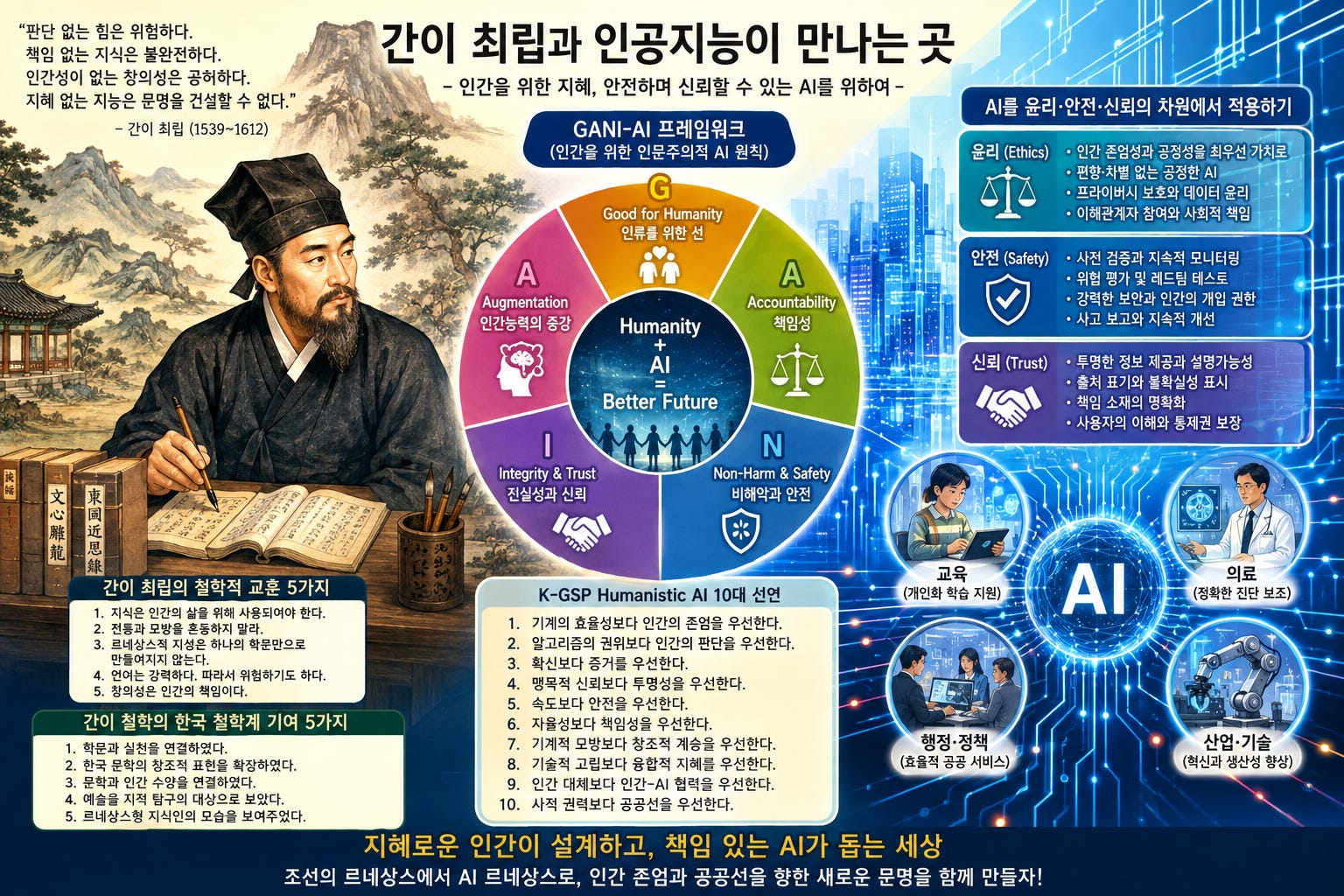
A possible framework inspired by Choi Rip can be called:
GANI-AI
G — Good for Humanity
AI must ultimately contribute to human flourishing.
A — Accountability
Every consequential AI system must have identifiable human and institutional responsibility.
N — Non-Harm and Safety
AI power must be constrained by rigorous testing, monitoring, and safeguards.
I — Integrity and Trust
AI should earn calibrated trust through evidence, transparency, reliability, and accountability.
A — Augmentation
AI should strengthen human intelligence rather than encourage humans to surrender judgment.
This framework is not a claim that Choi Rip himself formulated an AI theory.
Rather, it is a modern philosophical reconstruction inspired by his intellectual orientation.
That distinction is important for serious scholarship.
8. AI Ethics: Put the Person Back at the Center
Imagine an AI system making decisions about a student’s admission to college.
Or a patient’s medical treatment.
Or someone’s eligibility for a loan.
Or an employee’s promotion.
The algorithm may be efficient.
But efficiency is not justice.
A Gani-inspired AI ethics framework would ask:
Who is affected?
Who benefits?
Who could be harmed?
Can the person understand the decision?
Can the decision be challenged?
Who is accountable?
Recent research on human-centered AI emphasizes that human agency and meaningful human control must remain central as AI systems become more influential (Rodilosso, 2025).
The principle is therefore:
The human being must never disappear behind the algorithm.
9. AI Safety: Powerful Systems Need Powerful Restraints
There is another lesson from history.
When human beings acquire power faster than wisdom, civilization becomes vulnerable.
The same applies to AI.
A powerful AI system should not automatically receive unlimited authority.
It needs:
testing,
monitoring,
red teaming,
cybersecurity,
human override,
incident reporting,
continuous evaluation,
and institutional accountability.
Gyevnár and Kasirzadeh (2025) argue that AI safety should involve broader participation rather than remaining confined to a narrow technical community.
That is an important principle.
AI safety is not merely an engineering problem.
It is a social responsibility.
The Gani-inspired formula is therefore:
The greater the intelligence, the greater the need for restraint.
10. AI Trust: Do Not Ask People to Trust What They Cannot Understand
There is a dangerous temptation in the AI era:
“The AI is smarter than humans, so trust it.”
That is precisely the wrong conclusion.
A trustworthy system is not one that demands trust.
It is one that earns appropriate trust.
Research on human-AI trust emphasizes the importance of understanding when people appropriately rely on AI and when they become over-reliant on it (Li et al., 2024).
This distinction is critical.
If a physician blindly follows an AI diagnosis, that is not trustworthy AI.
If a student accepts every AI-generated answer without verification, that is not trustworthy AI.
If a government delegates consequential decisions to an opaque algorithm, that is not trustworthy governance.
The goal is calibrated trust.
Not:
Trust everything.
Not:
Trust nothing.
But:
Trust AI exactly as much as evidence warrants.
11. The Most Important AI Principle: Do Not Abdicate Human Judgment
Perhaps the greatest danger of AI is not that machines will become too intelligent.
It is that humans will become too willing to stop thinking.
Imagine a student who asks AI to write every paper.
A researcher who lets AI formulate every hypothesis.
A professor who lets AI grade every student.
A physician who accepts every recommendation.
A manager who delegates every difficult decision.
The human may become more productive.
But perhaps less capable.
That is why the ultimate goal should be:
Human + AI
rather than
Human replaced by AI.
Alfiras et al. (2026), in their systematic examination of generative AI governance in education, highlight the importance of responsible adoption, including concerns about privacy, bias, transparency, and human oversight.
The educational lesson is profound:
AI should help students think better, not think instead of them.
12. What Can Korea Contribute to Global AI Ethics?
This may be the most exciting question for K-GSP.
Korea has become one of the world’s technological powerhouses.
But technological leadership is only one form of leadership.
There is another:
the ability to contribute ideas about how technology should serve humanity.
Korean philosophy has resources that can contribute to this conversation.
Choi Rip provides one example.
His intellectual legacy can be connected to broader Korean traditions of:
learning,
human cultivation,
community responsibility,
cultural creativity,
disciplined communication,
and practical wisdom.
Recent scholarship increasingly recognizes that global AI ethics should not be built from a single cultural tradition. Waddington et al. (2026), for example, examine how Western and African ethical perspectives can be integrated in developing ethical frameworks for generative AI in higher education.
This opens the door for Korean perspectives.
The future could therefore see:
Western AI ethics + African relational ethics + Asian philosophical traditions + Korean humanistic thought
contributing to a genuinely global AI ethics.
That would be real global soft power.
13. From Joseon’s Renaissance to AI Renaissance
There is a beautiful historical irony here.
Choi Rip lived during what we might call a Korean intellectual renaissance.
He used:
paper + brush + language + learning
to expand human intellectual capability.
We now use:
data + algorithms + networks + generative models
to do the same thing at an extraordinary scale.
The tools have changed.
The fundamental question has not:
What should human intelligence become?
Perhaps this is why Choi Rip matters today.
He reminds us that intellectual power is valuable only when connected to judgment.
Creativity is meaningful only when connected to responsibility.
Knowledge becomes wisdom only when it improves human life.
And communication becomes civilization only when it creates understanding and trust.
14. A K-GSP Manifesto for Humanistic AI
If we were to condense the entire philosophy into ten principles, they might read:
Human dignity before machine efficiency.
Human judgment before algorithmic authority.
Evidence before confidence.
Transparency before blind trust.
Safety before speed.
Accountability before autonomy.
Creative inheritance before mechanical imitation.
Interdisciplinary wisdom before technological isolation.
Human–AI collaboration before human replacement.
Public good before private power.
These principles are compatible with the emerging international discourse on responsible and trustworthy AI (Batool et al., 2025; Gyevnár & Kasirzadeh, 2025; Li et al., 2024; Rodilosso, 2025).
But their particular framing through Choi Rip gives them a distinctly Korean humanistic character.
15. The Final Question
One day, perhaps sooner than we expect, AI systems will be able to outperform humans in an extraordinary range of intellectual tasks.
Then what?
Will humanity become unnecessary?
Or will humanity finally have the opportunity to focus on the things machines cannot decide for us?
What is worth loving?
What is worth preserving?
What is just?
What is beautiful?
What kind of society should we build?
What kind of human beings should our technologies help us become?
These questions cannot be answered by increasing computing power.
They require philosophy.
And that is where Gani Choi Rip unexpectedly returns.
He comes to us from a world of paper and ink.
We live in a world of chips and algorithms.
But his fundamental message remains remarkably contemporary:
Power without judgment is dangerous.
Knowledge without responsibility is incomplete.
Creativity without humanity is empty.
And intelligence without wisdom cannot build a civilization.
The AI revolution therefore needs more than engineers.
It needs philosophers.
It needs historians.
It needs artists.
It needs educators.
It needs citizens.
And perhaps it needs to rediscover forgotten intellectuals such as Gani Choi Rip.
Because the most important AI question may not be:
“How intelligent can machines become?”
It may be:
“How wise can humanity become while building them?”
That is the question that could transform the AI revolution from a technological revolution into a genuine Human Renaissance.
And that is where Gani Choi Rip meets artificial intelligence.
References
Alfiras, M. I. I., Emran, A. Q., & Mohamed, A. M. (2026). Ethics and governance of generative AI in education: A systematic review on responsible adoption. Discover Education, 5, Article 37. https://doi.org/10.1007/s44217-025-01051-y
Batool, A., Zowghi, D., & Bano, M. (2025). AI governance: A systematic literature review. AI and Ethics, 5, 3265–3279. https://doi.org/10.1007/s43681-024-00653-w
Gyevnár, B., & Kasirzadeh, A. (2025). AI safety for everyone. Nature Machine Intelligence, 7, 531–542. https://doi.org/10.1038/s42256-025-01020-y
Hwang, H. W. (2022). A study on Choi Rip’s life and poetry. Dongyang Studies in Korean Classics, 61, 251–271. https://doi.org/10.35374/dyha.61..202202.009
Laine, J., Minkkinen, M., & Mäntymäki, M. (2025). Understanding the ethics of generative AI: Established and new ethical principles. Communications of the Association for Information Systems, 56, 1–25. https://doi.org/10.17705/1CAIS.05601
Li, Y., Wu, B., Huang, Y., & Luan, S. (2024). Developing trustworthy artificial intelligence: Insights from research on interpersonal, human-automation, and human-AI trust. Frontiers in Psychology, 15, 1382693. https://doi.org/10.3389/fpsyg.2024.1382693
Maeng, Y. (2011). A study on Gani Choi Rip (簡易 崔岦)’s painting theory. Dongyang Studies, 50, 21–42. https://doi.org/10.17320/orient.2011..50.21
Rodilosso, E. (2025). Epistemic vs. moral: A differentiated approach to human-centered AI ethics. Topoi. https://doi.org/10.1007/s11245-025-10324-y
Sullivan, V., & Weger, K. (2025). Transparency and explainability in AI-assisted decision making: Effects on trust, perceived reliability, confidence, and ease of understanding. Proceedings of the Human Factors and Ergonomics Society Annual Meeting, 69(1). https://doi.org/10.1177/10711813251369473
Taeihagh, A. (2025). Governance of generative AI. Policy and Society, 44(1), 1–22. https://doi.org/10.1093/polsoc/puaf001
Waddington, L., de Blacquiere-Clarkson, R., & Olojede, H. T. (2026). Ethical frameworks for generative artificial intelligence (GenAI) in higher education: Integrating Western and African perspectives. AI and Ethics, 6, Article 276. https://doi.org/10.1007/s43681-025-00937-9
간이 최립과 인공지능이 만나는 곳
조선의 르네상스형 인간이 오늘날의 윤리적·안전하고 신뢰할 수 있는 AI에 주는 다섯 가지 교훈
“인공지능이 얼마나 더 강력해질 것인가가 진정한 질문은 아니다. 진정한 질문은 AI가 강력해질수록 인간은 얼마나 더 지혜로워질 것인가이다.”
인공지능은 이제 몇 초 만에 글을 쓰고, 거의 즉시 언어를 번역하며, 그림을 그리고, 음악을 작곡하고, 방대한 데이터를 분석하고, 컴퓨터 프로그램을 작성하며, 점점 더 복잡한 의사결정을 지원한다.
그런데 여기에는 묘한 역설이 있다.
기계가 더욱 지능화될수록 우리는 인간의 지능이 과연 무엇을 위해 존재하는지를 더욱 절실하게 물어야 한다는 것이다.
바로 이 지점에서 16세기의 한 한국 학자가 오늘날의 AI 논의에 초대될 만한 이유가 생긴다.
그의 이름은 간이(簡易) 최립(崔岦, 1539–1612)이다.
최립은 조선의 격동기에 살았다. 그는 학자이자 시인이었으며, 문장가, 관료, 외교관, 문화비평가로 활동했다. 현대 한국학 연구는 그의 한시를 강건하고 독특한 문체로 평가하며, 그의 회화론에서 예술, 예술적 창작, 미적 감상에 관한 중요한 사유를 발견한다(Hwang, 2022; Maeng, 2011).
물론 그는 신경망도, 대규모 언어모델도, 생성AI도, 자율시스템도 알지 못했다.
그러나 그의 지적 삶은 오늘날 우리에게 놀라울 정도로 현대적인 질문을 던진다.
지식은 무엇을 위해 존재하는가?
힘은 어떻게 사용되어야 하는가?
무엇이 신뢰할 수 있는 의사소통을 만드는가?
전통은 어떻게 혁신으로 이어질 수 있는가?
그리고 인간이 자신이 통제하기 어려울 정도의 지적 능력을 갖게 된다면 어떤 일이 일어나는가?
이것은 16세기의 학자만을 위한 질문이 아니다.
오늘날 실리콘밸리, 서울, 워싱턴, 베이징, 브뤼셀, 그리고 궁극적으로 전 인류가 함께 고민해야 할 질문이다.
1. 첫 번째 교훈: 지능은 인간의 삶을 위해 사용되어야 한다
최립에게서 얻을 수 있는 가장 중요한 교훈은 어쩌면 매우 단순하다.
지식은 결국 삶으로 돌아와야 한다.
최립에게 학문은 정보를 축적하는 지적 훈련만이 아니었다. 그의 삶은 문학, 공직, 외교, 문화비평, 지적 수양을 연결하고 있었다. 그의 생애는 학문과 공공의 책임을 연결했던 조선의 지식인 이상을 보여준다.
이 원칙은 오늘날 특히 중요하다.
우리는 놀라운 AI 성능을 매일 접한다.
어떤 AI는 시험에서 높은 점수를 얻는다.
어떤 AI는 아름다운 시를 쓴다.
어떤 AI는 질병을 진단한다.
어떤 AI는 컴퓨터 코드를 작성한다.
어떤 AI는 존재하지 않는 사람과 장소를 실제 사진처럼 만들어낸다.
그러나 성능만을 찬양하면서 그 목적을 묻지 않는 데에는 위험이 있다.
AI 시스템은 기술적으로 뛰어나면서도 동시에 사회적으로 해로운 결과를 만들어낼 수 있다.
최근 AI 거버넌스 연구 역시 책임 있는 AI를 위해서는 기술적 성능만이 아니라 위험, 제도적 책임, 거버넌스 체계를 함께 고려해야 한다고 강조한다(Batool et al., 2025).
최립이라면 아마 이렇게 물었을 것이다.
“사람을 위해 책임 있게 사용되지 않는 지능이 무슨 의미가 있는가?”
여기서 첫 번째 AI 원칙이 나온다.
AI의 능력은 인간의 목적에 종속되어야 한다.
2. 두 번째 교훈: 전통과 모방을 혼동하지 말라
최립은 고전 문학 전통과 깊이 연결되어 있었다.
그러나 그는 과거를 단순히 복사하지 않았다.
그의 시는 기존 문학 전통을 적극적으로 받아들이면서도 강건하고 독특한 자신의 표현을 추구한 것으로 평가된다(Hwang, 2022).
이것은 매우 현대적인 생각이다.
최고의 혁신은 반드시 과거를 버리는 데서 시작되는 것이 아니다.
때로는 과거를 창조적으로 다시 해석하는 것에서 시작된다.
생성AI도 정확히 같은 문제를 안고 있다.
AI는 엄청난 규모의 인간 지식으로부터 학습한다. 언어, 문학, 과학, 예술, 문화적 패턴, 역사적 정보 등이 그 안에 들어 있다.
그러나 여기에는 근본적인 질문이 있다.
AI는 축적된 인간의 지식을 어떻게 활용하면서도 그 안에 존재하는 오류와 편견을 단순히 반복하지 않을 수 있는가?
생성AI 윤리 역시 단순한 체크리스트로 해결될 수 없다.
Laine et al. (2025)은 생성AI를 둘러싼 여러 윤리적 원칙들이 서로 충돌할 수 있으며, 따라서 고정된 규칙보다는 지속적인 윤리적 판단이 필요하다고 설명한다.
최립에게서 얻는 교훈은 간단하다.
지식을 물려받되, 책임 있게 변형하라.
AI에 적용하면 다음과 같다.
인간 지식 → AI의 증강 → 인간의 판단 → 책임 있는 혁신
이지,
인간 지식 → 기계적 반복 이어서는 안 된다.
3. 세 번째 교훈: 르네상스적 지성은 하나의 학문만으로 만들어지지 않는다
현대의 대학에서 최립을 만난다면 어느 학과에 배치해야 할까?
국문학?
역사학?
철학?
정치학?
미술사?
국제관계학?
교육학?
아마 하나만 고르기 어려울 것이다.
바로 그것이 핵심이다.
최립의 중요성은 그의 지적 활동의 폭에서 나온다. 그의 문학, 공직, 외교, 미학적 사유는 서로 분리해서 이해하기 어렵다.
그의 회화론 역시 예술 일반론, 예술 창작론, 미적 감상론이라는 여러 차원에서 연구되어 왔다(Maeng, 2011).
오늘날 우리가 말하는 융합적 사고의 한 사례라고 볼 수 있다.
그리고 AI에는 바로 이러한 융합적 사고가 필요하다.
컴퓨터과학자에게 알고리즘이 어떤 결정을 내릴 수 있는지 물으면 대답할 수 있다.
그러나 철학자에게 그 결정을 내려야 하는지 물으면 전혀 다른 문제가 된다.
법학자는 책임 소재를 묻는다.
심리학자는 인간의 반응을 묻는다.
사이버보안 전문가는 시스템이 공격받을 가능성을 묻는다.
교육학자는 학습에 미칠 영향을 묻는다.
경제학자는 누가 이익을 얻고 누가 손해를 보는지를 묻는다.
그 순간 AI는 더 이상 단순한 컴퓨터과학의 문제가 아니다.
문명의 문제가 된다.
최근 신뢰할 수 있는 AI 연구도 인간의 주체성, 투명성, 신뢰성, 공정성, 거버넌스 등을 통합적으로 다룰 필요성을 강조한다(Li et al., 2024; Rodilosso, 2025).
최립의 르네상스적 교훈은 따라서 다음과 같다.
모든 사람에게 영향을 미치는 기술을 하나의 학문만으로 통제해서는 안 된다.
4. 네 번째 교훈: 언어는 강력하다. 따라서 위험하기도 하다
최립은 언어의 대가였다.
이 점 때문에 그의 유산은 ChatGPT 시대에 더욱 흥미롭다.
400여 년 전에는 가장 설득력 있는 문서를 작성할 수 있는 사람이 상당한 지적 권력을 가졌다.
오늘날 AI는 설득력 있는 언어를 엄청난 속도와 규모로 만들어낸다.
이것은 모든 것을 바꾼다.
인간 작가는 열 쪽의 글을 쓸 수 있다.
AI는 수천 쪽을 만들 수 있다.
인간 기자는 하나의 기사를 취재한다.
AI는 그럴듯한 기사를 수천 개 만들어낼 수 있다.
인간 시인은 한 편의 시를 다듬는 데 몇 주를 보낼 수 있다.
AI는 몇 분 만에 수백 편을 만들 수 있다.
따라서 이제 문제는 단순히 “AI가 글을 쓸 수 있는가?”가 아니다.
더 중요한 문제는 다음과 같다.
AI는 그럴듯함과 진실을 구별할 수 있는가?
유창함은 진실이 아니다.
확신에 찬 말투는 증거가 아니다.
아름다운 문장은 정확성을 보장하지 않는다.
아름다운 문장도 거짓일 수 있다.
최근 AI 투명성과 설명가능성 연구는 AI 시스템에 관한 정보가 제시되는 방식이 사용자의 신뢰성 인식, 확신, 신뢰에 영향을 줄 수 있음을 보여준다(Sullivan & Weger, 2025).
따라서 최립의 문학적 정신에서 다음과 같은 AI 원칙을 도출할 수 있다.
언어의 힘이 커질수록 진실에 대한 책임도 커져야 한다.
생성AI에는 따라서 단순한 언어 생성 능력만 필요한 것이 아니다.
출처 인식 + 불확실성 표시 + 검증 + 책임성
이 필요하다.
5. 다섯 번째 교훈: 창의성은 인간의 책임이다
최립이 예술과 회화론에 관심을 가졌다는 사실은 생성AI와 또 하나의 흥미로운 연결점을 제공한다.
오늘날 우리는 다음과 같은 명령 하나만 입력하면 된다.
“전통적인 한국 수묵화 스타일로 아름다운 한국의 풍경을 그려줘.”
몇 초 뒤 이미지가 만들어진다.
그렇다면 누가 화가인가?
기계인가?
프롬프트를 작성한 사람인가?
모델을 만든 개발자인가?
AI 학습에 사용된 수많은 인간 예술가의 작품인가?
아니면 이들 모두의 결합인가?
이것은 단순한 저작권 문제가 아니다.
창의성이란 무엇인가에 대한 철학적 질문이다.
최립의 예술론을 보면 예술은 단순한 결과물이 아니다. 창작, 감상, 해석, 문화적 의미가 함께 작동한다(Maeng, 2011).
따라서 AI가 이미지를 만들어냈다고 하더라도 그 이미지의 의미와 사용에 대한 책임은 여전히 인간에게 있다.
AI는 생성할 수 있다.
그러나 인간은 판단해야 한다.
앞으로 이 구분은 더욱 중요해질 것이다.
6. 최립은 한국 철학에 무엇을 남겼는가?
최립을 체계적 철학자라는 하나의 범주로만 규정하는 것은 지나치게 단순화할 수 있다.
그의 중요성은 오히려 문학, 예술, 학문, 공직, 외교, 문화적 실천 속에 철학적 사고를 구현했다는 데 있다.
다섯 가지를 생각해 볼 수 있다.
첫째, 학문과 실천을 연결했다.
지식은 소유하는 것이 아니라 실천하는 것이었다.
둘째, 한국 문학의 창조적 표현을 확장했다.
전통을 계승하면서도 독자적인 표현을 추구했다.
셋째, 문학과 인간 수양을 연결했다.
언어는 생각과 인격을 형성하는 수단이었다.
넷째, 예술을 지적 탐구의 대상으로 보았다.
예술은 단순한 아름다움의 생산이나 감상이 아니었다.
다섯째, 르네상스형 지식인의 모습을 보여주었다.
문학, 행정, 외교, 문화의 경계를 넘나들었다.
바로 이러한 특성 때문에 그는 AI 시대에 더욱 흥미로운 인물이 된다.
AI 역시 전통적인 학문 경계를 빠르게 허물고 있기 때문이다.
7. 최립에서 한국적 Humanistic AI Framework로
여기서 K-GSP의 관점에서 매우 흥미로운 가능성이 열린다.
한국의 AI 기여가 더 빠른 반도체, 더 큰 모델, 더 강력한 플랫폼에만 머물러야 하는가?
한국은 또 하나의 것을 세계에 기여할 수 있지 않을까?
바로 AI를 위한 인문주의적 철학이다.
최립은 그 가능성을 보여주는 하나의 지적 자원이다.
최립의 철학적 지향을 현대적으로 재구성한다면 다음과 같은 GANI-AI Framework를 생각할 수 있다.
GANI-AI
G — Good for Humanity: 인류를 위한 선
AI는 궁극적으로 인간의 번영에 기여해야 한다.
A — Accountability: 책임성
중요한 AI 시스템에는 명확한 인간과 조직의 책임이 있어야 한다.
N — Non-Harm & Safety: 비해악과 안전
AI의 힘은 엄격한 검증, 감시, 보호장치에 의해 제한되어야 한다.
I — Integrity & Trust: 진실성과 신뢰
AI는 증거, 투명성, 신뢰성, 책임성을 통해 신뢰를 얻어야 한다.
A — Augmentation: 인간능력의 증강
AI는 인간의 지능을 강화해야 하며 인간이 판단을 포기하도록 만들어서는 안 된다.
이것은 최립이 직접 만든 AI 이론이라는 뜻이 아니다.
그보다는 최립의 지적 성향에서 영감을 얻어 현대적으로 재구성한 철학적 모델이다.
이러한 구분은 학술적으로 매우 중요하다.
8. AI 윤리: 알고리즘 뒤에 있는 인간을 다시 보자
AI가 대학생의 입학 여부를 결정한다고 생각해 보자.
환자의 치료 방법을 결정할 수도 있다.
누군가의 대출 자격을 판단할 수도 있다.
직원의 승진 여부를 평가할 수도 있다.
알고리즘은 효율적일 수 있다.
그러나 효율성이 곧 정의는 아니다.
최립에서 영감을 받은 AI 윤리는 다음을 묻는다.
누가 영향을 받는가?
누가 이익을 얻는가?
누가 피해를 입을 수 있는가?
당사자는 그 결정을 이해할 수 있는가?
이의를 제기할 수 있는가?
책임자는 누구인가?
최근 인간 중심 AI 연구 역시 AI 시스템이 영향력을 확대할수록 인간의 주체성과 의미 있는 인간 통제가 핵심적으로 유지되어야 한다고 강조한다(Rodilosso, 2025).
따라서 원칙은 명확하다.
인간이 알고리즘 뒤에서 사라져서는 안 된다.
9. AI 안전: 강력한 시스템일수록 강력한 제동장치가 필요하다
역사는 우리에게 하나의 교훈을 준다.
인간이 지혜보다 빠르게 힘을 획득하면 문명은 위험해진다.
AI도 마찬가지다.
강력한 AI라고 해서 무제한의 권한을 자동으로 부여해서는 안 된다.
AI에는 다음이 필요하다.
테스트
지속적 모니터링
레드팀 평가
사이버보안
인간의 개입과 중지 권한
사고 보고
지속적 평가
제도적 책임
Gyevnár와 Kasirzadeh (2025)는 AI 안전이 소수의 기술 전문가만의 문제가 아니라 보다 폭넓은 사회적 참여를 필요로 한다고 주장한다.
이것은 중요한 원칙이다.
AI 안전은 단순한 공학 문제가 아니다.
사회 전체의 책임이다.
따라서 최립적 관점에서 AI 안전의 원칙을 한 문장으로 표현하면 다음과 같다.
지능이 강력해질수록 절제의 필요성도 커져야 한다.
10. AI 신뢰: 이해할 수 없는 것을 무조건 믿으라고 요구해서는 안 된다
AI 시대에는 위험한 유혹이 있다.
“AI가 인간보다 똑똑하니까 믿어도 된다.”
그러나 이것은 정확히 반대의 결론이다.
신뢰할 수 있는 시스템은 신뢰를 요구하는 시스템이 아니다.
적절한 신뢰를 얻는 시스템이다.
인간-AI 신뢰 연구는 인간이 AI에 언제 적절하게 의존하고 언제 과도하게 의존하는지를 구별하는 것이 중요하다고 강조한다(Li et al., 2024).
이 차이는 매우 중요하다.
의사가 AI의 진단을 아무런 검토 없이 따른다면 그것은 신뢰할 수 있는 AI가 아니다.
학생이 AI가 생성한 모든 답을 검증 없이 받아들인다면 그것 역시 신뢰할 수 있는 AI가 아니다.
정부가 불투명한 알고리즘에 중요한 결정을 맡긴다면 그것은 신뢰할 수 있는 거버넌스가 아니다.
목표는 보정된 신뢰(calibrated trust)여야 한다.
모든 것을 믿는 것도 아니고,
아무것도 믿지 않는 것도 아니다.
증거가 허용하는 만큼만 AI를 신뢰하는 것.
11. 가장 중요한 AI 원칙: 인간의 판단을 포기하지 말라
AI의 가장 큰 위험은 기계가 지나치게 똑똑해지는 것이 아닐지도 모른다.
오히려 인간이 생각하기를 너무 쉽게 포기하는 것일 수 있다.
학생이 모든 과제를 AI에게 맡긴다고 생각해 보자.
연구자가 모든 연구 가설을 AI에게 맡긴다.
교수가 모든 학생 평가를 AI에게 맡긴다.
의사가 모든 진단 권고를 그대로 받아들인다.
관리자가 모든 어려운 결정을 AI에게 위임한다.
인간은 더 생산적이 될 수 있다.
그러나 어쩌면 덜 유능한 인간이 될 수도 있다.
그래서 궁극적인 목표는
인간 + AI
이어야지,
AI에 의해 대체되는 인간
이어서는 안 된다.
Alfiras et al. (2026)은 교육 분야의 생성 AI 거버넌스를 체계적으로 검토하면서 개인정보, 편향, 투명성, 인간의 감독을 포함한 책임 있는 활용의 중요성을 강조한다.
교육적 교훈은 매우 분명하다.
AI는 학생 대신 생각하는 도구가 아니라 학생이 더 잘 생각하도록 돕는 도구가 되어야 한다.
12. 한국은 세계 AI 윤리에 무엇을 기여할 수 있는가?
이것은 K-GSP가 던질 수 있는 가장 흥미로운 질문 가운데 하나다.
한국은 이미 세계적인 기술 강국이 되었다.
그러나 기술적 리더십은 하나의 리더십일 뿐이다.
또 하나의 리더십이 있다.
기술이 인류를 어떻게 섬겨야 하는지에 관한 생각을 제시하는 능력이다.
한국 철학에는 이러한 대화에 참여할 수 있는 자원이 있다.
최립이 그 한 사례다.
그의 지적 유산은 다음과 같은 한국적 전통과 연결될 수 있다.
학문
인간 수양
공동체적 책임
문화적 창의성
절제된 의사소통
실천적 지혜
최근 AI 윤리 연구는 세계적 AI 윤리가 하나의 문화적 전통에만 의존해서는 안 된다는 점을 점점 더 인식하고 있다. Waddington et al. (2026)은 고등교육에서 생성AI의 윤리적 프레임워크를 개발하면서 서구와 아프리카의 윤리적 관점을 결합하는 가능성을 탐구했다.
이것은 한국적 관점이 참여할 수 있는 중요한 공간을 열어준다.
미래에는
서구 AI 윤리 + 아프리카의 관계적 윤리 + 아시아 철학 + 한국적 인문주의
가 함께 진정한 글로벌 AI 윤리를 만들어갈 수 있을 것이다.
이것이야말로 진정한 글로벌 소프트파워가 아닐까.
13. 조선의 르네상스에서 AI 르네상스로
여기에는 아름다운 역사적 역설이 있다.
최립은 우리가 조선의 지적 르네상스라고 부를 수 있는 시대에 살았다.
그가 사용한 도구는
종이 + 붓 + 언어 + 학문
이었다.
우리가 사용하는 도구는
데이터 + 알고리즘 + 네트워크 + 생성모델
이다.
도구는 완전히 달라졌다.
그러나 근본적인 질문은 변하지 않았다.
인간의 지능은 무엇이 되어야 하는가?
어쩌면 이것이 바로 오늘날 최립을 다시 읽어야 하는 이유다.
그는 지적 능력에는 판단이 따라야 한다는 사실을 일깨운다.
창의성에는 책임이 따라야 한다.
지식은 인간의 삶을 개선할 때 비로소 지혜가 된다.
그리고 의사소통은 이해와 신뢰를 만들어낼 때 비로소 문명이 된다.
14. K-GSP Humanistic AI를 위한 10가지 선언
지금까지의 논의를 열 가지 원칙으로 압축한다면 다음과 같다.
기계의 효율성보다 인간의 존엄을 우선한다.
알고리즘의 권위보다 인간의 판단을 우선한다.
확신보다 증거를 우선한다.
맹목적 신뢰보다 투명성을 우선한다.
속도보다 안전을 우선한다.
자율성보다 책임성을 우선한다.
기계적 모방보다 창조적 계승을 우선한다.
기술적 고립보다 융합적 지혜를 우선한다.
인간 대체보다 인간-AI 협력을 우선한다.
사적 권력보다 공공선을 우선한다.
이 원칙들은 책임 있고 신뢰할 수 있는 AI에 관한 국제적 논의와도 밀접하게 연결된다(Batool et al., 2025; Gyevnár & Kasirzadeh, 2025; Li et al., 2024; Rodilosso, 2025).
그러나 최립이라는 한국의 지적 전통을 통해 이를 재구성한다는 점에서 독특한 한국적 인문주의적 색채를 갖게 된다.
15. 마지막 질문
언젠가, 우리가 생각하는 것보다 훨씬 빠른 시기에 AI가 엄청나게 많은 지적 과제에서 인간을 능가할지도 모른다.
그렇다면 어떻게 될까?
인간은 필요 없어질까?
아니면 인간이 마침내 기계가 우리 대신 결정할 수 없는 문제에 집중할 기회를 얻게 될까?
무엇을 사랑할 것인가?
무엇을 보존할 것인가?
무엇이 정의로운가?
무엇이 아름다운가?
어떤 사회를 만들 것인가?
기술은 우리가 어떤 인간이 되어야 하는지 결정할 수 있는가?
이 질문들은 컴퓨팅 능력을 높인다고 답할 수 있는 문제가 아니다.
철학이 필요한 질문이다.
그리고 바로 그곳에서 간이 최립이 다시 등장한다.
그는 종이와 붓의 세계에서 우리에게 온다.
우리는 반도체와 알고리즘의 세계에 살고 있다.
그러나 그의 근본적인 메시지는 놀랍도록 현대적이다.
판단 없는 힘은 위험하다.
책임 없는 지식은 불완전하다.
인간성이 없는 창의성은 공허하다.
지혜 없는 지능은 문명을 건설할 수 없다.
AI 혁명에는 엔지니어만 필요한 것이 아니다.
철학자가 필요하다.
역사학자가 필요하다.
예술가가 필요하다.
교육자가 필요하다.
시민이 필요하다.
그리고 어쩌면 간이 최립과 같은 잊혀진 지식인을 다시 발견할 필요가 있다.
왜냐하면 AI 시대의 가장 중요한 질문은
“기계는 얼마나 지능적으로 될 수 있는가?”
가 아닐지도 모르기 때문이다.
오히려 진짜 질문은 이것일 것이다.
“그 기계를 만드는 동안 인간은 얼마나 지혜로워질 수 있는가?”
이 질문이 AI 혁명을 단순한 기술혁명이 아니라 진정한 인간 르네상스(Human Renaissance)로 바꾸어 놓을 수 있다.
그리고 바로 그곳에서,
간이 최립과 인공지능이 만난다.
참고문헌
Alfiras, M. I. I., Emran, A. Q., & Mohamed, A. M. (2026). Ethics and governance of generative AI in education: A systematic review on responsible adoption. Discover Education, 5, Article 37. https://doi.org/10.1007/s44217-025-01051-y
Batool, A., Zowghi, D., & Bano, M. (2025). AI governance: A systematic literature review. AI and Ethics, 5, 3265–3279. https://doi.org/10.1007/s43681-024-00653-w
Gyevnár, B., & Kasirzadeh, A. (2025). AI safety for everyone. Nature Machine Intelligence, 7, 531–542. https://doi.org/10.1038/s42256-025-01020-y
Hwang, H. W. (2022). A study on Choi Rip’s life and poetry. Dongyang Studies in Korean Classics, 61, 251–271. https://doi.org/10.35374/dyha.61..202202.009
Laine, J., Minkkinen, M., & Mäntymäki, M. (2025). Understanding the ethics of generative AI: Established and new ethical principles. Communications of the Association for Information Systems, 56, 1–25. https://doi.org/10.17705/1CAIS.05601
Li, Y., Wu, B., Huang, Y., & Luan, S. (2024). Developing trustworthy artificial intelligence: Insights from research on interpersonal, human-automation, and human-AI trust. Frontiers in Psychology, 15, 1382693. https://doi.org/10.3389/fpsyg.2024.1382693
Maeng, Y. (2011). A study on Gani Choi Rip (簡易 崔岦)’s painting theory. Dongyang Studies, 50, 21–42. https://doi.org/10.17320/orient.2011..50.21
Rodilosso, E. (2025). Epistemic vs. moral: A differentiated approach to human-centered AI ethics. Topoi. https://doi.org/10.1007/s11245-025-10324-y
Sullivan, V., & Weger, K. (2025). Transparency and explainability in AI-assisted decision making: Effects on trust, perceived reliability, confidence, and ease of understanding. Proceedings of the Human Factors and Ergonomics Society Annual Meeting, 69(1). https://doi.org/10.1177/10711813251369473
Taeihagh, A. (2025). Governance of generative AI. Policy and Society, 44(1), 1–22. https://doi.org/10.1093/polsoc/puaf001
Waddington, L., de Blacquiere-Clarkson, R., & Olojede, H. T. (2026). Ethical frameworks for generative artificial intelligence (GenAI) in higher education: Integrating Western and African perspectives. AI and Ethics, 6, Article 276. https://doi.org/10.1007/s43681-025-00937-9
2026년 8월 9일
{솔티}
Source Paper:

Prof. Dr. Young Choi (Editor in Chief) — Regent University
Young B. Choi is a Professor in the Department of Engineering & Computer Science at Regent University. He published 38 books with ‘Selected Readings in Cybersecurity’ (2018) (over 800 copies archived globally at university/college libraries around the world) and ‘Cybersecurity Applications and Artificial Intelligence’ (2023) available in seven major world languages. He proposed the world’s first global and universal telecommunications “Service Order Handling (SOH)” Model (T-SOH Model) (1995) with Dr. Adrian Tang. With this innovative research work, he received the IEEE NOMS ’96 Best Paper Award and became the first recipient of the Outstanding Contribution Award of the TeleManagement Forum in 1998. His research areas include Natural Language Processing-focused AI, AI-applied cybersecurity, network and telecom service management, and Korean studies on Gani Choi Rip’s Jeonggwan (靜觀: Quiet Contemplation) philosophy and Shilhak ( 實學: Practical Learning).
© K-GSP (K-Global Scholars and Professionals) Forum. All rights reserved. August 2026. Content published in the K-GSP Forum may not be reproduced, distributed, or transmitted in any form without prior written permission from the K-GSP Forum, except for brief quotations with full attribution.
Choi, Y. B. (2026, August 10). When Gani Choi Rip Meets Artificial Intelligence: Five Lessons from a Joseon Renaissance Man for Ethical, Safe, and Trustworthy AI. K-GSP.