

When the Alphabet Is the Easy Part: The Hidden Complexity of Korean Honorifics
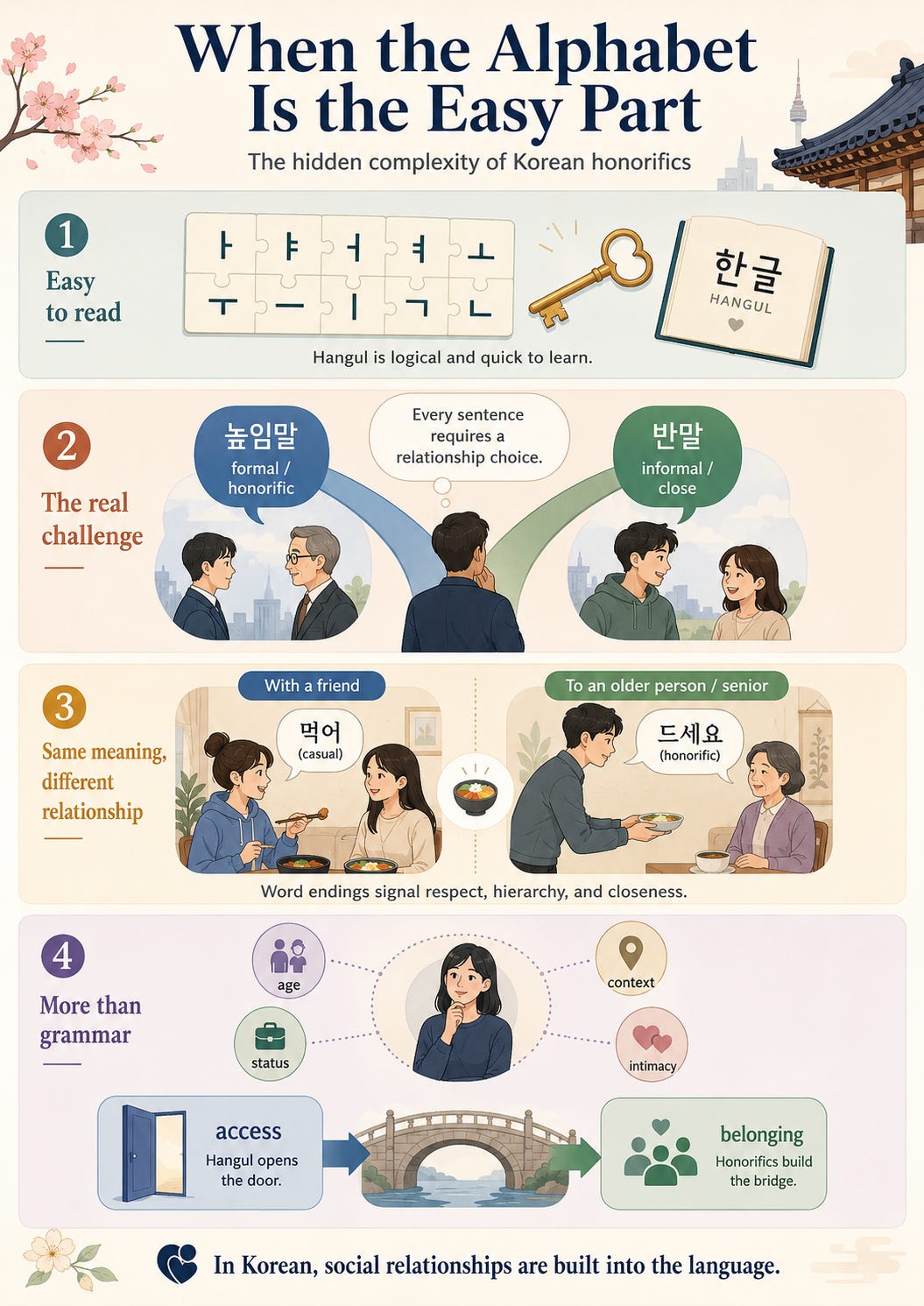
Most people who decide to learn Korean feel a quick rush of confidence. Within a weekend, they can read Hangul — every syllable, every character. King Sejong’s fifteenth-century invention really is that elegant: a phonetic system so logically constructed that linguists still marvel at it. One scholar called it “perhaps the most scientific writing system in the world.” Learning to read Korean feels like solving a puzzle designed to be solved.
Then someone asks you a simple question: Are you close with that person?
And you realize: the alphabet was never the hard part.
The Moment the Language Splits in Two
Korean operates on two parallel universes of speech — 높임말 (nopimmal), the formal honorific register, and 반말 (banmal), the informal register. Every sentence you speak lands in one or the other, and the choice carries enormous social weight. You are not just choosing words. You are declaring a relationship, acknowledging a hierarchy, and either earning trust or committing a quiet offense.
For Korean-Americans of the second and third generation, this is often where the language breaks down — not in pronunciation, not in vocabulary, but here. Many grew up hearing Korean at home: warmth, food, family, love. Mostly 반말, because families are intimate. Then they visit Korea, meet a senior colleague at a company dinner, and freeze. The grammar their grandmother never had to teach them suddenly matters enormously. They understand the words being spoken. They cannot find the words to respond — not without risking rudeness they did not intend.
One Word for “You” Is Never Enough
For non-Korean learners, the challenge is conceptual before it is grammatical. English has “you” — one word, for everyone, forever. Korean has a layered architecture of address terms, verb endings, and sentence-final markers that shift depending on age, status, social context, and the intimacy of the relationship. The same action — eating — becomes 먹어 among friends and 드세요 when speaking to an elder. Miss the distinction, and you have not simply made a grammatical error. You have accidentally implied that hierarchy does not apply to you.
Linguists classify Korean as a “sociolinguistically stratified” language — meaning its grammatical structure is inseparable from its social structure. The honorific system is not decorative. It is load-bearing. It reflects a Confucian framework that has shaped Korean society for centuries: relationships defined by age, role, and mutual obligation. Speaking Korean well means navigating that framework fluently, not just reciting its rules.
Access Is Not the Same as Belonging
This is precisely what makes Korean both hard and fascinating. The alphabet gives you access. The honorifics give you belonging — but only if you use them correctly. For diaspora communities navigating identity across cultures, that gap between access and belonging is painfully familiar. Korean, it turns out, makes that experience grammatical.
Perhaps Sejong gave us the easy part on purpose. The rest — the reading of rooms, the calibration of relationships, the weight of the right ending — that has always been the work of living Korean, not just learning it.
© K-Global Scholars and Professionals Forum. All rights reserved. Content published in the K-GSP Forum may not be reproduced, distributed, or transmitted in any form without prior written permission from the K-GSP Forum, except for brief quotations with full attribution.


