

Executive Summary
Generative AI is reshaping the U.S. labor market not through mass layoffs but through a quieter mechanism: hiring freezes at the entry level. Drawing on data from 62 million workers, Hosseini Maasoum and Lichtinger (2025) document that AI-adopting firms sharply reduced junior hiring beginning in 2023, while senior roles continued to grow. This seniority-biased technological change threatens talent pipelines, disrupts career ladders, and exposes gaps in higher education curricula. Organizations and institutions must act urgently to redesign workforce development strategies — ensuring that quality humans remain meaningfully, not nominally, in the loop.
Keywords: generative AI, job polarization, seniority-biased technological change, entry-level employment, human capital development
Introduction
There is a paradox quietly unfolding inside American firms. Organizations are racing to adopt generative artificial intelligence — restructuring workflows, investing in automation, and posting productivity gains that shareholders find increasingly difficult to ignore. Yet at the very same moment, the front door for new workers is swinging shut. The hiring of junior employees is slowing — not because companies are contracting, but because the tasks that once justified those hires are being absorbed by machines. The result is a labor market growing more unequal not by firing people, but by never bringing them in.
This is not speculation. A landmark working paper by Hosseini Maasoum and Lichtinger (2025), drawing on résumé and job-posting data covering nearly 62 million workers across 285,000 U.S. firms over a decade (2015–2025), offers some of the most rigorous empirical evidence yet that generative AI is operating as what the authors call “seniority-biased technological change.” Using difference-in-differences and triple-difference estimation, they found that beginning in the first quarter of 2023, junior employment in AI-adopting firms declined sharply relative to non-adopting firms, while senior employment continued to rise. Crucially, the junior decline was driven by slower hiring rather than increased separations or promotions. Companies simply stopped opening the door at the bottom.
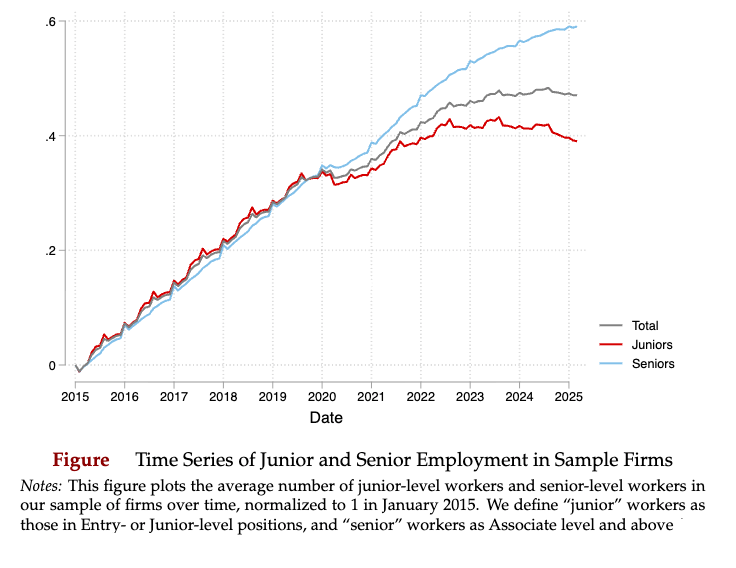
Figure 1. Within-Firm Employment Trends by Seniority Level Following GenAI Adoption (2015–2025)
Note. Adapted from Hosseini Maasoum and Lichtinger (2025). The figure illustrates difference-in-differences estimates comparing junior and senior employment trajectories in AI-adopting versus non-adopting firms. Beginning in Q1 2023, junior employment in adopting firms declined sharply while senior employment remained stable or continued to grow. X-axis: calendar quarter (2015 Q1–2025 Q2). Y-axis: within-firm employment index (baseline = 1.0, Q4 2022).
The Anatomy of Seniority-Biased Change
To understand what is happening, it helps to recognize that generative AI did not arrive as a general disruptor. It arrived as a very precise one. The tasks most amenable to automation — drafting documents, summarizing research, generating initial code, processing structured data, reviewing routine materials — are precisely the tasks traditionally assigned to entry-level workers. These are the assignments through which junior employees have historically learned their professions: debug this code, draft this brief, prepare this analysis, run this report.
Hosseini Maasoum and Lichtinger (2025) extend the classical economic concept of skill-biased technological change — the well-documented phenomenon whereby automation tends to favor educated and experienced workers — by adding a new dimension: seniority. Even within the same firm, even among workers with equivalent credentials, the most junior are bearing the greatest cost of adoption. The authors argue that if AI disproportionately targets entry-level tasks, the bottom rungs of career ladders may already be eroding.
The scale of this shift is visible across multiple independent data sources. Analysis of 126 million global job postings found that entry-level positions declined by 29 percentage points since January 2024, as AI adoption and economic uncertainty led employers to raise the bar for new hires, fundamentally disrupting the traditional career ladder (The Interview Guys, 2026). A complementary working paper by Brynjolfsson et al. (2025), drawing on ADP payroll data, documented a 13% relative employment drop for workers aged 22–25 in AI-exposed occupations, with declines driven by hiring cuts rather than wage reductions. Their findings showed the sharpest contractions in software development, customer service, and clerical work — the traditional entry points of many professional careers.
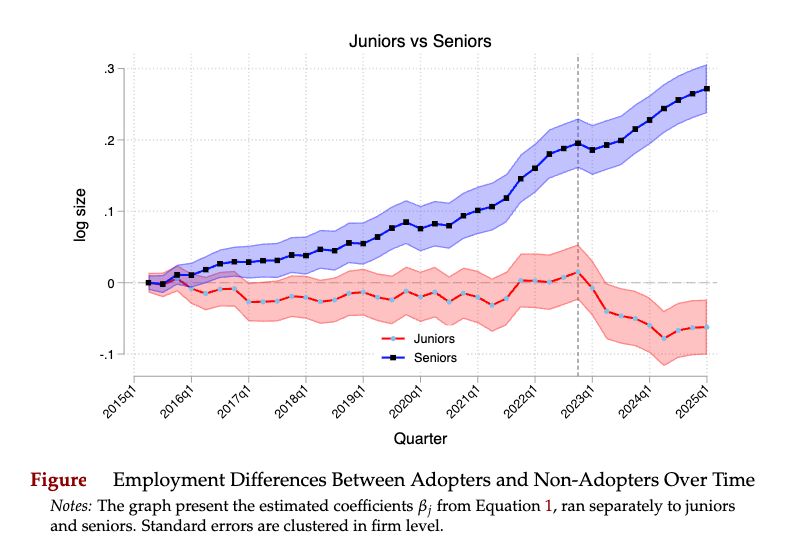
Figure 2. Decline in Entry-Level Job Postings Globally, January 2024–December 2025
Note. Based on Randstad analysis of 126 million global job postings, as reported in The Interview Guys (2026). The figure depicts a 29-percentage-point decline in entry-level postings from the January 2024 baseline. Decline is cross-sectoral, with the steepest drops in technology, financial services, and professional services. Healthcare entry-level postings bucked the trend, rising approximately 13 percentage points over the same period.
Not a Downturn — A Structural Shift
It would be tempting to attribute this contraction entirely to macroeconomic conditions. The 2023 period coincided with Federal Reserve tightening, post-pandemic hiring corrections, and broader corporate caution. Researchers at Yale’s Budget Lab and Stanford’s Digital Economy Lab have appropriately urged caution in attributing the full weight of labor market change to generative AI alone (Budget Lab at Yale, 2025; Stanford Digital Economy Lab, 2025). Macro forces matter, and intellectual honesty demands we acknowledge them.
Nevertheless, the structural dimension of the current shift appears qualitatively different from a cyclical correction. Previous technological transitions — the mechanization of manufacturing, the computerization of clerical work — ultimately generated new employment categories even as they eliminated old ones. The concern in 2025 is that we are observing a significant lag between displacement and reinstatement. While 64% of organizations report that AI is enabling innovation, only 39% report tangible enterprise-level financial impact — suggesting that companies are adopting the technology faster than they are expanding to absorb the labor it displaces (Rezi, 2026).
The roles being created tend to require not simply skill but demonstrated, senior-level experience: AI architects, workflow orchestrators, strategy integrators. Research drawing on 124 years of U.S. Census data finds that the labor market pattern of the 2000s — growth at both top and bottom of the wage distribution — has shifted to an upward ramp, with growth now concentrated almost entirely in high-paid, high-skill positions (Deming & Summers, as cited in Harvard Gazette, 2025). The barbell that defined job polarization for a generation is collapsing into a single weight at the top.
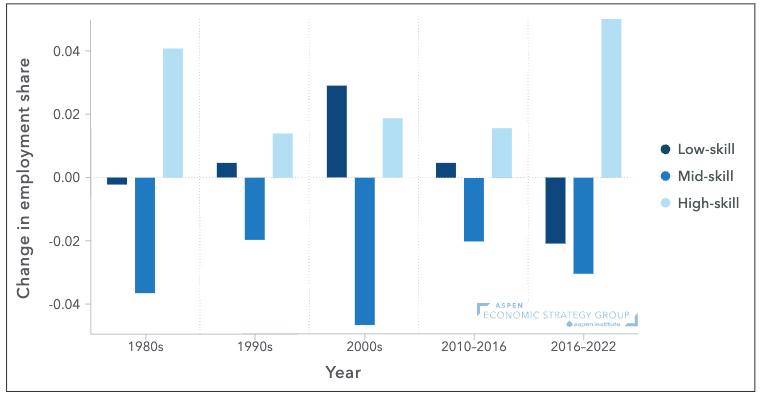
Figure 3. Employement growth by jo skill level, 1980-2022
Note. Calculations are based on the 1980, 1990, and 2000 U.S. Censuses (5% state sample from each) and American Community Survey (ACS) data from 2010 and 2022, sourced via IPUMS (Flood et al., 2023; Ruggles et al., 2024). Occupations are harmonized to two-digit SOC codes using the IPUMS occ1950 encoding and the methodology of Autor and Dorn (2013); full methodological details are provided in the data appendix of the source paper. Samples are restricted to workers aged 18 to 64 in noninstitutional settings who provided nonmilitary occupational responses. See Deming et al. (2025) for exhaustive category definitions.
The Talent Pipeline Problem
This matters beyond the immediate employment fortunes of recent graduates. Organizations depend on junior roles to build the pipelines of experienced talent they will need five, ten, and twenty years from now. Senior workers were once junior workers. The analytical instincts, institutional knowledge, client-facing judgment, and organizational resilience that define exceptional senior professionals are not born fully formed. They are cultivated through years of doing foundational work — exactly the work now being automated away.
A healthy labor market operates through what economists call “vacancy chains”: a senior worker departs, a mid-level professional moves up, and a junior hire fills the bottom (Rezi, 2026). Generative AI disrupts this chain by automating the bottom link, severing the pathway for new entrants. If that pathway closes for a sustained period — not one hiring cycle but five or ten years — the consequences will compound. Leadership pipelines will thin. Organizational memory will narrow. Institutions that accelerated AI adoption for near-term productivity gains will find themselves strategically exposed by the mid-career talent gaps they inadvertently created.
For human resource practice, this is not abstract. It demands immediate rethinking of talent architecture: how firms recruit, develop, and retain early-career workers when the traditional apprenticeship model — learning by doing the foundational work — is structurally unavailable. Reskilling initiatives, while necessary, cannot bridge a gap that the gap itself is widening.
Education and the Mis-Calibrated Curriculum
The implications run upstream into higher education. Universities and professional schools have built curricula around preparing students for the entry-level roles now contracting most sharply. The paradox facing educators is acute: institutions that invested most heavily in teaching the technical skills most susceptible to AI displacement — code generation, document analysis, data processing — are seeing the sharpest declines in graduate employment outcomes.
Hosseini Maasoum and Lichtinger (2025) found that the junior employment decline was concentrated precisely in high AI-exposure occupations. The curriculum question is therefore no longer simply “what skills will AI replace?” but “what capacities does AI structurally lack, and how do we develop them intentionally?” Judgment under ambiguity. Ethical reasoning in complex systems. Cross-cultural fluency. The capacity to hold complexity without collapsing it into a prompt. In a labor market shaped by seniority-biased AI adoption, these are not soft supplements to technical competence. They may constitute the core.
Conclusion: Quality Humans in the Loop
The engineering and AI governance community has a phrase: Human in the Loop (HITL). It designates the design principle that consequential AI decisions require human review before action is taken. The concept was born in technical necessity. It is acquiring a wider moral urgency.
If generative AI erodes the entry points through which professionals develop contextual intelligence, institutional wisdom, and ethical discernment, the long-term risk is not merely unemployment. It is the gradual impoverishment of the human workforce’s qualitative depth. The systems we are building require, at every consequential node, someone with genuine judgment and genuine experience — experience that has to come from somewhere, cultivated through the foundational work now being automated away.
The evidence from Hosseini Maasoum and Lichtinger (2025) and the convergent findings from Brynjolfsson et al. (2025), the Budget Lab at Yale (2025), and Stanford’s Digital Economy Lab (2025) suggest we are at an inflection point. The choices made in the next three to five years — in hiring, in curriculum, in workforce development policy — will determine whether the humans remaining in the loop are genuinely equipped for the role that label assigns them.
That is not merely an economic question. It is a question about the kind of organizations, institutions, and communities we wish to inhabit. It deserves the full weight of our scholarly, professional, and human attention.
References
Brynjolfsson, E., Chandar, A., & Chen, L. (2025). Canaries in the coal mine? Six facts about the recent labor market effects of artificial intelligence [Working paper]. Stanford Digital Economy Lab.
Budget Lab at Yale. (2025). Evaluating the impact of AI on the labor market: Current state of affairs. Yale University.
Deming, D. J., Ong, C., & Summers, L. H. (2025). Technological disruption in the labor market (NBER Working Paper No. 33323). National Bureau of Economic Research. https://doi.org/10.3386/w33323
Harvard Gazette. (2025, February 14). Is AI already shaking up the labor market? Harvard Gazette.
Hosseini Maasoum, S. M., & Lichtinger, G. (2025). Generative AI as seniority-biased technological change: Evidence from U.S. résumé and job posting data [Working paper]. SSRN.
Rezi. (2026, January 15). The crisis of entry-level labor in the age of AI (2024–2026) [Report]. Rezi.
Stanford Digital Economy Lab. (2025, October 10). AI and labor markets: What we know and don’t know. Stanford University.
The Interview Guys. (2026, January 2). The 2025 job market year-end review: How AI reshaped American employment[Research report]. The Interview Guys.
About the Author

Prof. Dr. Jeonghwan (Jerry) Choi — Editor-in-Coordination, University of Maine at Presque Isle
Jeonghwan (Jerry) Choi, PhD is an Associate Professor of Business at the University of Maine at Presque Isle and Editor-in-Coordination of K-GSP Forum (contact: jeonghwan.choi@gmail.com). With over 25 years of industry and consulting experience, he specializes in leadership development, human resource management, organizational behavior, and social entrepreneurship. His research focuses on workforce resilience, organizational health, and self-directed leadership — bridging rigorous scholarship with practical insight to cultivate leaders who create meaningful, sustainable, and humane organizations .
© K-Global Scholars and Professionals Forum. All rights reserved. Content published in the K-GSP Forum may not be reproduced, distributed, or transmitted in any form without prior written permission from the K-GSP Forum, except for brief quotations with full attribution.