

EXECUTIVE SUMMARY
This article uses Hannah Arendt and Franz Kafka to help a general audience understand statistical distributions through the ideas of normality, outliers, and change. Arendt shows how unusual or harmful behavior can become accepted as ordinary, while Kafka illustrates how strange systems can gradually appear normal to those living within them. Together, their ideas provide a memorable way to explain how observations may cluster around the mean, appear in the tails, or shift as the overall distribution changes. The article further develops a 2×2 framework of frequency and association orientation as an author-developed heuristic dimension to distinguish how repeated behaviors can evolve into antisocial, relational, competitive, or transformational patterns.
Keywords: Statistical distribution; Mean; Outliers; Hannah Arendt; Franz Kafka
1. Introduction
As a global supply chain scholar, I have long been interested in how complex systems shape human behavior, organizational routines, and societal outcomes. Supply chains are not simply networks of firms, technologies, products, and information; they are also human systems in which rules, incentives, relationships, and institutional pressures influence what people come to regard as normal. This systems perspective led me to the writings of Hannah Arendt and Franz Kafka, whose work raises enduring questions about bureaucracy, conformity, judgment, responsibility, and the behavior of individuals within powerful institutions.
This article does not approach Arendt as a specialist in political philosophy or Kafka as a literary scholar would. Rather, it views their ideas from the perspective of a global supply chain researcher interested in dynamic networks, institutional behavior, and changing patterns over time. Arendt’s reflections on thoughtlessness, responsibility, and the “banality of evil,” together with Kafka’s portrayals of individuals caught in impersonal and often irrational bureaucratic systems, provide useful lenses for examining how institutions gradually shape expectations and behavior.
A central idea connecting these perspectives is normalization. Small changes may initially seem insignificant or appear as isolated outliers, but repeated behavior can become familiar, accepted, and eventually embedded in the prevailing pattern. Over time, repetition can shift expectations so that what was once unusual moves closer to the center of accepted practice. This process can generate either constructive or destructive outcomes, depending on the direction of the behavior being reinforced.
Statistical concepts such as the mean, outliers, frequency, and changing distributions offer a simple language for examining these processes. The mean identifies the arithmetic center or average of the observations, outliers draw attention to what departs from the dominant pattern, and changes in frequency help explain how patterns become established over time. By bringing together Arendt, Kafka, statistical thinking, and a systems perspective, this article asks a broader question: How can small changes, repeated over time, transform what individuals, organizations, and societies eventually accept as normal?
2. Contextual Overview: The World of Hannah Arendt and Franz Kafka
Hannah Arendt and Franz Kafka were shaped by the turbulent intellectual and political environment of Central Europe in the twentieth century. Although they worked in different forms, Arendt in political thought and Kafka in literature, both examined the vulnerability of individuals living within large, impersonal, and often incomprehensible systems. Their personal experiences and writings help explain why questions of authority, bureaucracy, responsibility, alienation, and human judgment became central to their work.
2.1 Hannah Arendt: Life, Historical Context, and Major Works
Hannah Arendt was born in 1906 in Germany and studied philosophy under major thinkers including Martin Heidegger and Karl Jaspers. As a Jewish intellectual, she experienced the rise of Nazism directly, fled Germany in the 1930s, lived for a period in France, and later emigrated to the United States. These experiences profoundly shaped her lifelong interest in totalitarianism, political responsibility, human freedom, and the conditions that make independent judgment possible.
Among Arendt’s most influential works are The Origins of Totalitarianism, The Human Condition, Eichmann in Jerusalem, and The Life of the Mind (Arendt, 1951, 1958, 1963, 1978; Canovan, 1992). In The Origins of Totalitarianism, she examined the political and social conditions that enabled totalitarian rule (Arendt, 1951), while The Human Conditionexplored labor, work, action, and public life (Arendt, 1958). Her phrase “the banality of evil,” developed in Eichmann in Jerusalem, became especially influential because it raised difficult questions about ordinary people, bureaucratic responsibility, obedience, and the failure to think critically about one’s actions (Arendt, 1963).
2.2 Franz Kafka: Life, Historical Context, and Major Works
Franz Kafka was born in Prague in 1883 into a German-speaking Jewish family within the Austro-Hungarian Empire. He was trained in law and spent much of his professional life working in an insurance institution, giving him close familiarity with administrative procedures, formal rules, and bureaucratic organizations. His personal sense of alienation, his complicated relationship with authority, and his experience of modern institutional life strongly influenced his literary imagination.
Kafka’s best-known works include The Trial, The Castle, The Metamorphosis, and the short story “In the Penal Colony” (Kafka, 1972, 1998; Robertson, 2004). His characters frequently confront authorities whose rules are unclear, distant, or impossible to challenge. In The Trial, Josef K. is drawn into a mysterious legal process without fully understanding the accusation against him (Kafka, 1998), while The Castle portrays another individual struggling unsuccessfully to gain access to an inaccessible administrative authority. Kafka’s fiction captures the anxiety, helplessness, and absurdity that can arise when individuals confront systems larger than themselves.
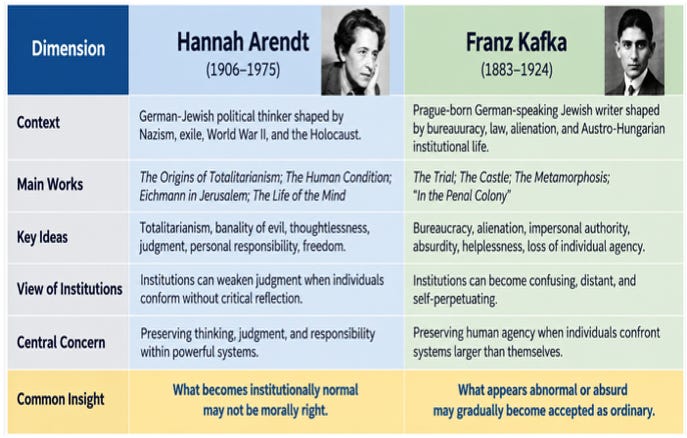
Table 1 presents a concise comparison of Hannah Arendt and Franz Kafka by summarizing their personal and historical contexts, major works, and key ideas. It shows that although Arendt worked primarily in political thought and Kafka in literature, both were deeply concerned with the effects of bureaucracy, authority, alienation, and the weakening of individual judgment within powerful systems. The table also highlights their common insight that what becomes institutionally normal or widely accepted is not necessarily reasonable, just, or morally right.
Table 1. Hannah Arendt and Franz Kafka: Contexts, Main Works, and Key Ideas
Source: Author’s own synthesis
2.3 Commonality of Their Ideas
Arendt and Kafka shared a deep concern with the relationship between individuals and powerful institutional systems. Kafka portrayed this problem imaginatively through characters caught within bureaucracies that appear impersonal, confusing, and self-perpetuating, while Arendt analyzed how political and administrative systems can weaken individual judgment and personal responsibility. Both therefore explored the danger that human beings may become passive participants in systems whose purposes and consequences they no longer critically examine.
Their works also share a concern with alienation, authority, conformity, and the erosion of individual agency. Kafka shows how individuals can become powerless before procedures and institutions, while Arendt emphasizes the importance of thinking, judging, and taking responsibility even within powerful systems. Together, they offer complementary literary and philosophical perspectives on a central modern problem: how individuals can preserve human judgment and responsibility when institutional structures become dominant.
What becomes common is not always what is right; the mean describes an arithmetic average, while Arendt and Kafka challenge us to judge what becomes normalized.
3. Mean, Outliers, and Normalization
Statistical distributions help us understand how observations are organized around what is common and what is unusual. Three basic ideas are especially useful for a general audience: the mean, outliers, and normalization. These concepts provide a simple foundation for later connecting statistical patterns with the broader ideas raised by Arendt and Kafka.
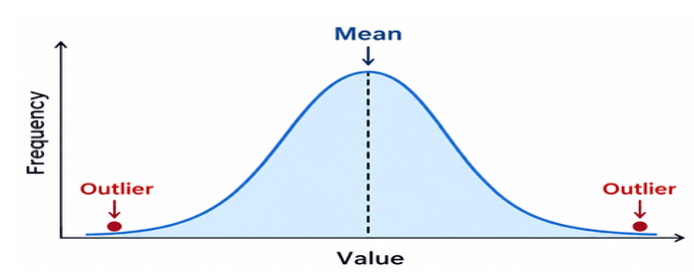
Figure 1. Mean and Outliers in a Distribution
Source: Author’s own synthesis
Figure 1 illustrates an example distribution with the arithmetic mean marked at the center of the displayed curve. It also identifies outliers at the outer edges, emphasizing that some observations lie far from the central pattern. The figure visually distinguishes what is typical from what is unusual within a distribution. Its main purpose is to show that understanding a dataset requires attention not only to the mean but also to the presence and meaning of outliers.
3.1 Mean: Understanding the Center
The mean is one of the most familiar measures of central tendency. It is calculated by adding all observations and dividing the total by the number of observations, and it provides a simple representation of the center of a dataset (Moore et al., 2017). The mean summarizes the arithmetic average of a group, but it need not be the most common or typical value. However, the mean does not describe everything about a distribution. Two datasets may have the same mean but very different levels of variation, concentration, or extreme values. For this reason, the mean should be interpreted together with the broader shape and spread of the distribution (Field, 2017).
3.2 Outliers: Understanding What Is Unusual
An outlier is an observation that lies far away from most other observations in a dataset. Outliers may result from measurement error, unusual circumstances, rare events, or genuinely different behavior. Rather than automatically removing them, statisticians first ask why they exist and whether they provide important information (Iglewicz & Hoaglin, 1993). Outliers are useful because they draw attention to cases that do not follow the dominant pattern. A single unusual observation may have little effect in some datasets but can significantly influence the mean in others. Studying outliers therefore helps readers understand both variation and the limits of relying only on averages.
3.3 Normalization: When Patterns Become Common
Normalization is used here as a conceptual and social process through which something that was once unusual becomes increasingly common or accepted within a larger pattern; it is not the technical statistical procedure of rescaling or standardizing data. As an analogy using statistical distributions, this process may be illustrated by repeated observations accumulating in an area that was previously part of the tail of a distribution. Over time, the center and overall shape of the distribution may shift. This idea is especially important because statistical normality is not necessarily permanent. What is unusual in one period may become common in another when underlying conditions change. Thus, distributions should be viewed not only as static pictures of data, but also as patterns that can evolve over time. Repeated exposure may also increase familiarity and cognitive ease, making patterns feel less unusual even when their underlying character has not changed (Kahneman, 2011).
4. From Unusual to Normal: Arendt, Kafka, and Changing Patterns
The ideas of mean, outliers, and normalization provide a useful way to interpret the worlds described by Hannah Arendt and Franz Kafka. Their works show how behavior that initially appears unusual, troubling, or irrational can gradually become accepted when it is repeatedly reinforced by institutions and social systems. This section connects their ideas with a simple statistical way of thinking about changing patterns.
4.1 Kafka: When the Unusual Becomes Routine
Kafka’s fiction often begins with circumstances that appear strange or unreasonable. In The Trial, Josef K. is arrested without a clear explanation, yet the surrounding officials and institutions behave as though the process is entirely ordinary. The disturbing feature of Kafka’s world is therefore not only the unusual event itself, but the way the system treats the unusual as routine. This can be understood conceptually as movement from the margin toward the center. What initially appears exceptional becomes repeated, institutionalized, and increasingly familiar. Kafka therefore helps us see how a system can create its own sense of normality even when its procedures remain confusing, unfair, or irrational.
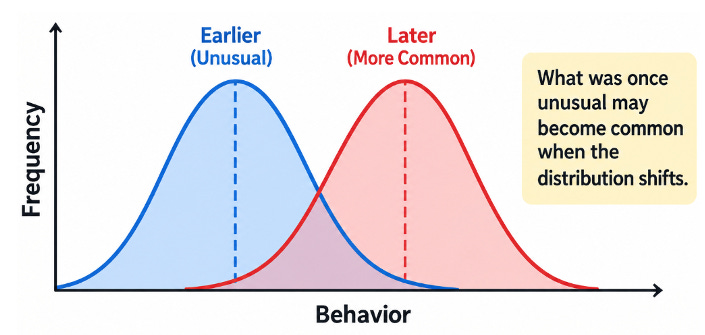
Figure 2 illustrates how a behavioral distribution can shift over time as an initially unusual practice becomes more common. The earlier distribution places the behavior farther from the prevailing center, while the later distribution shows the pattern moving toward greater frequency and acceptance. This movement provides a statistical analogy for normalization, in which repeated exposure and reinforcement can relocate what once appeared exceptional toward the center of practice. The figure therefore emphasizes that normality is dynamic and can change as the underlying distribution shifts.
Figure 2. From Unusual to Normal
A distribution can shift when a behavior becomes more common
Source: Author’s own synthesis
4.2 Arendt: When Harmful Behavior Becomes Ordinary
Arendt’s concept of the banality of evil raises a related but more serious question about human behavior within powerful systems. Her analysis suggests that destructive actions may become embedded in routines, procedures, and organizational responsibilities, allowing individuals to participate without fully reflecting on the consequences. The danger lies partly in the transformation of extraordinary wrongdoing into ordinary administrative activity.
From this perspective, behavior that might once have appeared extreme can move closer to the accepted center of institutional life. As more people comply with the same expectations and practices, the behavior may appear increasingly normal simply because it has become common. Arendt therefore reminds us that frequency and acceptance do not necessarily establish moral legitimacy.
4.3 From Outlier to Normalized Pattern
Taken together, Kafka and Arendt illustrate a broader process of normalization. An unusual practice may first appear as an outlier, but repeated exposure, institutional reinforcement, and widespread participation can make it increasingly common. Eventually, the overall pattern may shift so that behavior once regarded as exceptional becomes part of the new norm.
This offers readers an intuitive way to think about changing distributions. The important issue is not only whether an observation is unusual at one point in time, but whether the entire pattern is gradually moving. The central lesson is simple: when the distribution shifts, yesterday’s unusual pattern may move closer to tomorrow’s center.
5. From a General Model to Contextual Specification
The movement from a general normalization model to contextual specification means going beyond the question of how often a behavior occurs to examine what the behavior means within a particular social setting. Frequency helps identify whether a behavior is unusual, emerging, or widely established, but frequency alone cannot show whether normalization produces constructive or harmful consequences. Contextual specification therefore adds Association Orientation, an author-developed heuristic dimension that considers whether behavior is primarily self-directed and relationship-weakening or cooperative and relationship-strengthening. Together, these two dimensions distinguish whether repeated behaviors develop into antisocial, relational, competitive, or transformational patterns.
The resulting 2×2 framework serves as a contextual diagnostic tool rather than a rigid classification scheme. By combining Frequency with Association Orientation, it shows how behaviors can move from isolated practices toward established norms through repetition, imitation, reinforcement, and institutional acceptance. Frequency indicates how established a behavior has become, while Association Orientation identifies the relational direction and social consequences of that behavior. In this sense, the framework explains not only how strongly a behavior becomes normalized, but also what kind of social system that normalization is helping to create.
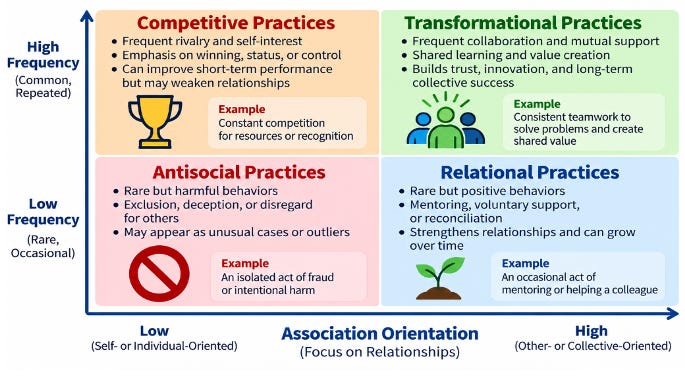
Figure 3 presents four behavioral patterns based on two dimensions: frequency of behavior and association orientation toward self or others. Low-frequency behaviors appear as either antisocial practices, such as exclusion or deception, or relational practices, such as mentoring and voluntary support. High-frequency behaviors develop into competitive practices when self-interest and rivalry dominate, or transformational practices when collaboration, shared learning, and mutual support become common. The framework shows that repeated behavior can become normalized in very different ways depending on whether it weakens relationships or strengthens collective value.
Figure 3. Four Behavioral Patterns: Association and Frequency
Source: Author’s own synthesis
5.1 Four Behavioral Patterns: From Outliers to Established Practices
The 2×2 framework distinguishes four behavioral patterns by combining frequency with association orientation. Antisocial practices combine low frequency with low association orientation and may appear as isolated acts of exclusion, deception, hostility, or disregard for others. Relational practices combine low frequency with high association orientation and may include occasional mentoring, cooperation, reconciliation, listening, or voluntary support. Because both occur infrequently, they may initially appear as behavioral outliers rather than established characteristics of the larger group or organization.
As frequency increases, these initially unusual behaviors may develop into more established patterns. Competitive practices combine high frequency with low association orientation when repeated behavior emphasizes individual advantage, rivalry, status, or winning at the expense of constructive relationships. Transformational practices combine high frequency with high association orientation through repeated collaboration, mutual learning, responsible leadership, knowledge sharing, and shared value creation. The framework therefore shows that increasing frequency can normalize very different kinds of behavior depending on the relationships and values being reinforced.
5.2 From Small Choices to Normalized Patterns
Normalization develops through a gradual progression that can be summarized as Small Choice → Repetition → Pattern → Normalization. A single action may initially appear unusual relative to an established behavioral pattern, but repetition gradually increases its frequency and visibility. Reinforcement, imitation, organizational routines, and institutional acceptance can further move the behavior from the margins toward the center of practice. What begins as an isolated outlier can therefore become an accepted expectation or dominant norm over time.
This process can be observed in simple everyday behaviors as well as in organizational and societal settings. Making the bed regularly, choosing the stairs instead of the elevator, experimenting with small improvements, or listening attentively rather than remaining preoccupied may begin as occasional choices but become habits through repetition. These examples are not morally equivalent to the historical and institutional problems examined by Arendt and Kafka, but they make the mechanism of normalization easier to recognize. They illustrate how repeated choices can gradually reshape both individual routines and collective behavioral patterns.
5.3 Interpreting What Becomes Normal
The comparison of Hannah Arendt, Franz Kafka, and statistical distributions highlights an important distinction between what becomes common and what should be considered desirable. Kafka illustrates how strange, impersonal, or bureaucratic practices can become routine, while Arendt shows how ordinary people may participate in troubling systems through conformity and failures of judgment. Statistical ideas such as the mean, outliers, and shifting distributions provide a useful language for describing how exceptional behavior can move toward the center of a population. Yet statistical descriptions of frequency and distribution do not establish moral, relational, or social value. Because intuitive judgments are shaped by familiarity, salience, and cognitive shortcuts, what feels normal or plausible should not automatically be treated as objectively desirable or correct (Kahneman, 2011).
The 2×2 framework adds this missing contextual dimension by asking not only how often behavior occurs but also what kind of relationships and outcomes it creates. Frequency indicates how strongly a practice has become established, while association orientation indicates whether repeated behavior tends to weaken constructive relationships or strengthen cooperation, mutual benefit, and shared value. Human judgment therefore remains essential because behavioral patterns may begin as antisocial or relational practices and, through repetition, develop toward more established competitive or transformational patterns. The central lesson is that outliers can become norms through repetition, but what ultimately matters is not only how often behavior occurs, but what kind of pattern and social system it creates.
Outliers can become norms through repetition—what matters is not only how often behavior occurs, but what kind of pattern it creates.
6. Conclusion
Hannah Arendt and Franz Kafka show how unusual, irrational, or troubling practices can gradually become accepted when systems repeatedly reinforce them, while statistical concepts such as the mean, outliers, and changing distributions provide a simple way to visualize this process. The 2×2 framework of frequency and association orientation further demonstrates that repeated behavior can develop in different directions, from antisocial and competitive practices to relational and transformational practices. Everyday choices remind us that normalization often begins with small acts that, through repetition, develop into habits and eventually more established patterns. The enduring lesson is that what becomes common is not necessarily what is right, and understanding a pattern requires both statistical observation and thoughtful human judgment.
References
Arendt, H. (1951). The origins of totalitarianism. Harcourt, Brace and Company.
Arendt, H. (1958). The human condition. University of Chicago Press.
Arendt, H. (1963). Eichmann in Jerusalem: A report on the banality of evil. Viking Press.
Arendt, H. (1978). The life of the mind. Harcourt Brace Jovanovich.
Canovan, M. (1992). Hannah Arendt: A reinterpretation of her political thought. Cambridge University Press.
Field, A. (2017). Discovering statistics using IBM SPSS statistics (5th ed.). SAGE Publications.
Iglewicz, B., & Hoaglin, D. C. (1993). How to detect and handle outliers. ASQC Quality Press.
Kafka, F. (1972). The metamorphosis (S. Corngold, Trans.). Bantam Books.
Kafka, F. (1998). The trial (B. Mitchell, Trans.). Schocken Books.
Kahneman, D. (2011). Thinking, fast and slow. Farrar, Straus and Giroux.
Moore, D. S., McCabe, G. P., & Craig, B. A. (2017). Introduction to the practice of statistics (9th ed.). W. H. Freeman.
Robertson, R. (2004). Kafka: A very short introduction. Oxford University Press.
ABOUT THE AUTHOR

Paul C. Hong — Distinguished University Professor, University of Toledo, USA
Paul C. Hong is a Distinguished University Professor of Information Systems and Supply Chain Management and an affiliated faculty of Asian Studies Program at the University of Toledo. His work focuses on leadership, governance, and decision-making in the AI era, integrating strategy, technology, and institutional trust. He has published extensively in leading academic journals and writes on how individuals and organizations navigate complexity, disruption, and global transformation.
© K-Global Scholars and Professionals Forum. September 2026. All rights reserved. Content published in the K-GSP Forum may not be reproduced, distributed, or transmitted in any form without prior written permission from the K-GSP Forum, except for brief quotations with full attribution.
Original Article:

Suggested Citation
Hong, P. C. (2026, September 15). When the unusual becomes normal: Arendt, Kafka, and statistical distributions. K-GSP Forum, pp. 1–12.
한글요약
비정상이 정상으로 변할 때: 한나 아렌트, 프란츠 카프카, 그리고 평균·이상치·정상화의 역학
한나 아렌트(Hannah Arendt)와 프란츠 카프카 (Franz Kafka)는 서로 다른 방식으로 거대한 제도와 조직 속에서 살아가는 인간의 모습을 탐구하였다. 카프카는 『소송』과 『성』 등을 통해 개인이 이해하기 어려운 관료적 체계에 갇히는 모습을 문학적으로 그렸으며, 아렌트는 전체주의, 무사유(thoughtlessness), 개인적 책임, 그리고 “악의 평범성”을 분석하였다. 두 사람의 공통된 문제의식은 비합리적이거나 해로운 제도적 관행도 반복되고 수용되면 일상적인 것으로 받아들여질 수 있다는 점에 있다.
이러한 현상은 **평균(mean), 이상치(outlier), 정상화(normalization)**라는 통계적 개념을 통해 쉽게 설명할 수 있다. 여기서 정상화는 데이터의 재척도화나 표준화를 뜻하는 기술적 통계 절차가 아니라, 반복을 통해 행동이나 관행이 점차 익숙하고 수용되는 개념적·사회적 과정을 의미한다. 평균은 관측값들의 산술적 중심 또는 평균값을 나타내며, 이상치는 지배적인 패턴에서 상당히 벗어난 관측치를 의미한다. 처음에는 예외적으로 보이던 행동도 반복되고 제도적으로 강화되면 점차 일반적인 패턴으로 이동하여 새로운 정상으로 자리 잡을 수 있다.
아렌트와 카프카의 통찰은 어떤 현상이 평균이나 중심으로 이동한다고 해서 반드시 바람직해지는 것은 아니라는 점을 강조한다. 카프카는 비정상적인 제도와 절차가 어떻게 일상적인 현실처럼 받아들여지는지를 보여주며, 아렌트는 다수의 사람들이 따르는 행동이라 하더라도 개인의 사고와 판단, 책임이 사라지는 것은 아니라고 강조한다. 따라서 통계적으로 흔한 것, 사회적으로 수용된 것, 그리고 도덕적으로 옳은 것은 서로 동일하지 않다.
이 글은 또한 **빈도(Frequency) × 관계지향성(Association Orientation)**의 2×2 틀을 통해 반사회적, 관계적, 경쟁적, 변혁적 관행이라는 네 가지 패턴을 제시한다. 낮은 빈도의 반사회적 또는 관계적 행동은 처음에는 이상치처럼 나타날 수 있지만, 반복되면서 각각 경쟁적 또는 변혁적 패턴으로 발전할 수 있다. 결국 빈도는 무엇이 정상화되는가를 설명하고, 관계지향성은 그 정상화가 어떠한 방향과 결과로 발전하는가를 설명한다.
Paul C. Hong은 미국 톨레도대학교의 Distinguished University Professor of Global Supply Chain Management이다. 그는 글로벌 공급망, 조직, 리더십, 기술 변화, 사회 현상을 동태적 네트워크 인프라(dynamic network infrastructure) 관점에서 연구하며, 관계, 제도, 역량, 환경 변화가 시간의 흐름 속에서 어떻게 상호작용하는지를 분석해 왔다. 최근에는 공급망 연구를 AI, 리더십, 역사, 문학, 철학, 사회 변화와 연결하는 학제적 연구를 확대하고 있다. 특히 통계적 분포, 제도적 행동, 인간의 판단과 책임을 함께 살펴봄으로써 조직과 사회에서 무엇이 중심적 패턴이 되고 무엇이 이상치로 남는지를 탐구한다. 이러한 접근은 한나 아렌트와 프란츠 카프카의 사상을 현대 조직과 사회 시스템의 변화 과정과 연결하여 해석하는 데에도 활용되고 있다.