

Artificial Intelligence (AI) is transforming the world. From AI assistants on our smartphones to self-driving cars, medical diagnostic systems, and generative AI, we have entered an age where it is difficult to imagine daily life without intelligent technologies. Many people assume that the leaders of the future will simply be technology experts. But is that really true?
Interestingly, to discover what kind of leadership the future demands, we may need to look back more than a century to five Korean leaders who worked tirelessly in the United States during one of the darkest periods of Korean history. These figures—Ahn Chang-ho, Syngman Rhee, Philip Jaisohn (Seo Jae-pil), Kim Kyu-sik, and Park Yong-man—devoted their lives to Korea’s independence and the advancement of overseas Korean communities. Yet their stories reveal something even more profound: they embodied many of the qualities that the AI era urgently needs today.
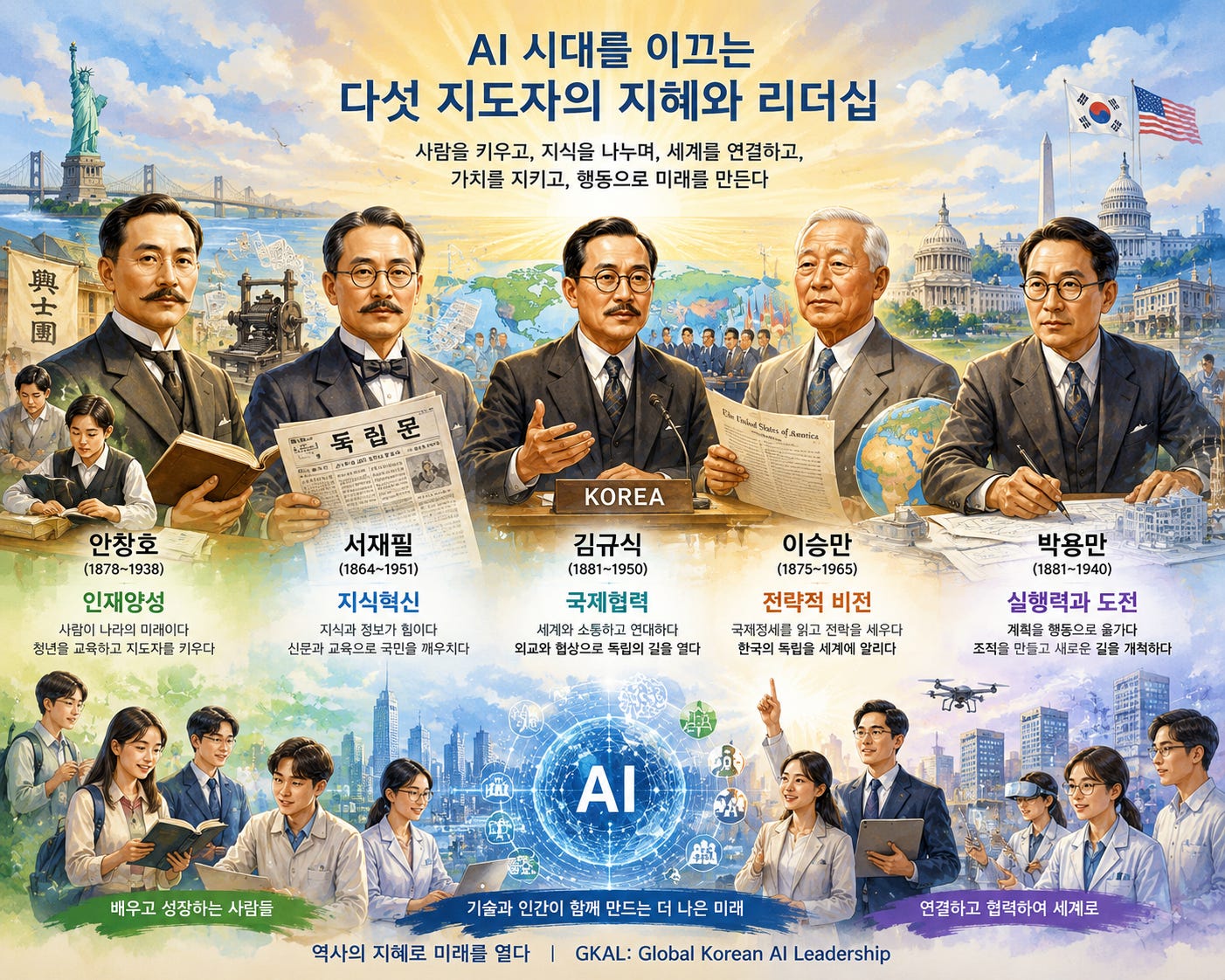
Let us begin with Ahn Chang-ho. He believed that people were more important than weapons. While many independence activists focused on immediate political goals, Ahn emphasized education and character development. He organized the Heungsadan (Young Korean Academy) and invested his energy in cultivating future leaders. Modern experts often remind us that the greatest asset in the AI era is not technology itself but human talent. AI systems may become increasingly sophisticated, but it is people who create, guide, and apply them. In this sense, Ahn’s philosophy of human development is more relevant today than ever before.
Kim Kyu-sik represented a different kind of leadership. Fluent in multiple languages and highly respected in international circles, he worked tirelessly to bring Korea’s cause to the world stage. He participated in the Paris Peace Conference and engaged diplomats from many nations. In today’s AI-driven world, international cooperation is essential. Issues such as AI ethics, data governance, cybersecurity, and global regulations cannot be solved by any single country. Kim’s gift for diplomacy and cross-cultural communication provides an excellent model for future global leaders.
Philip Jaisohn believed in the transformative power of knowledge. Through the publication of The Independent, Korea’s first modern newspaper, he sought to educate citizens and encourage civic participation. In many ways, he was an early architect of a knowledge platform. The tools have changed—from newspapers to digital platforms—but the principle remains the same. In an age overwhelmed by information, misinformation, and rapidly changing technologies, Jaisohn’s commitment to public education and informed citizenship is more valuable than ever.
Syngman Rhee was a master strategist. He understood the importance of international politics and sought to leverage global power structures to advance Korea’s independence. While his legacy remains complex and sometimes controversial, his ability to think strategically on a global scale was undeniable. Today, as nations compete for leadership in AI, semiconductors, and advanced technologies, strategic vision and geopolitical awareness remain critical leadership qualities. Future leaders must understand not only technology but also the global environment in which technology operates.
Park Yong-man was, above all, a man of action. He believed that ideas alone were insufficient unless they were translated into concrete results. He built organizations, embraced challenges, and was willing to experiment with new approaches. His entrepreneurial spirit resembles that of today’s startup founders and innovators. In a rapidly changing AI landscape, execution is often the difference between success and failure. Park’s determination to act decisively remains a timeless lesson.
When we compare these five leaders, an important realization emerges: none of them was perfect. Ahn Chang-ho excelled in developing people but was less focused on international political maneuvering. Syngman Rhee possessed extraordinary strategic skills but faced criticism regarding social unity and consensus-building. Park Yong-man demonstrated remarkable execution but was less successful in establishing long-term institutional structures.
The lesson is clear. The ideal leader of the future should not attempt to imitate only one of these figures. Instead, he or she should combine the strengths of all five: Ahn’s commitment to human development, Kim’s diplomatic skill, Jaisohn’s passion for knowledge and education, Rhee’s strategic vision, and Park’s execution-oriented mindset.
This integrated approach forms the basis of what may be called the GKAL (Global Korean AI Leadership) Model. The model consists of four interconnected pillars:
Vision – the ability to anticipate the future and think strategically.
Capability – understanding AI, digital technologies, and innovation.
Network – building global relationships and collaborative partnerships.
Value – maintaining ethics, trust, and cultural identity.
Among these four pillars, the last may be the most important. AI possesses immense capabilities, but it cannot determine what is morally right or wrong. Human values, judgment, and responsibility ultimately shape the direction of technology. The more advanced technology becomes, the more essential human character becomes.
The leaders of the future will not succeed through charisma alone. They must educate and empower others, connect cultures and communities, embrace technological innovation, and lead with integrity. Above all, they must recognize that leadership is ultimately about serving people and strengthening communities.
Perhaps the five Korean leaders who worked for independence on American soil more than a century ago still have a message for us today:
“Technology may shape the future, but people create it. And the greatest leadership of all is the ability to help people grow.”
No matter how rapidly AI transforms our world, that truth is unlikely to change. +++
{Solti}
June 17, 2026
AI 시대가 찾는 지도자는 누구인가?
다섯 독립운동가가 오늘 우리에게 들려주는 이야기
인공지능(AI)이 세상을 바꾸고 있다. 스마트폰 속 인공지능 비서부터 자율주행 자동차, 의료 진단 시스템, 생성형 AI까지 우리는 하루도 AI 없이 살아가기 어려운 시대에 들어섰다. 많은 사람들은 미래 사회를 이끌 지도자가 뛰어난 기술 전문가일 것이라고 생각한다. 그러나 정말 그럴까?
흥미롭게도 미래 지도자의 모습을 찾기 위해 우리는 오히려 100여 년 전 미국 땅에서 활동했던 다섯 명의 독립운동가를 돌아볼 필요가 있다. 안창호, 이승만, 서재필, 김규식, 박용만. 이들은 나라를 잃은 암울한 시대에 조국의 독립을 위해 헌신했던 인물들이다. 그런데 그들의 삶을 자세히 들여다보면 오늘날 AI 시대가 요구하는 지도자의 모습이 놀랍도록 선명하게 드러난다.
먼저 안창호 선생을 생각해 보자. 그는 총이나 칼보다 사람을 더 중요하게 여겼다. 많은 독립운동가들이 당장의 독립을 위해 분투할 때 그는 “사람을 키우는 것이 나라를 살리는 길”이라고 믿었다. 흥사단을 조직하고 청년들을 교육하며 미래를 준비했다. 오늘날 AI 전문가들은 기술보다 인재가 더 중요하다고 말한다. 아무리 뛰어난 AI가 등장해도 결국 그것을 만들고 활용하는 것은 사람이다. 그런 점에서 안창호의 철학은 오히려 21세기에 더욱 빛을 발한다.
김규식은 또 다른 유형의 지도자였다. 그는 여러 언어를 구사하며 국제무대에서 한국의 독립을 호소했다. 파리강화회의에 참석하여 세계 각국 대표들과 대화하고 협상했다. 오늘날 AI 시대는 국가 간 협력이 필수적이다. AI 윤리, 데이터 보호, 사이버 보안과 같은 문제는 어느 한 나라만의 힘으로 해결할 수 없다. 김규식이 보여준 국제적 소통 능력과 협상력은 글로벌 시대 지도자의 중요한 덕목으로 남아 있다.
서재필은 지식의 힘을 믿었다. 그는 독립신문을 창간하여 국민들에게 새로운 정보를 제공하고 시민의식을 일깨웠다. 지금으로 말하면 미디어 혁신가이자 지식 플랫폼 구축자였다. AI 시대에도 정보와 지식은 여전히 핵심 자산이다. 차이가 있다면 종이신문이 디지털 플랫폼으로 바뀌었을 뿐이다. 사람들에게 올바른 정보를 제공하고 비판적 사고를 길러주는 서재필의 정신은 가짜 뉴스와 정보 과잉 시대에 더욱 절실하다.
이승만은 국제정치를 활용하는 데 뛰어났다. 그는 미국과 국제사회의 힘을 이용하여 한국 문제를 세계적 의제로 만들고자 했다. 그의 방식은 때때로 논란이 되기도 했지만, 국제 정세를 읽고 전략적으로 움직이는 능력만큼은 탁월했다. AI 기술 패권 경쟁이 치열해지는 오늘날에도 국제정치와 전략적 사고는 여전히 중요하다. 미래의 지도자는 기술뿐 아니라 세계 질서의 흐름도 읽을 줄 알아야 한다.
박용만은 행동하는 지도자였다. 그는 계획만 세우지 않았다. 직접 조직을 만들고 실행에 옮겼다. 실패를 두려워하지 않고 새로운 길을 개척했다. 오늘날 스타트업 창업가들이 보여주는 도전정신과도 닮아 있다. AI 시대는 변화 속도가 매우 빠르다. 아무리 좋은 아이디어가 있어도 실행하지 못하면 의미가 없다. 박용만의 실행력은 여전히 강력한 경쟁력이다.
이 다섯 사람을 비교해 보면 한 가지 흥미로운 사실을 발견하게 된다. 누구도 완벽하지 않았다는 점이다. 안창호는 사람을 키우는 데 탁월했지만 국제정치에서는 상대적으로 약했다. 이승만은 전략에 강했지만 공동체 통합에서는 논란이 있었다. 박용만은 실행력이 뛰어났지만 장기적인 제도 구축에는 한계가 있었다.
그래서 미래 지도자는 한 사람을 그대로 따라 하기보다 다섯 사람의 장점을 함께 배워야 한다. 안창호의 인재육성 능력, 김규식의 국제협력 정신, 서재필의 지식혁신 역량, 이승만의 전략적 사고, 박용만의 실행력을 균형 있게 갖추는 것이 중요하다.
필자는 이를 “GKAL(Global Korean AI Leadership)” 모델이라고 부른다. 이 모델은 네 가지 축으로 구성된다. 첫째는 미래를 내다보는 비전(Vision), 둘째는 AI와 디지털 기술을 이해하는 역량(Capability), 셋째는 세계를 연결하는 네트워크(Network), 넷째는 윤리와 신뢰를 지키는 가치(Value)이다.
특히 마지막 요소인 가치가 중요하다. AI는 놀라운 능력을 가지고 있지만 스스로 선과 악을 판단하지 못한다. 결국 인간의 윤리와 책임감이 AI의 방향을 결정한다. 기술이 발전할수록 인간다움의 가치가 더욱 중요해지는 이유가 여기에 있다.
미래의 지도자는 더 이상 카리스마만으로 사람들을 이끌 수 없다. 지식을 나누고, 사람을 키우고, 다양한 문화를 연결하며, 기술을 올바르게 활용할 수 있어야 한다. 그리고 무엇보다 공동체를 위한 책임감을 가져야 한다.
100년 전 미국 땅에서 독립운동을 펼쳤던 다섯 지도자는 어쩌면 오늘날 우리에게 이렇게 말하고 있는지도 모른다.
“미래를 만드는 것은 기술이 아니라 사람이다. 그리고 사람을 성장시키는 것이야말로 가장 위대한 지도력이다.”
AI 시대가 아무리 빠르게 변화하더라도 이 진리는 변하지 않을 것이다. +++
{솔티}
2026년 6월 17일
Prof. Dr. Young Choi (Editor in Chief) — Regent University
Young B. Choi is a Professor in the Department of Engineering & Computer Science at Regent University. He published 38 books with ‘Selected Readings in Cybersecurity’ (2018) (over 800 copies archived globally at university/college libraries around the world) and ‘Cybersecurity Applications and Artificial Intelligence’ (2023) available in seven major world languages. He proposed the world’s first global and universal telecommunications “Service Order Handling (SOH)” Model (1995) with Dr. Adrian Tang. With this innovative research work, he received the IEEE NOMS ’96 Best Paper Award and became the first recipient of the Outstanding Contribution Award of the TeleManagement Forum in 1998. His research areas include Natural Language Processing-focused AI, AI-applied cybersecurity, network and telecom service management, and Korean studies on Gani Choi Rip’s Jeonggwan (靜觀: Quiet Contemplation) philosophy and Shilhak ( 實學: Practical Learning).
Thank you for this thoughtful article.
I find myself often reflecting on what leadership means in the age of AI. In the past, leaders were naturally seen as those who had more knowledge and experience. However, as AI now provides vast amounts of information instantly, I agree that this standard is changing significantly.
I was especially struck by the idea that, in this new era, it is more important to be someone who asks the right questions rather than someone who simply has the answers. In my own experience, I also feel that the questions people ask often have a deeper impact than the information itself, because good questions shape direction and thinking.
I also deeply resonate with the point that, as technology advances, human qualities such as empathy, responsibility, and understanding become even more essential in leadership. No matter how advanced AI becomes, guiding people, building trust, and giving meaning to a community ultimately remain human responsibilities.
In the end, I believe the leader of the AI era is not the one who knows everything, but the one who thinks together with others, provides direction, and helps people move forward with trust and purpose.