

Foreign observers often ask why Koreans lose their minds over the World Cup. It is, after all, just a game. But the fury has never really been about football.
When young office workers watch an underqualified national-team manager fumble on the pitch, they are not watching a coach. They are watching their boss. The one hired not for talent but through backroom loyalty and school ties. The one whose incompetence gets exposed in public, yet who is handed another chance anyway. The pitch becomes a mirror, and what it reflects is the reality millions face on their morning commute.
The root cause can be named with precision using the language of organizational justice, one of the most robust frameworks in human resource scholarship (Colquitt, 2001). Employees do not simply want to win. They want fairness. And Korean work life, for all its strengths, is straining against three kinds of injustice at once.
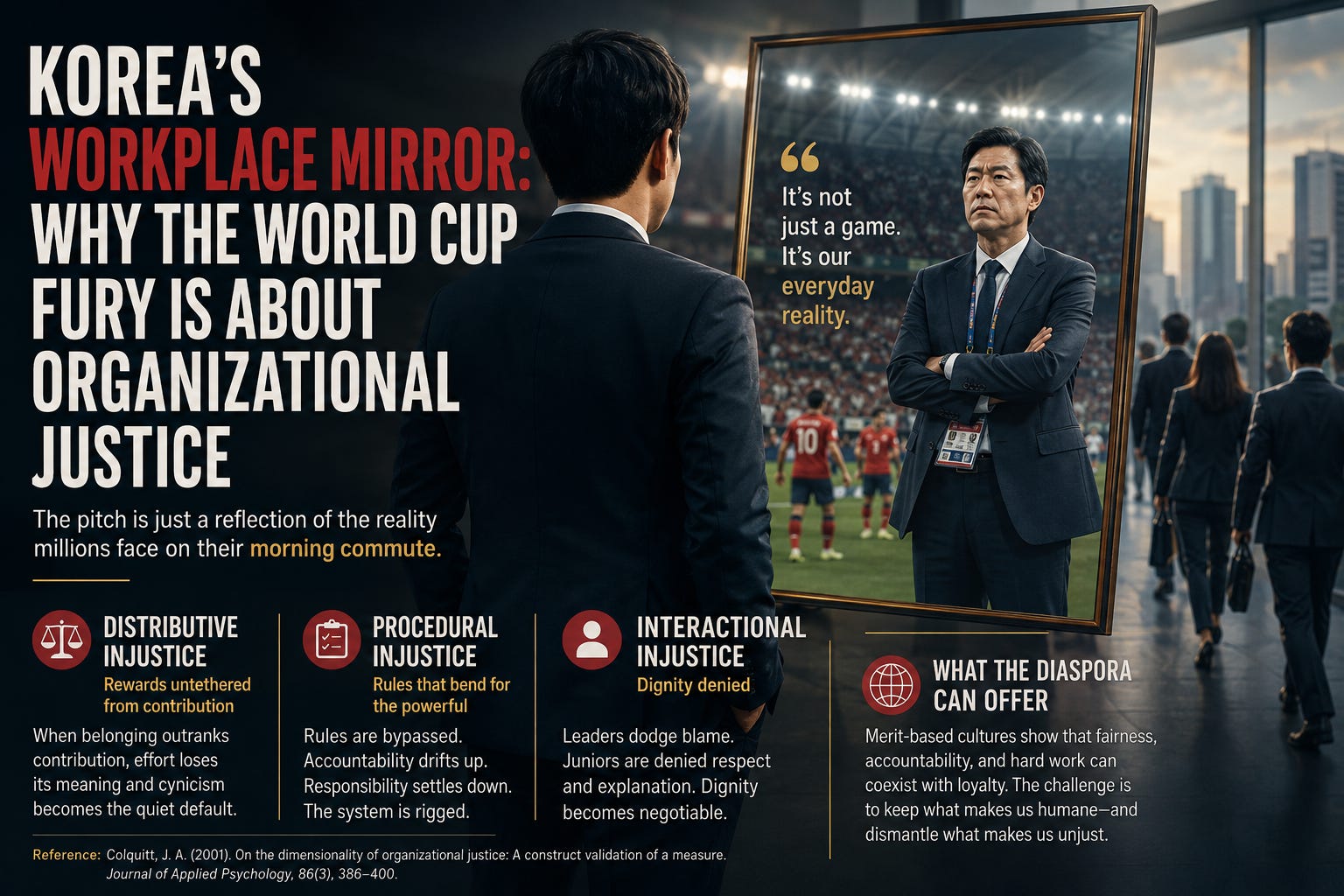
Distributive injustice: rewards untethered from contribution
Distributive justice asks a simple question: do outcomes match inputs? When a governing body skips its own rules to install a favored local candidate over world-class ones, the answer is no. This is the everyday grievance of the Korean office, where promotions flow through region, cohort, and alumni networks rather than results. Postwar Korea was built on such bonds, and in an era of catch-up growth they mobilized people at astonishing speed. But the same networks have hardened into cartels that protect their own. When belonging outranks contribution, effort loses its meaning, and cynicism becomes the quiet default.
Procedural injustice: rules that bend for the powerful
Procedural justice concerns the fairness of the process itself, whether decisions are consistent, transparent, and correctable. Here the failure is structural. Selection rules exist but are quietly bypassed. Accountability drifts upward and vanishes, while responsibility settles on those least able to refuse it. The incompetent manager cannot be removed; the junior who names the problem cannot be protected. When leaders cannot fail and juniors cannot rise, the process is not neutral. It is rigged, and everyone knows it.
Interactional injustice: dignity denied
Interactional justice is about how people are treated, with respect and honest explanation, or with silence and evasion. This is the deepest wound. Leaders dodge blame, offer no account, and expect deference regardless. The message is that some people owe explanations and others are owed obedience. That asymmetry does not merely frustrate employees. It quietly tells them their dignity is negotiable.
What the diaspora can offer
Many Korean scholars and professionals now work inside merit-based institutions abroad, and the contrast is instructive. There, the higher one climbs, the more one is held accountable, and often the harder one works. That difference is disorienting at first, then clarifying. It demonstrates that the dysfunction at home was never inevitable. It was a design choice, and design choices can be remade.
Therein lies the diaspora’s particular contribution, not criticism from a distance but testimony from experience. Those who have lived inside both systems understand the warmth of Korean solidarity and the freedom of institutions that judge people by what they build. Holding both makes possible the harder question: how can organizations keep the loyalty that makes them humane while dismantling the protectionism that makes them unjust?
The World Cup was over. But the boss on Monday still be there. Jstice at work is not a foreign luxury. It is a system that can be chosen, and one worth building wherever Korean professionals happen to stand.
Reference: Colquitt, J. A. (2001). On the dimensionality of organizational justice: A construct validation of a measure. Journal of Applied Psychology, 86(3), 386–400.
Full Transcrip:
“Why are Koreans losing their minds over the World Cup? It’s just a game, right?”
Some foreign friends asked me this recently.
I told them, “Look, it’s not actually about football. It’s because when young office workers look at that manager, they see the exact same unfair, toxic boss they have to deal with every single morning.”
He had world-class global candidates ready, but the Football Association skipped all the rules and hired a local guy in a shady backdoor deal. And as expected, his incompetence was fully exposed on the pitch.
It instantly reminded me of that boss at my old Korean company—the one who gets promoted not by talent, but by playing politics and relying on school ties. That incompetent manager who is literally impossible to fire due to strict labor laws.
These guys build their own little cartel, stick to outdated ways, and ruin projects. But instead of taking the blame, they get handed another chance anyway.
It wasn’t until I started working at a merit-based global company that I realized how insane this is. Over there, the higher up you go, the more you’re held accountable and, honestly, the harder you actually work. Everything is transparent.
So yeah, people aren’t just mad about losing a match. We’re completely fed up with a broken system and useless leaders dodging responsibility.
What we all saw on that football pitch is just a bitter reflection of the exact same reality we face every single day on our morning commute.

Prof. Dr. Jeonghwan (Jerry) Choi (Managing Editor), University of Maine at Presque Isle
Jeonghwan (Jerry) Choi, PhD is an Associate Professor of Business at the University of Maine at Presque Isle and Editor-in-Coordination of K-GSP Forum (contact: jeonghwan.choi at gmail.com). With over 25 years of industry and consulting experience, he specializes in leadership development, human resource management, organizational behavior, and social entrepreneurship. His research focuses on workforce resilience, organizational health, and self-directed leadership — bridging rigorous scholarship with practical insight to cultivate leaders who create meaningful, sustainable, and humane organizations.
© K-Global Schoalrs and Professionals Forum. All rights reserved. Content published in the K-GSP Forum may not be reproduced, distributed, or transmitted in any form without prior written permission from the K-GSP Forum, except for brief quotations with full attribution.