

EXECUTIVE SUMMARY
Why Are Koreans So Responsive? explores the cultural, historical, and spiritual foundations that have shaped Korea’s distinctive capacity for empathy, courtesy, and collective action. Drawing upon Confucian traditions of Ye (courtesy and respect) and In (benevolence and humaneness), reinforced by family-centered communities, national experiences of shared hardship, and the compassionate influence of Christianity, the study explains why responsiveness remains a defining characteristic of Korean society. As Korea enters the AI era, the article argues that preserving this culture of human connection and care may prove to be one of the nation’s most valuable contributions to an increasingly fragmented and technologically driven world.
Key Words: Korean Responsiveness; Empathy; Courtesy (Ye); Human Connection; Compassionate Leadership
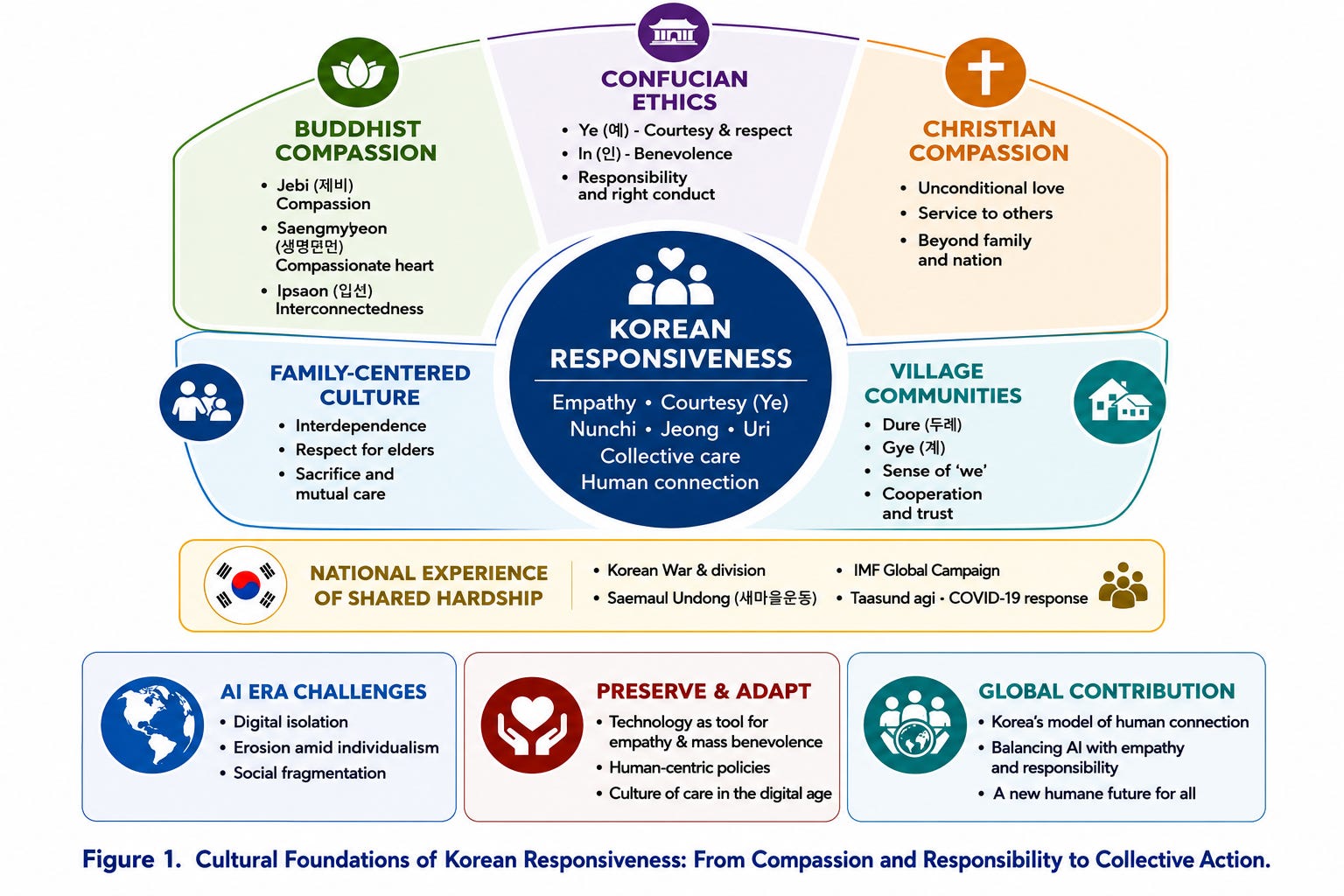
Figure 1. Cultural roots and contemporary relevance of Korean responsiveness: from spiritual-ethical foundations through social transmission to human flourishing in the AI era.
Introduction
A foreign visitor once shared a simple but revealing experience while traveling in Korea. During a social experiment, he intentionally dropped his wallet in a public place. A young Korean woman quickly picked it up, ran after him, and returned it. Curious, he asked why she had gone to such trouble. Her answer surprised him: “Because if you lost your wallet, you would be sad.” The visitor was not astonished that she returned the wallet; he was struck by the fact that she cared about how he might feel. This small incident captures a larger question that many foreigners ask after spending time in Korea: Why are Koreans so responsive to the needs, concerns, and emotions of others?
Scholars often describe Korean interpersonal sensitivity through concepts such as Jeong (deep relational affection), Nunchi (social awareness and situational sensitivity), and Uri (a collective sense of “we”). Together these cultural orientations help explain why Koreans frequently anticipate and respond to the needs of others before those needs are explicitly expressed.
The puzzle of Korean responsiveness extends far beyond isolated acts of kindness (Seth, 2011; Berger & Luckmann, 1966). Visitors frequently observe that people offer directions to strangers, assist the elderly, respond quickly during emergencies, and participate actively in community efforts. During national crises, Koreans have demonstrated remarkable levels of collective action, from the IMF Gold Collection Movement during the Asian Financial Crisis to the volunteer mobilization following the Taean oil spill and various public health initiatives during the COVID-19 pandemic. Such examples suggest that responsiveness in Korea is not merely a personal virtue but a broader social characteristic embedded within cultural norms, institutions, and everyday life.
Why do foreigners notice this responsiveness so readily? Often, it is because many societies have become increasingly individualistic, fragmented, and digitally isolated. Visitors encounter in Korea traces of social habits that have diminished elsewhere: concern for neighbors, attentiveness to others, and a willingness to place communal well-being alongside personal interests. While Korea is by no means free from social challenges, its culture continues to exhibit a distinctive capacity for empathy, courtesy, and collective responsibility. This article explores the cultural roots of that responsiveness, tracing its foundations through Confucian traditions, historical experiences, Christian influences, and contemporary social practices that continue to shape Korean society today.
Spiritual and Ethical Foundations of Korean Responsiveness
The roots of Korean responsiveness emerged through the interaction of Buddhist compassion and Confucian ethics, which together shaped Korean understandings of empathy, human relationships, and social responsibility over many centuries.
2.1. Buddhist Compassion: 측은지심, 자비, and Interconnectedness
Buddhism entered Korea during the Three Kingdoms period and remained the dominant spiritual tradition for nearly a thousand years (Buswell, 1992; Seth, 2011). Central to Buddhist teaching are Jabi (자비, compassion and mercy) and Cheugeunjisim (측은지심, the compassionate heart that feels another’s suffering), which encourage individuals to view suffering not as someone else’s problem but as a shared human reality. Equally important is the concept of Inyeon (인연), which emphasizes the interconnectedness of human relationships and mutual influence. Through temple communities, charitable works, and centuries of spiritual teaching, Buddhism cultivated habits of compassion, humility, and attentiveness that became deeply embedded within Korean culture.
The continuing influence of these values can still be observed in many everyday acts of consideration that foreigners notice in Korea. Returning lost property, assisting strangers, helping elderly passengers, and offering practical assistance without expectation of reward often reflect a sensitivity to another person’s circumstances and emotions. The wallet story introduced earlier illustrates this spirit well: the young woman returned the wallet not merely because it was the right thing to do, but because she imagined the sadness its owner might experience if it remained lost. Such actions demonstrate how Buddhist compassion continues to shape Korean responsiveness in everyday life.
2.2. Confucian Ethics: Ye (禮) and In (仁)
While Buddhism cultivated the heart of compassion, Confucianism provided the ethical framework through which compassion could be expressed in everyday relationships and social institutions. During the Joseon Dynasty, the Confucian ideals of Ye (禮, courtesy and respect) and In (仁, benevolence and humaneness) became guiding principles of governance, education, family life, and public conduct (De Bary & Haboush, 1985; Tu, 1985). Ye taught individuals how to demonstrate respect appropriately, while In encouraged genuine concern for the welfare of others. Together, they transformed inner compassion into observable patterns of courtesy, attentiveness, and responsibility.
The enduring influence of these values remains visible in Korean customs, language, hospitality, and social expectations. Respectful speech, consideration for elders, attentiveness to guests, and sensitivity to the needs of others continue to shape interpersonal interactions. Over time, responsiveness became more than a personal virtue; it evolved into a social norm that encouraged individuals to balance personal interests with concern for family, community, and the broader society.
2.3. The Synthesis of Buddhist Compassion and Confucian Responsibility
The distinctive character of Korean responsiveness is best understood not as the product of Buddhism or Confucianism alone, but as the result of their long interaction across centuries of Korean history (Seth, 2011; De Bary & Haboush, 1985). Buddhism cultivated jabi (compassion), cheugeunjisim (the compassionate heart that feels another’s suffering), and inyeon (the interconnectedness of human relationships), encouraging people to recognize and respond to the needs of others. Confucianism complemented these values through the principles of Ye (courtesy and respect) and In (benevolence and humaneness), translating inner compassion into responsible social conduct. One tradition emphasized the heart, while the other emphasized conduct; together they nurtured a culture that values both empathy and responsibility.
This synthesis became particularly visible through the ideals of the Seonbi and Sadaebu during the Joseon Dynasty (Haboush, 2001; Palais, 1996). These scholar-leaders viewed education, leadership, and public service as moral responsibilities rather than merely pathways to personal advancement. Their emphasis on integrity, humility, self-discipline, and service helped institutionalize responsiveness within Korean society (Palais, 1996; Tu, 1985). Although contemporary Korea differs greatly from Joseon Korea, the influence of this civilizational heritage remains evident in expectations regarding social responsibility, community contribution, and concern for others. Later reinforced by Christian ideals of sacrificial love and service, this enduring tradition helps explain why many Koreans continue to view attentiveness to others as an expression of moral character and shared humanity.
Historical Reinforcement
While Confucian values provided the moral foundations of responsiveness, Korean history reinforced these virtues through family life, local communities, and collective experiences of hardship and national recovery.
3.1. Family-Centered Culture
The Korean family has historically served as the primary institution through which values of empathy, responsibility, and mutual care are transmitted across generations. Influenced by Confucian traditions, family members were expected to care for one another through respect, sacrifice, and practical support. Children learned to honor elders, parents invested deeply in their children’s future, and extended family networks often provided assistance during times of hardship. Through these everyday interactions, responsiveness became a lived practice rather than an abstract moral ideal.
Family relationships in Korea have traditionally emphasized interdependence and shared responsibility. Success and failure were often viewed not merely as individual matters but as concerns affecting the entire family, encouraging individuals to remain attentive to the needs of others. Although modernization, urbanization, and demographic changes have transformed family structures, the expectation of caring for aging parents, supporting relatives in times of need, and contributing to collective well-being continues to shape Korean society. These enduring values have helped cultivate a broader culture of attentiveness, reciprocity, and social responsibility that extends beyond the household into the wider community.
3.2. Village Communities
Beyond the family, traditional Korean village communities reinforced responsiveness through close social interaction and collective cooperation. For centuries, agricultural life required neighbors to depend upon one another for farming, irrigation, construction, celebrations, and crisis management. Community members shared labor, exchanged resources, and provided mutual assistance during times of illness, natural disasters, and economic hardship. These practices strengthened trust, social cohesion, and a sense of shared responsibility while encouraging individuals to remain attentive to the needs of others.
Traditional concepts such as Jeong (정), often understood as deep emotional bonds developed through long-term relationships, further reinforced communal responsiveness. People were viewed not as isolated individuals but as members of interconnected social networks whose well-being was closely linked to that of the broader community. Although contemporary Korea has become highly urbanized and technologically advanced, these traditions remain visible through volunteer organizations, church communities, civic groups, alumni networks, and neighborhood associations. Such networks continue to mobilize assistance rapidly during times of need, preserving and adapting longstanding patterns of cooperation and mutual support to modern society.
3.3. National Crises and Collective Action
Perhaps the strongest reinforcement of Korean responsiveness emerged through shared experiences of national crisis. Throughout modern history, Koreans have faced war, poverty, political upheaval, economic hardship, and natural disasters, strengthening collective resilience and fostering a belief that societal problems require communal responses rather than isolated individual efforts. The Korean War (1950-1953) left deep scars on Korean society, separating families, devastating communities, and creating widespread poverty (Seth, 2011). During this period, survival often depended on cooperation, sacrifice, and mutual assistance among family members, neighbors, churches, and local communities. These experiences created a collective memory of suffering that reinforced empathy and a strong sensitivity to the needs of others.
Following the war, Korea faced the challenge of rebuilding both its economy and its communities. One of the most influential initiatives was the Saemaul Undong (New Village Movement) of the 1970s, which promoted the values of diligence (근면), self-help (자조), and cooperation (협동) through collective efforts to improve rural infrastructure and living conditions (Kwon, 2010; Seth, 2011). Another remarkable demonstration of national responsiveness occurred during the 1997 Asian Financial Crisis, when millions of citizens voluntarily donated personal gold possessions to support economic recovery. The Gold Collection Movement transcended social class, age, and political affiliation, reflecting a collective willingness to place national recovery above personal interests and illustrating how empathy often translates into action (Hong & Hyun, 2025).
More recent events demonstrate the continuing relevance of this tradition of collective responsibility. Following the Hebei Spirit oil spill near Taean in 2007, millions of volunteers from across the nation participated in cleanup efforts despite having no direct connection to the affected communities. Similarly, Korea’s response to the COVID-19 pandemic involved extensive cooperation among healthcare professionals, public officials, volunteers, and ordinary citizens in testing, contact tracing, vaccination, and community protection. Although challenges and disagreements existed, these experiences reinforced the conviction that responsiveness is not merely a personal virtue but a shared social responsibility embedded in Korean society.
Christianity and the Expansion of Compassion
While Confucian traditions provided Korea with a strong ethical framework of respect, benevolence, and social responsibility, Christianity broadened and deepened these values by emphasizing universal love, sacrificial service, and compassion that extends beyond family, community, and national boundaries.
4.1. Why Christianity Resonated in Korea
Christianity’s remarkable growth in Korea can be attributed in part to its compatibility with existing Korean cultural values (Kim, 2000). Long before the arrival of Christianity, Confucian and Buddhist traditions had already cultivated respect for moral development, compassion toward others, and a strong sense of social responsibility. As a result, many Koreans found Christian teachings spiritually meaningful and culturally accessible. Christianity’s emphasis on the dignity and value of every individual, along with its message of love, hope, and service, resonated deeply during periods of social change, political uncertainty, and economic hardship.
In addition to its spiritual appeal, Christianity contributed significantly to Korea’s modernization and social development. Churches established schools, hospitals, universities, and charitable organizations that provided education, healthcare, and community support. Christian communities offered not only personal faith but also practical assistance and opportunities for leadership development. Consequently, Christianity became associated with service, social transformation, and global engagement, further strengthening Korea’s tradition of responsiveness and care for others.
4.2. Love, Sacrifice, Service, and Missions
At the heart of Christianity lies the commandment to love one’s neighbor. This teaching expanded the scope of compassion beyond family and community obligations, encouraging believers to serve others regardless of social status, ethnicity, or nationality. Throughout Korea, Christian communities expressed their faith through practical acts of charity, volunteerism, caregiving, education, healthcare, and community development. In this way, compassion became not merely a belief but a way of life demonstrated through service to others.
The Christian ideal of sacrificial service resonated strongly with Korea’s experiences of hardship and recovery. During periods of war, poverty, and national reconstruction, churches often became centers of assistance and mutual support. Over time, Korean Christianity also developed a strong missionary tradition, sending pastors, educators, healthcare workers, and volunteers around the world. This global mission movement reflects a responsiveness that extends beyond national boundaries, demonstrating how faith-inspired compassion can become a powerful force for humanitarian service and international engagement.
4.3. Synergy Between Confucian Ethics and Christian Compassion
Rather than replacing Confucian values, Christianity often complemented and strengthened existing Korean ethical traditions. Confucianism emphasized Ye (courtesy and respect) and In (benevolence and humaneness), while Christianity introduced the ideals of unconditional love, grace, forgiveness, and service to all people. Together, these traditions created a distinctive cultural synthesis that combined moral responsibility with compassionate action. Confucian ethics provided strong foundations for discipline, education, family commitment, and social harmony, while Christian teachings broadened concern beyond one’s immediate circle to include strangers, the marginalized, and those in need.
This synergy can be observed in volunteer movements, charitable organizations, educational institutions, healthcare ministries, disaster relief efforts, and international humanitarian work. Although contemporary Korea is religiously diverse and increasingly secular in some respects, the combined influence of Confucian responsibility and Christian compassion continues to shape social expectations regarding empathy, service, and care for others. Together, these traditions help explain why responsiveness remains one of the most distinctive and admired characteristics of Korean society (Kim, 2000; Tu, 1985).
Challenges in the AI Era
The qualities that have historically contributed to Korean responsiveness are not guaranteed to endure. As artificial intelligence, digital platforms, and technological systems become increasingly integrated into daily life, Korean society faces new challenges that may weaken the interpersonal connections and communal habits upon which responsiveness depends. The future of Korean responsiveness will require not only technological innovation but also conscious efforts to preserve empathy, trust, and meaningful human relationships.
5.1. Individualism and Digital Isolation
One of the most significant challenges facing contemporary Korean society is the growing tension between traditional communal values and increasing individualism. Rapid urbanization, changing family structures, economic pressures, and digital lifestyles have created an environment in which many individuals spend more time interacting through screens than through direct human relationships. While digital technologies provide unprecedented convenience and connectivity, they may also reduce opportunities for face-to-face interaction and emotional engagement.
The challenge is not technology itself but the possibility that efficiency gradually replaces empathy (Berger & Luckmann, 1966). Social media, online entertainment, remote work, and virtual communication offer new forms of connection, yet they can also contribute to loneliness, social withdrawal, and emotional detachment. As Korea confronts concerns related to social isolation, declining birth rates, and mental health, preserving genuine human connection remains essential to sustaining the culture of responsiveness that has long characterized Korean society.
5.2. Declining Trust and Social Fragmentation
A second challenge involves the gradual erosion of social trust and the emergence of new forms of fragmentation. Korean society has traditionally benefited from strong family networks, community ties, and shared experiences that foster cooperation and mutual responsibility. However, political polarization, generational differences, economic inequality, and intense social competition have created divisions that can weaken social cohesion.
Digital technologies may unintentionally amplify these challenges. Online environments often encourage interaction within like-minded groups while increasing misunderstanding and conflict across social boundaries. As trust declines, responsiveness becomes more difficult because individuals are less willing to assume responsibility for the well-being of others. Preserving Korea’s tradition of collective care therefore requires rebuilding trust, strengthening social bonds, and cultivating a renewed sense of shared purpose.
5.3. Preserving Responsiveness Amid Technological Acceleration
Artificial intelligence offers extraordinary opportunities to improve healthcare, education, transportation, communication, and economic productivity. As one of the world’s leading technological innovators, Korea is well positioned to benefit from these advances. Yet a critical question remains: How can a society maintain human responsiveness while increasingly relying on intelligent machines and automated systems?
The answer lies in ensuring that technology remains guided by human values (Floridi, 2023). AI can enhance efficiency and support decision-making, but it cannot fully replace empathy, compassion, moral judgment, or the capacity to care for another person’s suffering. If Korea can successfully integrate technological innovation with its long tradition of empathy, courtesy, and social responsibility, it may offer the world a valuable model for balancing artificial intelligence with authentic human connection. In the AI era, the most important technology may ultimately be the human heart that guides its use.
Conclusion
Korean responsiveness reflects a distinctive cultural tradition that combines compassion with responsibility, empathy with action, and personal virtue with collective care. Shaped by centuries of religious, philosophical, familial, and communal influences, Korean society has cultivated a remarkable capacity to recognize human needs and respond with practical concern. Korea’s greatest contribution to the world may extend beyond cultural exports and technological innovation to include a culture that encourages people to respond actively to the needs of others. As Korea enters the AI era, its enduring example suggests that technological progress achieves its highest value when guided by empathy, responsibility, and respect for human dignity.
References
Berger, P. L., & Luckmann, T. (1966). The social construction of reality: A treatise in the sociology of knowledge. Anchor Books.
Buswell, R. E., Jr. (1992). The Zen monastic experience: Buddhist practice in contemporary Korea. Princeton University Press.
De Bary, W. T., & Haboush, J. K. (Eds.). (1985). The rise of Neo-Confucianism in Korea. Columbia University Press.
Floridi, L. (2023). The ethics of artificial intelligence: Principles, challenges, and opportunities. Oxford University Press.
Haboush, J. K. (2001). The Confucian kingship in Korea: Yongjo and the politics of sagacity. Columbia University Press.
Hong, P. C., & Hyun, Y. R. (2025). Impact of diverse orientations in human emergency responses: Illustrations of Korean national experiences in modern history. In K. A. Thomas & J. V. Kureethara (Eds.), Education and pedagogical experiences: Coping with human emergencies and exploring resilience strategies (pp. 277-301). Routledge India.
Kim, A. E. (2000). Christian millennium movements in Korea: A study of the history and dynamics of Christian expansion. Korea Journal, 40(2), 5-34.
Kim, Y. (Ed.). (2013). The Korean Wave: Korean media go global. Routledge.
Kwon, H. J. (2010). Implications of Korea’s Saemaul Undong for international development policy: A structural perspective. Journal of Policy Studies, 25(3), 87-100.
Palais, J. B. (1996). Confucian statecraft and Korean institutions: Yu Hyongwon and the late Choson dynasty. University of Washington Press.
Seth, M. J. (2011). A history of Korea: From antiquity to the present. Rowman & Littlefield.
Tu, W. M. (1985). Confucian thought: Selfhood as creative transformation. State University of New York Press.
Original Article Here:

ABOUT THE AUTHORS
Distinguished Professor, Dr. Paul Hong (Editor in Chief) — University of Toledo
Paul C. Hong is a Distinguished University Professor and Chair of Information Systems and Supply Chain Management at the University of Toledo. His work focuses on leadership, governance, and decision-making in the AI era, integrating strategy, technology, and institutional trust. He has published extensively in leading academic journals and writes on how individuals and organizations navigate complexity, disruption, and global transformation.
Moses Yoon, Pastor of University Bible Fellowship and Global Missional Leader

Moses Yoon is the former General Director of University Bible Fellowship (UBF) and a global missional leader. For several decades, he has devoted himself to leadership development, disciple-making, and the advancement of Christian missions across diverse cultural and national contexts. Prior to his full-time ministry, he served as a transportation executive and later pioneered mission work in the United Kingdom, gaining extensive experience in organizational leadership, cross-cultural engagement, and community building. His work focuses on nurturing future leaders and strengthening missional communities both locally and globally.
© K-Global Schoalrs and Professionals Forum. All rights reserved. Content published in the K-GSP Forum may not be reproduced, distributed, or transmitted in any form without prior written permission from the K-GSP Forum, except for brief quotations with full attribution.
I found it particularly impressive that the author explained Koreans’ agility, proactiveness, and consideration for their neighbors through the perspectives of Buddhism, Confucianism, and Christianity. I also thought it was a novel and insightful approach.
한국사람들의 민첩하고 적극적인 이웃에 대한 배려를 불교, 유교, 기독교의 관점에서 서술한 것인 인상적이며, 새로운 접근이라고 생각합니다.