

In my 2015 KAIST seminar, Joy of Learning & Sharing, I tried to connect scientific curiosity with the deeper questions of human life. Learning begins with facts, but it does not end there. A good scientific question often leads us back to ourselves: Why do we live this way? Why do we choose certain people? Why do we love, marry, raise children, and share our lives with someone who is not exactly like us?
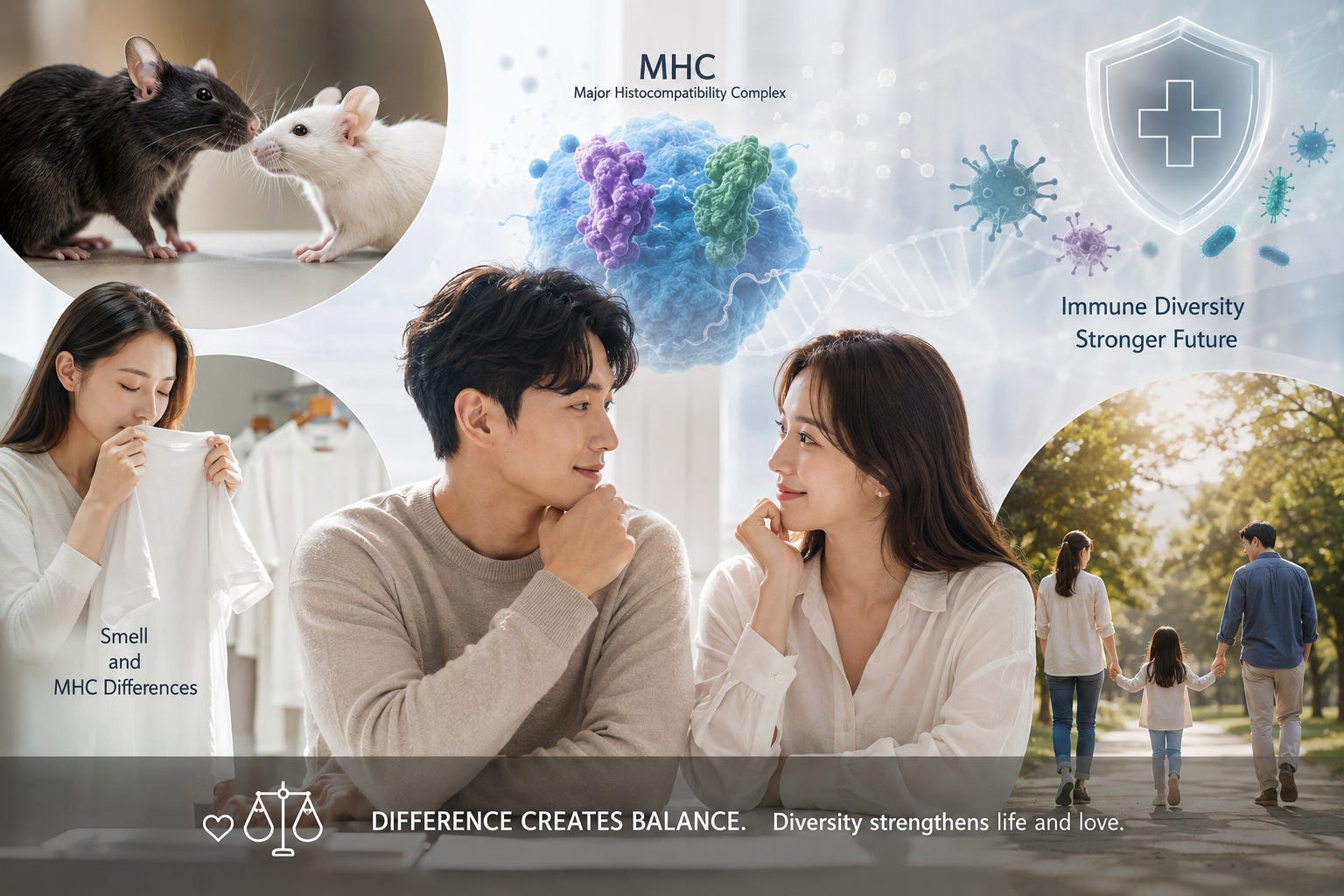
One of the questions I raised in that lecture was: Why do we marry spouses with different traits? At first, this sounds like a social or psychological question. We may answer that people marry because of love, attraction, personality, shared values, or destiny. These are all true in human experience. But biology adds another fascinating layer. From the viewpoint of life science, attraction may also be connected with genetic difference, especially in the immune system.
A key concept here is MHC, the Major Histocompatibility Complex. In humans, these genes are related to the immune system’s ability to recognize self and non-self. They help our bodies detect pathogens and respond to infections. In simple terms, MHC genes are part of our biological defense system. The more diverse these genes are, the broader the immune protection may be for future offspring.
This leads to an intriguing biological idea: perhaps we are sometimes attracted not only to beauty, kindness, intelligence, or personality, but also to genetic difference. In nature, choosing a mate with different immune-system genes can increase diversity in the next generation. That diversity may help offspring survive in a world filled with changing viruses, bacteria, parasites, and other biological threats.
This idea has been studied in animals. Mice, for example, can use smell to distinguish potential mates. Female mice often prefer males with MHC genes different from their own. This does not mean that mice ‘understand genetics.’ Rather, their bodies have evolved sensory mechanisms that help them choose mates in a way that may benefit their offspring. Nature often works quietly, without explanation, but with remarkable wisdom.
A famous human study related to this topic is the Smelly T-shirt experiment by Swiss researcher Claus Wedekind and colleagues in the 1990s. In this experiment, male students wore T-shirts for two nights. Female students then smelled the shirts and rated the odors. The surprising result was that women tended to prefer the smell of men whose MHC genes were more different from their own. In other words, what seemed like a simple sense of smell might carry hidden biological information.
Even more interesting, the study suggested that this preference could be affected by hormonal status, such as the use of oral contraceptives. This reminds us that human attraction is not a simple formula. It is influenced by biology, hormones, experience, culture, memory, and personal choice. We should not reduce love to genes alone. Still, biology gives us a wonderful window into the hidden layers of attraction.
This also helps answer the broader question: why do we often marry someone with different traits? One answer is that difference creates balance. A spouse may bring qualities that we do not have. One may be analytical, the other artistic. One may be cautious, the other adventurous. One may be quiet and reflective, the other expressive and social. In daily life, such differences can sometimes create friction, but they can also create harmony. A good marriage is not the union of two identical people. It is often the lifelong conversation between two different worlds.
Biology seems to agree. Life does not flourish through sameness alone. Sexual reproduction itself is based on the mixing of differences. Each generation is not a photocopy of the previous one, but a new combination. Genetic diversity is one of nature’s strategies for survival. In this sense, marriage between different people reflects a much larger principle of life: diversity strengthens continuity.
When I think about this question personally, I also see a connection to family life. Husband and wife do not need to be the same. In fact, their differences may become a source of growth. Through marriage, we learn patience, humility, adjustment, and appreciation. We begin by noticing differences; over time, we learn how those differences complete us.
The same principle applies to society. A healthy community is not made only of people who think alike, look alike, or live alike. It is strengthened by different talents, backgrounds, experiences, and viewpoints. Science teaches us that diversity is not an accident. It is one of the foundations of life.
In my KAIST lecture, the larger theme was the joy of learning and sharing. The MHC story is a good example of that joy. We begin with a simple question about marriage and attraction. Then we travel into immunology, genetics, olfaction, animal behavior, and human relationships. Finally, we return to a very human lesson: difference is not something merely to tolerate. Difference may be something to value.
A Korean professor’s lecture once impressed me with the phrase: ‘Helping others is helping oneself.’ This idea also fits the biology of life. We are not isolated individuals. Our survival and happiness are connected with others. In marriage, family, science, and community, we grow by meeting those who are different from us. Their difference challenges us, teaches us, and sometimes saves us from becoming too narrow.
So why do we marry spouses with different traits? We may say: because love is mysterious. We may say: because personality seeks balance. We may say: because biology favors diversity. We may also say: because life itself grows through difference.
In the end, the spouse who is different from us may become our greatest teacher. Through that person, we learn not only about love, but also about ourselves. And perhaps that is one of the deepest joys of learning and sharing.
References and Notes
Sung-Kwon Kang, Joy of Learning & Sharing, KAIST Seminar, Daejeon, Korea, October 7, 2015. YouTube lecture:
. This essay was inspired by a short section of my 2015 KAIST lecture, especially the question: ‘Why do we marry spouses with different traits?’
Sung-Kwon Kang, 배움과 나눔의 즐거움 / Joy of Learning & Sharing, PowerPoint slides, KAIST Seminar, October 7, 2015. The slides used for this essay include the topics of MHC genes, mate choice in mice and humans, the Smelly T-shirt experiment, and the reflection: ‘Helping others is helping oneself.’
Wedekind, C., Seebeck, T., Bettens, F., & Paepke, A. J. ‘MHC-dependent mate preferences in humans.’ Proceedings of the Royal Society of London. Series B: Biological Sciences, 260(1359), 245–249, 1995. https://doi.org/10.1098/rspb.1995.0087. This is the original ‘Smelly T-shirt experiment’ paper.
McFadden, Johnjoe, and Al-Khalili, Jim. Life on the Edge: The Coming of Age of Quantum Biology. Bantam Press, 2014. This book introduced broader questions about how physics, chemistry, and biology meet in living systems, including discussions of smell and quantum biology.
McFadden, Johnjoe. ‘Quantum weirdness is everywhere in the living world.’ Aeon, October 29, 2014. https://aeon.co/essays/quantum-weirdness-is-everywhere-in-the-living-world. This essay discusses examples from quantum biology, including the possibility that smell may involve more than the traditional lock-and-key model of molecular recognition.
Jung, Yong-Seok. Lecture quoted in my KAIST seminar: ‘당신은 이미 기적의 존재’ (’You Are Already a Miraculous Being’), 2013. His memorable phrase ‘남을 돕는 것 = 나를 돕는 것’ helped me connect biology, human relationships, and the joy of sharing.
우리는 왜 서로 다른 배우자들을 만나는가?
강성권 박사, IBM Research retired
2015년 KAIST 세미나, 배움과 나눔의 즐거움에서 나는 과학적 호기심을 인간 삶의 더 깊은 질문들과 연결해 보고자 했다. 배움은 사실에서 시작되지만, 거기서 끝나지 않는다. 좋은 과학적 질문은 종종 우리 자신에게 다시 돌아오게 한다. 우리는 왜 이렇게 살아가는가? 왜 어떤 사람에게 끌리는가? 왜 사랑하고, 결혼하고, 자녀를 낳고, 나와 똑같지 않은 한 사람과 평생을 나누며 살아가는가?
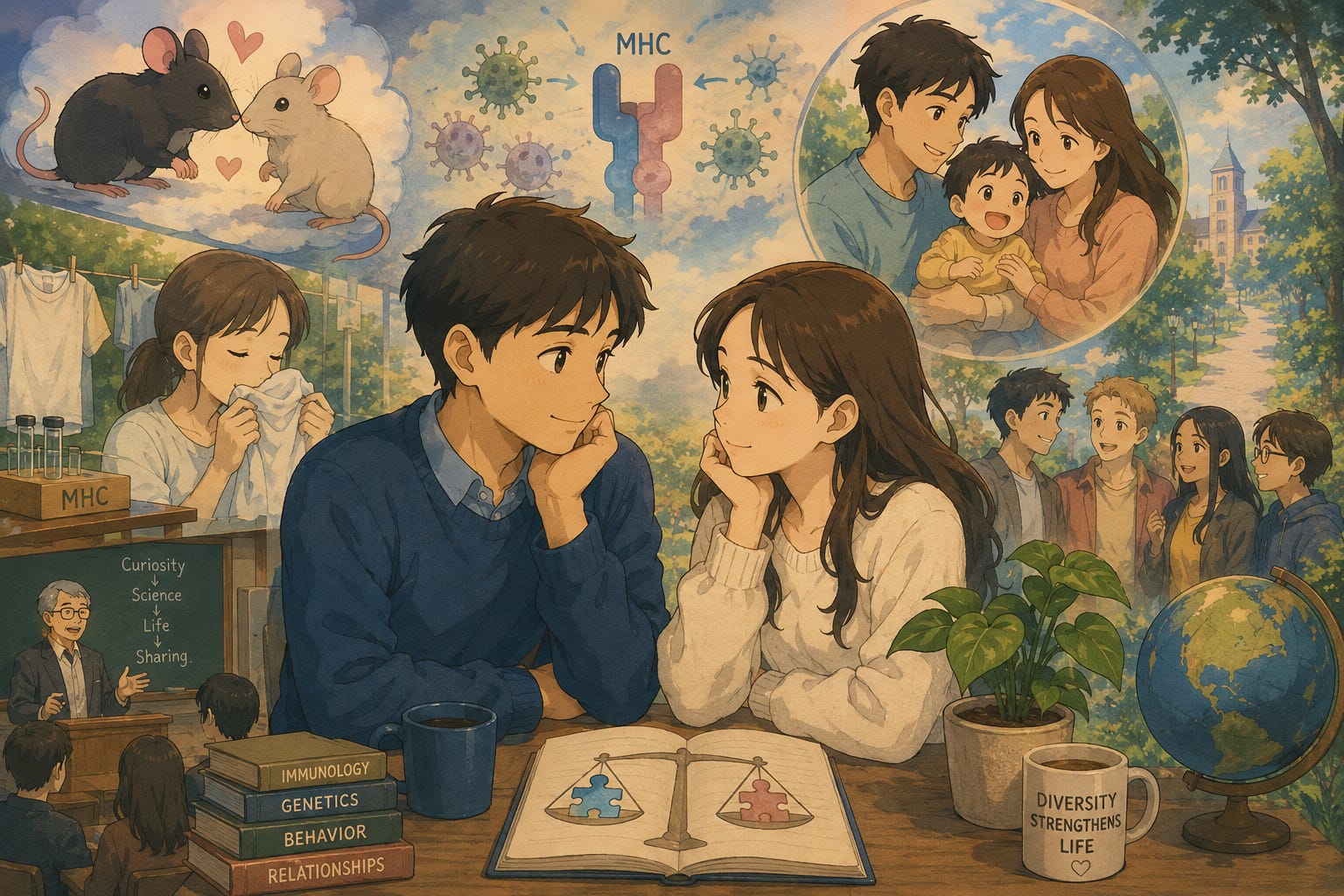
그 강연에서 내가 던진 질문 가운데 하나는 이것이었다. 우리는 왜 서로 다른 배우자들을 만나는가? 처음에는 이 질문이 사회적이거나 심리적인 질문처럼 들린다. 사람들은 사랑, 매력, 성격, 가치관, 혹은 운명 때문에 결혼한다고 말할 수 있다. 인간 경험 속에서 이것들은 모두 사실이다. 그러나 생물학은 여기에 또 하나의 흥미로운 층을 더한다. 생명과학의 관점에서 보면, 끌림은 유전적 차이, 특히 면역체계와 관련된 유전적 차이와도 연결되어 있을 수 있다.
여기서 중요한 개념이 MHC, 즉 주요 조직적합성 복합체 (Major Histocompatibility Complex)이다. 인간에게서 이 유전자들은 우리 몸이 자기와 비자기를 구별하는 면역체계의 능력과 관련되어 있다. 이들은 병원체를 감지하고 감염에 대응하는 데 도움을 준다. 쉽게 말하면 MHC 유전자는 우리 몸의 생물학적 방어체계의 일부이다. 이 유전자들이 다양할수록 다음 세대가 더 넓은 면역 보호 능력을 가질 가능성이 있다.
이것은 매우 흥미로운 생물학적 생각으로 이어진다. 우리는 아름다움, 친절함, 지성, 성격에만 끌리는 것이 아니라, 때로는 유전적 차이에도 끌릴 수 있다는 것이다. 자연계에서 자기와 다른 면역체계 유전자를 가진 배우자를 선택하는 일은 다음 세대의 유전적 다양성을 높일 수 있다. 그러한 다양성은 끊임없이 변하는 바이러스, 박테리아, 기생충, 그리고 여러 생물학적 위협 속에서 자손의 생존 가능성을 높이는 데 도움이 될 수 있다.
이 생각은 동물 연구에서도 관찰되어 왔다. 예를 들어 쥐는 냄새를 통해 잠재적인 짝을 구별할 수 있다. 암컷 쥐는 자기와 다른 MHC 유전자를 가진 수컷을 선호하는 경향을 보인다. 물론 쥐가 유전학을 이해한다는 뜻은 아니다. 오히려 그들의 몸은 자손에게 유리할 수 있는 방식으로 짝을 고르도록 감각적 기제를 진화시켜 온 것이다. 자연은 종종 말없이 조용히 작동하지만, 그 안에는 놀라운 지혜가 숨어 있다.
이 주제와 관련된 유명한 인간 연구가 스위스 연구자 Claus Wedekind와 동료들이 1990년대에 수행한 이른바 냄새나는 티셔츠 실험이다. 이 실험에서 남학생들은 이틀 밤 동안 티셔츠를 입었다. 그 다음 여학생들이 그 티셔츠 냄새를 맡고 평가했다. 놀라운 결과는 여성들이 자기와 MHC 유전자가 더 다른 남성의 냄새를 더 선호하는 경향을 보였다는 점이다. 다시 말해 단순한 후각처럼 보이는 감각 속에도 숨겨진 생물학적 정보가 담겨 있을 수 있다는 것이다.
더 흥미로운 점은, 이 선호가 경구 피임약 사용과 같은 호르몬 상태에 따라 영향을 받을 수 있다는 사실이었다. 이것은 인간의 끌림이 단순한 공식으로 설명될 수 없음을 보여준다. 끌림은 생물학, 호르몬, 경험, 문화, 기억, 그리고 개인의 선택이 함께 작용하는 복합적인 현상이다. 사랑을 유전자만으로 환원해서는 안 된다. 그러나 생물학은 사랑과 끌림의 숨겨진 층을 들여다볼 수 있는 멋진 창을 제공한다.
이 이야기는 더 넓은 질문, 즉 왜 우리는 종종 서로 다른 특성을 가진 사람과 결혼하는가에 대한 답에도 도움을 준다. 하나의 답은 차이가 균형을 만든다는 것이다. 배우자는 내가 갖지 못한 성품과 능력을 가져올 수 있다. 한 사람은 분석적이고, 다른 한 사람은 예술적일 수 있다. 한 사람은 조심스럽고, 다른 한 사람은 모험적일 수 있다. 한 사람은 조용하고 사색적이며, 다른 한 사람은 표현력이 풍부하고 사교적일 수 있다. 일상 속에서 이런 차이는 때로 갈등을 만들기도 하지만, 동시에 조화를 만들어 내기도 한다. 좋은 결혼은 똑같은 두 사람의 결합이 아니다. 그것은 서로 다른 두 세계가 평생 이어 가는 대화일 때가 많다.
생물학도 이 생각에 동의하는 듯하다. 생명은 같음만으로 번성하지 않는다. 유성생식 자체가 차이의 섞임에 기반을 두고 있다. 각 세대는 이전 세대의 복사본이 아니라 새로운 조합이다. 유전적 다양성은 자연이 생존을 위해 사용하는 중요한 전략 가운데 하나이다. 그런 의미에서 서로 다른 사람들의 결혼은 생명의 더 큰 원리를 반영한다. 다양성은 지속성을 강하게 만든다.
이 질문을 개인적으로 생각해 보면, 나는 가족생활과의 연결도 보게 된다. 남편과 아내가 꼭 같을 필요는 없다. 사실 그 차이가 성장의 원천이 될 수 있다. 결혼을 통해 우리는 인내, 겸손, 조정, 그리고 감사의 마음을 배운다. 처음에는 차이를 발견하지만, 시간이 지나면서 그 차이가 어떻게 우리를 보완해 주는지를 배우게 된다.
같은 원리는 사회에도 적용된다. 건강한 공동체는 같은 생각, 같은 모습, 같은 삶의 방식을 가진 사람들만으로 만들어지지 않는다. 서로 다른 재능, 배경, 경험, 관점이 모일 때 공동체는 더 강해진다. 과학은 다양성이 우연이 아니라고 가르쳐 준다. 다양성은 생명의 기초 가운데 하나이다.
내 KAIST 강연의 더 큰 주제는 배움과 나눔의 즐거움이었다. MHC 이야기는 그 즐거움을 잘 보여 주는 예이다. 우리는 결혼과 끌림에 관한 간단한 질문에서 출발한다. 그러고 나서 면역학, 유전학, 후각, 동물행동학, 인간관계의 세계로 여행한다. 마지막에는 매우 인간적인 교훈으로 돌아온다. 차이는 단순히 참아야 할 것이 아니다. 차이는 오히려 소중히 여겨야 할 것일 수 있다.
언젠가 한 한국 교수님의 강연에서 나는 남을 돕는 것 = 나를 돕는 것이라는 말에 깊은 인상을 받았다. 이 생각은 생명의 생물학에도 잘 맞는다. 우리는 고립된 개인이 아니다. 우리의 생존과 행복은 타인과 연결되어 있다. 결혼, 가족, 과학, 공동체 속에서 우리는 나와 다른 사람들을 만나며 성장한다. 그들의 차이는 우리에게 도전이 되고, 가르침이 되며, 때로는 우리가 너무 좁아지는 것을 막아 준다.
그렇다면 우리는 왜 서로 다른 배우자들을 만나는가? 우리는 이렇게 말할 수 있다. 사랑은 신비롭기 때문이다. 성격은 균형을 찾기 때문이다. 생물학은 다양성을 선호하기 때문이다. 그리고 생명 자체가 차이를 통해 성장하기 때문이다.
결국 나와 다른 배우자는 나의 가장 큰 스승이 될 수 있다. 우리는 그 사람을 통해 사랑뿐 아니라 우리 자신에 대해서도 배운다. 그리고 아마도 그것이 배움과 나눔의 가장 깊은 즐거움 가운데 하나일 것이다.
참고문헌 및 주
강성권, 배움과 나눔의 즐거움 / Joy of Learning & Sharing, KAIST 세미나, 대전, 2015년 10월 7일. 유튜브 강연:
. 이 글은 2015년 KAIST 강연 가운데 ‘우리는 왜 서로 다른 배우자들을 만나는가?’라는 짧은 부분에서 영감을 받아 작성되었다.
강성권, 배움과 나눔의 즐거움 / Joy of Learning & Sharing, PowerPoint 슬라이드, KAIST 세미나, 2015년 10월 7일. 이 글에 사용된 슬라이드에는 MHC 유전자, 쥐와 사람의 짝 선택, 냄새나는 티셔츠 실험, 그리고 ‘남을 돕는 것 = 나를 돕는 것’이라는 성찰이 포함되어 있다.
Wedekind, C., Seebeck, T., Bettens, F., & Paepke, A. J. ‘MHC-dependent mate preferences in humans.’ Proceedings of the Royal Society of London. Series B: Biological Sciences, 260(1359), 245–249, 1995. https://doi.org/10.1098/rspb.1995.0087. 이 논문은 이른바 ‘냄새나는 티셔츠 실험’의 원 논문이다.
McFadden, Johnjoe, and Al-Khalili, Jim. Life on the Edge: The Coming of Age of Quantum Biology. Bantam Press, 2014. 이 책은 물리학, 화학, 생물학이 생명현상 안에서 어떻게 만나는지를 다루며, 냄새와 양자생물학에 관한 논의를 포함한다.
McFadden, Johnjoe. ‘Quantum weirdness is everywhere in the living world.’ Aeon, 2014년 10월 29일. 글 주소: https://aeon.co/essays/quantum-weirdness-is-everywhere-in-the-living-world. 이 글은 양자생물학의 여러 예를 설명하며, 냄새가 전통적인 자물쇠와 열쇠 모델만으로 설명되지 않을 가능성을 소개한다.
정용석. 2013년 강연 ‘당신은 이미 기적의 존재’. KAIST 강연에서 인용한 ‘남을 돕는 것 = 나를 돕는 것’이라는 표현은 생물학, 인간관계, 나눔의 즐거움을 연결하는 데 중요한 영감을 주었다.
Original Article:

About the Author:

Dr. Sung-Kwon Kang is a distinguished materials scientist and metallurgical engineer whose career spans more than five decades of research, innovation, and leadership across academia, industry, and professional societies. He earned his B.S. in Metallurgical Engineering from Seoul National University in 1969 and his Ph.D. in Materials Science and Metallurgy from the University of Pennsylvania in 1973.
After a postdoctoral fellowship at Carnegie Mellon University, he held faculty roles at Nova Scotia Technical University and Stevens Institute of Technology. He then moved into industrial research, joining IBM’s T. J. Watson Research Center, where he served as a Senior Research Scientist for 34 years.
Dr. Kang’s work on lead-free solders reshaped the microelectronics field. He was named IEEE Fellow in 2009 and IEEE Life Fellow in 2024. He has written 145 technical papers, co-edited books, holds 148 patents, and has drawn more than 6,000 citations. His honors include the TMS Fellow Award, the 17th KBS Global Korean Award for Science & Technology, and the TMS Legion of Honor in 2022.
A longtime pillar of the Korean-American Scientists and Engineers Association (KSEA), he served as its 35th President. He recently published his memoir, Joy of Learning and Sharing, on Amazon.
© K-Global Scholars and Professionals Forum. All rights reserved. Content published in the K-GSP Forum may not be reproduced, distributed, or transmitted in any form without prior written permission from the K-GSP Forum, except for brief quotations with full attribution.