

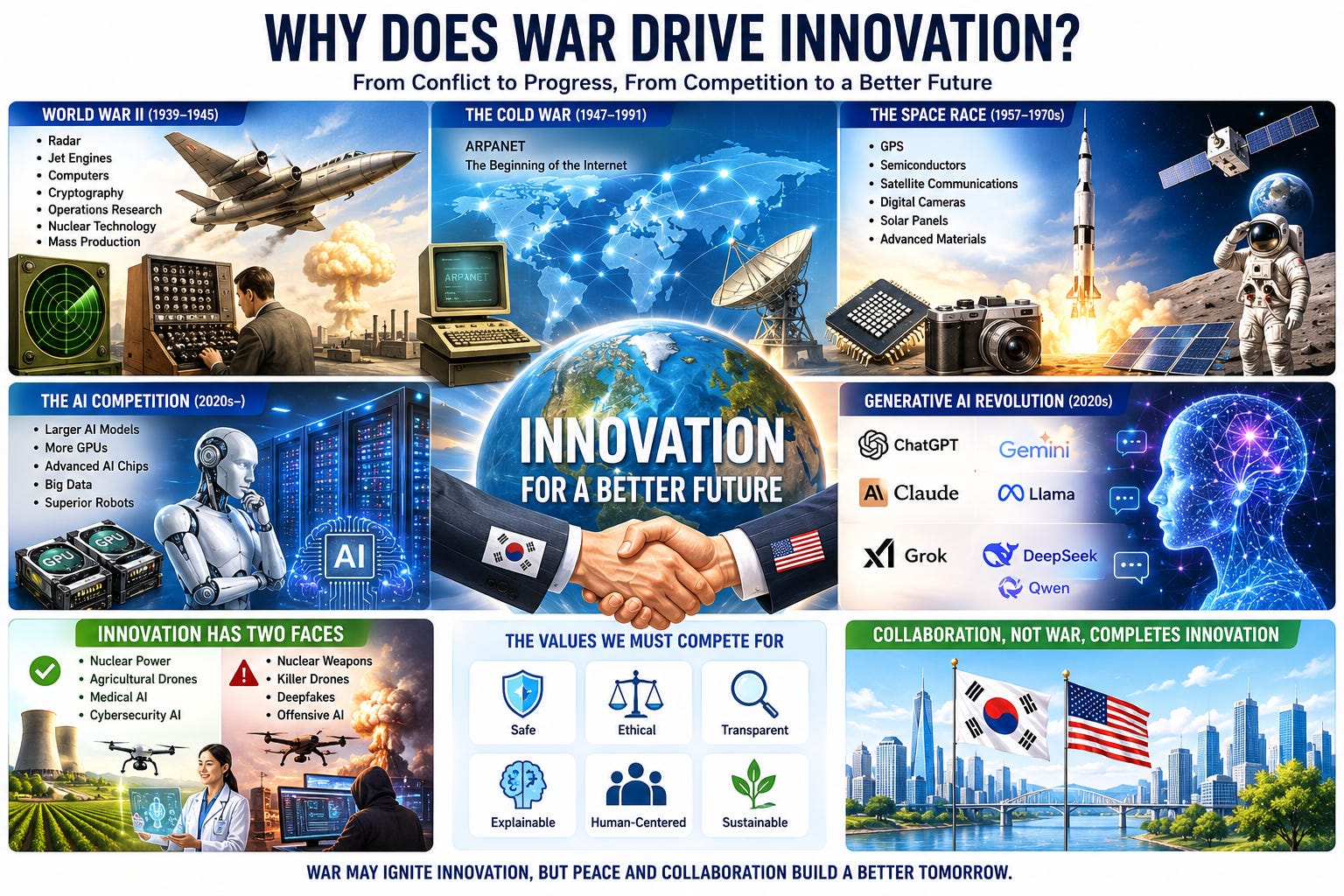
“Many of humanity’s greatest technologies were born during its darkest moments.”
During a lecture by recipients of the 2025 Nobel Prize in Economic Sciences, a member of the audience reportedly asked a thought-provoking question:
“Why does humanity innovate faster during times of war than during times of peace?”
For a moment, the lecture hall fell silent.
No one wished to glorify war, yet few could deny the historical reality. War has inflicted immeasurable suffering upon humanity, but it has also served as one of the most powerful catalysts for scientific and technological progress.
Today, we are living through another era of intense global competition.
Instead of guns and missiles, nations compete with GPUs and AI models. Instead of aircraft carriers, massive AI data centers increasingly determine national competitiveness.
So, does war still create innovation in the age of artificial intelligence?
Or has the global AI race become a new form of warfare?
Why Does War Accelerate Innovation?
Under normal circumstances, developing a breakthrough technology may take decades.
War, however, does not allow that luxury.
“We must survive.”
That single imperative sweep away bureaucratic barriers.
Governments invest enormous resources.
Universities mobilize their best laboratories.
Industries recruit the brightest minds.
Failure becomes an acceptable cost of progress.
As a result, the pace of innovation increases dramatically.
Economists often describe this phenomenon as innovation under extreme pressure.
The Unexpected Legacy of World War II
World War II was one of the most devastating conflicts in human history.
Ironically, many of the foundational technologies of modern civilization emerged during this period.
Among them were:
Radar
Jet engines
Digital computers
Cryptography
Operations research
Nuclear technology
Automated mass production
Alan Turing’s efforts to decipher Germany’s Enigma code led to groundbreaking advances in modern computing.
Those innovations ultimately laid the intellectual foundation for today’s artificial intelligence.
The Cold War Gave Birth to the Internet
During the Cold War, the United States worried about the possibility of nuclear conflict with the Soviet Union.
A crucial question emerged:
“If the nation’s capital were attacked, how could communication networks continue to function?”
The answer eventually became ARPANET, the precursor to today’s Internet.
At the time, no one could have imagined YouTube, online shopping, cloud computing, ChatGPT, virtual classrooms, or remote work.
A military communication network evolved into one of humanity’s greatest technological achievements.
The Space Race Was Also a Form of War
In 1961, the Soviet Union shocked the world by sending Yuri Gagarin into space.
The United States responded with determination.
President John F. Kennedy boldly declared that America would land a man on the Moon within a decade.
That ambitious national mission accelerated the development of numerous technologies, including:
GPS
Semiconductor technology
Satellite communications
Digital imaging
Solar panels
Advanced materials
Today’s smartphone is, in many ways, a collection of technologies born from the space race.
Is the AI Race the New Cold War?
Today, the United States and China compete not by pointing weapons at each other, but by advancing artificial intelligence.
Who can build the largest foundation models?
Who can secure the greatest number of GPUs?
Who can manufacture the most advanced AI chips?
Who can train on the largest datasets?
Who can develop the most capable humanoid robots?
This competition has already become a new form of strategic rivalry.
AI researchers in Silicon Valley command compensation packages worth tens of millions of dollars, while governments around the world are unveiling ambitious national AI strategies.
This is a technological war without gunfire.
Generative AI: Innovation Fueled by Competition
Since the introduction of ChatGPT, the pace of innovation has accelerated dramatically.
OpenAI developed ChatGPT.
Google released Gemini.
Anthropic introduced Claude.
Meta launched Llama.
xAI unveiled Grok.
China introduced DeepSeek and Qwen.
Only a few years ago, such rapid progress would have seemed unimaginable.
Competition continues to fuel innovation.
Fortunately, today’s competition is primarily a contest of knowledge rather than armed conflict—a far more hopeful path for humanity.
The New Manhattan Project of the AI Era
In the 1940s, nuclear weapons became national strategic projects. In the 2020s, artificial intelligence has assumed that role.
Governments across the globe are investing hundreds of billions of dollars in AI infrastructure, including:
Hyperscale AI data centers
AI-specialized semiconductors
Quantum computing
Humanoid robotics
Autonomous weapons
Digital healthcare
AI-powered education.
Virtually every one of these technologies has implications for national security.
Every Innovation Has Its Shadow
Technologies born during wartime almost always possess two faces.
Nuclear technology generates electricity.
Yet it also produces nuclear weapons.
Drones increase agricultural productivity.
Yet they can also become instruments of war.
Artificial intelligence is no different.
Medical AI saves lives.
Deepfakes threaten democracy.
Cybersecurity AI protects nations.
Offensive AI can create entirely new forms of warfare.
Technology itself is morally neutral.
Its ultimate direction depends on human choices.
What Should the Next Great Competition Be?
Humanity must now ask a different question.
Rather than asking,
“How can we build more powerful AI?”
perhaps the more important question is,
“How can we build more trustworthy AI?”
The future should not be defined merely by a race for speed.
Instead, we should compete to create:
The safest AI
The most ethical AI
The most transparent AI
The most explainable AI
The most human-centered AI
The most sustainable AI.
This is the competition that can lead humanity toward a better future.
Collaboration, Not War, Completes Innovation
Republic of Korea transformed itself from the devastation of war into one of the world’s leading ICT nations.
The United States has long driven innovation through its open research ecosystem and entrepreneurial culture.
In the AI era, the strengths of both countries can complement one another.
K-GSP (Korean Global Scholars & Professionals) embodies this spirit of international collaboration.
When Korea’s speed of execution meets America’s culture of creativity and research excellence, technology becomes more than a tool of competition—it becomes a foundation for shared human prosperity.
The true leaders of artificial intelligence may not be the nations possessing the greatest number of GPUs, but those earning the world’s greatest trust.
From Innovation Born of War to Innovation Built Through Peace
History clearly demonstrates that war has often accelerated technological innovation. Yet this does not mean that war is necessary for progress.
The greatest challenge of the AI era is no longer military confrontation, but competition over knowledge, talent, data, and ethical leadership. Unlike armed conflict, this competition can be designed to advance humanity rather than divide it.
The wars of the past gave us remarkable technologies.
The collaborations of the future must give us greater wisdom.
The true winner of the AI age will not be the nation with the most powerful algorithms, but the society that develops and governs artificial intelligence with the greatest responsibility, transparency, and respect for human dignity.
War may ignite innovation.
But only peace, cooperation, and shared human values can transform innovation into lasting prosperity for all.
That is the new formula for civilization in the age of generative artificial intelligence. +++
{Solti}
July 27, 2026
References
The Rise and Fall of American Growth
Gordon, R. J. (2016). The rise and fall of American growth: The U.S. standard of living since the Civil War. Princeton University Press.The Second Machine Age
Brynjolfsson, E., & McAfee, A. (2014). The second machine age: Work, progress, and prosperity in a time of brilliant technologies. W. W. Norton & Company.Chip War
Miller, C. (2022). Chip war: The fight for the world’s most critical technology. Scribner.The Coming Wave
Suleyman, M. (2023). The coming wave: Technology, power, and the twenty-first century’s greatest dilemma. Crown Currency.National Security Commission on Artificial Intelligence
National Security Commission on Artificial Intelligence. (2021). Final report. U.S. Government.
왜 전쟁은 혁신을 만드는가?
인공지능 시대에 다시 묻는 기술혁신의 역설
“인류의 가장 위대한 기술 가운데 상당수는 가장 비극적인 시대에 태어났다.”
2025년 노벨경제학상 수상자들의 한 강연에서 한 청중이 이런 질문을 던졌다고 한다.
“인류는 왜 평화로운 시대보다 전쟁 중에 더 빠르게 혁신하는가?”
순간 강연장은 조용해졌다. 누구도 전쟁을 찬양할 수는 없지만, 역사적 사실을 부인하기도 어려웠다. 전쟁은 인간에게 엄청난 고통을 안겨 주었지만 동시에 과학기술 발전을 가장 강력하게 가속시켜 온 촉매이기도 했기 때문이다.
오늘날 우리는 또 다른 거대한 경쟁의 시대를 살아간다. 총과 미사일 대신 GPU와 AI 모델이 경쟁하고, 항공모함 대신 초거대 데이터센터가 국가 경쟁력을 결정하는 시대다.
그렇다면 인공지능 시대에도 전쟁은 여전히 혁신을 만드는가? 혹은 이제는 “AI 경쟁” 이 새로운 형태의 전쟁이 된 것일까?
전쟁은 왜 혁신을 가속하는가?
평상시에는 새로운 기술을 개발하는 데 수십 년이 걸린다. 그러나 전쟁은 그런 시간을 허락하지 않는다. “살아남아야 한다.”는 이 한 문장이 모든 규제를 무너뜨린다.
정부는 막대한 예산을 투입한다. 대학은 연구실을 총동원한다. 기업은 최고의 인재를 한곳에 모은다. 실패를 두려워하지 않는다. 결국 혁신 속도가 폭발적으로 빨라진다. 경제학자들은 이를 Innovation under Extreme Pressure라고 부른다.
제2차 세계대전이 남긴 뜻밖의 유산
제2차 세계대전은 역사상 가장 끔찍한 전쟁이었다. 그러나 아이러니하게도 현대 문명의 기반 기술 상당수가 이 시기에 태어났다.
대표적인 사례는 다음과 같다. 레이더, 제트엔진, 컴퓨터, 암호학, 운영연구(Operation Research), 핵기술, 그리고 대량생산 자동화 등.
앨런 튜링은 독일의 암호를 해독하기 위해 최초의 현대 컴퓨터 개념을 발전시켰다. 그 기술은 오늘날 AI의 뿌리가 되었다.
냉전은 인터넷을 만들었다
미국은 소련과의 핵전쟁 가능성을 우려했다. “만약 수도가 공격받으면 통신망은 어떻게 유지할 것인가?” 이 질문에서 탄생한 것이 ARPANET이다. 오늘날 전 세계를 연결하는 인터넷의 시작이었다.
흥미로운 점은 당시 누구도 유튜브, 온라인 쇼핑, 클라우드, ChatGPT, 원격수업, 재택근무 등을 상상하지 못했다는 사실이다. 군사용 기술이 인류 전체의 기술이 된 것이다.
우주 경쟁도 사실은 전쟁이었다
1961년 소련은 유리 가가린을 우주에 보냈다. 미국은 충격에 빠졌다.
존 F. 케네디 대통령은 “10년 안에 인간을 달에 보내겠다.”고 선언했다.
그 결과 GPS, 반도체, 위성통신, 디지털 카메라, 태양광 패널, 신소재 등 수많은 기술이 탄생했다. 오늘날 스마트폰은 당시 우주개발 기술의 집합체라고 해도 과언이 아니다.
AI 경쟁은 새로운 냉전인가?
오늘날 미국과 중국은 총을 겨누기보다 AI를 겨누고 있다.
누가 더 큰 AI 모델을 만드는가.
누가 더 많은 GPU를 확보하는가.
누가 더 많은 AI 반도체를 생산하는가.
누가 더 많은 데이터를 학습하는가.
누가 더 뛰어난 로봇을 만드는가.
이 경쟁은 이미 새로운 형태의 국가 경쟁이 되었다. 실리콘밸리에서는 AI 연구자에게 연봉 수백억 원이 제시되고, 세계 각국은 AI 국가전략을 앞다투어 발표하고 있다. 이것은 총성이 없는 기술전쟁이다.
생성형 AI 역시 경쟁이 만든 혁신
ChatGPT가 등장한 이후 Google은 Gemini를, Anthropic은 Claude를, Meta는 Llama를, xAI는 Grok을, 중국은 DeepSeek과 Qwen을 잇따라 발표했다.
몇 년 전만 해도 상상하기 어려웠던 발전 속도다. 경쟁은 혁신을 만들고 있다. 그러나 이번 경쟁은 전쟁이 아니라 지식 경쟁이라는 점에서 인류에게 더 희망적이다.
AI 시대의 새로운 ‘맨해튼 프로젝트’
1940년대에는 핵무기가 국가 프로젝트였다. 2020년대에는 AI가 국가 프로젝트가 되었다.
각국 정부는 수천억 달러 규모의 AI 인프라를 구축하고 있다. 초거대 데이터센터, AI 전용 반도체, 양자컴퓨팅, 휴머노이드 로봇, 자율무기, 디지털 헬스케어, 그리고 교육 AI 등등. 모든 것이 국가 안보와 연결되고 있다.
그러나 혁신에는 그림자도 있다
전쟁이 만든 기술은 항상 두 얼굴을 가진다.
원자력은 전기를 만든다. 그러나 핵폭탄도 만든다.
드론은 농업을 돕는다. 그러나 전쟁에서는 살상무기가 된다.
AI 역시 마찬가지다.
의료 AI는 생명을 구한다. 그러나 딥페이크는 민주주의를 위협한다.
사이버 보안 AI는 국가를 보호한다. 그러나 공격형 AI는 새로운 전쟁을 만든다.
혁신은 가치중립적이다. 그 방향을 결정하는 것은 인간이다.
앞으로의 경쟁은 무엇이어야 하는가?
인류는 이제 새로운 질문을 던져야 한다.
“어떻게 더 강한 AI를 만들 것인가?”
보다 중요한 질문은
“어떻게 더 신뢰할 수 있는 AI를 만들 것인가?”
이다.
앞으로의 경쟁은 단순한 속도 경쟁이 되어서는 안 된다.
우리가 경쟁해야 할 것은 다음과 같은 가치들이다.
가장 안전한 AI
가장 윤리적인 AI
가장 투명한 AI
가장 설명 가능한 AI
가장 인간 중심적인 AI
가장 지속 가능한 AI.
이러한 경쟁이야말로 인류를 더 나은 미래로 이끌 것이다.
K-GSP의 시각: 전쟁이 아니라 협력이 혁신을 완성한다
한국은 전쟁의 폐허 속에서 세계적인 ICT 강국으로 성장했다. 미국은 개방형 연구생태계를 통해 혁신을 이끌어 왔다. 양국은 이제 AI 시대에도 서로의 강점을 결합할 수 있다.
K-GSP(Korean Global Scholars & Professionals)는 이러한 협력의 가치를 상징한다.
한국의 빠른 실행력과 미국의 창의적 연구 문화가 만나면, 기술은 경쟁의 도구를 넘어 인류 공동 번영의 기반이 될 수 있다. 미래의 AI 리더십은 더 많은 GPU를 가진 나라가 아니라, 더 큰 신뢰를 얻는 나라에게 돌아갈 가능성이 크다.
전쟁이 만든 혁신을 넘어, 평화가 만드는 혁신으로
역사는 전쟁이 혁신을 가속했음을 보여 준다. 그러나 그것이 전쟁이 필요하다는 뜻은 아니다. 오늘날 AI 시대의 가장 큰 도전은 군사적 충돌이 아니라 지식, 인재, 데이터, 윤리를 둘러싼 경쟁이다. 이 경쟁은 인류를 파괴하는 방향이 아니라 함께 발전시키는 방향으로 설계될 수 있다.
우리는 과거의 전쟁에서 기술을 얻었지만, 미래에는 협력에서 지혜를 얻어야 한다. AI 시대의 진정한 승자는 가장 강력한 알고리즘을 가진 국가가 아니라, 가장 책임 있게 기술을 사용하는 사회일 것이다.
전쟁은 혁신을 촉발할 수 있다. 그러나 평화와 협력만이 그 혁신을 인류 모두의 번영으로 완성할 수 있다. 이것이 생성형 AI 시대가 우리에게 요구하는 새로운 문명의 공식이다. +++
2026년 7월 27일
{솔티}
참고문헌
The Rise and Fall of American Growth
Gordon, R. J. (2016). The rise and fall of American growth: The U.S. standard of living since the Civil War. Princeton University Press.
→ 제2차 세계대전이 미국의 기술혁신과 생산성 향상을 어떻게 가속했는지를 분석한 대표 저서.The Second Machine Age
Brynjolfsson, E., & McAfee, A. (2014). The second machine age: Work, progress, and prosperity in a time of brilliant technologies. W. W. Norton & Company.
→ AI와 디지털 혁신이 산업과 사회를 어떻게 변화시키는지를 설명하는 대표적인 저작.Chip War
Miller, C. (2022). Chip war: The fight for the world’s most critical technology. Scribner.
→ 반도체 경쟁과 미·중 기술 패권 경쟁을 이해하는 데 가장 많이 인용되는 현대의 대표 저서.The Coming Wave
Suleyman, M. (2023). The coming wave: Technology, power, and the twenty-first century’s greatest dilemma. Crown Currency.
→ 생성형 AI와 첨단기술이 국가 경쟁, 안보, 거버넌스에 미치는 영향을 폭넓게 다룬 최신 저서.National Security Commission on Artificial Intelligence
National Security Commission on Artificial Intelligence. (2021). Final report. U.S. Government.
→ AI를 국가안보와 경제경쟁력의 핵심 요소로 규정하며, AI 경쟁이 새로운 전략적 경쟁임을 제시한 미국 정부의 대표 보고서.

Prof. Dr. Young Choi (Editor in Chief) — Regent University
Young B. Choi is a Professor in the Department of Engineering & Computer Science at Regent University. He published 38 books with ‘Selected Readings in Cybersecurity’ (2018) (over 800 copies archived globally at university/college libraries around the world) and ‘Cybersecurity Applications and Artificial Intelligence’ (2023) available in seven major world languages. He proposed the world’s first global and universal telecommunications “Service Order Handling (SOH)” Model (T-SOH Model) (1995) with Dr. Adrian Tang. With this innovative research work, he received the IEEE NOMS ’96 Best Paper Award and became the first recipient of the Outstanding Contribution Award of the TeleManagement Forum in 1998. His research areas include Natural Language Processing-focused AI, AI-applied cybersecurity, network and telecom service management, and Korean studies on Gani Choi Rip’s Jeonggwan (靜觀: Quiet Contemplation) philosophy and Shilhak ( 實學: Practical Learning).