

We are now living in an age in which artificial intelligence writes faster than humans, searches information more accurately, and even creates paintings and music. Increasingly, the central question of our era is no longer merely “What do we know?” but rather “How do we judge wisely?” In such a time, paradoxically, humanity finds itself returning to old wisdom. Among the voices that still resonate powerfully today is Benjamin Franklin — a statesman, scientist, diplomat, inventor, publisher, and one of the architects of the American spirit.
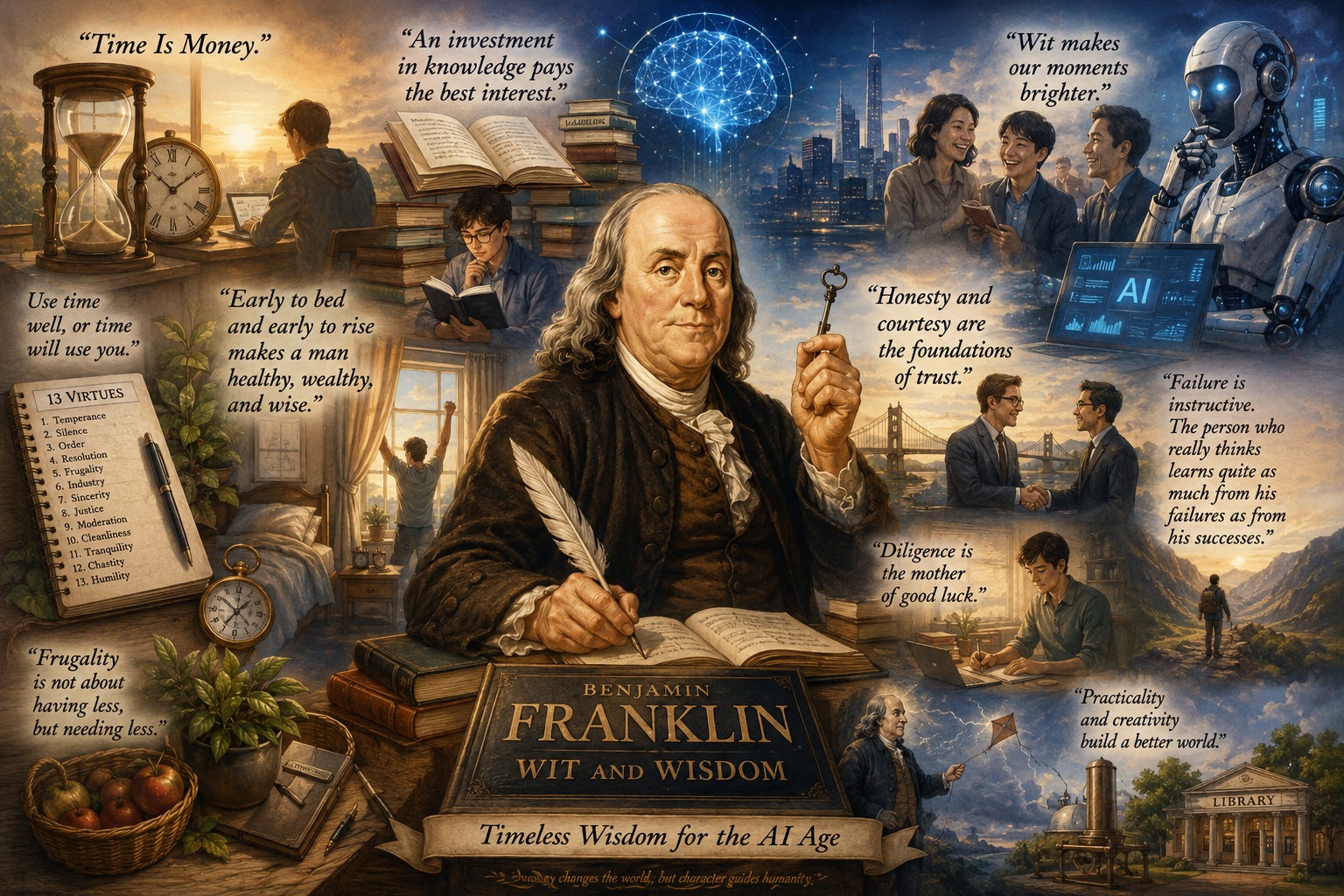
Benjamin Franklin: Wit and Wisdom is far more than a simple collection of quotations. It is a compressed treasury of reflections on human life, habits, time, labor, learning, and relationships. Franklin’s sentences are brief, yet they carry profound relevance for people living in the AI era. Technology has advanced dramatically, but human weaknesses, desires, and existential struggles remain remarkably unchanged.
1. “Time Is Money” — The Meaning of Time Has Become Even Heavier
One of Franklin’s most famous sayings is, “Time is money.” Many interpret this merely as a slogan of economic efficiency. Yet in today’s world, the phrase carries a much deeper meaning. AI saves enormous amounts of human time. It summarizes reports, translates languages, generates images, and writes computer code. But the critical question is this: What are we doing with the time we save?
The greatest danger of the AI era may not be the lack of time, but rather the meaningless consumption of it. Endless short videos and algorithm-driven recommendations gradually weaken humanity’s ability to think deeply. Franklin reminds us that managing time is not merely about scheduling tasks; it is about choosing the direction of one’s life.
2. “An Investment in Knowledge Pays the Best Interest”
Franklin emphasized the value of learning more than almost anyone of his generation. Born into poverty, he educated himself and expanded his influence into science, politics, diplomacy, and publishing. Today, AI search engines provide information instantly, yet the real problem is no longer a shortage of information but a shortage of wisdom.
AI can provide answers, but only humans can decide which questions truly matter. As Franklin observed, investment in knowledge yields the greatest return. In our time, critical thinking, insight, and ethical judgment have become more valuable than mere memorization.
3. The Humanity of Humor and Wit
One of the greatest charms of Benjamin Franklin: Wit and Wisdom is Franklin’s remarkable wit. Rather than attacking people harshly, he revealed truth through humor. AI can generate logical sentences, but genuine human humor and warm irony still remain uniquely human domains.
Franklin’s remarks are sometimes sharp, sometimes playful. He criticized vanity and laziness without falling into bitterness or cynicism. Such balance is desperately needed in today’s online culture. In an age flooded with machine-generated information, the ability to preserve warmth and humanity may become one of the most valuable forms of intelligence.
4. The Philosophy of Self-Discipline
Franklin famously attempted to govern his life through thirteen virtues, including temperance, silence, order, resolution, frugality, and sincerity. Today, smartphones and AI platforms constantly fragment human attention. We live in an age rich in information but poor in concentration.
Franklin’s philosophy of self-management is not mere asceticism; it is the discipline of governing one’s own mind. In the AI age, the ability to control oneself may become even more important than the ability to control technology.
5. “Early to Bed and Early to Rise…”
“Early to bed and early to rise makes a man healthy, wealthy, and wise.” Franklin’s famous line may sound like an old-fashioned proverb, yet modern neuroscience and productivity studies increasingly affirm the importance of regular habits for creativity and mental health.
The AI era is a 24-hour connected world. People stay awake late into the night attached to digital devices, suffering from sleep deprivation and information fatigue. Franklin’s advice now reads less like an old moral lesson and more like a timeless insight into human well-being.
6. The New Meaning of Frugality
Franklin regarded frugality as an essential virtue. In today’s consumer-driven society, frugality is often viewed as outdated. Yet as AI and automation rapidly advance, humanity risks becoming trapped in endless cycles of overconsumption and information overload.
The growing popularity of minimalism and digital detox movements reflects this reality. Franklin’s message is not simply “consume less,” but rather “focus on what truly matters.” His philosophy aligns closely with today’s growing search for mental and spiritual sustainability.
7. Human Relationships and the Value of Trust
Franklin was an exceptional diplomat who deeply understood the importance of trust and courtesy in human relationships. In the AI age, direct human interaction is diminishing. Communication has increased, yet sincerity often feels reduced.
Franklin’s wisdom reminds us that authentic relationships are ultimately built upon respect and attentive listening. Technology may increase connection, but only human beings can create meaningful relationships.
8. The Attitude Toward Failure
Franklin’s life was marked by continuous experimentation and challenge. He experienced numerous failures and setbacks but transformed them into opportunities for learning. Today, many people fear that AI may eventually replace their professions and skills.
Yet Franklin’s life suggests that in times of rapid change, the willingness to learn and adapt matters most. The true measure of success is not perfection but continuous growth. Humanity’s greatest competitive advantage lies not in memorizing answers but in adapting creatively.
9. The Union of Practicality and Creativity
Franklin was both a scientist who experimented with electricity and a practical thinker devoted to solving real-world problems. He invented the lightning rod, improved heating systems, and promoted public libraries — innovations designed to improve everyday life.
Likewise, AI gains its highest meaning when it serves humanity constructively. Franklin’s life demonstrates that creativity and practicality together can elevate society. Even in the technological future, human-centered thinking remains indispensable.
10. Why Franklin Still Feels Alive Today
What is most remarkable while reading Benjamin Franklin: Wit and Wisdom is how contemporary Franklin’s insights feel. Though he lived in the eighteenth century, many of his observations seem to anticipate modern dilemmas.
AI can amplify human capability, but technology without moral direction can also deepen confusion. Franklin’s wisdom reminds us that character and judgment ultimately matter more than technological power.
Today, many people worry about whether AI will replace humanity. Yet perhaps the more important question is this: What kind of humans should we become? Benjamin Franklin: Wit and Wisdom offers a quiet yet powerful response.
Franklin speaks to us about diligence, moderation, learning, humor, relationships, and self-reflection. Remarkably, these values have not become obsolete in the age of artificial intelligence. On the contrary, the more technology threatens to overshadow humanity, the more brightly his wisdom shines.
In the end, the true competitive advantage in the AI era may not be faster algorithms, but deeper humanity. And it is precisely there that Franklin’s centuries-old words begin to live again. +++
{Solti}
May 11, 2026

Young Choi, PhD is a Professor at Regent University bringing a rare combination of technical expertise and creative spirit to everything he does. A scholar in AI, cybersecurity, and network & telecommunications service management, he has published 38 books including AI and cybersecurity area books, over 200 refereed articles, and over 20 book chapters. Beyond the academy, Dr. Choi is a passionate poet, essayist, and wooden block engraving artist whose reflective writing invites readers to rediscover life’s beauty in quiet contemplation(靜觀). He lives under the motto: “Study hard and give generously without holding back! (열심히 공부해서 아낌없이 남주자 !)”
Published books: https://www.amazon.com/stores/Young-Choi/author/B0DMZ5S6R7?ref=ap_rdr&shoppingPortalEnabled=true