

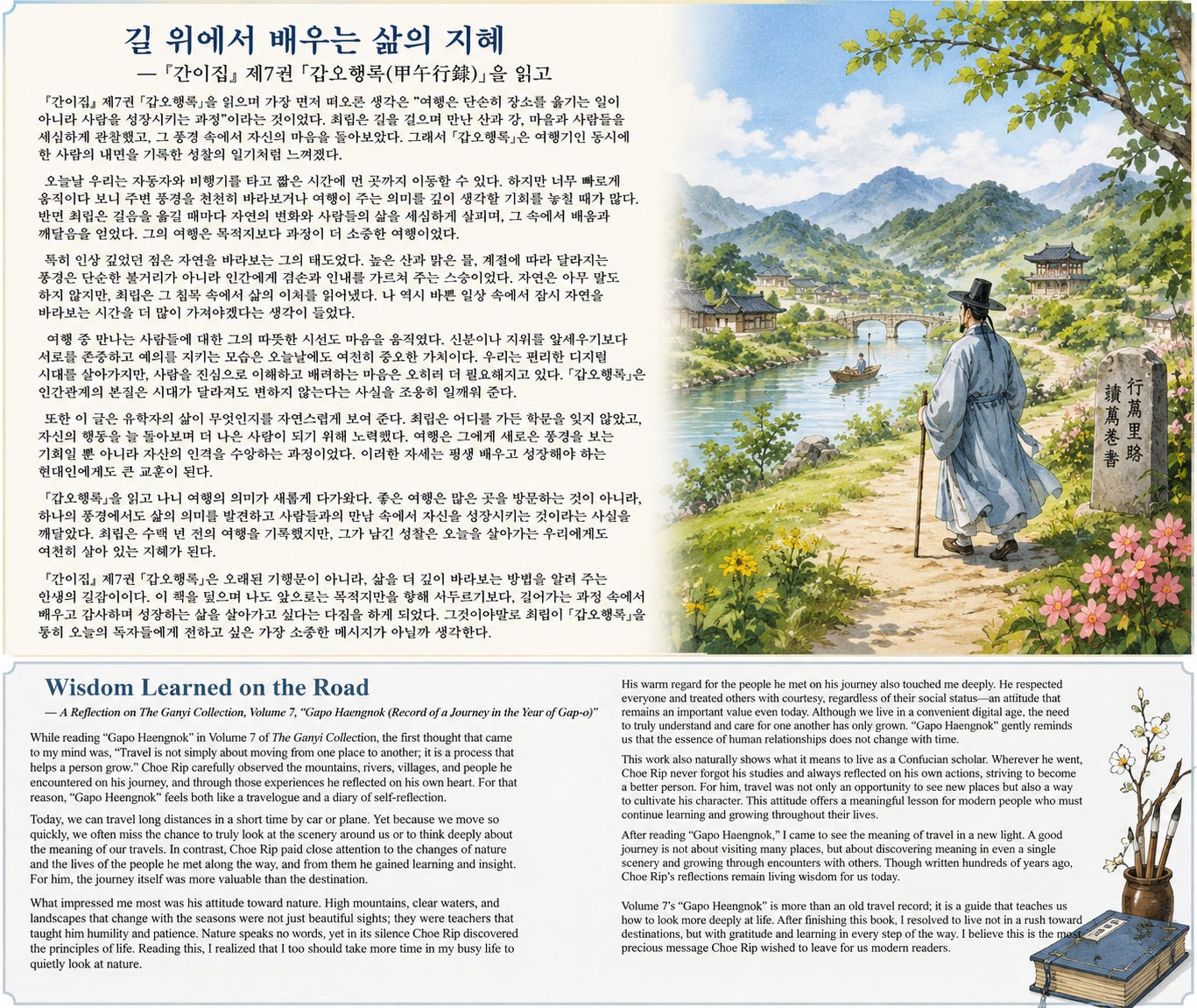
Wisdom Learned Along the Journey
A Reflection on “Gapo Haengnok (Record of a Journey in the Gapo Year)” from The Gani-jio, Volume 7
As I read Gapo Haengnok in Volume 7 of The Gani-jip, the first thought that came to my mind was that travel is not simply about moving from one place to another—it is a journey that shapes a person’s character. Throughout his travels, Choe Rip carefully observed the mountains, rivers, villages, and the people he encountered. More importantly, he used these experiences as opportunities to reflect on his own heart and mind. In this sense, Gapo Haengnok is not merely a travel journal but also a diary of self-examination and personal growth.
Today, we can travel great distances in just a few hours by car or airplane. Yet because we move so quickly, we often overlook the beauty around us and miss the deeper meaning that travel can offer. Choe Rip, by contrast, appreciated every step of his journey. He observed the changing landscapes, learned from the people he met, and discovered wisdom through each experience. For him, the journey itself was far more valuable than simply reaching the destination.
One aspect that particularly impressed me was his attitude toward nature. Towering mountains, flowing rivers, and the changing seasons were not merely beautiful scenery; they were silent teachers of humility, patience, and perseverance. Nature never speaks with words, yet Choe Rip found profound lessons within its quiet presence. Reading his reflections reminded me that I, too, should slow down amid the busyness of everyday life and spend more time appreciating the natural world.
Equally moving was his warm regard for the people he met along the way. Rather than emphasizing social rank or status, he treated everyone with courtesy and respect. These virtues remain just as important today as they were centuries ago. Although modern technology has made communication easier than ever, genuine understanding and sincere compassion for others have become increasingly precious. Gapo Haengnok gently reminds us that the essence of meaningful human relationships never changes.
The work also reveals the true spirit of a Confucian scholar. Wherever Choe Rip traveled, he never neglected his pursuit of learning. He constantly reflected on his own conduct and sought to become a better person. For him, travel was not only an opportunity to experience new places but also a lifelong practice of self-cultivation. His example offers an inspiring lesson for modern readers, reminding us that learning and personal growth should continue throughout our lives.
After finishing Gapo Haengnok, I came to see travel in a new light. A truly meaningful journey is not measured by the number of places we visit, but by our ability to discover wisdom in every landscape and to grow through every encounter with others. Although Choe Rip recorded his travels more than four hundred years ago, the insights he left behind continue to speak powerfully to readers today.
Gapo Haengnok is far more than an old travel record; it is a timeless guide that teaches us how to observe life more deeply. As I closed the book, I resolved not to rush merely toward my destination, but to appreciate every step of the journey, learning with gratitude and growing through each experience. I believe this is the most enduring message that Choe Rip wished to pass on to future generations through Gapo Haengnok. +++
{Solti}
July 21, 2026
길 위에서 배우는 삶의 지혜
『간이집』 제7권 「갑오행록」을 읽고
『간이집』 제7권 「갑오행록」을 읽으며 가장 먼저 떠오른 생각은 “여행은 단순히 장소를 옮기는 일이 아니라 사람을 성장시키는 과정”이라는 것이었다. 최립은 길을 걸으며 만난 산과 강, 마을과 사람들을 세심하게 관찰했고, 그 풍경 속에서 자신의 마음을 돌아보았다. 그래서 「갑오행록」은 여행기인 동시에 한 사람의 내면을 기록한 성찰의 일기처럼 느껴졌다.
오늘날 우리는 자동차와 비행기를 타고 짧은 시간에 먼 곳까지 이동할 수 있다. 하지만 너무 빠르게 움직이다 보니 주변 풍경을 천천히 바라보거나 여행이 주는 의미를 깊이 생각할 기회를 놓칠 때가 많다. 반면 최립은 걸음을 옮길 때마다 자연의 변화와 사람들의 삶을 세심하게 살피며, 그 속에서 배움과 깨달음을 얻었다. 그의 여행은 목적지보다 과정이 더 소중한 여행이었다.
특히 인상 깊었던 점은 자연을 바라보는 그의 태도였다. 높은 산과 맑은 물, 계절에 따라 달라지는 풍경은 단순한 볼거리가 아니라 인간에게 겸손과 인내를 가르쳐 주는 스승이었다. 자연은 아무 말도 하지 않지만, 최립은 그 침묵 속에서 삶의 이치를 읽어냈다. 나 역시 바쁜 일상 속에서 잠시 자연을 바라보는 시간을 더 많이 가져야겠다는 생각이 들었다.
여행 중 만나는 사람들에 대한 그의 따뜻한 시선도 마음을 움직였다. 신분이나 지위를 앞세우기보다 서로를 존중하고 예의를 지키는 모습은 오늘날에도 여전히 중요한 가치이다. 우리는 편리한 디지털 시대를 살아가지만, 사람을 진심으로 이해하고 배려하는 마음은 오히려 더 필요해지고 있다. 「갑오행록」은 인간관계의 본질은 시대가 달라져도 변하지 않는다는 사실을 조용히 일깨워 준다.
또한 이 글은 유학자의 삶이 무엇인지를 자연스럽게 보여 준다. 최립은 어디를 가든 학문을 잊지 않았고, 자신의 행동을 늘 돌아보며 더 나은 사람이 되기 위해 노력했다. 여행은 그에게 새로운 풍경을 보는 기회일 뿐 아니라 자신의 인격을 수양하는 과정이었다. 이러한 자세는 평생 배우고 성장해야 하는 현대인에게도 큰 교훈이 된다.
『갑오행록』을 읽고 나니 여행의 의미가 새롭게 다가왔다. 좋은 여행은 많은 곳을 방문하는 것이 아니라, 하나의 풍경에서도 삶의 의미를 발견하고 사람들과의 만남 속에서 자신을 성장시키는 것이라는 사실을 깨달았다. 최립은 수백 년 전의 여행을 기록했지만, 그가 남긴 성찰은 오늘을 살아가는 우리에게도 여전히 살아 있는 지혜가 된다.
『간이집』 제7권 「갑오행록」은 오래된 기행문이 아니라, 삶을 더 깊이 바라보는 방법을 알려 주는 인생의 길잡이이다. 이 책을 덮으며 나도 앞으로는 목적지만을 향해 서두르기보다, 걸어가는 과정 속에서 배우고 감사하며 성장하는 삶을 살아가고 싶다는 다짐을 하게 되었다. 그것이야말로 최립이 「갑오행록」을 통해 오늘의 독자들에게 전하고 싶은 가장 소중한 메시지가 아닐까 생각한다. +++
2026년 7월 21일
{솔티}
{솔티}

Prof. Dr. Young Choi (Editor in Chief) — Regent University
Young B. Choi is a Professor in the Department of Engineering & Computer Science at Regent University. He published 38 books with ‘Selected Readings in Cybersecurity’ (2018) (over 800 copies archived globally at university/college libraries around the world) and ‘Cybersecurity Applications and Artificial Intelligence’ (2023) available in seven major world languages. He proposed the world’s first global and universal telecommunications “Service Order Handling (SOH)” Model (T-SOH Model) (1995) with Dr. Adrian Tang. With this innovative research work, he received the IEEE NOMS ’96 Best Paper Award and became the first recipient of the Outstanding Contribution Award of the TeleManagement Forum in 1998. His research areas include Natural Language Processing-focused AI, AI-applied cybersecurity, network and telecom service management, and Korean studies on Gani Choi Rip’s Jeonggwan (靜觀: Quiet Contemplation) philosophy and Shilhak ( 實學: Practical Learning).