

EXECUTIVE SUMMARY
Yi Sang and Anton Chekhov portray individuals whose desire for change, freedom, or meaningful action is constrained by inner fragmentation, social conditions, habit, fear, illness, dependence, and other forces beyond easy control. Yi Sang’s experimental modernism reveals a divided and unstable self-struggling to become coherent enough to act, while Chekhov’s restrained realism shows relatively ordinary people who often understand what should change yet remain unable to move beyond routines, obligations, fatigue, or hesitation. Read together, their works illuminate broader forms of constrained human agency that extend beyond literature to war, disaster, poverty, displacement, illness, aging, and other life situations in which people may still possess desire and dignity even when their practical ability to act, escape, or change their circumstances has narrowed.
Keywords: Yi Sang; Chekhov; human agency; constrained action; fragmentation; freedom
1. Introduction
My first indirect encounter with Yi Sang occurred during my first year of high school in Korea (서울고등학교). One student in my class rarely spoke, formed almost no visible relationships, and came to school each day in silence, as though he were physically present but psychologically separated from everyone around him. The only thing I knew about him was that he often read the works of Yi Sang. At that age, I could not understand either the student or the writer who seemed to attract him, but the image remained with me: a young person surrounded by classmates yet living in a private world of silence, distance, and fragmentation.
Only much later did I begin to understand why Yi Sang’s writing might speak so powerfully to someone who felt detached from ordinary social life. His works enter states of confinement, dependence, divided identity, bodily weakness, and the longing to escape from a life that no longer feels coherent. More recently, I came to know Anton Chekhov, whose characters are usually less visibly fragmented but often equally unable to move toward the lives they desire. They speak, work, remember, and imagine a better future, yet remain trapped by habit, fear, fatigue, social obligation, and postponed action. Yi Sang’s figures long to fly from an enclosed existence, while Chekhov’s ordinary people often know what should be done but cannot bring themselves to do it (Kim, 2013; Yi Sang, 2020).
This article is written not from the standpoint of a literary specialist, but from that of a literature-loving global supply chain scholar interested in the broader life ecosystem of people whose ability to act is constrained by illness, poverty, dependency, displacement, aging, or other difficult circumstances. Using Yi Sang and Chekhov as interpretive lenses, it seeks to understand such lives more carefully, recognizing hidden suffering, fragmentation, and inaction while encouraging readers to observe with greater patience, judge less quickly, and respond with dignity and compassionate presence.
2. Yi Sang: Fragmentation and the Longing to Fly
Yi Sang’s short life, experimental writings, and divided narrators reveal a modern consciousness confined by illness, dependence, colonial disruption, and an uncertain longing for escape.
2.1. Life, Colonial Modernity, and Personal Confinement
Yi Sang was born Kim Hae-gyeong in Seoul in 1910, during the period of Japanese colonial rule. He studied architecture and worked as a technical draftsman, experiences that later influenced his fascination with numbers, geometry, spatial enclosure, repetition, and mechanical forms. His life unfolded within a rapidly changing colonial city in which modern buildings, technologies, and cultural influences appeared alongside political domination, social dislocation, and uncertain identity. These conditions helped shape a literary imagination that viewed modern life not simply as progress, but also as confinement, fragmentation, and estrangement (Kim, 2013; Literature Translation Institute of Korea, n.d.).
Yi Sang also suffered from serious illness, including tuberculosis, and died in Tokyo in 1937 at only twenty-six years of age. His short life was marked by physical weakness, unstable work, financial difficulty, complicated relationships, and a persistent sense of psychological enclosure. Although his biography should not be used to explain every aspect of his writing, illness and colonial modernity clearly form an important background to his concern with the body, restricted space, dependency, and limited freedom. Where Chekhov developed a broad and compassionate view of ordinary society over many years, Yi Sang wrote from within a more compressed, unstable, and deeply fractured world (Literature Translation Institute of Korea, n.d.; Yi Sang, 2020).
2.2. Major Works and Experimental Style
Yi Sang is best known for works such as Wings (Nalgae), the Crow’s-Eye View (Ogamdo) poems, “The Spider Met a Pig,” and other experimental poems and stories that challenged conventional literary form. Wings presents a narrator living in dependency and isolation, moving between confinement in a room and brief attempts to enter the outside world. Rather than following a conventional path of development or resolution, the story conveys confusion, passivity, humiliation, bodily weakness, and a persistent desire to escape from an existence the narrator only partly understands (Yi Sang, 2020).
His writing frequently uses repetition, broken syntax, shifting perspectives, mathematical signs, architectural imagery, mirrors, rooms, streets, and divided bodies. These methods do more than describe alienation; they make the reader experience uncertainty and disorientation. Yi Sang’s work may appear difficult because it does not organize reality into a stable sequence. The fragmented form reflects a fragmented consciousness. Where Chekhov creates depth through ordinary conversation and restrained realism, Yi Sang creates meaning through disruption, instability, and the breakdown of familiar language (Kim, 2013; Yi Sang, 2020).
2.3. Central Ideas: The Divided Self, Enclosure, and Escape
A central concern in Yi Sang’s work is the divided self. His narrators often seem detached from their own bodies, actions, and surroundings. They observe themselves as though they were both subject and object, participant and spectator, imprisoned person and uncertain observer. This division makes purposeful action difficult. The problem is not merely that the character lacks courage or opportunity; the self itself may no longer feel sufficiently whole to choose, act, or sustain a direction (Yi Sang, 2020).
Enclosure and escape therefore become recurring themes. Rooms, windows, mirrors, urban streets, illness, marriage, money, and dependence can all function as structures of confinement. Yet the desire to escape remains present, most memorably in the longing to grow wings and fly. That desire is powerful precisely because freedom remains uncertain and perhaps impossible. Yi Sang’s lasting significance lies in his ability to express forms of psychological suffering that ordinary language often fails to capture. His work reminds readers that some people do not simply struggle to change their circumstances; they struggle to experience themselves as coherent persons capable of change (Kim, 2013; Yi Sang, 2020).
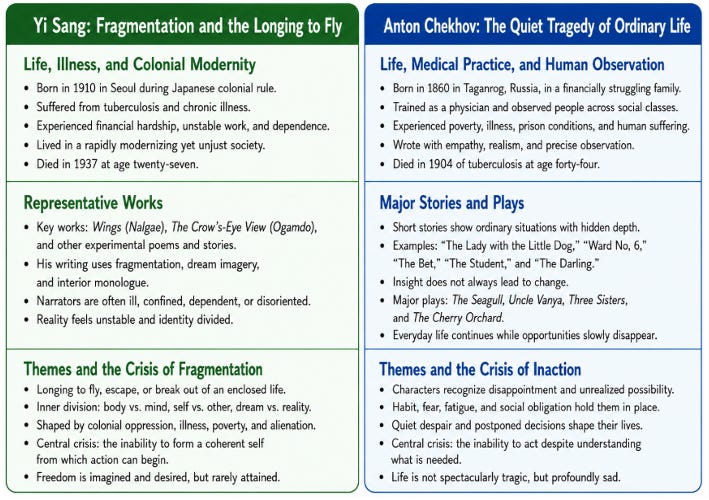
Figure 1 compares Yi Sang and Anton Chekhov as writers who illuminate two related crises of human agency: Yi Sang portrays fragmented selves shaped by illness, dependence, colonial modernity, and longing for escape, while Chekhov depicts relatively coherent individuals who recognize the need for change yet remain constrained by habit, fear, fatigue, and social obligation. Together, they show that human freedom may be limited either by fragmentation within the self or by paralysis within ordinary life.
Figure 1
A Comparative Overview of Yi Sang and Chekhov: Two Crises of Human Agency
Source: Author’s Own Compilation
3. Anton Chekhov: The Quiet Tragedy of Ordinary Life
Chekhov’s life, major works, and central themes reveal how ordinary people may recognize their disappointments and unrealized possibilities yet remain unable to change the direction of their lives.
3.1. Life, Medical Practice, and Human Observation
Anton Chekhov was born in 1860 in Taganrog, a provincial port city in southern Russia, into a financially struggling family dominated by a strict and deeply religious father. His childhood combined discipline, insecurity, family responsibility, and exposure to the lives of merchants, laborers, teachers, clergy, and ordinary townspeople. After his father’s business failed, most of the family moved to Moscow, while the young Chekhov temporarily remained behind to complete his schooling and support himself. These early experiences taught him that outwardly respectable families could contain fear, humiliation, financial pressure, and emotional suffering (Loehlin, 2010).
Chekhov later studied medicine in Moscow and supported his family by writing humorous sketches and short stories for popular publications. Medicine became more than a profession; it expanded his contact with sickness, poverty, loneliness, and death across different social classes. He continued treating patients even after becoming an established writer and undertook an arduous journey to the Sakhalin penal colony, where he investigated the conditions of prisoners and settlers. Chekhov suffered from tuberculosis for many years and died in 1904 at the age of forty-four, yet he produced a body of work that profoundly influenced the modern short story and drama (Loehlin, 2010).
3.2. Major Stories and Plays
Chekhov wrote hundreds of short works that portray apparently ordinary situations while gradually revealing moral, emotional, and psychological depth. Stories such as “The Lady with the Little Dog,” “Ward No. 6,” “The Bet,” “The Student,” “The Darling,” and “The Death of a Government Clerk” explore love, isolation, fear, self-deception, institutional indifference, and the unpredictable moments through which people become aware of themselves. His stories often resist dramatic resolutions. A character may experience an insight without possessing the courage or opportunity to transform that insight into sustained action (Chekhov, 2000; Loehlin, 2010).
His major plays, The Seagull, Uncle Vanya, Three Sisters, and The Cherry Orchard, helped reshape modern theater. Their characters eat, visit, complain, remember, work, and speak about the future, while the most important conflicts frequently remain beneath the surface. Love is misplaced, opportunities disappear, estates decline, and years pass while people continue hoping that life will somehow improve. These plays became closely associated with the Moscow Art Theatre and demonstrated that dramatic power could arise from silence, interruption, mood, and unresolved longing, not only from spectacular action (Chekhov, 2006; Peace, 1983).
3.3. Central Ideas: Paralysis, Compassion, and Unfinished Life
A central feature of Chekhov’s work is the distance between what people understand and what they are able to do. His characters often recognize that their work is meaningless, their relationships are damaged, their talents are being wasted, or their lives require change. Yet recognition does not automatically produce action. Habit, fear, social obligation, exhaustion, economic dependence, and uncertainty hold them in place. Chekhov’s tragedy is therefore rarely created by one catastrophic event; it develops through delayed decisions, unspoken feelings, neglected responsibilities, and years that quietly disappear (Chekhov, 2000, 2006; Loehlin, 2010).
Chekhov observes this paralysis without reducing his characters to moral failures. He allows readers to see their vanity, laziness, selfishness, and weakness, while also recognizing their loneliness and desire for dignity. His restrained style does not tell readers exactly whom to condemn or how every problem should be resolved. It asks them to pay closer attention to the complicated human beings before them. Chekhov’s enduring lesson is that ordinary life can become tragic when people continue living without confronting what they already know. His characters remain recognizable because many people still postpone difficult conversations, tolerate empty routines, and wait for a better future while the present steadily passes away (Loehlin, 2010; Peace, 1983).
4. Discussion: When People Cannot Fly or Act
Human responses to emergencies vary considerably according to individual orientation, circumstances, available resources, and the surrounding social environment (Hong & Hyun, 2025). Yi Sang and Chekhov provide complementary literary lenses for understanding why people may desire change yet remain unable to act. Some people cannot act because war has destroyed the conditions of ordinary life; others are immobilized by natural disaster, extreme poverty, displacement, illness, or aging. In these circumstances, “unable to fly” and “unable to act” are not merely metaphors for psychological hesitation. They become descriptions of people whose freedom has been materially restricted by forces much larger than themselves.
4.1. Lives Trapped by War and Disaster
The realities of war offer perhaps the starkest contemporary expression of being unable to fly or act. On the Ukrainian front and in communities repeatedly exposed to bombardment, ordinary civilians may want nothing more complicated than to remain with their families, continue working, educate their children, or return home. Yet homes can disappear, communities can be divided, transportation disrupted, and familiar choices suddenly narrowed to evacuation, shelter, military service, separation, or survival. The individual may possess courage and determination, but personal agency operates inside circumstances that no individual created and few individuals can control (UNHCR, 2026).
Natural disasters create a similar, though different, form of confinement. In disaster-stricken communities from Nepal to Latin America, earthquakes, floods, landslides, and infrastructure failures can abruptly remove the material foundations that make purposeful action possible. A person may want to rebuild a home, return to work, protect children, or relocate to safety but lack transportation, financial resources, secure shelter, medical care, or functioning public institutions. What appears from a distance to be passivity may therefore be constrained agency. Yi Sang’s image of longing for flight acquires a concrete social meaning: people may intensely desire another future while having few immediate means of reaching it (World Bank, 2025a, 2025b).
Chekhov adds another dimension to this condition. His characters remind us that suffering does not always produce dramatic action. Under prolonged uncertainty, people may continue performing ordinary routines even when their world has become unstable. War and disaster can therefore create both Yi Sang’s enclosure and Chekhov’s paralysis: the person wants release but cannot escape, understands that something must be done but discovers that the available choices are painfully limited.
4.2. Poverty and the Absence of Conditions for Human Growth
Extreme poverty presents a quieter but equally consequential form of being unable to act. People struggling without reliable food, clean water, housing, education, healthcare, electricity, transportation, or employment may possess intelligence, ambition, and willingness to work yet remain unable to convert those qualities into meaningful opportunities. Poverty is therefore not simply a shortage of income. It can become a restriction on the range of actions a person can realistically undertake (World Bank, 2026).
A child without adequate nutrition or schooling cannot develop capabilities in the same way as a child whose basic needs are secure. A parent living from one uncertain day to the next may understand the importance of education, savings, preventive healthcare, or long-term planning but be forced continually to choose immediate survival instead. From the outside, such lives can mistakenly be interpreted through the language of insufficient initiative. Chekhov and Yi Sang encourage a more careful interpretation: before asking why someone has failed to act, we should ask whether the person actually possessed the conditions necessary for action.
This distinction is important because human flourishing requires more than personal motivation. Freedom becomes meaningful when people have at least some realistic capacity to exercise it. Food, shelter, security, education, health, relationships, and institutional stability provide the ground from which people can imagine and pursue a future. Without them, the desire to “fly” may remain powerful while the means of flight remain unavailable (World Bank, 2026).
4.3. When the Body and Mind No Longer Permit Action
Later life reveals another form of constrained agency: an older person may retain memories, relationships, desires, and a strong wish for independence while illness, dementia, sensory disturbance, frailty, or approaching death gradually reduces the ability to act. I knew an elderly woman who remained relatively healthy until about age ninety-two, when she began experiencing persistent voices and sounds that no one around her could hear; despite medical treatment, prayer, counseling, and daily visits from her son and daughter, the experience continued for nearly four years and remained deeply distressing.
She wanted to escape from the world that had enclosed her, regain control, and return to the ordinary reality shared by those around her, yet increasingly she could not act. Her experience brings together Yi Sang’s longing to fly from unbearable confinement and Chekhov’s painful distance between desire and action, reminding us that war, disaster, poverty, illness, and aging can all leave freedom intensely desired but severely constrained; in such circumstances, the most humane response may be protection, material support, accompaniment, and patient presence.
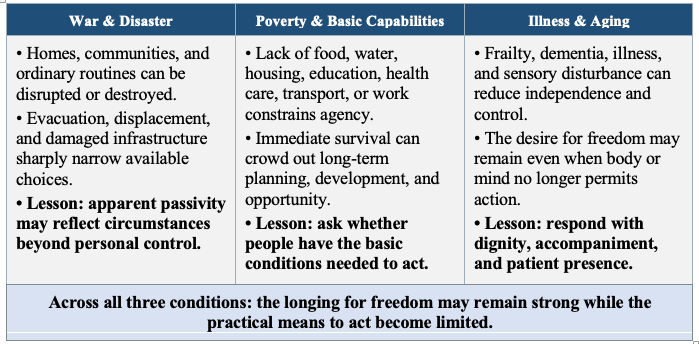
Figure 2 extends the literary comparison into three contemporary conditions in which human agency can be severely constrained: war and disaster, poverty and limited basic capabilities, and illness and aging. Across these settings, people may retain desire, judgment, and dignity even when the practical means to act, escape, or change their circumstances have narrowed.
War & DisasterPoverty & Basic CapabilitiesIllness & AgingHomes, communities, and ordinary routines can be disrupted or destroyed.Lack of food, water, housing, education, health care, transport, or work constrains agency.Frailty, dementia, illness, and sensory disturbance can reduce independence and control.Evacuation, displacement, and damaged infrastructure sharply narrow available choices.Immediate survival can crowd out long-term planning, development, and opportunity.The desire for freedom may remain even when body or mind no longer permits action.Lesson: apparent passivity may reflect circumstances beyond personal control.Lesson: ask whether people have the basic conditions needed to act.Lesson: respond with dignity, accompaniment, and patient presence.
Across all three conditions: the longing for freedom may remain strong while the practical means to act become limited.
Figure 2
When People Cannot Fly or Act: Three Conditions of Constrained Agency
Source: Author’s Own Synthesis
Chekhov: Interpretive Insight
We know what must change, yet let life pass without acting.
5. Conclusion
Anton Chekhov and Yi Sang reveal two related forms of human brokenness: Chekhov portrays people who understand their circumstances but remain unable to act, while Yi Sang enters the fragmented consciousness of individuals who can no longer experience themselves or their world as coherent. Their works teach ordinary readers to look beneath silence, passivity, confusion, and unusual behavior before judging another person, because apparently familiar lives may conceal loneliness, illness, fear, dependency, and realities that feel like hell. These insights become especially meaningful in later life and hospice care, where dementia, physical decline, unresolved memories, and approaching death may leave individuals unable to communicate their needs through ordinary language, even though dementia is not an inevitable or normal consequence of aging. Chekhov and Yi Sang ultimately enrich our lives by calling us to act before opportunities disappear, accompany people whose inner worlds we cannot fully understand, and protect human dignity through attentive and faithful presence until the end.
References
Chekhov, A. (2000). Selected stories of Anton Chekhov (R. Pevear & L. Volokhonsky, Trans.). Bantam Books.
Chekhov, A. (2006). The complete plays (L. Senelick, Trans.). W. W. Norton.
Hong, P. C., & Hyun, Y. R. (2025). 17 Impact of diverse orientations in human emergency responses. Education and Pedagogical Experiences: Coping with Human Emergencies and Exploring Resilience Strategies, 277.
Kim, Y.-M. (2013). Colonial modernity and the avant-garde imagination of Yi Sang. Korea Journal, 53(4), 36–66.
Literature Translation Institute of Korea. (n.d.). Yi Sang. Digital Library of Korean Literature.
Loehlin, J. N. (2010). The Cambridge introduction to Chekhov. Cambridge University Press.
National Institute on Aging. (2021). What are palliative care and hospice care? U.S. Department of Health and Human Services. https://www.nia.nih.gov/health/hospice-and-palliative-care/what-are-palliative-care-and-hospice-care
National Institute on Aging. (2024). Care in the last stages of Alzheimer’s disease. U.S. Department of Health and Human Services. https://www.nia.nih.gov/health/alzheimers-caregiving/care-last-stages-alzheimers-disease
Peace, R. (1983). Chekhov: A study of the four major plays. Yale University Press.
UNHCR. (2026, May 22). UNHCR appalled by attacks on aid operations and rising civilian toll in Ukraine. https://www.unhcr.org/ua/en/news/briefing-notes/unhcr-appalled-attacks-aid-operations-and-rising-civilian-toll-ukraine
World Bank. (2025a, November 5). ADB, IDA, and Switzerland partner to strengthen Nepal’s disaster risk management and build climate-resilient infrastructure. https://www.worldbank.org/en/news/press-release/2025/11/05/adb-ida-and-switzerland-partner-to-strengthen-nepal-s-disaster-risk-management-and-build-climate-resilient-infrastructur
World Bank. (2025b, June 30). Strengthening disaster resilience and response in Latin America and the Caribbean. https://www.worldbank.org/en/results/2025/06/30/strengthening-disaster-resilience-and-response-in-lac
World Bank. (2026, April). Multidimensional poverty measure. https://www.worldbank.org/en/topic/poverty/brief/multidimensional-poverty-measure
World Health Organization. (2020). Palliative care. https://www.who.int/news-room/fact-sheets/detail/palliative-care
World Health Organization. (2023). Dementia. https://www.who.int/news-room/fact-sheets/detail/dementia
Yi Sang. (2020). Yi Sang: Selected works (D. Jack, S. Chung, J. H. Park, & W. K. Lew, Trans.). Wave Books.
ABOUT THE AUTHOR
Paul C. Hong
Distinguished University Professor, University of Toledo
Paul C. Hong is a Distinguished University Professor at the University of Toledo whose research spans supply chain management, leadership, governance, and decision-making. Drawing on more than two decades of scholarship on organizational resilience, competitiveness, and long-term development, he has become increasingly interested in how individuals confront suffering, responsibility, isolation, and the search for meaning across the life course. His engagement with literature, biography, history, and philosophy reflects a broader effort to understand the hidden dimensions of human behavior that conventional analysis may overlook. He believes that literature can help ordinary readers observe suffering more carefully, judge others less quickly, and protect human dignity through responsible action and faithful presence.
Original Article.

Suggested Citation
Hong, P. C. (2026, September 3). Yi Sang and Anton Chekhov: Longing to fly and unable to act. K-GSP Forum, pp. 1–11.
한글요약
이상과 안톤 체호프: 날아갈 수 없고 움직일 수 없는 삶
폴 C. 홍(Paul C. Hong)은 미국 톨레도대학교의 석좌교수로, 공급망 관리·리더십·거버넌스·의사결정을 연구하며 고전문학과 철학을 인간의 성장과 책임 있는 리더십의 관점에서 탐구하고 있다. 저자가 고등학교 1학년 때 만난 한 학생은 누구와도 거의 어울리지 않은 채 조용히 이상(李箱)의 작품을 읽었고, 그 기억은 오랫동안 침묵과 고립, 내면의 분열에 대한 질문으로 남았다. 이후 안톤 체호프를 접하면서 저자는 두 작가가 서로 다른 시대와 문학적 방식으로 인간이 왜 자신이 원하는 삶을 살지 못하는지를 보여준다는 사실에 주목했다.
이상은 1910년 일제강점기 서울에서 김해경이라는 이름으로 태어나 건축을 공부하고 제도사로 일했다. 숫자, 기하학, 방, 거울, 거리, 반복과 분절된 문장은 그의 건축적 감각과 식민지 근대의 불안정한 현실을 반영한다. 「날개」와 「오감도」를 비롯한 그의 작품은 질병, 경제적 의존, 심리적 폐쇄, 분열된 정체성과 탈출의 욕망을 실험적 언어로 표현한다. 체호프의 인물들이 사회적 관계 속에서 무엇을 해야 하는지 알면서도 행동하지 못한다면, 이상의 인물들은 몸과 마음, 현실과 꿈, 자기와 타인의 경계가 흔들려 행동할 수 있는 안정된 자아 자체를 잃어간다. 「날개」의 비상 욕망은 자유에 대한 강렬한 열망을 상징하지만, 그 자유가 실제로 가능한지는 끝내 불확실하다.
체호프는 가난한 가정에서 성장해 가족을 부양하며 의학을 공부했고, 의사와 작가로 살아가면서 질병·빈곤·외로움·착취 속의 인간을 깊이 관찰했다. 그의 사할린 조사와 진료 경험은 인간의 고통과 존엄을 이상화하지 않고 바라보는 시각을 형성했으며, 이러한 관찰은 그의 단편과 희곡에 깊이 반영되었다. 체호프의 작품은 사람들이 무엇이 필요한지 알면서도 침묵과 망설임, 지연 속에서 중요한 기회를 놓치는 모습을 보여주며, 그는 그들의 나약함을 비난하기보다 연민 어린 시선으로 바라본다.
두 작가의 가장 중요한 차이는 ‘행동의 마비’와 ‘자아의 분열’이다. 이상은 식민지 현실, 질병, 의존, 도시적 소외 속에서 개인이 자기 자신과 세계를 일관되게 경험하지 못하는 상태를 보여준다. 체호프는 익숙한 가정, 직장, 마을과 인간관계 속에서 사람들이 습관, 두려움, 피로, 사회적 의무 때문에 삶을 바꾸지 못하는 모습을 그린다. 그러나 두 사람은 모두 겉으로 평범해 보이는 삶이 실제로는 외로움, 고통, 의존과 절망을 품고 있음을 드러낸다. 체호프는 타인을 성급히 판단하기 전에 그가 말하지 못한 고통을 살피라고 가르치고, 이상은 일반적인 논리와 언어만으로는 이해할 수 없는 내면의 혼란이 존재함을 일깨운다.
두 작가의 통찰은 전쟁과 재난, 빈곤, 질병과 노화처럼 인간의 선택과 행동 가능성을 실제로 제한하는 조건으로 확장된다. 전쟁과 재난은 삶의 터전과 일상의 선택을 무너뜨리고, 빈곤은 식량·주거·교육·의료와 같은 기본 역량을 제한하며, 질병과 노화는 행동과 독립성을 점차 축소시킬 수 있다. 이런 상황에서도 사람은 더 나은 삶과 자유를 원하지만 실제로 움직이거나 벗어날 수 있는 수단을 잃을 수 있으며, 특히 노년·치매·호스피스 돌봄에서는 설명보다 익숙한 목소리, 따뜻한 손길, 존중하는 침묵과 지속적인 동행이 더 중요할 때가 있다. 체호프와 이상을 함께 읽는다는 것은 타인의 무기력함을 성급히 판단하지 않고 그가 행동할 수 있는 조건을 먼저 살피며, 필요한 경우 물질적 지원, 돌봄과 동행을 통해 삶의 마지막 순간까지 인간의 존엄을 지키는 법을 배우는 일이다.
© K-Global Scholars and Professionals Forum. September 2026. All rights reserved. Content published in the K-GSP Forum may not be reproduced, distributed, or transmitted in any form without prior written permission from the K-GSP Forum, except for brief quotations with full attribution.
저는 University of Illinois at Urbana-Champaign에서 체호프의 「바냐 아저씨(Uncle Vanya)」 연극과 작품을 통해, 질적 사례연구(qualitative case study) 방법을 공부한 적이 있습니다. 희곡 한 편을 사례로 놓고 인물의 말과 침묵, 관계와 상황을 반복해 분석하고 새로운 통찰을 끌어내는 훈련이었는데, 그때 슬라브 민족 특유의 염세적 인생관과 그 안에 담긴 깊은 철학적 통찰에 강한 인상을 받았습니다. 바냐 아저씨가 자신의 삶이 헛되었음을 깨닫는 순간, 그 깨달음이 아무것도 바꾸지 못한 채 다시 일상으로 돌아가는 장면은 지금도 선명합니다.
한국인으로서 건축학도였던 천재 시인 이상의 이름은 익숙합니다. 하지만 그의 작품을 이해하는 일은 늘 어렵기만 했습니다. 「건축무한육면각체(建築無限六面角體)」를 읽으며 원래 전공하던 기계공학 분야의 카오스 이론이 말하는 복잡계를 떠올려보기도 했지만, 그렇다고 작품이 이해되는 것은 아니었습니다. 어쩌면 이해되지 않는다는 그 사실 자체가 이상이 우리에게 남긴 경험인지도 모르겠습니다.
그래서 이상과 체호프를 나란히 놓고 두 사람의 대비되는 점과 공통점을 짚어낸 이 글이 더욱 독특하게 읽힙니다. 두 작가가 처했던 염세적 인생관과 암울한 현실 속 지식인의 갈등은 서로 닮아 있습니다. 그러나 그 대응이 한쪽은 '자아의 분열'로, 다른 한쪽은 '행동의 마비'로 나타난다는 통찰은 매우 예리합니다. 체호프의 인물은 자기가 누구인지 알면서 움직이지 못하고, 이상의 인물은 움직일 자아 자체를 잃어갑니다. 같은 시대의 압력이 서로 다른 지점에서 사람을 무너뜨린다는 이야기입니다.
이 구분은 문학을 넘어섭니다. 조직에서도, 돌봄의 현장에서도 우리는 주변상황에 무기력한 사람을 종종 만납니다. 그가 알면서 못 하는 것인지, 아니면 판단할 자기 자신이 이미 흩어진 것인지를 구별하지 못하면 우리의 도움은 번번이 빗나갑니다.
인류에게 가장 어려운 작품을 남긴 두 천재를 대비시켜 그들이 던지는 질문을 끌어낸 이 글은 인간에 대한 한 단계 높은 이해를 촉구합니다. 매우 소중한 글입니다.