

EXECUTIVE SUMMARY
Yuval Noah Harari’s four major works—Sapiens, Homo Deus, 21 Lessons for the 21st Century, and Nexus (2024)—offer an ambitious interpretation of humanity’s past, technological future, and contemporary challenges through the interaction of biology, shared narratives, institutions, and information systems. His greatest strength lies in synthesizing history, technology, culture, and human behavior into accessible grand narratives, while his principal limitations concern historical simplification, speculative forecasting, and insufficient attention to institutional complexity and human agency. Taken together, Harari’s writings provide a provocative framework for understanding the AI era, particularly the changing relationships among technology, power, meaning, and the future role of human beings.
Keywords: Yuval Noah Harari; artificial intelligence; human agency; technological change; grand narrative
1. Introduction
As artificial intelligence began to transform business, education, politics, work, and everyday life, I purchased and read Yuval Noah Harari’s major books—Sapiens: A Brief History of Humankind, Homo Deus: A Brief History of Tomorrow, 21 Lessons for the 21st Century, and most recently Nexus: A Brief History of Information Networks from the Stone Age to AI—as an important introduction to understanding the emerging AI era. Taken together, these books offer an unusually broad intellectual journey: Sapiens examines how human beings came to dominate the world through cooperation and shared narratives; Homo Deus considers how biotechnology, algorithms, and intelligent machines may reshape humanity’s future; 21 Lessons addresses the political, social, and existential challenges of contemporary technological disruption; and Nexus places AI within the much longer history of information networks. Harari’s ability to connect history, biology, technology, politics, and philosophy makes his work highly useful for readers seeking to understand the scale of the changes now taking place (Harari, 2015, 2017, 2018, 2024).
Yet the more I read Harari, the more his writings generated questions rather than simply providing answers. His warnings about algorithms, information networks, manipulation, loss of human control, and potentially non-human intelligence are valuable precisely because they force readers to confront risks that conventional technological optimism may underestimate. Nexus, for example, explicitly considers both the promises and threats of the AI revolution and argues that technological outcomes are not predetermined but depend on human choices. Nevertheless, such warnings raise a deeper question: Are we in danger of concentrating so intensely on what AI may do to humanity that we give insufficient attention to what human beings, organizations, institutions, and political systems may choose to do with AI? (Harari, 2024).
In this research note, I use the term AI Monster Fallacy as my interpretive extension of the debate about AI and human responsibility, drawing also on a related chapter coauthored with Young Soo Park (Hong & Park, 2027). The term does not originate in Harari’s books and should not be mistaken for his own argument. It identifies a tendency in some public discussion to portray AI principally as an independent external “monster” while giving insufficient attention to decisions about its design, deployment, incentives, oversight, and accountability. This concern does not deny the genuine risks of increasingly autonomous AI systems, including unforeseen behavior, loss of control, and scalable harms; it instead asks how technical safeguards and responsible institutions can jointly address those risks.
From this perspective, Harari’s work should be read neither as technological prophecy nor dismissed as excessive pessimism. Its greater value lies in providing a powerful intellectual starting point from which more specific questions can be developed concerning AI, human agency, institutional capability, governance, and responsible action. The central issue of the AI era may therefore be not simply whether increasingly capable machines will become dangerous, but whether human beings will develop the wisdom, institutions, and collective capacity necessary to govern technologies whose capabilities are advancing faster than many of the social systems designed to control them. The AI Monster Fallacy thus shifts the analytical focus from “What will AI do to us?” toward the equally important question, “What will human beings do with AI—and what kinds of institutions will shape those choices?” (Acemoglu & Johnson, 2023; Dignum, 2019).
2. Contextual Overview
Harari’s work can be examined through three interconnected conceptual lenses that help clarify both its intellectual value and its limitations for understanding the AI era. The first concerns humanity’s distinctive capacity to create shared narratives and organize large-scale cooperation; the second focuses on the growing power of algorithms, data, and information networks; and the third considers the implications of these developments for human agency, institutional responsibility, and the AI Monster Fallacy. Together, these perspectives provide a foundation for assessing how far technological systems themselves drive change and how far their consequences remain shaped by human choices and governance.
Table 1 compares Sapiens, Homo Deus, 21 Lessons for the 21st Century, and Nexus in terms of their primary focus, dominant placement within the 2×2 framework, main contribution, and principal scholarly counterpoint. The comparison shows that Harari moves from historical analysis of cooperation, institutions, and ambiguous progress toward increasingly future-oriented concerns about algorithms, data, information networks, and human control. At the same time, the table highlights that each work contributes important insights while remaining open to qualification regarding historical complexity, empirical depth, institutional mediation, and governance.
Table 1. Comparative Assessment of Yuval Noah Harari’s Major Works
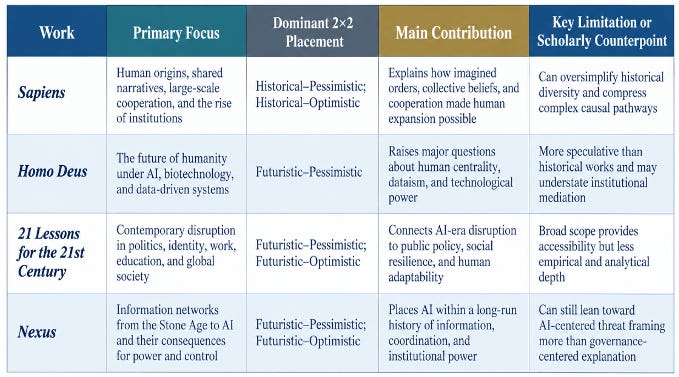
Source: Author’s Own Synthesis
Note: Dominant placement reflects the analytical framework developed in this article; individual works may extend across more than one cell.
2.1. Humanity, Shared Narratives, and Collective Power
A foundational idea in Harari’s work is that the success of Homo sapiens rests not only on individual intelligence but also on the ability to create and collectively accept shared narratives concerning religion, nations, money, law, corporations, political systems, and social identities. These intersubjective realities enable large-scale cooperation among people who otherwise lack direct personal ties, placing collective belief and institutional coordination at the center of human social development. This perspective is especially relevant to the AI era because technological systems are developed, financed, legitimized, regulated, and deployed within existing human institutions and narratives. Governments, corporations, universities, and societies shape AI outcomes through priorities, incentives, norms, and expectations concerning security, competition, knowledge, privacy, employment, fairness, and technological progress. The deeper issue is therefore not simply whether machines become more capable, but whether societies increasingly accept algorithmic recommendations, predictions, and decisions as legitimate sources of authority (Acemoglu & Johnson, 2023; Harari, 2015).
2.2. Algorithms, Information Networks, and the Transformation of Human Agency
A second major theme in Harari’s work concerns the growing role of data, algorithms, biotechnology, and information networks in shaping human behavior and institutional power. In Homo Deus, he considers whether increasingly sophisticated systems may understand patterns of human behavior better than individuals understand themselves, while 21 Lessons for the 21st Century extends these concerns to employment, politics, surveillance, education, misinformation, and social stability, and Nexus situates AI within the longer history of information networks. As algorithms become more capable of predicting preferences, allocating resources, generating content, and supporting complex decisions, societies may gain major benefits in efficiency, forecasting, medicine, knowledge discovery, and coordination while also facing greater dependency, opacity, concentrated power, and weakened accountability. Harari’s central insight is that more information does not necessarily produce greater truth, wisdom, or social progress because the same networks that improve coordination can also amplify manipulation, misinformation, polarization, and centralized control. The fundamental challenge is therefore to capture the benefits of increasingly capable computational systems while preserving meaningful human judgment, responsibility, and agency (Harari, 2017, 2018, 2024; O’Neil, 2016; Pasquale, 2015).
2.3. From AI Risk to the AI Monster Fallacy
Harari’s warnings appropriately recognize the possibility of increasingly capable systems operating beyond ordinary human oversight. The AI Monster Fallacy is the present author’s interpretive extension, not a concept attributed to Harari: it describes an explanatory imbalance in which AI is portrayed primarily as an independently acting threat while human choices, organizational incentives, and institutional governance receive inadequate attention. This distinction does not imply that AI autonomy risks are imaginary or reducible to human intention. Autonomous behavior, misalignment, opacity, and harmful emergent outcomes may create genuine technical and social dangers even where responsible actors seek to prevent them. The analytic task is therefore to examine technological capability and governance together, asking under which human and institutional conditions AI risks are amplified or constrained (Russell, 2019; Hong & Park, 2027).

3. Analysis of Yuval Noah Harari’s Major Works Through a 2×2 Framework
This section proposes an author-developed 2×2 interpretive framework contrasting historical and future-oriented perspectives with pessimistic and optimistic orientations. The categories are heuristic reading lenses, not a systematic coding scheme or empirical classification of Harari’s books; the eight propositions are conceptual prompts for discussion and future testing, not results established by data.
3.1. Why a 2×2 Framework Is Useful for Analyzing Harari’s Work
Harari’s major works move between historical interpretation and future-oriented speculation, and between warnings about harm and consideration of human adaptation. The two axes—historical to futuristic and pessimistic to optimistic—offer a deliberately simplified, author-constructed reading tool. A single book can appear in more than one cell, and placements represent judgments about dominant emphases, not mutually exclusive classifications, validated scores, or Harari’s own taxonomy. The eight propositions below are analytically derived hypotheses or interpretive statements that have not been empirically tested or shown to imply causal relationships.
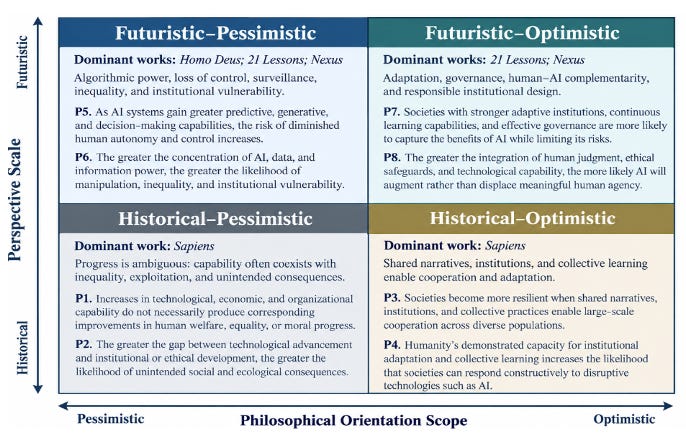
Figure 1. A 2×2 Framework for Analyzing Yuval Noah Harari’s Major Works
Source: Author’s Own Synthesis
Note: The quadrant placements are the author’s interpretive judgments. Books may span multiple cells. No systematic coding, empirical classification, or causal validation is claimed.
Figure 1. A 2×2 Framework for Analyzing Yuval Noah Harari’s Major Works. Figure 1 organizes Harari’s major works along two dimensions: philosophical orientation, ranging from pessimistic to optimistic, and perspective scale, ranging from historical to futuristic. The historical cells emphasize both the unintended costs of progress and humanity’s capacity for cooperation and adaptation, while the futuristic cells contrast concerns about algorithmic power and loss of control with more optimistic possibilities for governance and human–AI complementarity. The eight propositions derived from the four cells summarize how technological capability, institutional quality, human agency, and collective learning interact across Harari’s historical and future-oriented arguments.
3.2. Historical–Pessimistic: Progress, Inequality, and Unintended Consequences
This cell captures Harari’s critical interpretation of historical progress, especially in Sapiens. Agricultural development, empire, industrialization, and technological advancement expanded human capability, yet they also produced inequality, exploitation, warfare, ecological damage, and uncertain gains in happiness. The central insight is that greater capability does not automatically generate greater wisdom, justice, or well-being (Acemoglu & Johnson, 2023; Harari, 2015).
P1: Increases in technological, economic, and organizational capability do not necessarily produce corresponding improvements in human welfare, equality, or moral progress.
P2: The greater the gap between technological advancement and institutional or ethical development, the greater the likelihood of unintended social and ecological consequences.
3.3. Historical–Optimistic: Cooperation, Narratives, and Human Adaptability
This cell emphasizes Harari’s account of humanity’s extraordinary ability to cooperate through shared narratives, institutions, and collective beliefs. Religion, money, law, nations, corporations, and other intersubjective systems enabled large numbers of strangers to coordinate action and build increasingly complex societies. This historical capacity for institutional innovation and collective adaptation provides an important basis for optimism regarding humanity’s ability to respond to future technological disruptions (Graeber & Wengrow, 2021; Harari, 2015).
P3: Societies become more resilient when shared narratives, institutions, and collective practices enable large-scale cooperation across diverse populations.
P4: Humanity’s demonstrated capacity for institutional adaptation and collective learning increases the likelihood that societies can respond constructively to disruptive technologies such as AI.
3.4. Futuristic–Pessimistic: Algorithmic Power and Loss of Human Control
This cell reflects the strongest warning themes in Homo Deus, 21 Lessons for the 21st Century, and Nexus. Harari raises the possibility that algorithms and AI may increasingly predict behavior, shape preferences, concentrate informational power, transform work, and shift decision-making authority away from human beings. These developments create risks involving surveillance, manipulation, inequality, dependency, and the gradual erosion of meaningful human autonomy (Harari, 2017, 2018, 2024; O’Neil, 2016; Pasquale, 2015).
P5: As AI systems gain greater predictive, generative, and decision-making capabilities, the risk of diminished human autonomy and control increases.
P6: The greater the concentration of AI, data, and information power, the greater the likelihood of manipulation, inequality, and institutional vulnerability.
3.5. Futuristic–Optimistic: Adaptation, Governance, and Human–AI Complementarity
This cell highlights the more constructive possibilities embedded in Harari’s future-oriented writings. Education, institutional adaptation, responsible governance, self-correction, and human judgment may enable societies to use AI as an augmenting rather than dominating force. The key implication is that technological outcomes are not predetermined but depend heavily on governance quality, leadership, ethical safeguards, and the capacity of institutions to learn and adapt (Dignum, 2019; Floridi, 2023; Harari, 2018, 2024).
P7: Societies with stronger adaptive institutions, continuous learning capabilities, and effective governance are more likely to capture the benefits of AI while limiting its risks.
P8: The greater the integration of human judgment, ethical safeguards, and technological capability, the more likely AI will augment rather than displace meaningful human agency.
4. Critical Assessment: Major Counterarguments and Future Research
Harari’s major works raise important questions about human history, technological power, information systems, and agency, while also intersecting with broader scholarly debates that qualify and reinterpret his claims; accordingly, this section examines three major counterarguments from the literature, including relevant contributions by Hong and colleagues, rather than presenting a personal critique of Harari.
Figure 2 traces the conceptual progression from Harari’s major works through their core themes, the principal scholarly counterarguments, and the development of the AI Monster Fallacy. The framework shows that concerns about AI should be interpreted not only in terms of technological capability but also through historical complexity, human agency, institutional design, leadership, and governance. It therefore shifts the debate from viewing AI primarily as an autonomous threat toward examining how human choices and institutional arrangements shape constructive or destructive AI outcomes.
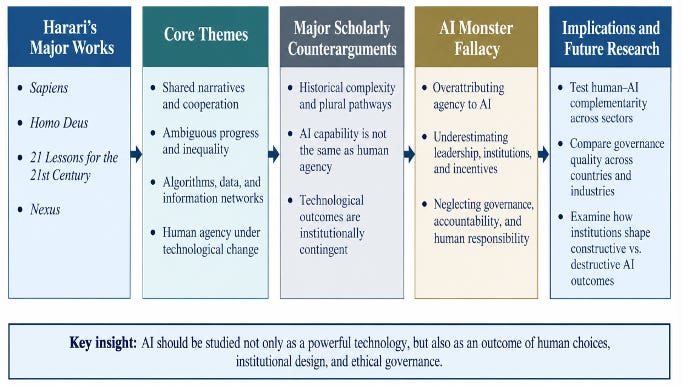
Figure 2. Conceptual Path from Harari’s Major Works to the AI Monster Fallacy
4.1. Grand Narratives and Historical Complexity
A first counterargument concerns the risks inherent in constructing sweeping explanations of human history. Harari’s strength lies in connecting biological evolution, cognition, religion, economics, politics, technology, and culture within an accessible narrative, yet Graeber and Wengrow (2021) caution against interpreting human development as a single linear progression, while Acemoglu and Johnson (2023) show that technological advancement produces different outcomes depending on institutions and distributions of power. Crawford (2021) similarly emphasizes that contemporary AI systems are embedded in material infrastructures, labor arrangements, resource extraction, and political-economic structures rather than emerging as independent technological forces, suggesting that Sapiens is best read as a broad interpretive framework rather than a definitive account of universal historical processes. The broader counterargument is one of historical pluralism, in which civilizational outcomes emerge from interacting biological, geographical, political, cultural, institutional, and technological forces, leaving concepts such as the cognitive revolution, imagined orders, agricultural transformation, and large-scale cooperation open to contextual qualification. Future research should therefore test Harari’s major propositions across Western, East Asian, African, Latin American, and other settings to determine which patterns of cooperation, technological progress, inequality, and institutional adaptation are broadly generalizable and which remain context dependent.
4.2. AI Agency, Human Control, and Responsibility
A second major counterargument concerns the tendency to equate increasing technological capability with increasing autonomous agency. Harari appropriately emphasizes that algorithms can influence decisions, generate information, shape preferences, and operate beyond ordinary human cognitive scale, yet Floridi (2023), Dignum (2019), and Shneiderman (2022) distinguish computational capability from human intentionality, responsibility, moral judgment, and meaningful agency. Highly capable AI systems should therefore not automatically be treated as independent social actors, since they remain embedded within infrastructures created, financed, governed, and used by firms, governments, engineers, investors, professionals, and users. Greater AI capability may consequently increase rather than reduce the need for human accountability, responsible design, institutional oversight, ethical safeguards, and human-centered approaches that preserve meaningful judgment and control. Future research should examine how human agency changes across healthcare, education, manufacturing, supply chains, government, and professional services to identify the conditions under which human–AI complementarity strengthens rather than weakens responsible human agency.
4.3. Institutional Power, Governance, and the AI Monster Fallacy
A third counterargument concerns interpretations that make AI’s expanding capabilities appear to determine social outcomes without adequate attention to institutions. Russell (2019) examines advanced AI risks involving objectives, alignment, and control, while Zuboff (2019) highlights concentration of data and institutional power. Building on these perspectives and related work with Park, I employ the AI Monster Fallacy here as an interpretive extension to identify arguments that over-attribute independent agency to AI while underexamining leadership, incentives, governance, and accountability (Hong & Park, 2027). Harari does not advance this named concept, and his books themselves recognize human choices and institutional responsibility. Nor does the concept negate genuine autonomy, alignment, or control risks. Rather, it invites research into how technical safeguards and institutional arrangements interact in constructive and destructive AI outcomes across settings.

5. Conclusion
Yuval Noah Harari’s major works provide an expansive view of historical cooperation, shared narratives, information networks, and the opportunities and dangers of artificial intelligence. The author-developed 2×2 framework offers one interpretive reading of tensions between historical and futuristic perspectives and between pessimistic and optimistic possibilities; its placements and eight propositions are neither empirically validated classifications nor demonstrated causal effects. The AI Monster Fallacy, advanced here as the present author’s interpretive extension rather than Harari’s own concept, cautions against overlooking human decisions and institutional responsibility when discussing AI as an independent threat. This does not diminish serious technical risks of autonomy or loss of control; instead, it underscores the need to study technical capability and governance together. Harari’s enduring value may be less in prediction than in provoking the question of whether societies can develop the judgment, institutions, and accountability to govern increasingly powerful technologies.
References
Acemoglu, D., & Johnson, S. (2023). Power and progress: Our thousand-year struggle over technology and prosperity. PublicAffairs.
Crawford, K. (2021). Atlas of AI: Power, politics, and the planetary costs of artificial intelligence. Yale University Press.
Dignum, V. (2019). Responsible artificial intelligence: How to develop and use AI in a responsible way. Springer. https://doi.org/10.1007/978-3-030-30371-6
Floridi, L. (2023). The ethics of artificial intelligence: Principles, challenges, and opportunities. Oxford University Press. https://doi.org/10.1093/oso/9780198883098.001.0001
Graeber, D., & Wengrow, D. (2021). The dawn of everything: A new history of humanity. Farrar, Straus and Giroux.
Harari, Y. N. (2015). Sapiens: A brief history of humankind. Harper.
Harari, Y. N. (2017). Homo Deus: A brief history of tomorrow. Harper.
Harari, Y. N. (2018). 21 lessons for the 21st century. Spiegel & Grau.
Harari, Y. N. (2024). Nexus: A brief history of information networks from the Stone Age to AI. Random House.
Hong, P. C., & Park, Y. S. (2027). Faith-inspired foresight: Leading global supply chains beyond the AI Monster Fallacy. In Leading with faith and ethics in an AI world (pp. 307–342). IGI Global Scientific Publishing. https://www.igi-global.com/chapter/faith-inspired-foresight/415073
O’Neil, C. (2016). Weapons of math destruction: How big data increases inequality and threatens democracy. Crown.
Pasquale, F. (2015). The black box society: The secret algorithms that control money and information. Harvard University Press.
Shneiderman, B. (2022). Human-centered AI. Oxford University Press.
Russell, S. J. (2019). Human compatible: Artificial intelligence and the problem of control. Viking.
Zuboff, S. (2019). The age of surveillance capitalism: The fight for a human future at the new frontier of power. PublicAffairs.
ABOUT THE AUTHOR

Paul C. Hong (Editor-in-Chief) - Distinguished University Professor, University of Toledo
Full list of his K-GSP columns:
Paul C. Hong is a Distinguished University Professor of Information Systems and Supply Chain Management and an affiliated faculty of Asian Studies Program at the University of Toledo. His work focuses on leadership, governance, and decision-making in the AI era, integrating strategy, technology, and institutional trust. He has published extensively in leading academic journals and writes on how individuals and organizations navigate complexity, disruption, and global transformation.
© K-Global Scholars and Professionals Forum. All rights reserved. Content published in the K-GSP Forum may not be reproduced, distributed, or transmitted in any form without prior written permission from the K-GSP Forum, except for brief quotations with full attribution.
Suggested Citation:
Paul C. Hong (2026, November 5). Yuval Noah Harari and the Human Future: History, Technology, Agency, and the Limits of Grand Narrative. K-GSP Forum. pp. 1–12.
Original Article:

한글 요약
유발 노아 하라리의 주요 저작과 AI 시대의 인간 주체성: 역사적 통찰, 미래 전망, 그리고 ‘AI 괴물 오류’에 대한 비판적 재검토
본 연구는 유발 노아 하라리의 『사피엔스』, 『호모 데우스』, 『21세기를 위한 21가지 제언』, 『넥서스』를 비판적으로 읽고 AI 시대의 인간 주체성과 제도적 책임을 고찰한다. 본 글의 ‘AI 괴물 오류(AI Monster Fallacy)’는 하라리 자신의 개념이 아니라 필자가 관련 논의를 확장하여 제시하는 해석적 개념이다. 이는 AI의 자율성, 통제 상실, 정렬 실패와 같은 실제 위험을 부정하지 않으면서도 기술의 설계·사용·감독에 관한 인간과 제도의 역할을 함께 검토할 필요성을 강조한다.
본 논문의 2×2 분석 틀은 역사적·미래적 관점과 비관적·낙관적 지향을 대조하는 필자의 해석적 도구이며, 하라리 저작의 실증적 분류나 인과관계의 검증 결과가 아니다. 각 저작은 복수 영역에 걸칠 수 있으며 여덟 명제 역시 향후 연구를 위한 개념적 제안이다.
본 논문은 하라리의 주요 저작을 분석하기 위해 두 개의 축으로 구성된 2×2 틀을 제시한다. 수평축은 비관적–낙관적 철학적 지향을, 수직축은 역사적–미래적 관점을 나타내며, 이를 통해 역사적 비관, 역사적 낙관, 미래적 비관, 미래적 낙관의 네 영역을 구분한다. 각 영역에서는 기술 발전과 인간 복지의 불일치, 공동체와 제도의 적응 능력, 알고리즘 권력과 인간 통제의 약화, 그리고 책임 있는 거버넌스를 통한 인간–AI 상호보완 가능성을 중심으로 총 여덟 개의 명제를 제시한다.
비판적 평가에서는 하라리 개인에 대한 저자의 주관적 비판이 아니라, Graeber와 Wengrow, Acemoglu와 Johnson, Crawford, Floridi, Dignum, Shneiderman, Russell, Zuboff 등 주요 학자들의 연구를 토대로 세 가지 반론을 제시한다. 첫째, 거대 역사서사는 복잡한 역사적 다양성을 지나치게 단순화할 수 있고, 둘째, AI의 기술적 능력은 인간과 동일한 의미의 의도성이나 책임 있는 주체성과 동일시될 수 없으며, 셋째, 기술의 결과는 그 자체보다 제도, 권력구조, 리더십, 소유권, 규제, 윤리적 통제에 의해 크게 좌우된다는 점이다. 이러한 논의를 통해 본 논문은 하라리의 경고를 부정하기보다, 그것을 인간과 제도의 책임이라는 관점에서 보완한다.
결론적으로 하라리의 가장 큰 공헌은 AI 미래를 정확하게 예측하는 데 있다기보다, 인간이 기술과 권력, 정보, 제도, 주체성의 관계를 다시 생각하도록 만드는 데 있다. 그러나 AI 시대의 핵심 문제는 단순히 “AI가 인간에게 무엇을 할 것인가”가 아니라 “인간과 제도가 AI를 어떻게 설계하고 통제하며 책임 있게 사용할 것인가”에 있다. 따라서 향후 연구는 인간–AI 상호보완성, 제도적 거버넌스, 리더십, 윤리적 통제, 국가 및 산업 간 차이를 실증적으로 비교함으로써 AI의 건설적 또는 파괴적 결과가 어떠한 조건에서 나타나는지를 규명해야 한다.
Paul C. Hong 교수는 University of Toledo의 Distinguished University Professor로서 글로벌 공급망, AI, 리더십, 전략, 조직 적응을 연구해 왔다.
그는 25년 이상 국제경영과 공급망 분야에서 연구를 수행하며 다수의 학술 논문과 저서를 발표하였다. 최근에는 ‘AI Monster Fallacy’를 통해 AI 위험을 인간의 리더십, 제도, 윤리, 책임의 관점에서 재해석하고 있다.
© K-Global Scholars and Professionals Forum. All rights reserved. Content published in the K-GSP Forum may not be reproduced, distributed, or transmitted in any form without prior written permission from the K-GSP Forum, except for brief quotations with full attribution.