
The Transformation of American University Libraries
From Repositories of Books to Platforms for Knowledge Creation
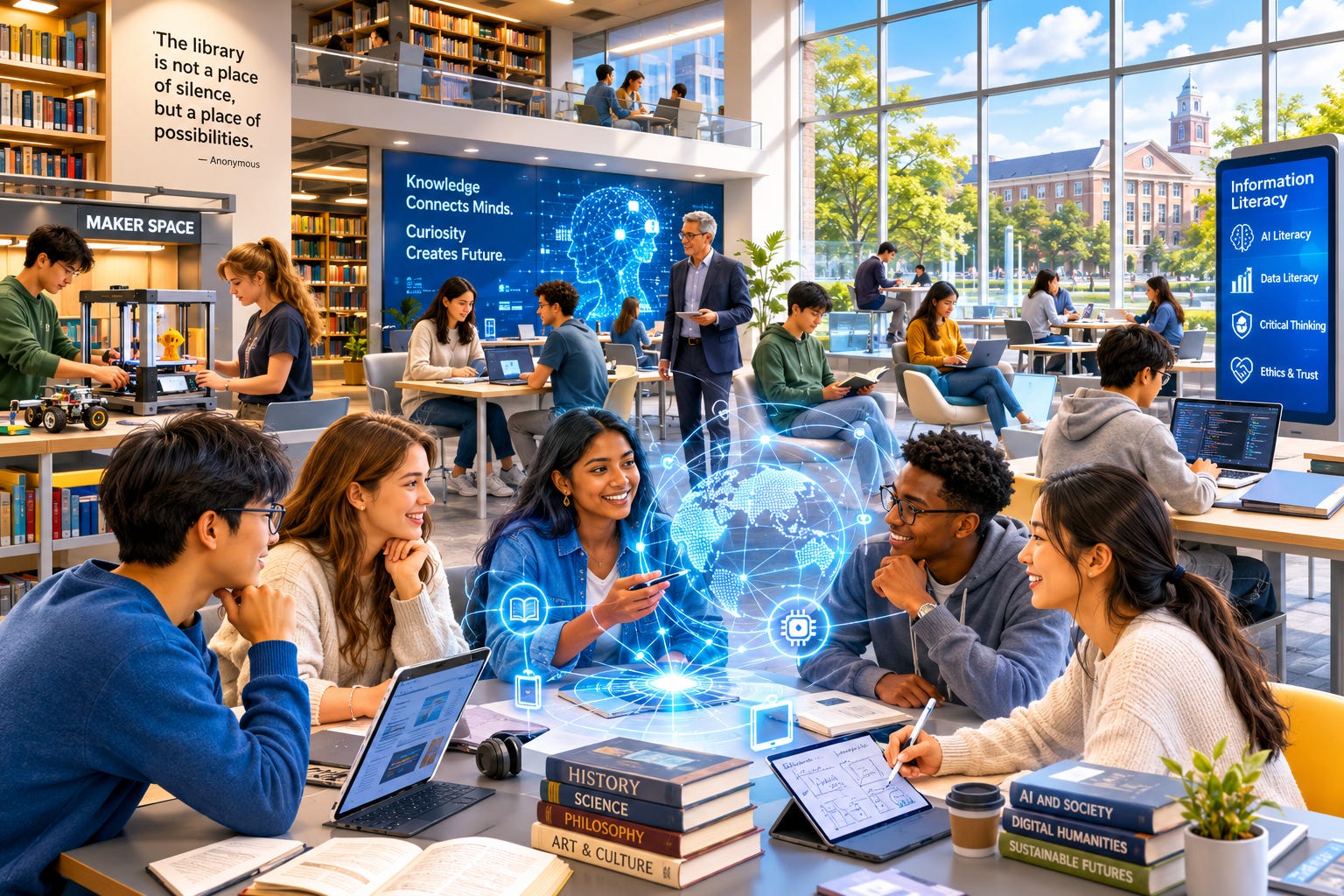
“The future of the university library is not the end of books. It is the beginning of a new era of human intelligence.”
When the Library Is No Longer Just a Library
Walk into an American university library today, and you may encounter a scene that would have been almost unimaginable a generation ago.
Students are no longer simply sitting silently between rows of books. Some are working together around large screens. Others are analyzing data, producing digital media, designing prototypes, or consulting librarians about research strategies. In some libraries, students can find makerspaces, 3D printers, multimedia studios, collaborative learning areas, and technology-rich research environments alongside traditional collections.
And increasingly, another presence has entered the library: artificial intelligence.
Students ask generative AI systems to summarize articles, identify research questions, compare theories, translate documents, write computer code, and help organize ideas. Librarians are responding by teaching students not merely how to find information, but how to evaluate information generated by machines.
This raises a fundamental question:
If students can access millions of books and articles from anywhere, why do universities still need libraries?
The answer may be found precisely in the transformation taking place.
The American university library is not disappearing.
It is redefining itself.
From the House of Books to the Ecosystem of Knowledge
For centuries, libraries were fundamentally repositories.
They collected books, organized them, preserved them, and made them available to readers. Knowledge was embodied primarily in physical objects, and the library was the institution that protected and organized those objects.
The digital revolution changed that equation.
A student can now access scholarly journals, books, databases, archives, government documents, videos, and datasets without physically entering a library. Information has escaped the walls of the building.
The university library therefore faces a new competitor—not another library, but the entire digital information ecosystem.
This has forced academic libraries to ask a deeper question.
The question is no longer simply:
“What does the library own?”
It is increasingly:
“What can the library enable students and scholars to do?”
That is a profound institutional transformation.
The library is becoming less a warehouse of information and more an infrastructure for learning, research, collaboration, creativity, and intellectual judgment.
Recent ACRL guidance on academic library spaces reflects this broader understanding. Welcoming library environments are increasingly viewed as places that promote belonging, intellectual curiosity, academic achievement, and supportive engagement rather than merely providing shelves and desks (Association of College and Research Libraries [ACRL], 2025a).
From Silent Reading Rooms to Living Learning Spaces
Perhaps the most visible transformation is architectural.
The traditional university library was designed around silence. Individual desks, reading rooms, stacks, and reference counters dominated the environment.
The contemporary academic library increasingly offers a more complex ecology of spaces.
There are quiet areas for concentrated study, collaborative rooms for group projects, technology laboratories, media-production spaces, informal lounges, classrooms, and makerspaces.
This is not merely a change in interior design.
It reflects a transformation in the philosophy of learning.
Learning is no longer understood exclusively as an individual activity in which a student reads a book and takes notes. Modern higher education emphasizes collaboration, experimentation, communication, problem solving, creativity, and interdisciplinary work.
Research on learning commons has similarly demonstrated that students use library spaces for multiple combinations of individual and collaborative learning activities (DeFrain & Hong, 2020).
In this environment, the library becomes a learning commons—a place where knowledge is not simply consumed but discussed, tested, connected, and transformed.
The Library as a Makerspace
One of the most fascinating developments is the emergence of the academic library as a place for making rather than merely reading.
Makerspaces originally associated with 3D printing and fabrication have increasingly evolved into technology-rich environments supporting experiential learning, innovation, social learning, and student success (Childrey, 2025).
This represents a remarkable reversal.
For centuries, libraries were associated with the preservation of finished knowledge.
Now they are increasingly becoming places where new things are made.
A student may enter the library with an idea and leave with a prototype.
An engineering student may design a physical object.
A computer science student may build an interactive system.
An art student may create digital media.
A humanities student may transform an archival collection into a digital exhibition.
The library is therefore moving from read → understand toward read → understand → create.
That final step may be the most important one in the age of artificial intelligence.
The Librarian Is Changing, Too
The transformation of the library necessarily transforms the librarian.
The traditional image of the librarian is familiar: a professional who helps users locate books, databases, and scholarly sources.
But the librarian of the AI era requires a much broader intellectual toolkit.
Today, academic librarians increasingly engage with data literacy, digital scholarship, open access, copyright, research ethics, digital preservation, information literacy, and artificial intelligence.
In October 2025, ACRL formally approved AI Competencies for Academic Library Workers, organized around ethical considerations, knowledge and understanding, analysis and evaluation, and use and application.
This is more than a professional-development document.
It signals a change in the identity of the librarian.
The librarian of the past helped students find information.
The librarian of the future must help students judge information.
That distinction is enormous.
AI Changes the Meaning of Information Literacy
Generative AI has created a paradox.
It has made information easier to obtain while making trustworthy knowledge harder to identify.
A student can ask an AI system for ten scholarly references in seconds. But some may be inaccurate, incomplete, misinterpreted, or nonexistent.
AI can produce a beautifully written explanation that is factually wrong.
It can summarize a paper without capturing its limitations.
It can provide a confident answer without providing reliable evidence.
Therefore, the most important skill in the AI era may not be information retrieval.
It may be information verification.
Recent research illustrates this emerging responsibility. Ko and Chiu (2024), examining generative-AI literacy guides from 28 libraries, found that the ACRL Information Literacy Framework can provide a useful foundation for developing AI literacy programs in academic libraries.
Similarly, Lo’s study of 760 academic library employees, predominantly in the United States, found significant gaps in AI knowledge, hands-on experience, ethical discussion, and institutional readiness, reinforcing the need for professional development and clear ethical guidance (Lo, 2024).
Lo (2025) subsequently proposed a broader model of AI literacy for academic libraries encompassing technical knowledge, ethical awareness, critical thinking, practical skills, and societal impact.
This suggests a new mission for the university library:
Not simply teaching students how to search—but teaching them how to question the search.
The Library as a Research Platform
Another major transformation is occurring in scholarly research.
The traditional library supported research primarily by providing books, journals, archives, reference services, and research consultations.
The digital library increasingly supports computational research.
Researchers now work with datasets, digital archives, geospatial information, large text collections, multimedia repositories, machine-readable documents, and computational tools.
This has opened the door to digital humanities, text and data mining, computational social science, and other interdisciplinary forms of scholarship.
The library is consequently becoming part of the research infrastructure itself.
The distinction between library and laboratory is becoming less clear.
This is especially important for interdisciplinary research.
A historian may use natural-language processing.
A computer scientist may analyze historical archives.
A political scientist may examine millions of digital documents.
A linguist may use machine learning to identify patterns in language.
A public-health researcher may combine scholarly literature with large datasets.
The modern academic library can provide the intellectual and technical infrastructure that connects these disciplines.
The Library and Student Success
Perhaps the most human dimension of this transformation is the growing connection between libraries and student success.
American universities increasingly recognize that academic success involves more than access to information. Students also need belonging, persistence, support, confidence, and opportunities to develop meaningful academic identities.
ACRL’s 2025 publication on Student Success Librarianship reflects the emergence of this new professional role. Such positions may involve retention, persistence, graduation, well-being, belonging, and students’ sense of purpose (ACRL, 2025b).
This represents another profound change.
The library is no longer asking only:
“What information does this student need?”
It is beginning to ask:
“What does this student need in order to succeed?”
That is a much more human question.
Research has also found that students associate library use and library spaces with their learning and academic success beyond simple measures such as GPA (Scoulas & De Groote, 2022).
The library therefore becomes not simply an information service, but part of the university’s student-success ecosystem.
The Paradox of Books in the Digital Age
Yet there is an important paradox.
The transformation of the library does not mean that books have become irrelevant.
It may mean the opposite.
The more information becomes instantaneous, fragmented, algorithmically filtered, and AI-generated, the more valuable, sustained reading may become.
A short AI summary can provide information quickly.
A search engine can provide thousands of results.
A social-media feed can deliver hundreds of ideas.
But reading a serious book requires something fundamentally different: time.
A book asks the reader to remain with an argument.
It requires patience.
It creates intellectual continuity.
It allows an author to develop a complex idea beyond the limits of a short answer.
In an age of acceleration, the library may therefore have a new responsibility:
to protect the human capacity for deep attention.
The future library should not choose between print and digital.
It should preserve both.
It should offer the speed of digital information and the depth of sustained reading.
The Library as a Defense of Intellectual Trust
There is an even larger reason why university libraries matter.
It concerns democracy.
We live in an environment saturated with information but increasingly challenged by misinformation, manipulated media, algorithmic bias, fabricated sources, deepfakes, and synthetic content.
The central problem of the information age is no longer simply scarcity.
It is abundance without certainty.
In such an environment, academic libraries can serve as institutions of intellectual trust.
They preserve primary sources.
They teach students how to evaluate evidence.
They provide access to scholarly literature.
They encourage citation and attribution.
They introduce students to multiple perspectives.
And they help create a culture in which claims must be supported by evidence.
This mission becomes even more important when AI can produce plausible language at extraordinary speed.
The university library may therefore become one of the institutions that protects something civilization cannot afford to lose:
the distinction between information and knowledge, and between knowledge and wisdom.
What Can Korean Universities Learn?
The transformation of American university libraries offers important lessons for Korean higher education.
Korean university libraries have developed sophisticated digital collections and electronic-resource services. But the next transformation should go beyond digitization.
The central question should not be how many books a library owns or how many databases it subscribes to.
The question should be:
What intellectual capabilities does the library help students develop?
A future-oriented university library could become an AI literacy center.
It could become a data-literacy hub.
It could support digital humanities and computational research.
It could provide makerspaces and creative laboratories.
It could become a student-success center.
It could provide research consultations integrated directly into courses.
And it could become a place where students learn one of the most important skills of the twenty-first century:
how to distinguish an answer from a trustworthy answer.
This is particularly important for Korean universities seeking to compete globally.
Universities should not simply give students access to AI.
They should teach students how to think with AI without surrendering their thinking to AI.
The Library of Tomorrow
Imagine walking into a university library in 2035.
On one side, a student is reading a centuries-old manuscript.
Nearby, another student is using an AI research assistant to compare thousands of historical documents.
A group of engineering students is building a prototype in a makerspace.
A humanities researcher is transforming an archival collection into an interactive digital exhibition.
A librarian is helping a student verify whether AI-generated references actually exist.
Students are discussing a difficult question in a collaborative learning space.
And somewhere in the building, an old, printed book is quietly waiting for someone to open it.
That is the future library.
It is simultaneously ancient and futuristic.
It preserves civilization’s memory while providing tools for creating civilization’s next chapter.
The Future of the Library Is the Future of Human Judgment
Ultimately, the transformation of American university libraries is not fundamentally a story about buildings, databases, or artificial intelligence.
It is a story about human beings and their relationship with knowledge.
AI can retrieve information.
AI can summarize.
AI can translate.
AI can generate text.
AI can analyze patterns.
AI can increasingly perform tasks that once required considerable human effort.
But one responsibility remains profoundly human:
deciding what deserves to be believed, what deserves to be questioned, and what deserves to be remembered.
That is why the university library will not disappear.
It will change.
The library of yesterday was a repository of knowledge.
The library of today is becoming an ecosystem of learning and research.
The library of tomorrow may become an infrastructure for human-AI collaboration.
But its deepest purpose should remain unchanged:
to help human beings become wiser through their encounter with knowledge.
The great transformation of the American university library, therefore, is not the disappearance of the book.
It is the emergence of a new intellectual institution—one that connects books, databases, people, data, machines, creativity, and judgment.
In the age of artificial intelligence, the university library may become more important, not less.
Because when machines become exceptionally good at generating answers, humanity will need places where people learn to ask better questions.
And when information becomes nearly infinite, civilization will need institutions capable of protecting truth, evidence, memory, and wisdom.
The library of the future will not merely preserve what humanity has learned.
It will help humanity decide what is worth learning next.
References
Association of College and Research Libraries. (2025a). Creating welcoming spaces in academic libraries guide. American Library Association.
Association of College and Research Libraries. (2025b). Student success librarianship: Critical perspectives on an evolving profession. American Library Association.
Association of College and Research Libraries. (2025c). AI competencies for academic library workers. American Library Association.
Chaudhuri, J., & Terrones, L. (2024). Reshaping academic library information literacy programs in the advent of ChatGPT and other generative AI technologies. Internet Reference Services Quarterly, 29(1), 1–25. https://doi.org/10.1080/10875301.2024.2400132
Childrey, C. (2025). Scaling innovation: How academic library leaders can develop and sustain next generation makerspaces for student success and community engagement. Journal of Library Administration, 65(2), 235–243. https://doi.org/10.1080/01930826.2024.2437965
DeFrain, E., & Hong, M. (2020). Interiors, affect, and use: How does an academic library’s learning commons support students’ needs? Evidence Based Library and Information Practice, 15(4). https://doi.org/10.18438/eblip29677
Ko, C. R., & Chiu, M.-H. (2024). How can academic librarians support generative AI literacy: An analysis of library guides using the ACRL Information Literacy Framework. Proceedings of the Association for Information Science and Technology. https://doi.org/10.1002/pra2.1159
Lo, L. S. (2024). Evaluating AI literacy in academic libraries: A survey study with a focus on U.S. employees. College & Research Libraries, 85(5), 635–?. https://doi.org/10.5860/crl.85.5.635
Lo, L. S. (2025). AI literacy: A guide for academic libraries. College & Research Libraries News, 86(3), 120–123. https://doi.org/10.5860/crln.86.3.120
Scoulas, J. M., & De Groote, S. L. (2022). Impact of undergraduate students’ library use on their learning beyond GPA: Mixed-methods approach. College & Research Libraries, 83(3), 452–?. https://doi.org/10.5860/crl.83.3.452
Chambers, B. D., & Dowell, Z. (2025). The role of undergraduate assistants in a university makerspace. Journal of Engineering Education, 114(3), e70018. https://doi.org/10.1002/jee.70018
미국 대학 도서관의 변신
책을 보관하는 공간에서 지식을 창조하는 플랫폼으로
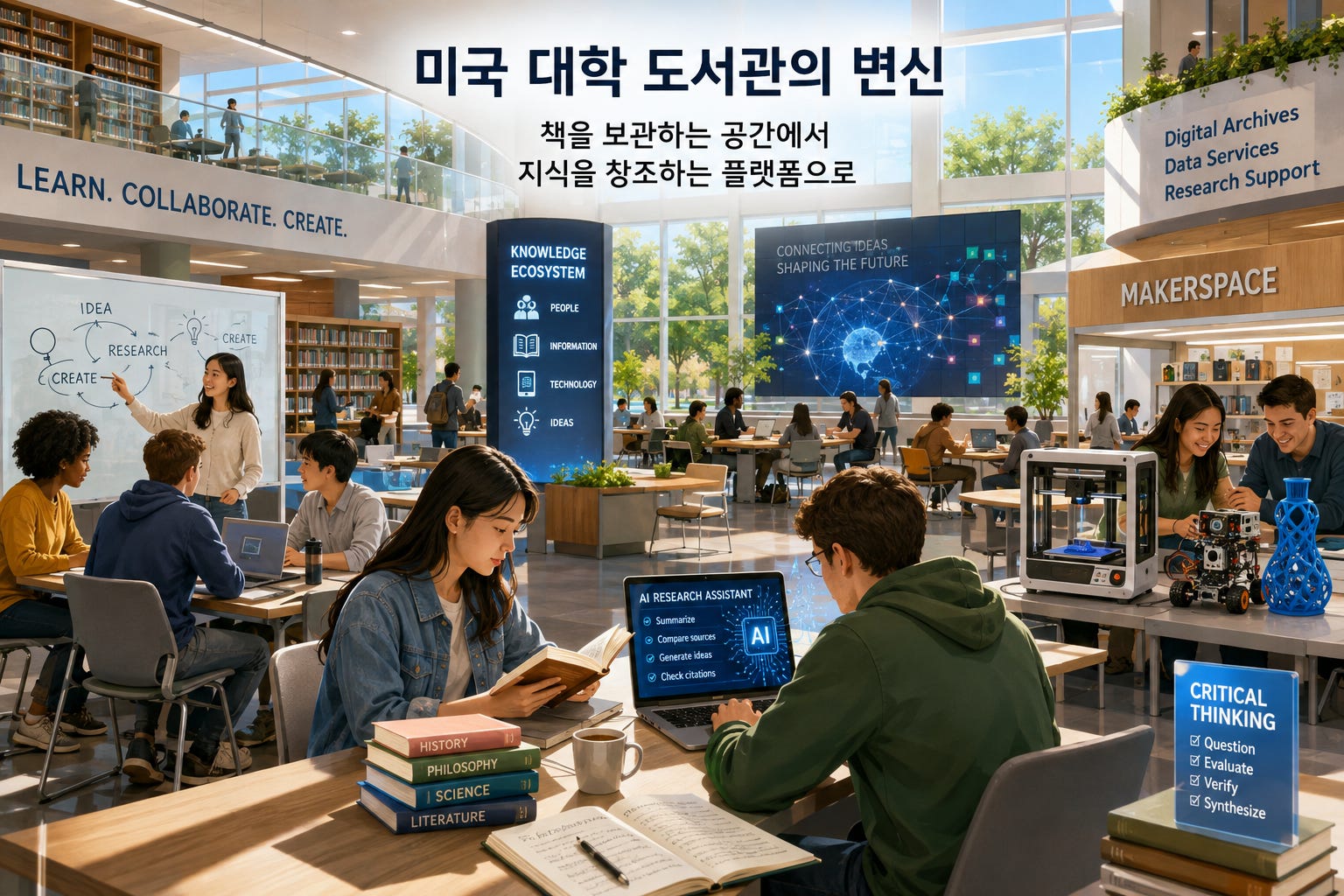
“미래의 대학 도서관은 책의 종말이 아니다. 인간 지성의 새로운 시대가 시작되는 곳이다.”
도서관은 더 이상 단순한 도서관이 아니다
오늘날 미국 대학 도서관에 들어서면 한 세대 전과는 사뭇 다른 모습을 발견하게 된다.
학생들은 더 이상 책장 사이에 조용히 앉아 책만 읽지 않는다. 여러 학생이 대형 화면 앞에서 함께 프로젝트를 수행한다. 어떤 학생은 데이터를 분석하고, 다른 학생은 디지털 콘텐츠를 제작한다. 또 다른 학생은 새로운 연구 아이디어를 구상하거나 인공지능 도구를 활용한다.
도서관 안에는 전통적인 장서와 함께 협업 공간, 미디어 제작실, 데이터 연구 공간, 메이커스페이스, 3D 프린터와 같은 새로운 시설도 등장하고 있다.
그리고 이제 대학 도서관에는 또 하나의 새로운 존재가 들어왔다.
인공지능이다.
학생들은 생성형 AI를 이용해 논문을 요약하고, 연구 질문을 만들고, 자료를 비교하고, 번역하고, 코드를 작성하고, 연구 아이디어를 발전시킨다.
이에 따라 사서의 역할도 달라지고 있다.
학생들에게 단순히 정보를 찾는 방법을 알려주는 것만으로는 충분하지 않다. 이제는 AI가 만들어낸 정보를 어떻게 평가하고 검증할 것인가를 가르쳐야 한다.
여기에서 근본적인 질문이 나온다.
“학생들이 어디서나 수많은 책과 논문을 검색할 수 있다면, 대학 도서관은 왜 여전히 필요한가?”
어쩌면 이 질문에 대한 답은 도서관이 사라지는 것이 아니라 도서관의 존재 이유 자체가 변하고 있다는 사실에서 찾을 수 있다.
책의 집에서 지식의 생태계로
수백 년 동안 도서관의 가장 중요한 역할은 지식을 보존하는 것이었다.
책을 수집하고, 분류하고, 보존하고, 독자에게 제공했다. 지식은 주로 책과 같은 물리적 형태로 존재했다. 도서관은 그 지식을 안전하게 보호하는 기관이었다.
그러나 디지털 혁명은 이 구조를 근본적으로 바꾸었다.
오늘날 학생은 도서관에 직접 가지 않아도 학술논문, 전자책, 데이터베이스, 정부자료, 영상, 디지털 아카이브 등 방대한 정보에 접근할 수 있다.
지식은 더 이상 도서관 건물 안에 갇혀 있지 않다.
이제 대학 도서관의 경쟁자는 다른 도서관이 아니다.
인터넷 전체가 도서관의 새로운 경쟁자가 되었다.
이러한 환경에서 대학 도서관은 새로운 질문을 던지기 시작했다.
과거에는 이렇게 물었다.
“우리 도서관은 무엇을 소장하고 있는가?”
이제는 이렇게 묻는다.
“우리 도서관은 학생과 연구자가 무엇을 할 수 있도록 만들어 주는가?”
이 질문의 변화는 매우 중요하다.
도서관은 정보의 창고에서 벗어나 학습과 연구, 협업, 창의성과 지적 판단을 지원하는 지식 인프라로 변하고 있기 때문이다.
최근 미국 대학도서관계에서도 도서관 공간을 단순한 장서 보관 장소가 아니라 학생의 소속감과 지적 호기심, 학업 성취를 지원하는 환경으로 바라보는 움직임이 강화되고 있다(Association of College and Research Libraries [ACRL], 2025a).
조용한 독서실에서 살아 있는 학습공간으로
미국 대학 도서관에서 가장 눈에 띄는 변화 가운데 하나는 공간의 변화다.
전통적인 도서관은 침묵을 중심으로 설계되었다. 개인 책상과 열람실, 서가, 참고자료실이 핵심이었다.
그러나 현대의 대학 도서관은 훨씬 복잡한 학습 생태계를 갖추고 있다.
집중해서 공부할 수 있는 조용한 공간이 있는가 하면, 여러 학생이 함께 프로젝트를 수행할 수 있는 협업실도 있다. 미디어 제작실, 기술 연구실, 강의실, 비공식적인 휴식공간, 메이커스페이스도 등장하고 있다.
이것은 단순한 인테리어의 변화가 아니다.
학습에 대한 철학 자체가 변하고 있기 때문이다.
과거에는 학습을 책을 읽고 노트에 기록하는 개인적 활동으로 보는 경향이 강했다.
오늘날의 대학 교육은 협업, 실험, 의사소통, 문제 해결, 창의성, 융합적 사고를 더욱 중요하게 생각한다.
따라서 도서관은 Learning Commons, 즉 학습공유공간으로 발전하고 있다.
학생들은 이곳에서 지식을 단순히 소비하지 않는다.
서로 토론하고, 질문하고, 실험하고, 새로운 아이디어를 연결한다.
도서관은 점점 지식을 읽는 공간에서 지식을 움직이는 공간으로 변하고 있다.
책을 읽는 곳에서 무언가를 만드는 곳으로
현대 대학 도서관의 또 하나의 흥미로운 변화는 메이커스페이스의 등장이다.
메이커스페이스는 3D 프린팅과 제작 기술을 중심으로 시작했지만, 이제는 체험형 학습과 혁신, 협업, 학생 성공을 지원하는 공간으로 발전하고 있다(Childrey, 2025).
이것은 매우 흥미로운 역전이다.
수백 년 동안 도서관은 이미 만들어진 지식을 보존하는 장소였다.
이제 도서관은 새로운 것을 만드는 장소가 되고 있다.
학생은 도서관에 아이디어를 가지고 들어와 실제 결과물을 가지고 나올 수 있다.
공학도는 새로운 장치를 설계할 수 있다.
컴퓨터과학 전공 학생은 프로그램을 만들 수 있다.
예술 전공 학생은 디지털 작품을 제작할 수 있다.
인문학 연구자는 오래된 자료를 디지털 전시로 변환할 수 있다.
따라서 현대 도서관의 학습 과정은 다음과 같이 확장되고 있다.
읽는다 → 이해한다 → 연결한다 → 만든다.
그리고 마지막 단계인 ‘만든다’가 AI 시대에는 더욱 중요해질 것이다.
사서도 변하고 있다
도서관이 변하면 사서도 변할 수밖에 없다.
과거의 사서는 학생에게 책이나 논문을 찾아주는 전문가였다.
오늘날의 사서는 훨씬 넓은 전문성을 요구받는다.
데이터 리터러시, 디지털 연구, 오픈 액세스, 저작권, 연구윤리, 디지털 보존, 정보 리터러시, 인공지능 등이 새로운 전문 영역으로 들어왔다.
ACRL은 2025년 Academic Library Workers를 위한 AI 역량(AI Competencies for Academic Library Workers)을 제시했다. 여기에는 AI의 윤리적 고려, AI에 대한 이해, 분석과 평가, 실제 활용 등이 포함된다(ACRL, 2025c).
이는 단순한 직무교육의 변화가 아니다.
사서의 정체성이 변하고 있다는 신호다.
과거의 사서는 학생에게 정보를 찾아주는 사람이었다.
미래의 사서는 학생에게 정보를 판단하도록 돕는 사람이 되어야 한다.
이 차이는 매우 크다.
AI는 정보 리터러시의 의미를 바꾸고 있다
생성형 AI는 하나의 역설을 만들어냈다.
정보를 얻기는 훨씬 쉬워졌지만, 믿을 수 있는 지식을 찾기는 오히려 어려워졌다.
학생은 AI에게 몇 초 만에 여러 개의 학술 참고문헌을 요청할 수 있다.
그러나 그 가운데 일부는 부정확하거나 불완전할 수 있다. 때로는 실제로 존재하지 않는 논문이나 잘못된 인용이 만들어질 수도 있다.
AI는 매우 유창한 문장으로 틀린 내용을 설명할 수도 있다.
논문의 핵심을 요약하면서 중요한 한계를 생략할 수도 있다.
근거가 부족한 내용을 확신에 찬 어조로 제시할 수도 있다.
따라서 AI 시대의 핵심 능력은 단순한 정보 검색이 아니다.
정보 검증이다.
Ko와 Chiu(2024)는 28개 도서관의 생성형 AI 리터러시 가이드를 분석하면서 ACRL의 정보 리터러시 프레임워크가 대학 도서관의 AI 리터러시 교육에 유용한 기반이 될 수 있음을 보여주었다.
Lo(2024)는 주로 미국의 대학도서관 종사자들을 대상으로 조사한 연구에서 AI에 대한 지식과 실무 경험, 윤리적 논의, 기관 차원의 준비에 상당한 격차가 있음을 발견했다.
Lo(2025)는 이후 대학도서관의 AI 리터러시를 기술적 지식, 윤리적 인식, 비판적 사고, 실무 능력, 사회적 영향 등을 포함하는 보다 넓은 개념으로 제시했다.
따라서 미래 대학 도서관의 역할은 분명해진다.
학생에게 검색하는 방법만 가르쳐서는 안 된다.
검색 결과를 의심하고 검증하는 방법까지 가르쳐야 한다.
도서관은 연구 플랫폼이 되고 있다
또 하나의 중요한 변화는 학술연구의 변화다.
전통적인 도서관은 책, 논문, 자료, 아카이브, 참고서비스를 제공함으로써 연구를 지원했다.
그러나 디지털 시대의 연구는 훨씬 복잡해졌다.
연구자들은 대규모 데이터셋, 디지털 아카이브, 지리정보, 대규모 텍스트 자료, 영상자료, 기계가 읽을 수 있는 문서와 계산 도구를 사용한다.
이러한 변화는 디지털 인문학, 텍스트·데이터 마이닝, 계산사회과학 등 새로운 학문 영역을 만들어내고 있다.
따라서 도서관은 이제 연구 인프라의 일부가 되고 있다.
도서관과 연구실의 경계가 점점 희미해지고 있는 것이다.
역사학자는 자연어처리 기술을 사용할 수 있다.
컴퓨터과학자는 역사적 아카이브를 분석할 수 있다.
정치학자는 수백만 개의 디지털 문서를 분석할 수 있다.
언어학자는 머신러닝으로 언어의 패턴을 발견할 수 있다.
공공보건 연구자는 학술문헌과 대규모 데이터를 결합할 수 있다.
미래의 대학 도서관은 이러한 학문들을 연결하는 연구 플랫폼이 될 수 있다.
학생 성공을 지원하는 도서관
도서관의 변화에서 가장 인간적인 측면은 ‘학생 성공(Student Success)’과의 연결이다.
오늘날 미국 대학들은 학생의 성공을 단순히 정보에 대한 접근으로만 보지 않는다.
학생에게는 소속감이 필요하다.
학업을 계속할 수 있는 자신감도 필요하다.
동료와 교수와의 관계도 필요하다.
자신이 대학 공동체의 일부라는 느낌도 중요하다.
ACRL은 2025년 Student Success Librarianship이라는 새로운 전문 영역을 소개했다. 이 역할은 학생의 지속적인 학업 참여, 졸업, 소속감, 웰빙, 목적의식 등과 연결된다(ACRL, 2025b).
이것은 도서관의 질문 자체를 바꾼다.
과거에는 이렇게 물었다.
“이 학생에게 어떤 정보가 필요한가?”
이제는 이렇게 물어야 한다.
“이 학생이 대학에서 성공하기 위해 무엇이 필요한가?”
훨씬 더 인간적인 질문이다.
Scoulas와 De Groote(2022)의 연구 역시 학생들이 도서관 이용과 도서관 공간을 단순한 성적 이상의 학습과 학업 성공의 경험과 연결하고 있음을 보여준다.
따라서 대학 도서관은 점점 학생 성공 생태계의 일부가 되고 있다.
디지털 시대에 책은 사라지지 않는다
그러나 중요한 역설이 있다.
도서관의 변화가 책의 종말을 의미하는 것은 아니다.
오히려 디지털 시대에 책의 가치가 다시 커질 수도 있다.
정보가 즉시 제공되고, 짧게 요약되고, 알고리즘에 의해 선택되고, AI에 의해 생성될수록 인간에게는 깊이 있는 독서가 더욱 중요해진다.
AI 요약은 빠르다.
검색엔진은 수많은 결과를 제공한다.
소셜미디어는 수백 개의 아이디어를 끊임없이 보여준다.
그러나 한 권의 좋은 책을 읽는 것은 다르다.
책은 독자에게 한 가지 생각을 오랫동안 따라가도록 요구한다.
저자의 논리를 이해하게 한다.
질문을 만들게 한다.
자신의 생각과 비교하게 한다.
그리고 하나의 복잡한 세계관을 형성하게 한다.
따라서 속도가 지배하는 시대에 도서관은 새로운 역할을 맡아야 한다.
인간의 깊은 집중력을 보호하는 공간이 되어야 한다.
미래의 도서관은 디지털과 종이 중 하나를 선택해서는 안 된다.
두 세계를 연결해야 한다.
디지털 정보의 속도와 책의 깊이를 동시에 제공해야 한다.
도서관은 지적 신뢰를 지키는 기관이 될 수 있다
대학 도서관이 중요한 또 하나의 이유가 있다.
그것은 민주주의와 신뢰의 문제다.
오늘날 우리는 엄청난 정보 속에서 살아간다.
그러나 동시에 허위정보, 조작된 미디어, 알고리즘 편향, 딥페이크, 가짜 출처, 합성 콘텐츠의 문제도 커지고 있다.
정보시대의 핵심 문제는 더 이상 정보의 부족이 아니다.
정보는 넘쳐나지만 확실성이 부족한 것이 문제다.
이런 환경에서 대학 도서관은 지적 신뢰를 지키는 기관이 될 수 있다.
도서관은 원자료를 보존한다.
학술문헌에 접근하게 한다.
출처를 확인하게 한다.
인용과 저작권을 가르친다.
서로 다른 관점을 접하게 한다.
그리고 모든 주장이 근거를 필요로 한다는 문화를 만든다.
AI가 매우 빠른 속도로 그럴듯한 문장을 만들어내는 시대에는 이 역할이 더욱 중요해진다.
따라서 대학 도서관은 다음과 같은 문명의 중요한 경계를 지켜야 한다.
정보와 지식의 차이.
그리고
지식과 지혜의 차이.
한국 대학이 배워야 할 것
미국 대학 도서관의 변화는 한국 대학에도 중요한 질문을 던진다.
한국 대학도서관은 이미 상당한 수준의 디지털 장서와 전자자료 서비스를 구축했다.
그러나 다음 단계의 변화는 단순한 디지털화를 넘어야 한다.
이제 중요한 질문은 도서관이 몇 권의 책을 소장하고 있는가가 아니다.
또 얼마나 많은 데이터베이스를 구독하고 있는가도 아니다.
더 중요한 질문은 이것이다.
“도서관은 학생에게 어떤 지적 능력을 길러주고 있는가?”
미래의 대학 도서관은 AI 리터러시 센터가 될 수 있다.
데이터 리터러시 허브가 될 수 있다.
디지털 인문학과 계산연구를 지원할 수 있다.
메이커스페이스와 창의연구실을 운영할 수 있다.
학생 성공을 지원하는 공간이 될 수 있다.
그리고 학생들에게 21세기의 가장 중요한 능력 가운데 하나를 가르칠 수 있다.
“정답과 신뢰할 수 있는 정답을 구별하는 능력.”
특히 글로벌 대학으로 도약하려는 한국 대학이라면 이 문제를 중요하게 생각해야 한다.
학생들에게 단순히 AI를 사용할 기회를 주는 것만으로는 충분하지 않다.
학생들에게 AI와 함께 생각하는 법을 가르쳐야 한다.
동시에 AI에게 자신의 생각을 맡기지 않는 법도 가르쳐야 한다.
2035년의 대학 도서관을 상상하다
2035년의 어느 날, 미국의 한 대학 도서관에 들어간다고 상상해 보자.
한쪽에서는 학생이 수백 년 된 고문헌을 읽고 있다.
그 옆에서는 다른 학생이 AI 연구 도구를 이용해 수천 개의 역사문서를 비교하고 있다.
공학 전공 학생들은 메이커스페이스에서 새로운 장치를 만들고 있다.
인문학 연구자는 오래된 아카이브를 디지털 전시로 바꾸고 있다.
한 사서는 학생이 AI가 생성한 참고문헌의 실제 존재 여부를 확인하도록 도와주고 있다.
학생들은 협업공간에서 하나의 어려운 질문을 놓고 토론하고 있다.
그리고 건물 어딘가에서는 오래된 종이책 한 권이 누군가가 펼쳐주기를 기다리고 있다.
이것이 미래의 도서관이다.
과거와 미래가 동시에 존재하는 공간이다.
문명의 기억을 보존하면서 다음 문명의 장을 준비하는 공간이다.
도서관의 미래는 인간의 판단이다
결국 미국 대학 도서관의 변신은 건물이나 데이터베이스 또는 인공지능에 관한 이야기가 아니다.
그것은 인간과 지식의 관계에 관한 이야기다.
AI는 정보를 검색할 수 있다.
AI는 요약할 수 있다.
AI는 번역할 수 있다.
AI는 글을 쓸 수 있다.
AI는 패턴을 분석할 수 있다.
AI는 과거에 상당한 인간의 노력이 필요했던 일을 점점 더 많이 수행할 수 있다.
그러나 여전히 인간에게 남아 있는 중요한 책임이 있다.
무엇을 믿을 것인가.
무엇을 의심할 것인가.
무엇을 기억할 것인가.
이 판단은 여전히 인간의 몫이다.
그래서 대학 도서관은 사라지지 않을 것이다.
다만 변할 것이다.
어제의 도서관은 지식의 저장소였다.
오늘의 도서관은 학습과 연구의 생태계가 되고 있다.
내일의 도서관은 인간과 AI가 협력하는 지적 인프라가 될 것이다.
그러나 그 가장 깊은 목적은 변하지 않아야 한다.
지식과의 만남을 통해 인간을 더 지혜롭게 만드는 것.
미국 대학 도서관의 위대한 변신은 책의 종말이 아니다.
그것은 책, 데이터, 사람, AI, 창의성, 연구, 그리고 판단을 연결하는 새로운 지적 기관의 탄생이다.
인공지능 시대에 대학 도서관은 오히려 더 중요해질 수 있다.
기계가 정답을 만드는 능력이 뛰어나질수록 인간에게는 더 좋은 질문을 만드는 장소가 필요하기 때문이다.
정보가 무한해질수록 인류에게는 진실과 근거, 기억과 지혜를 지키는 기관이 필요하기 때문이다.
그리고 바로 그곳이 미래의 대학 도서관이다.
미래의 도서관은 인류가 지금까지 무엇을 배웠는지만 보존하는 곳이 아니다.
인류가 다음에는 무엇을 배워야 하는지를 함께 결정하는 곳이다.
참고문헌
Association of College and Research Libraries. (2025a). Creating welcoming spaces in academic libraries guide. American Library Association.
Association of College and Research Libraries. (2025b). Student success librarianship: Critical perspectives on an evolving profession. American Library Association.
Association of College and Research Libraries. (2025c). AI competencies for academic library workers. American Library Association.
Chaudhuri, J., & Terrones, L. (2024). Reshaping academic library information literacy programs in the advent of ChatGPT and other generative AI technologies. Internet Reference Services Quarterly, 29(1), 1–25. https://doi.org/10.1080/10875301.2024.2400132
Childrey, C. (2025). Scaling innovation: How academic library leaders can develop and sustain next generation makerspaces for student success and community engagement. Journal of Library Administration, 65(2), 235–243. https://doi.org/10.1080/01930826.2024.2437965
DeFrain, E., & Hong, M. (2020). Interiors, affect, and use: How does an academic library’s learning commons support students’ needs? Evidence Based Library and Information Practice, 15(4). https://doi.org/10.18438/eblip29677
Ko, C. R., & Chiu, M.-H. (2024). How can academic librarians support generative AI literacy: An analysis of library guides using the ACRL Information Literacy Framework. Proceedings of the Association for Information Science and Technology. https://doi.org/10.1002/pra2.1159
Lo, L. S. (2024). Evaluating AI literacy in academic libraries: A survey study with a focus on U.S. employees. College & Research Libraries, 85(5), 635–?. https://doi.org/10.5860/crl.85.5.635
Lo, L. S. (2025). AI literacy: A guide for academic libraries. College & Research Libraries News, 86(3), 120–123. https://doi.org/10.5860/crln.86.3.120
Scoulas, J. M., & De Groote, S. L. (2022). Impact of undergraduate students’ library use on their learning beyond GPA: Mixed-methods approach. College & Research Libraries, 83(3), 452–?. https://doi.org/10.5860/crl.83.3.452
2026년 8월 7일
{솔티}
Source Paper:


Prof. Dr. Young Choi (Editor in Chief) — Regent University
Young B. Choi is a Professor in the Department of Engineering & Computer Science at Regent University. He published 38 books with ‘Selected Readings in Cybersecurity’ (2018) (over 800 copies archived globally at university/college libraries around the world) and ‘Cybersecurity Applications and Artificial Intelligence’ (2023) available in seven major world languages. He proposed the world’s first global and universal telecommunications “Service Order Handling (SOH)” Model (T-SOH Model) (1995) with Dr. Adrian Tang. With this innovative research work, he received the IEEE NOMS ’96 Best Paper Award and became the first recipient of the Outstanding Contribution Award of the TeleManagement Forum in 1998. His research areas include Natural Language Processing-focused AI, AI-applied cybersecurity, network and telecom service management, and Korean studies on Gani Choi Rip’s Jeonggwan (靜觀: Quiet Contemplation) philosophy and Shilhak ( 實學: Practical Learning).
© K-GSP (K-Global Scholars and Professionals) Forum. All rights reserved. August 2026. Content published in the K-GSP Forum may not be reproduced, distributed, or transmitted in any form without prior written permission from the K-GSP Forum, except for brief quotations with full attribution.
Choi, Y. B. (2026, August 8). The transformation of American university libraries: From repositories of books to platforms for knowledge creation. K-GSP. https://www.k-gsp.org/p/research-the-transformation-of-american