

Executive Summary
The IEEE Authorship and Open Access Symposium (October 1, 2026) offered a publisher’s view of three questions every author now faces: how to get published, how to use artificial intelligence responsibly, and who pays for open access. This article summarizes the speakers’ concerns and solutions and connects them to my earlier K-GSP article on APCs. Together they suggest that venue choice, research integrity, and access costs all depend on governance and verification.
Keywords: open access, article processing charges, generative AI, research integrity, scholarly publishing
1. One Day, One Webinar
A day after I published an article on open access and article processing charges (APCs), a colleague shared the slides from a webinar I had missed. It came from IEEE, one of the largest scholarly publishers in engineering and computing. I expected a sales pitch. What I found was something more useful: a publisher speaking openly about the same tensions my co-authors and I had worked through in a single morning of emails.
My earlier article argued that open access is a business model, not a quality level, and that the real test of a journal is its editorial governance (Choi, 2026). The IEEE webinar approached the same terrain from the other side of the desk. Its speakers were editors and publishing staff explaining what they reward, what they reject, and what they now fear from artificial intelligence (AI).
2. What IEEE Told Its Authors
The webinar was the IEEE Authorship and Open Access Symposium: Tips and Best Practices to Get Published from IEEE Editors, held on October 1, 2026, for an audience in Europe, the Middle East, and Africa (Blaabjerg et al., 2026). Three speakers shared the program, and each one raised a concern and offered a remedy.
Figure 1
Screenshot of the IEEE Authorship and Open Access Symposium Webinar Platform
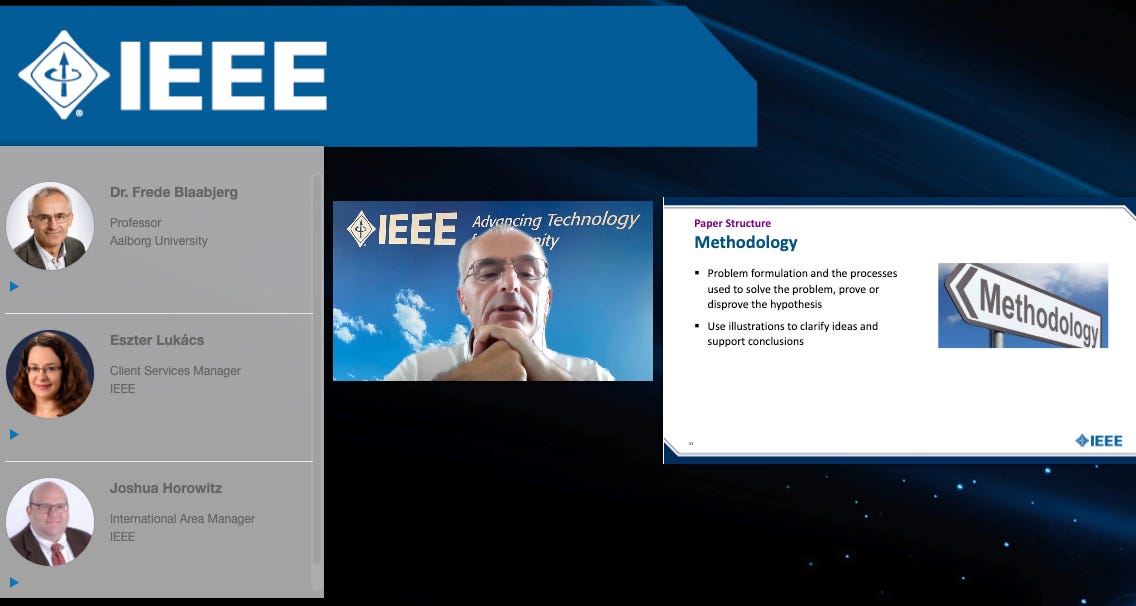
Note. The live broadcast interface displays the three featured speakers—Dr. Frede Blaabjerg, Eszter Lukács, and Joshua Horowitz—alongside Dr. Blaabjerg’s presentation slide detailing paper structure and methodology guidelines. From IEEE Authorship and Open Access Symposium: Tips and Best Practices to Get Published from IEEE Editors, by F. Blaabjerg, E. Lukács, and J. Horowitz, 2026, IEEE (https://event.on24.com/wcc/r/5467929/1780295C18BCB31FEF331400E48E35C4). Copyright 2026 by IEEE.
2.1 What Editors Reward and Reject
Dr. Frede Blaabjerg, Professor of Power Electronics and Drives at Aalborg University and a former Editor-in-Chief of the IEEE Transactions on Power Electronics, spoke from the editor’s chair. His advice was practical. Choose one target journal, since simultaneous submissions are unethical. Read its aims and scope. Write a specific title and an abstract of 250 words or fewer. He listed the usual reasons for rejection: a poor fit, serious scientific flaws, weak writing, incremental work, and a case too thin to persuade reviewers.
His sharper message concerned ethics. Plagiarism, he noted, was once the main form of misconduct. Publishers now also screen for disguised paraphrasing, citation coercion by editors or reviewers, citation stacking between journals, and paper mills that sell authorship. These are the same warning signs my earlier article described. High rates of citation within a publisher’s own journals and coordinated review networks, like the one Frontiers exposed in 2025 (Retraction Watch, 2025), are not problems of open access as such. They are failures of governance, and the webinar shows that a large publisher now treats them as routine screening work.
2.2 Using AI Without Losing the Evidence
Eszter Lukács, a Client Services Manager and Research Strategy Specialist at IEEE, turned to the risks of AI in research. Generative AI tools, she explained, can introduce hallucinations, bias, loss of provenance, and false citations. Her remedies asked researchers to slow down. Verify every citation an AI tool supplies, because a source you cannot find probably does not exist. Cross-check claims against primary sources, confirm that you cite the current version of record, and check for retractions. Write specific prompts that point toward trusted primary sources rather than generic web content.
IEEE’s rules follow the same logic. Authors must disclose AI-generated text, figures, images, or code in the acknowledgments, name the system, and identify the sections involved; disclosure is recommended even for grammar editing. Reviewers may not upload manuscripts to public AI platforms, because doing so breaches confidentiality. IEEE has also launched an AI Research Suite whose overviews link back to source documents so that users can check the answers (IEEE, 2026). One slide even listed common cues of AI-generated prose, including heavy use of em dashes, while warning that AI detectors are unreliable.
2.3 Open Access Options and a Correction to My Checklist
Josh Horowitz, an IEEE regional manager and publishing solutions specialist, described the open access options. IEEE offers more than 180 hybrid journals, more than 30 fully open access journals, and IEEE Access, a multidisciplinary open access journal with a stated peer review time of four to six weeks. IEEE reports more than 150,000 open access articles and more than 750 institutions with open access agreements, many of which cover the full APC. Authors can check their institution’s status at open.ieee.org.
This confirms the central point of my earlier article: whether an author pays often depends on the institution, not the journal. It also adds a correction. IEEE’s submission checklist tells authors to agree on the corresponding author before submission, because authors cannot be changed midstream. My co-authors and I asked a journal to change the corresponding author during review, and that journal kindly considered it. At an IEEE journal, that move might not have been possible. The lesson is simple: settle the corresponding author, and check that person’s institutional agreement, before you submit.
A fair reading also requires some caution. The webinar was a publisher presenting its own journals, and its rankings and impact figures are IEEE’s own selection from Clarivate and Scopus data. Speed appears as a benefit of open access, just as it does in the marketing of publishers that have drawn criticism. Speed alone tells us little. What matters is whether rigorous review and transparent governance stand behind it.
Figure 2
Summary of IEEE Authorship Symposium (Oct. 01, 2026)
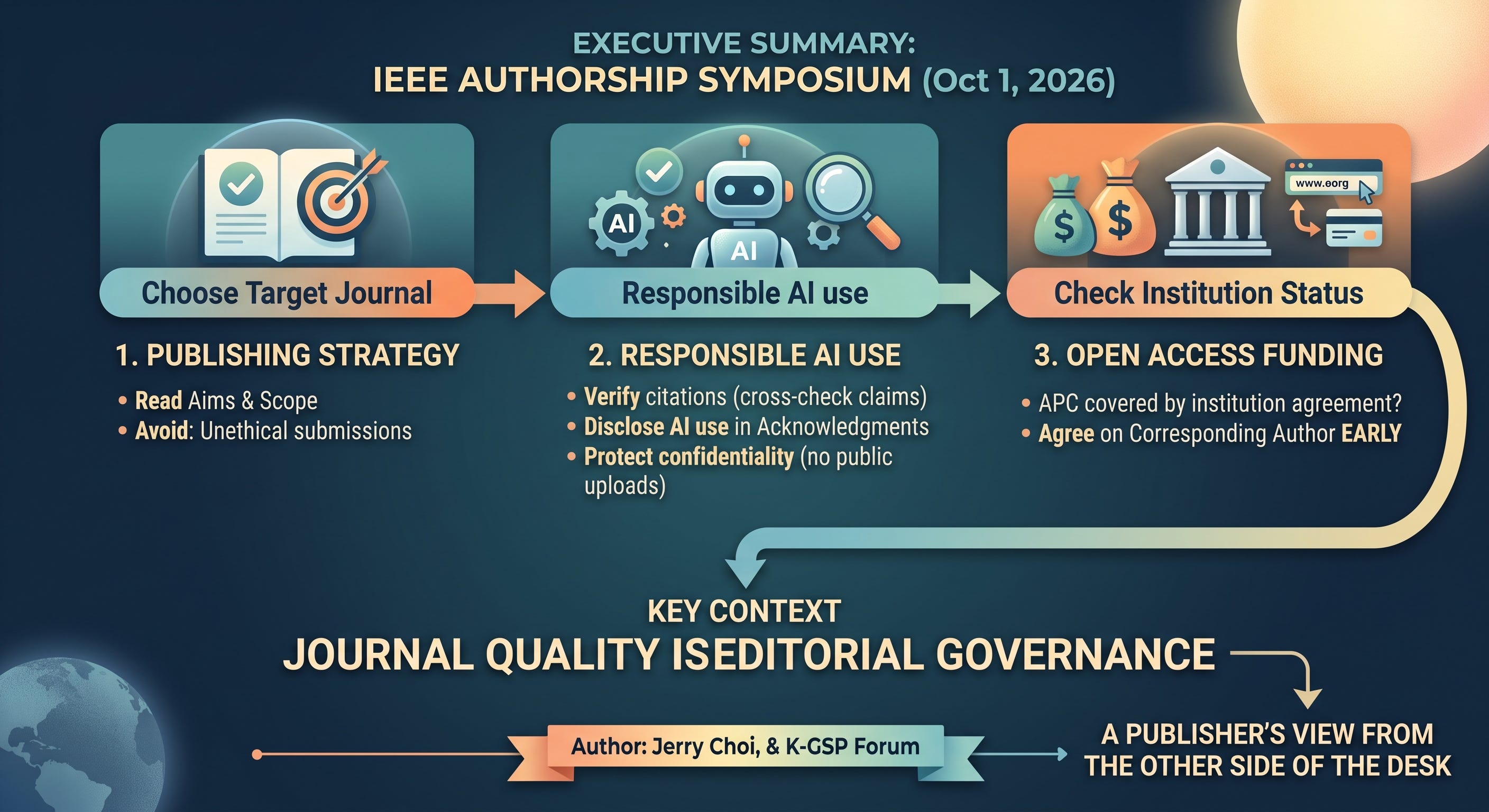
Note. A visual overview of a research symposium summarizing key lessons for academic publication. The infographic presents a four-step process—publishing strategy, responsible AI use, open access funding, and journal governance—highlighting best practices for researchers.
3. Governance, Verification, and the Names on the Paper
Read together, my earlier article and the IEEE webinar point in one direction. Getting published well now depends on three layers of judgment. The first is choosing the right venue. The second is protecting the integrity of the work, especially when AI tools are part of the process. The third is understanding who pays for access. None of these layers can be delegated entirely to a journal, an index, or an algorithm.
This matters most for scholars at smaller institutions, including many in our own K-GSP community, who may lack a library team to explain agreements or a research office to review AI policies. The IEEE webinar was free and its recording was shared openly. That kind of transparency helps. But the habits it recommends belong to us: verify before citing, disclose what tools we used, and ask early who will carry the corresponding author’s role.
Artificial intelligence can find sources faster than any of us. It cannot vouch for them. In the end, the integrity of a publication still rests on the people whose names appear on it.
References
Blaabjerg, F., Lukács, E., & Horowitz, J. (2026, October 1). IEEE authorship and open access symposium: Tips and best practices to get published from IEEE editors [Webinar]. IEEE. https://event.on24.com/wcc/r/5467929/1780295C18BCB31FEF331400E48E35C4
Choi, J. (2026, September 30). Who pays to make research free? Open access, APCs, and the quality question. K-GSP Forum. https://www.k-gsp.org/t/columnist_jerry_choi
IEEE. (2026). IEEE Xplore AI Research Suite [Brochure]. https://www.ieee.org/IEEEXploreAI
Retraction Watch. (2025, July 29). Frontiers to retract 122 articles, links thousands in other publishers’ journals to “unethical” network. https://retractionwatch.com/2025/07/29/frontiers-retract-122-articles-links-thousands-other-publishers-journals-to-unethical-network
About the Author
About the Author

Prof. Dr. Jeonghwan (Jerry) Choi (Managing Editor), University of Maine at Presque Isle
Full list of his K-GSP columns:
Jeonghwan (Jerry) Choi, PhD is an Associate Professor of Business at the University of Maine at Presque Isle and Editor-in-Coordination of K-GSP Forum (contact: jeonghwan.choi at gmail.com). With over 25 years of industry and consulting experience, he specializes in leadership development, human resource management, organizational behavior, and social entrepreneurship. His research focuses on workforce resilience, organizational health, and self-directed leadership — bridging rigorous scholarship with practical insight to cultivate leaders who create meaningful, sustainable, and humane organizations.

Prof. Dr. Young Choi (Editor in Chief) — Regent University
Full list of his K-GSP columns:
Young B. Choi is a Professor in the Department of Engineering & Computer Science at Regent University. He published 38 books with ‘Selected Readings in Cybersecurity’ (2018) (over 800 copies archived globally at university/college libraries around the world) and ‘Cybersecurity Applications and Artificial Intelligence’ (2023) available in seven major world languages. He proposed the world’s first global and universal telecommunications “Service Order Handling (SOH)” Model (1995) with Dr. Adrian Tang. With this innovative research work, he received the IEEE NOMS ’96 Best Paper Award and became the first recipient of the Outstanding Contribution Award of the TeleManagement Forum in 1998. His research areas include Natural Language Processing-focused AI, AI-applied cybersecurity, network and telecom service management, and Korean studies on Gani Choi Rip’s Jeonggwan (靜觀: Quiet Contemplation) philosophy and Shilhak ( 實學: Practical Learning).
Original Article :

Suggested Citation
Choi, J. & Choi Y., (2026, October 02). What the editors want: Lessons from IEEE’s authorship and open access symposium. K-GSP Forum. [URL]
한글요약
편집자들이 바라는 것: IEEE 저자·오픈 액세스 심포지엄에서 얻은 교훈
2026년 10월 1일 열린 IEEE 저자·오픈 액세스 심포지엄은 연구자라면 누구나 마주하는 세 가지 질문을 다뤘다. 어떻게 논문을 출판할 것인가, 인공지능을 어떻게 책임 있게 쓸 것인가, 그리고 오픈 액세스 비용은 누가 내는가이다.
올보르대학교의 프레데 블로비에르 교수는 편집자의 입장에서 조언했다. 한 번에 한 학술지에만 투고하고, 학술지의 목적과 범위를 먼저 읽으라고 했다. 또 요즘 출판사들은 표절뿐 아니라 교묘한 바꿔쓰기, 인용 강요, 학술지 간 인용 몰아주기, 저자 자리를 파는 ‘페이퍼 밀’까지 걸러 낸다고 설명했다.
IEEE의 에스테르 루카치는 생성형 AI가 거짓 정보와 가짜 인용을 만들어 낼 수 있다고 경고했다. 그래서 AI가 알려 준 출처는 반드시 직접 확인하고, AI를 사용했다면 감사의 글에 밝혀야 한다고 강조했다. 심사자가 심사 중인 원고를 공개 AI에 올리는 것도 금지된다.
조시 호로위츠는 IEEE의 오픈 액세스 경로를 소개하며, 750곳이 넘는 기관이 협약을 맺고 있고 많은 협약이 게재료 전액을 지원한다고 밝혔다.
이 내용은 K-GSP 이전 글, 곧 게재료를 누가 내는지는 학술지보다 소속 기관에 달려 있다는 주장을 뒷받침한다.
![[Expert Opinion] Who Pays to Make Research Free? Open Access, APCs, and the Quality Question](https://substackcdn.com/image/fetch/$s_!r1rD!,w_1300,h_650,c_fill,f_webp,q_auto:good,fl_progressive:steep,g_auto/https%3A%2F%2Fsubstack-post-media.s3.amazonaws.com%2Fpublic%2Fimages%2F48eeb152-26d5-4f52-bc8d-9810803788ef_1024x687.png)
동시에 한 가지를 바로잡는다. IEEE는 투고 전에 교신저자를 정해야 하며, 중간에 바꿀 수 없다고 안내한다. 결국 좋은 출판은 학술지 선택, 연구 진실성, 비용 이해라는 세 가지 판단에 달려 있고, 그 책임은 논문에 이름을 올린 사람에게 있다.
© K-Global Scholars and Professionals Forum. All rights reserved. Content published in the K-GSP Forum may not be reproduced, distributed, or transmitted in any form without prior written permission from the K-GSP Forum, except for brief quotations with full attribution.