
Executive Summary
In November 2026, the top scorer on South Korea’s national tax accountant exam confessed to cheating with a hidden microcamera, generative AI, and a smartphone, days before the national college entrance exam. Authorities responded with eyewear inspections and device bans. This essay argues that such measures are necessary but temporary. The deeper issue is that one-shot, standardized, paper-based exams can no longer certify human capability. Human resource development must build new forms of assessment.
Keywords: AI cheating, assessment, standardized exams, human resource development, competency
1. A Score Too Good to Be True
On November 15, 2026, Han Won-seok, the 34-year-old top scorer on South Korea’s 63rd national tax accountant exam, appeared on his lawyer’s YouTube channel and confessed. He said he had photographed the questions with a concealed microcamera, sent the images to a generative AI tool, and read the answers on a smartphone. “My passing the exam with the top score was not the result of fair effort,” he said (Kim, 2026a).
Video: Arirang News. (2026, November 15). Top scorer on Korea’s tax accountant exam admits to AI cheating, prompting gov’t crackdown
His scores had already drawn suspicion. He reported 397.5 out of 400 on the first-stage multiple-choice test in April and 663 out of 800 on the second-stage essay exam in July. One Korean newspaper compared those marks to “running a 100-meter sprint in under five seconds” (Kim, 2026b). The Human Resources Development Service of Korea (HRDK; Figure 1), which administers the exam, filed a complaint for obstruction of business and began procedures to cancel his qualification. Under the Tax Accountant Act, cheating invalidates the results and brings a five-year ban. Seoul police are investigating (Yun, 2026). Two days before the confession, the agency had reported no irregularities, although two supervisors were in the room and he was seated near the podium.
Figure 1
The Human Resources Development Service of Korea

Note. HRDK administers the national tax accountant exam and other national qualification exams. Photo source and usage rights to be confirmed.
The case is not isolated. Test-takers were caught using AI-powered smart glasses on a standardized English exam in June and on essay-based university entrance exams at Yonsei University and the University of Seoul in October (Arirang News, 2026; Kim, 2026b). The confession also came four days before the Suneung, the College Scholastic Ability Test, which more than 500,000 students will take. The education minister declined calls to postpone it. Instead, he promised “a thorough inspection of all glasses in each test session,” added smart glasses to the list of banned items, and warned of possible criminal punishment (CNN, 2026). At least one specially trained supervisor will be posted at each of about 1,300 test sites, and officials are weighing device collection and Wi-Fi shutdowns (Kim, 2026b).
2. The Real Problem Is the Assessment
These measures treat the scandal as a security failure. I read it as an assessment failure. The exam hall can be hardened, but the exam’s design assumes a world that no longer exists.
2.1 A Legacy Format Meets a New Technology
The standardized pen-and-paper exam rests on a simple inference: if a person, alone and unaided, produces correct answers in a fixed time, that person holds the knowledge. The inference held as long as outside help could be kept out of the room. AI devices have made that harder. Authorities spent months preparing for smart glasses (Figure 3), and the tax exam was beaten by a less conspicuous camera. Officials now advise proctors to watch “sleeves, collars or buttons” (Kim, 2026b). Figure 2 illustrates how many separate concealed components such a scheme could involve.
Figure 2
AI Cheating Detailed Communication Scenario (No Glasses)
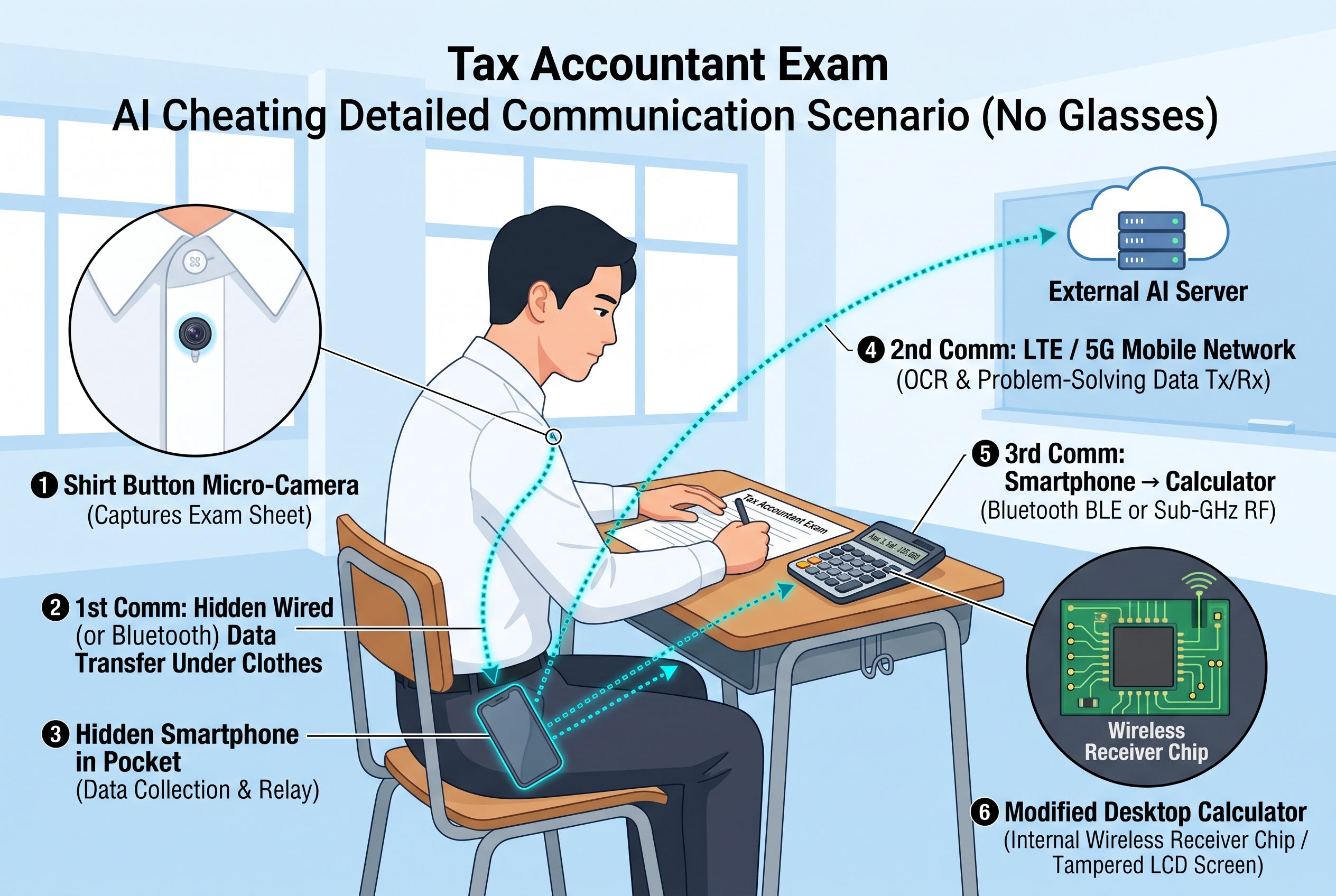
Note. Illustrative scenario only. News reports confirm a concealed microcamera, a generative AI tool, and a smartphone. The shirt-button placement and the modified calculator shown here are hypothetical and not confirmed by investigators. Image regenerated with Gemini from the author’s prompt based on MSNBC’s photo [https://www.nbcnews.com/world/asia/ai-cheating-scandal-spooks-south-korea-ahead-high-stakes-college-entra-rcna609550], for illustrative purposes.
The scheme in Figure 2 only works if several hidden parts operate together. One part captures the questions, another sends them to an AI tool, and a third shows the answers.
Smart glasses put these functions into a single wearable object (Figure 3), with the camera and display built into a frame worn like ordinary glasses. This is why the education ministry added smart glasses to the list of banned items and ordered an inspection of all glasses in each Suneung test session (CNN, 2026).
Earlier in 2026, test-takers had already been caught wearing such glasses on a standardized English exam and on university essay exams (Arirang News, 2026; Kim, 2026b). The two figures show different devices that raise the same problem. Whether the help comes through a button or a lens, the exam can no longer assume that what a candidate writes on the page came from the candidate alone.
Figure 3
AI-Enabled Smart Glasses
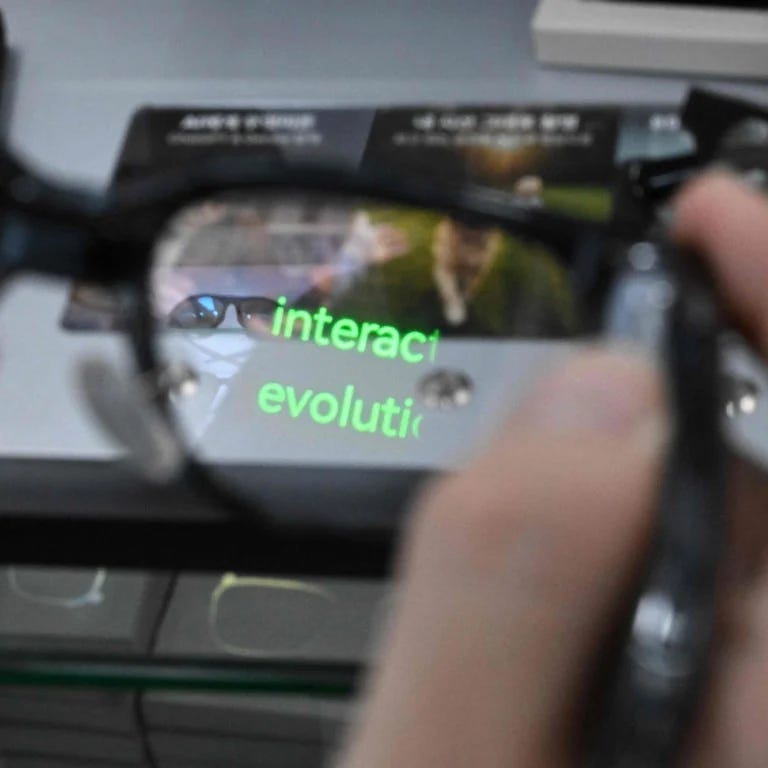
Note. Smart glasses with built-in cameras and displays have been used in several reported cheating cases in 2026. Photo source and usage rights to be confirmed.
Each new safeguard invites a smaller device. Officials have already acknowledged the limits: signal jamming is legally restricted, belongings cannot be searched without consent, and thermal cameras raise privacy concerns (Kim, 2026b).
2.2 More Than an Ethics Problem
It is tempting to treat this as the misconduct of a few dishonest people. Han’s conduct was wrong, and he says so himself. Yet the ethical framing is too narrow. In an earlier column, I argued that anyone using AI must be able to stand behind every sentence they produce (Choi, 2026b). A written exam was once our way of checking exactly that. If a top national score can be manufactured by a camera and a chatbot, the instrument has stopped measuring what we need it to measure.
For human resource development (HRD), this is a core professional question. Licenses, degrees, and hiring decisions rest on the claim that an assessment reveals what a person can actually do. That claim now requires a fundamental rethinking of how we assess human capability and competency.
2.3 Four Directions for Assessment
For now, keeping all electronic gadgets out of standardized exams is a reasonable tentative solution. It buys time. It does not solve the problem. Four directions deserve serious work.
The first is to track learning over time.
A one-shot exam captures a single performance on a single day. A record of how a person’s competency develops across months is far harder to fake, and learning data analytics can help assemble and interpret that record.
The second is the portfolio.
Aa body of work built across a period, with the process visible. MIT’s committee on AI in teaching recommended portfolios and oral examinations for similar reasons (MIT AI Committee, 2026).
The third is assessment through human interaction.
I have argued that teachers need to see their students’ faces again (Choi, 2026a). I would go beyond a single oral exam toward sustained Socratic conversation, in which an assessor follows the candidate’s reasoning with further questions. A memorized or borrowed answer does not hold up through several rounds of “why?”
The fourth is the supervised handwritten essay, written with pen or pencil within a set time under good control. It remains a legitimate option, especially when combined with the others.
None of these has been proven at the scale of a national exam. Each costs more time and human judgment than a multiple-choice sheet, and each raises its own fairness questions. They are directions to test, not finished answers.
3. Evaluating What People Are Really Worth
Korea will inspect half a million pairs of glasses this week, and it should. Students who prepared honestly deserve a fair room. Still, inspection only defends the old instrument for a little longer.
The high-tech cheating of 2026 is a reminder of what assessment is for. We test people because we want to know their real value, capability, and competency. If a machine in a pocket can pass the test, the test was measuring something a machine can supply. That leaves HRD with a hard question to work out: what a person can do that is truly theirs, and how we can come to see it.
References
Arirang News. (2026, November 15). Top scorer on Korea’s tax accountant exam admits to AI cheating, prompting gov’t crackdown [Video]. YouTube.
Choi, J. (2026a, October 15). In the age of AI, teachers need to see their students’ faces again. K-GSP Forum. https://www.k-gsp.org/p/expert-opinion-in-the-age-of-ai-teachers
Choi, J. (2026b, October 19). Stand behind every sentence: An AI use guideline from the field for research and practice. K-GSP Forum. https://www.k-gsp.org/p/stand-behind-every-sentence-an-ai
CNN. (2026, November 16). South Korea to inspect all exam takers’ glasses following AI cheating scandal. https://www.cnn.com/2026/11/16/asia/south-korea-ai-glasses-cheating-intl-hnk
Kim, C. (2026a, November 15). Top scorer on South Korean tax exam confesses to cheating with AI. Reuters. https://www.reuters.com/world/asia-pacific/top-scorer-south-korean-tax-exam-confesses-cheating-with-ai-2026-11-15/
Kim, T.-H. (2026b, November 16). AI cheating fears spook South Korea ahead of high-stakes college entrance exam. Associated Press. https://abcnews.com/Technology/wireStory/ai-cheating-fears-spook-south-korea-ahead-high-138171058
MIT AI Committee [Ad Hoc Committee on AI Use in Teaching, Learning, and Research Training]. (2026). Report of MIT’s Ad Hoc Committee on AI Use in Teaching, Learning, and Research Training. Massachusetts Institute of Technology. https://bpb-us-e1.wpmucdn.com/sites.mit.edu/dist/d/2418/files/2026/09/AI-Committee-Final-Report-Aug-13.pdf
Yun, S. (2026, November 16). Human Resources Development Service of Korea sues tax exam top scorer for AI cheating. The Chosun Daily. https://www.chosun.com/english/national-en/2026/11/15/AHL4PA22YVB4BFHMGR3USS757Y/
About the Author

Prof. Dr. Jeonghwan (Jerry) Choi (Managing Editor)
Full list of his K-GSP columns:
Jeonghwan (Jerry) Choi, PhD is Editor-in-Coordination of K-GSP Forum (contact: jeonghwan.choi at gmail.com). With over 25 years of industry and consulting experience, he specializes in leadership development, human resource management, organizational behavior, and social entrepreneurship. His research focuses on workforce resilience, organizational health, and self-directed leadership — bridging rigorous scholarship with practical insight to cultivate leaders who create meaningful, sustainable, and humane organizations.
Suggested Citation
Choi, J. (2026, November 16). Rethinking Human Capability Assessment in the Age of AI: Lessons from South Korea’s Tax Accountant Exam Cheating Scandal. K-GSP Forum.
Original Article

Update:
“Shocking Revelation by a Chinese Company… Even Interfering in South Korea's Tax Accountant Exam”
A Chinese company is selling specialized cheating gear—including camera-equipped glasses, button cameras, and undetectable micro-earpieces—alongside external “helpers” to assist exam takers remotely from up to 10 km away.
Targeting major civil service, licensing, and language exams like TOEIC and TOEFL, the firm accepts cryptocurrency and foreign currencies due to rising demand from South Korean clients.
Notably, the company claimed in a November 2026 post that a South Korean client used their service to rank first on the national tax accountant exam, prompting a surge in inquiries from Korea.
Watch the video at:
한글요약
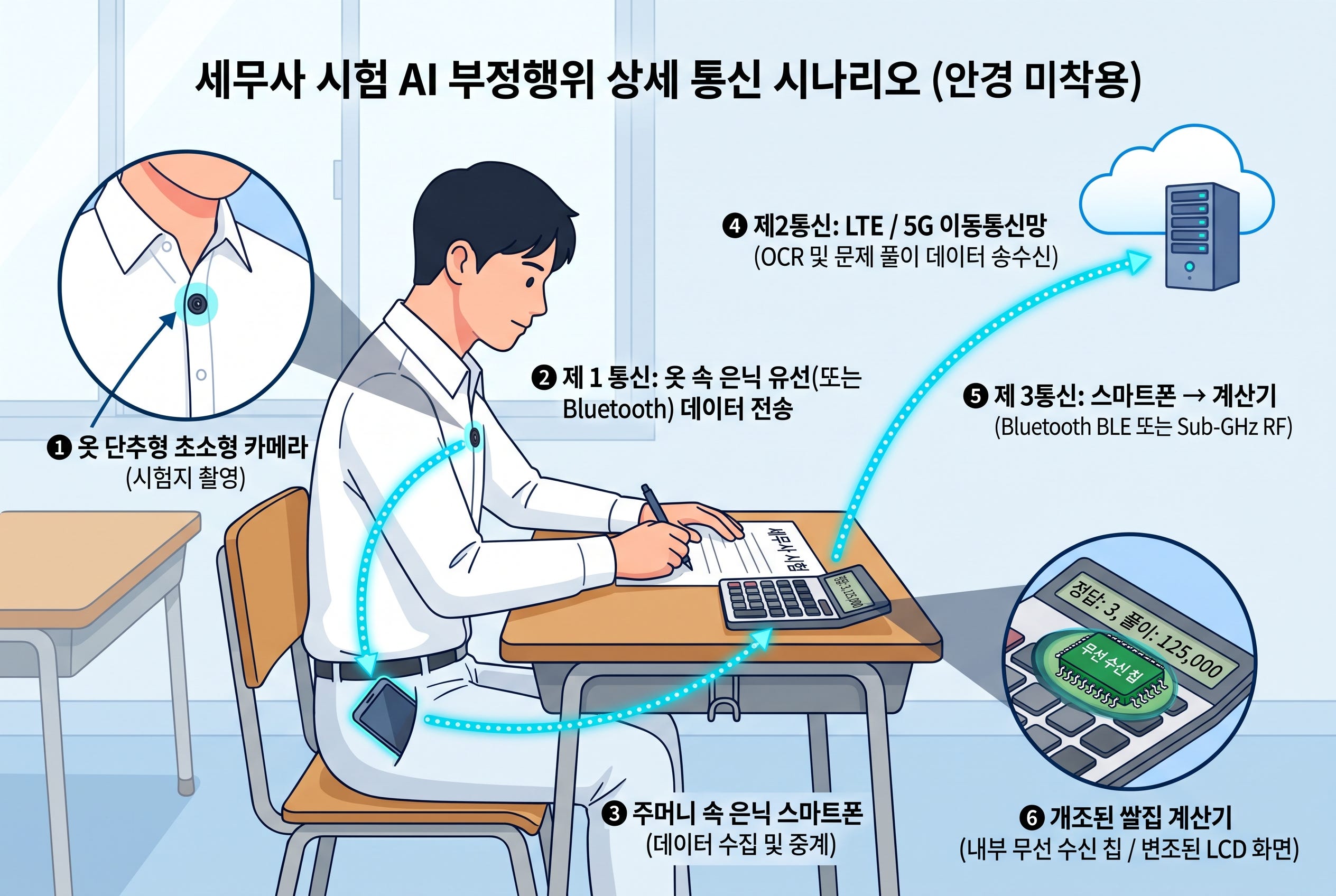
참고: 본 그림은 이해를 돕기 위해 재구성한 예시 시나리오입니다. 언론 보도를 통해 초소형 카메라, 생성형 AI 도구, 스마트폰이 사용된 사실은 확인되었으나, 본 그림에 묘사된 셔츠 단추 형태의 카메라 배치와 개조된 계산기는 수사 당국에 의해 공식 확인되지 않은 가상의 설정입니다. 본 이미지는 MSNBC 보도 사진(https://www.nbcnews.com/world/asia/ai-cheating-scandal-spooks-south-korea-ahead-high-stakes-college-entra-rcna609550)을을) 바탕으로 저자의 프롬프트를 통해 Gemini로 재생성한 예시 자료입니다.
AI 시대, 인간 역량 평가를 다시 생각한다: 한국 세무사 시험 부정행위 사건의 교훈
2026년 11월 15일, 제63회 세무사 시험 수석 합격자가 초소형 카메라로 문제를 찍어 생성형 AI에 보내고 스마트폰으로 답을 확인했다고 자백했습니다. 1차 400점 만점에 397.5점, 2차 800점 만점에 663점이라는 점수가 오히려 의심을 불렀습니다. 한국산업인력공단 (HRD Korea)은 업무방해 혐의로 고소하고 자격 취소 절차에 들어갔으며, 경찰이 수사하고 있습니다. 올해에는 영어 시험과 대학 논술 시험에서 스마트 안경을 쓴 부정행위도 적발되었습니다. 정부는 수능을 나흘 앞두고 연기 요구를 받아들이지 않았고, 모든 수험생의 안경을 검사하고 약 1,300개 시험장에 전담 감독관을 두기로 했습니다.
필자는 이런 조치가 필요하지만 임시방편이라고 봅니다. 진짜 문제는 연필과 종이로 한 번에 치르는 표준화 시험이 더 이상 사람의 실력을 보증하지 못한다는 점입니다. 이는 몇몇 사람의 윤리 문제가 아니라, 사람의 역량을 어떻게 평가할지 근본부터 다시 생각해야 하는 인적자원개발(HRD)의 과제입니다.
당장은 모든 전자기기 반입을 막는 것이 현실적인 대책입니다. 그와 함께 네 가지 방향을 서둘러 찾아야 합니다. 한 번의 시험 대신 학습 과정을 데이터로 꾸준히 추적하는 것, 포트폴리오로 평가하는 것, 한 번의 구술시험을 넘어 소크라테스식 대화로 생각을 따라가 보는 것, 그리고 잘 통제된 환경에서 손으로 쓰는 논술입니다.
첨단 기술을 이용한 부정행위는 사람의 진짜 가치와 능력을 어떻게 알아볼 것인지 다시 묻게 합니다.
Update:
중국 업체의 충격적인 폭로… 한국 세무사 시험까지 개입
요약: 한 중국 업체가 특수 부정행위 장비(초소형 카메라 안경, 단추형 카메라, 탐지 불가 이어폰)와 외부 조력자를 동원해 각종 시험의 원격 부정행위를 지원하고 있습니다. 최대 10km 밖에서도 실시간으로 문제를 전송하고 정답을 받아볼 수 있는 이 서비스는 공무원, 자격증, 어학 시험 등을 대상으로 하며, 늘어난 한국 고객을 겨냥해 외화 및 가상자산 결제까지 안내하고 있습니다. 특히 업체 측은 2026년 11월 게시물을 통해 자사의 도움으로 한국 세무사 시험 수석 합격자를 배출했다고 홍보하며 한국 수험생들의 문의가 폭주하고 있다고 주장했습니다.
영상 보기:
© K-Global Schoalrs and Professionals Forum. All rights reserved. Content published in the K-GSP Forum may not be reproduced, distributed, or transmitted in any form without prior written permission from the K-GSP Forum, except for brief quotations with full attribution.